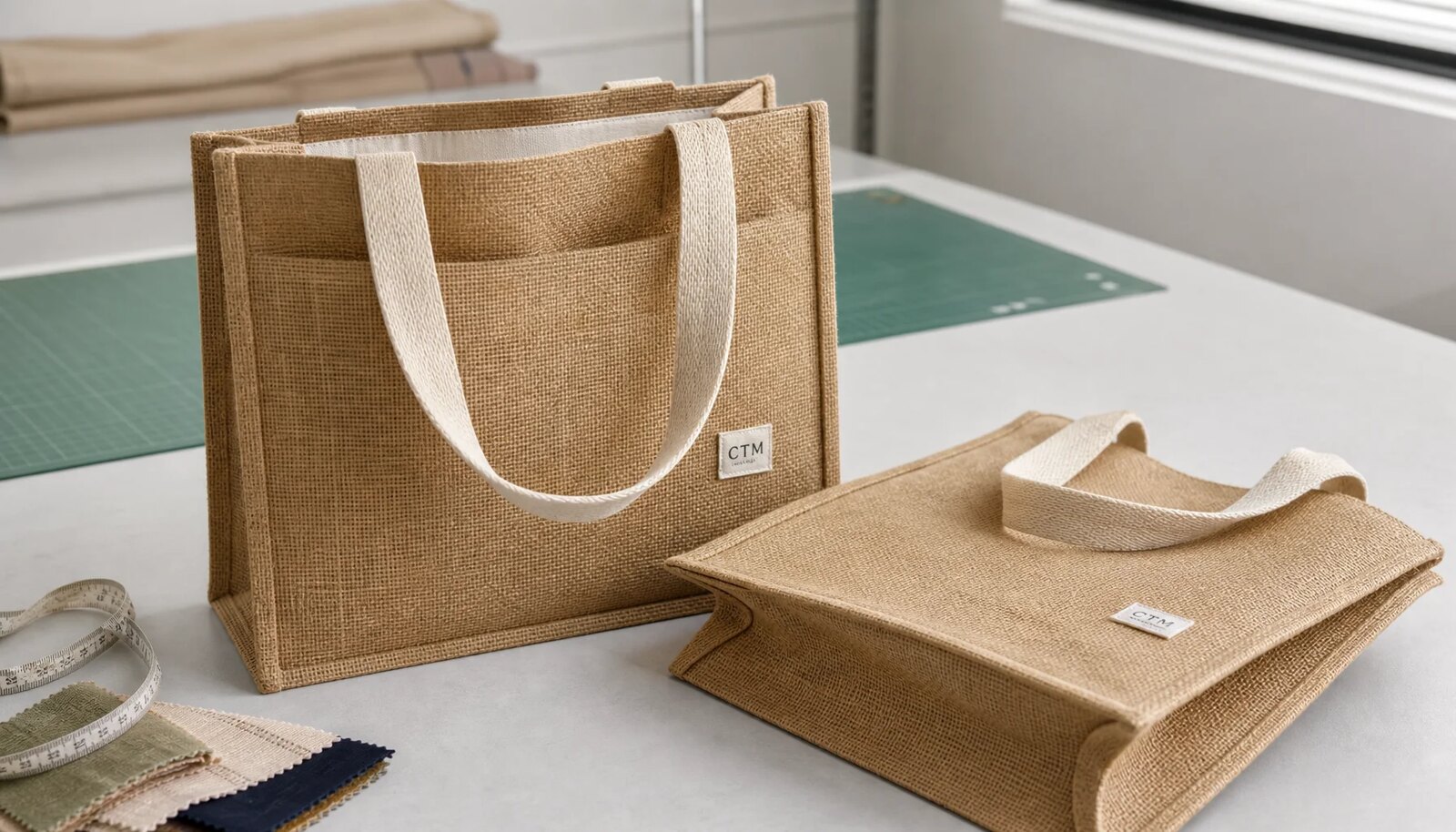
Price the tote by hotel use, not by photo
A jute tote for hotel retail has a different job than a cheap promotional giveaway. It may sit on a boutique shelf beside skincare and candles, carry towels to the pool, hold food gifts in a welcome room, or become a paid resort souvenir. Each use changes the specification. Shelf shape, odor, handle comfort, logo sharpness, packing cleanliness, and receiving accuracy all affect the buying decision.
That is why a supplier cannot quote the right bag from a photo alone. Two natural jute totes can look close in a catalog but use different GSM, weave density, lamination thickness, handle width, stitch reinforcement, print curing time, and carton packing. The lower quote may simply remove structure, trim width, inspection work, or retail packing.
Hotel buyers also carry brand risk. A strong smell, dusty panel, dirty handle, or crooked logo feels more serious when the bag carries the property name. For resale, the tote needs to look intentional next to other merchandise. For amenity programs, the receiving team needs accurate carton marks, clean folding, predictable counts, and property-level SKU separation.
- Retail resale: prioritize shelf shape, clean surfaces, low odor, consistent branding, and individual or retail-ready packing.
- Welcome amenity: prioritize controlled logo placement, cost discipline, receiving efficiency, and carton marks by property or event.
- Beach and pool retail: prioritize lamination, gusset depth, reinforced handles, and practical capacity for towels, bottles, and sandals.
- Spa boutique: prioritize low odor, smoother handle feel, clean trim, and packing that does not transfer lint to nearby merchandise.
- Hotel group programs: prioritize one repeatable base construction with logo, barcode, and carton variations controlled by SKU.
Turn the brief into a factory-ready spec
A useful jute tote bags bulk pricing plan for hotel retail starts with a written specification sheet. It should name the finished size, body material, lamination, handle construction, branding method, packing, carton details, sample path, QC tolerances, and delivery terms. Once those points are fixed, quotations become easier to compare and harder to dilute.
Use numbers wherever possible. Do not ask for a “medium tote” if the buying team needs a bag to hold two towels and a sunscreen pouch. State width, height, bottom gusset, side gusset if any, and tolerance in millimeters. Do not ask for a “strong handle.” State webbing width, finished drop, insertion depth, reinforcement, and intended load.
The spec should also explain natural variation. Jute may show shade movement, yarn slubs, and small weave irregularities. Those are not the same as oil marks, mildew odor, dirty handles, broken yarns across the logo area, peeling lamination, loose top-fold stitching, or badly skewed panels. Clear language keeps inspection fair for both sides.
- Dimensions: finished width, height, bottom gusset, side gusset if any, seam allowance expectation, and measurement tolerance.
- Material: jute oz or GSM, measurement basis, natural shade range, weave expectation, lamination type, and lamination thickness.
- Handles: material, width, color, total length, finished drop, insertion depth, stitch pattern, and reinforcement method.
- Branding: artwork file type, Pantone references, print size, placement tolerance, method, label position, and approval sample type.
- Packing: folding method, individual or bulk pack, hangtag and barcode rules, pieces per carton, carton marks, and moisture protection.
Compare GSM, lamination, and weave honestly
Terms such as “natural jute,” “burlap style,” and “premium eco bag” do not give procurement enough control. A practical hotel retail tote often uses 13 oz to 15 oz jute, commonly quoted around 370-425 GSM before lamination. The RFQ should say whether GSM is measured before lamination, after lamination, or as total finished fabric weight. Without that basis, price comparisons can be misleading.
Lighter jute can lower unit cost, carton weight, and freight. It can also feel soft, collapse on the shelf, and show a more open weave under the logo. Very heavy jute may look more premium, but it can create bulky seams, needle issues, slower sewing, heavier cartons, and higher CBM. The best construction is usually the one that carries the expected guest items and still packs efficiently.
Lamination changes both performance and messaging. Clear inner PP lamination around 18-25 micron is common when buyers want structure, reduced lint shedding, and basic moisture resistance. It helps in beach, pool, spa, and food-gift settings. It also adds sustainability complexity, so any environmental claim should match the real construction rather than the natural exterior alone.
Review samples the way the bag will be stored. A laminated jute tote may seem fine on an open table but smell stronger after sealed packing. Top folds may crack after compression. Ask how long laminated fabric is aired before cutting and how long printed bags cure before packing. The approved sample should use the same material type planned for bulk, or the factory should document the substitute clearly.
- Budget use: 10 oz to 12 oz jute may suit light promotional needs but often feels less retail-ready.
- Core hotel retail: 13 oz to 15 oz jute with inner lamination usually improves structure and presentation.
- Premium retail: heavier jute, contrast trim, inner pocket, woven label, or thicker handle raises labor and freight cost.
- Lamination check: fold the top edge, inspect bubbles and seam peeling, and reopen a sealed sample to evaluate odor.
- Quote control: require GSM basis, lamination micron range, approved roll reference, and acceptable shade variation.
Size, gusset, and handles decide usability
The right tote size depends on what guests will actually carry. Towels, sandals, sunscreen, books, bottled water, boxed gifts, wine, and spa sets all behave differently inside a bag. A flat tote uses less material, but it does not display bulky products well. A bottom gusset adds jute, lamination, cutting time, and sewing labor, yet it improves usable capacity and helps the bag stand upright.
Separate finished size from cut size. Finished size is measured after seams, folds, lamination, and gusset sewing. Cut size is the panel before construction. If a supplier quotes only cut size, the delivered tote may feel smaller than expected. Measure samples flat, opened, and lightly loaded, then test the actual merchandise before approval.
Handles deserve the same detail as the body. Cotton webbing is common for hotel retail because it feels smoother than raw jute rope and can coordinate with brand colors. A 35-40 mm width is usually more comfortable for loaded retail use than narrow tape. State handle drop separately from total handle length; a hand-carry tote and a shoulder-carry tote are not the same product.
Reinforcement should not be left to factory habit. Laminated jute can tear when load is concentrated at a small stitch area. Box-X stitching, bar tacks, reinforced top folds, correct insertion depth, and balanced stitch tension all matter. Lift the sample repeatedly with the intended load and check for stitch popping, handle movement, seam tearing, and top-edge distortion.
- Specify finished width, height, bottom gusset, side gusset if any, seam allowance, and tolerance in millimeters.
- State handle drop and total handle length separately, and confirm hand-carry versus shoulder-carry intent.
- Use reinforced top folds, box-X stitching, or bar tacks when guests may carry towels, bottles, books, or boxed goods.
- Test upright display using the actual gusset, lamination, fold method, and packed retail presentation.
- Load the sample with real hotel merchandise before bulk approval instead of judging capacity from flat dimensions.
Choose branding for jute texture
Jute is coarse, uneven, and honest. That texture is part of the appeal, but it also limits artwork. A crest that looks sharp on paper or cotton canvas may break up on jute. Screen printing works well for one to three spot colors, simple resort marks, property names, and clean line art. Approve a strike-off on the actual material, not only a digital proof.
Transfers can solve some multicolor or detailed artwork needs, but they must be tested. Heat transfer, digital transfer, and similar methods may create a patch-like feel, edge lifting, cracking, or an unnatural surface on coarse jute. Large transfer areas can also reduce the natural look many hotel buyers want. Check adhesion, fold behavior, rubbing, odor, and appearance after packing.
Woven labels and sewn cotton labels often suit premium marks, crests, and small typography better than direct print. They add label MOQ, sewing labor, placement tolerance, and another approval step, but the result can look cleaner. Hangtags help with retail storytelling, barcode placement, and pricing; they should not be the only brand mark if the tote needs to remain identifiable after purchase.
Pantone matching needs realistic expectations. Natural jute shifts color perception, and ink will not match coated paper exactly. The approval record should describe acceptable visual tolerance. For hotel groups using multiple property logos, each version needs its own placement file, print size, and dated approval record.
- Screen print: suitable for simple spot-color logos, resort names, and moderate coverage.
- Heat or digital transfer: approve only after adhesion, fold, rub, odor, and edge-lift testing on actual jute.
- Woven label: useful for fine crests, small text, and premium branding with added MOQ and sewing cost.
- Sewn cotton label: boutique look, but confirm fraying, shrinkage, stitch color, and placement tolerance.
- Large ink areas: review curing time, rubbing transfer, blocking, odor, cracking, and visible weave-through.
Build MOQ and price by component
A headline MOQ rarely tells the whole story. A factory may accept 500 pieces for a standard natural jute tote with one simple screen print, stock handles, and loose packing. The same factory may need 2,000 pieces or more for custom size, dyed handles, woven labels, multiple property logos, barcode stickers, or individual retail packing. Ask for component-level MOQ before you compare offers.
This matters even more for hotel groups and distributors. A program may total 3,000 bags across six properties, but each logo may need its own screen, strike-off, carton mark, barcode, and approval record. A custom handle color may have a trim MOQ even if the body fabric MOQ is covered. If those details come late, the buyer sees surprise charges after artwork approval.
Price breaks should reflect the real buying plan. Asking for 10,000-piece pricing when the launch order is 800 pieces creates a false benchmark. For many hotel retail programs, practical breaks are 500, 1,000, 2,000, 3,000, and 5,000 pieces. Each break should say whether it assumes one size, one logo, one packing method, one shipment date, and one destination.
Low MOQ can be useful for a short-run opening gift or test assortment. It can also mean less control. The factory may rely on available jute rolls, existing handle colors, manual cutting, simplified packing, or shared production. For repeat retail programs, a stable base bag with controlled logo variations usually protects quality better than chasing the lowest first-order MOQ.
- Request price breaks at realistic quantities such as 500, 1,000, 2,000, 3,000, and 5,000 pieces.
- Separate MOQ for jute roll, bag body, handle color, print screen, woven label, hangtag, barcode sticker, and carton mark.
- Clarify whether each logo version has its own setup cost, sample cost, MOQ, and inspection record.
- For repeat programs, standardize one base construction and vary print, label, barcode, or carton marks by property.
- For low MOQ orders, confirm whether stock material, stock handles, simplified packing, or shared production is being used.
Compare sourcing routes by scope
Hotel buyers may receive quotes from a direct bag factory, trading company, distributor, and local decorator. Those quotes may look similar, but they rarely cover the same scope. A direct factory usually gives more control over material, lamination, sewing, packing, and repeat production. A trading company can help when the tote belongs to a broader hotel retail or amenity bundle. A local decorator can move fast on small urgent orders, but the blank bag construction is usually less flexible.
Choose the route around risk and timing. A seasonal resort retail tote benefits from documented samples, material control, and repeat production records. A hotel opening kit with many items may benefit from a partner that coordinates labels, cartons, and consolidation. An urgent 200-piece event order may need local printing on available blanks, even at a higher unit cost.
Scope must be aligned before negotiation. One quote may include a plain sample, printed strike-off, screen charge, barcode application, export carton marks, and pre-shipment inspection. Another may include only a blank bag with a one-color print. A local decorator may exclude defects in incoming blanks. A trading company may include consolidation but give less visibility into the jute roll or sewing line.
Accountability after the purchase order is just as important as the first price. If odor, lamination, print, or packing problems appear, the buyer needs to know who owns the correction and what evidence will be used. The right supplier is the one that can repeat the approved spec, separate costs clearly, manage SKU changes, and avoid silent material substitutions.
- Direct factory: best for controlled construction, repeat orders, material accountability, and bulk cost discipline.
- Trading company: useful for multi-item hotel assortments, consolidation, coordinated packing, and vendor management.
- Local decorator: fastest for urgent small runs but limited on base bag quality, lamination, and handle construction.
- Distributor stock: convenient for replenishment but restrictive on size, color, print method, and carton configuration.
- Quote comparison: align sample scope, material, print, packing, inspection, delivery terms, and defect accountability.
Expose hidden quote gaps
A professional quote should show more than one unit price. Key cost drivers include jute body material, lamination, cutting, sewing, handles, reinforcement, printing, labels, trimming, folding, retail packing, export cartons, inland delivery, export handling, and inspection. Some suppliers roll setup into the unit price. Others show it separately. Either format can work if the buyer can tell recurring costs from one-time charges.
One-time charges affect reorder planning. Screen charges, label setup, artwork adjustment, pre-production samples, barcode setup, and carton marking templates may not repeat the same way on later orders. A first order that looks slightly higher can be more economical over a seasonal program if documentation and repeat control are stronger.
Review landed cost before approving the construction. Jute totes are bulkier than thin cotton bags. A laminated gusseted tote may have an attractive FOB price but poor carton efficiency. For air freight, CBM can dominate cost quickly. For sea freight, carton strength, moisture protection, and loading plan become more important. Request carton dimensions, pieces per carton, net weight, gross weight, CBM, and stacking guidance.
Packing and inspection are common quote gaps. A tote with individual recyclable polybag, hangtag, barcode, and property-specific carton marks is not comparable to a loose bulk-packed tote. Inspection scope can vary too. One supplier may include in-line checks and final AQL inspection; another may only glance at finished cartons. Put these points in a side-by-side comparison before choosing a supplier.
- Separate recurring unit cost from sample, screen, label setup, artwork, barcode, inspection, carton marking, and inland charges.
- Ask whether the price assumes one logo, one packing method, one shipment date, one carton mark, and one destination.
- Request carton dimensions, pieces per carton, net weight, gross weight, CBM, and carton board specification before PO release.
- Compare jute GSM, lamination micron, handle width, reinforcement, print method, packing, and QC scope before choosing a supplier.
- Review landed cost with freight input before approving heavier jute, deeper gussets, individual packing, or air-freight schedules.
Approve samples beyond appearance
Photo approval is not enough for hotel retail jute totes. Physical samples show shade, weave openness, yarn slubs, odor, lamination stiffness, handle comfort, print edge quality, and shelf behavior. A typical path may include a plain construction sample, printed strike-off, pre-production sample, and full packed sample. The sequence can be adjusted, but bulk cutting should wait until the critical points are approved.
The construction sample should confirm finished dimensions, gusset shape, top fold, lamination feel, handle width, handle drop, insertion depth, stitching, and upright structure. If the tote is for beach or spa use, load it with the actual products guests may carry. If it will hang on a fixture, check how the handles and hangtag sit. Measure the bag flat, opened, and lightly loaded.
The printed strike-off should use the actual jute or an approved equivalent. Review logo size, placement, Pantone appearance, edge clarity, ink coverage, curing, rubbing transfer, and odor. If small text or a crest fails, change the branding method before bulk production. A woven label, sewn label, or adjusted artwork is usually better than accepting a weak retail result.
Packed samples reveal receiving problems before they become expensive. If the order includes individual polybags, paper bands, hangtags, barcodes, property labels, or SKU-separated cartons, ask for a full packed sample. Confirm fold size, barcode scannability, carton marks, inner moisture protection, carton count, and whether the packing creates creases or traps odor.
- Measure the sample flat, opened, and lightly loaded because gusset construction changes usable capacity.
- Rub the print with a dry white cloth after the stated curing time and check for transfer or tackiness.
- Seal a sample overnight in a polybag or carton, then reopen it to evaluate odor concentration.
- Approve a dated golden sample with dimensions, print placement, handle drop, lamination, and packing notes.
- Require a full packed sample for hangtags, barcodes, paper bands, individual polybags, or property-specific carton marks.
Set QC thresholds for retail reality
Jute has natural fiber variation. The inspection standard should not reject every slub or slight shade difference. It should separate acceptable texture from defects that hurt retail value, guest comfort, safety, or receiving accuracy. Hotel retail defects include visible stains, oil marks, mildew smell, strong chemical odor, dirty handles, loose stitching, weak handle attachment, peeling lamination, skewed logos, incorrect barcodes, and mixed SKUs.
A practical QC plan covers dimensions, GSM, workmanship, print, odor, load strength, lamination, cleanliness, and packing. For larger orders, buyers can use AQL inspection or an agreed sampling plan. Define critical, major, and minor defects before production. Critical defects may include mildew, contamination, unsafe metal fragments, or severe odor. Major defects may include wrong size, wrong logo, weak handles, print smearing, peeling lamination, incorrect barcode, or wet cartons. Minor defects may include small loose threads or minor yarn irregularity away from the logo area.
Handle strength should match intended use. For hotel retail totes carrying guest items, a practical internal check is repeated lifting with 8-12 kg for a short duration. After testing, inspect for stitch popping, seam tearing, handle slippage, top-fold distortion, and webbing damage. A light spa merchandise tote may need a different target than a beach tote carrying towels and bottles, but the agreed load belongs in the QC plan.
Odor inspection should happen after sealed storage. Jute, lamination, and ink can smell acceptable in a ventilated room but become strong inside cartons. Inspectors should open sealed cartons or inner packs and record chemical, mildew, or damp fiber odor. Carton condition matters too; wet or weak cartons can transfer odor, crush corners, and cause hotel receiving problems.
- Size tolerance: commonly plus or minus 5 mm for width and height and plus or minus 8 mm for gusset unless otherwise approved.
- Print placement: commonly plus or minus 5 mm from approved position for front logos, labels, or centered marks.
- Handle check: test the agreed load, often 8-12 kg for hotel retail carrying use, and inspect attachment points afterward.
- Odor control: inspect after bags have been sealed in inner packs or cartons, not only on open production tables.
- Packing accuracy: verify SKU count, barcode placement, hangtag position, carton marks, destination labels, and mixed-pack rules.
Specification comparison for buyers
| Spec decision | Recommended option | When it fits | Buyer risk to check |
|---|---|---|---|
| Jute body weight | 13 oz to 15 oz natural jute, often quoted around 370-425 GSM before lamination; require the supplier to state the measurement basis | Hotel gift shops, resort boutiques, spa retail, beach shops, welcome amenity programs, and premium merchandise assortments | A lower GSM quote may look similar in photos but collapse on shelf, show open weave in the logo area, and feel promotional; very heavy jute can raise CBM, carton weight, seam bulk, and sewing rejection risk |
| Lamination | Clear inner PP lamination around 18-25 micron for most structured retail totes; unlaminated only when brand positioning and use conditions support it | Pool, beach, spa, food-gift, humid backroom, and upright retail display use where shape and lint control matter | Poor lamination can crack at top folds, peel near seams, bubble on panels, smell strong after sealing, or weaken sustainability messaging if claims are not carefully worded |
| Handle construction | 35-40 mm cotton webbing handles, specified handle drop, reinforced top fold, and box-X or bar-tack stitching | Guests carrying towels, bottled water, sandals, books, spa products, wine boxes, souvenirs, or retail purchases | Narrow tape, weak stitch density, shallow handle insertion, or raw jute rope can create discomfort, uneven appearance, and seam tearing under load |
| Print method | Screen print for 1-3 spot colors; woven or sewn label for fine crests and small text; transfer only after adhesion and fold testing | Hotel logos, resort marks, coastal artwork, boutique labels, property-specific branding, and simple retail graphics | Large ink coverage can smell, crack, block when stacked, or fill weave gaps; fine artwork must be tested on the actual jute surface, not approved from a flat digital proof |
| MOQ planning | 500-1000 pcs for stock-size logo programs; 2000+ pcs for custom size, dyed handles, custom labels, multi-SKU packing, or several property logos | Seasonal hotel retail drops, resort group replenishment, opening kits, distributor programs, and amenity gift bags | A low MOQ may rely on available rolls, shared trim, broad color tolerance, manual cutting, simplified packing, or limited control over carton configuration |
| Sourcing route | Direct bag factory for controlled specs; trading company for coordinated multi-item programs; local decorator for urgent small runs on stock blanks | Depends on whether price control, assortment coordination, development support, or speed is the main priority | Unit price comparisons are misleading unless sample scope, print setup, packing, inspection, freight readiness, and defect accountability are aligned |
| Retail packing | Individual recyclable polybag, paper band, hangtagged pack, or SKU-separated inner pack with dry export cartons and moisture protection | Hotel shops with clean display standards, coastal storage, multiple property shipments, barcodes, or retail receiving requirements | Loose bulk packing can cause lint transfer, dirty handles, odor concentration, crushed corners, mixed SKUs, and extra receiving labor at the hotel |
| Lead time buffer | 7-12 days for sample cycle and 25-40 days for bulk after approval, adjusted for quantity, print curing, label lead time, season, and packing complexity | Import programs, hotel openings, seasonal floorsets, spa launches, resort replenishment, and distributor rollouts | Rushing cutting, printing, curing, lamination airing, inspection, or packing can increase odor, ink tackiness, fold cracks, carton moisture, and rework risk |
| QC plan | Golden sample plus AQL or agreed sampling plan covering dimensions, print, odor, handle strength, lamination, workmanship, cleanliness, and carton condition | Any tote sold at retail, issued under hotel brand standards, shipped to several destinations, or used as a guest-facing amenity | Visual-only inspection can miss weak handles, wet cartons, odor after sealing, wrong barcode position, inconsistent folding, poor count accuracy, or SKU mixing |
Buyer checklist before sampling
- Define the commercial use first: retail shelf item, guest welcome bag, spa merchandise, beach shop tote, food or wine gift bag, conference merchandise, or multi-property replenishment SKU.
- State finished dimensions in millimeters, including width, height, bottom gusset, side gusset if any, seam allowance expectation, handle drop, and usable internal space after folds and seams.
- Specify jute weight in oz and/or GSM, acceptable GSM range, weave density expectation, natural shade tolerance, and whether the bag must stand upright when empty.
- Confirm whether GSM is measured before lamination, after lamination, or as total finished fabric weight so quotes from different factories can be compared fairly.
- Define lamination type, thickness range, odor expectation, fold-crack tolerance, peel tolerance, and whether food-adjacent gifting requires separate material or compliance review.
- Choose handle material, width, color, total length, finished drop, insertion depth, stitch pattern, reinforcement method, and intended carrying load instead of accepting generic handle wording.
- Provide vector artwork, Pantone references, print size, placement diagram, minimum line thickness, maximum ink coverage, and acceptance rules for jute texture showing through the logo.
- Confirm branding method: screen print, heat transfer, digital transfer, woven label, sewn cotton label, hangtag, barcode sticker, or a combination with separate approvals.
- Separate one-time charges from recurring unit price, including sample cost, screen charge, artwork adjustment, label setup, hangtag setup, barcode application, carton marking, inspection, and inland delivery.
- Request price breaks only at realistic order quantities and clarify whether each break assumes one size, one logo, one packing method, one shipment date, and one delivery term.
Factory quote questions to send
- What jute weight are you quoting in oz and GSM, is that before or after lamination, and what tolerance will apply to bulk material?
- What yarn count or weave description can you provide, and will the bulk use the same roll source or equivalent material as the approved sample?
- Is the jute laminated before cutting or after panel preparation, what lamination thickness is included, and how do you control odor, bubbles, peeling, and fold cracking?
- What exact finished bag size, bottom gusset, side gusset if any, seam allowance, and finished-size tolerance are included in the quotation?
- Which handle material, width, color, total length, finished drop, insertion depth, reinforcement method, and stitching pattern are included in the unit price?
- What intended load test do you recommend for this construction, and how will the factory check handle attachment during in-line and final inspection?
- Is the branding quoted as screen print, heat transfer, digital transfer, woven label, sewn label, hangtag, or barcode label, and how many colors or positions are included?
- What artwork limits apply on jute, including minimum line thickness, maximum print area, ink coverage, Pantone matching tolerance, curing time, and rubbing test method?
- What MOQ applies separately to jute roll purchase, bag body cutting, handle color, print setup, woven label production, hangtag production, barcode packing, and carton marking?
- How many days are required for material confirmation, plain sample, print strike-off, pre-production sample, bulk cutting, sewing, printing, inspection, packing, and export readiness?
Quality-control points to confirm
- Finished size tolerance should usually stay within plus or minus 5 mm for width and height and plus or minus 8 mm for gusset on standard tote sizes unless the approved sample or PO states another tolerance.
- GSM should be checked against the approved range using the agreed measurement basis, with the buyer and factory aligned on whether the value excludes or includes lamination.
- Handle drop should normally stay within plus or minus 10 mm, and paired handles must be symmetrical when the bag is laid flat and when it is lightly loaded.
- Handle pull or lift testing should match intended use; for hotel retail totes carrying guest items, a practical internal check is repeated lifting with 8-12 kg without seam tearing, stitch popping, handle slippage, or top-fold distortion.
- Print placement tolerance should be defined before production, often plus or minus 5 mm from approved artwork position for front panel logos, sewn labels, or centered marks.
- Ink should be cured with no tackiness, rubbing transfer, blocking between stacked bags, visible smearing, strong solvent odor, or obvious cracking after normal folding.
- Lamination should not crack at the top fold, peel at seams, show large bubbles across main panels, expose sharp film edges, or create excessive stiffness inconsistent with the approved sample.
- Odor should be assessed after opening sealed inner packs or cartons; strong chemical odor, mildew smell, or damp fiber smell should be treated as a shipment risk rather than a cosmetic issue.
- Workmanship inspection should check skipped stitches, loose threads, exposed raw edges, uneven top folds, distorted gussets, dirty handles, oil marks, stains, broken yarns in the logo area, and uneven handle placement.
- Packing inspection should confirm SKU count, folding method, hangtag position, barcode scannability, carton marks, inner moisture protection, carton dryness, carton strength, and property-specific destination labels.