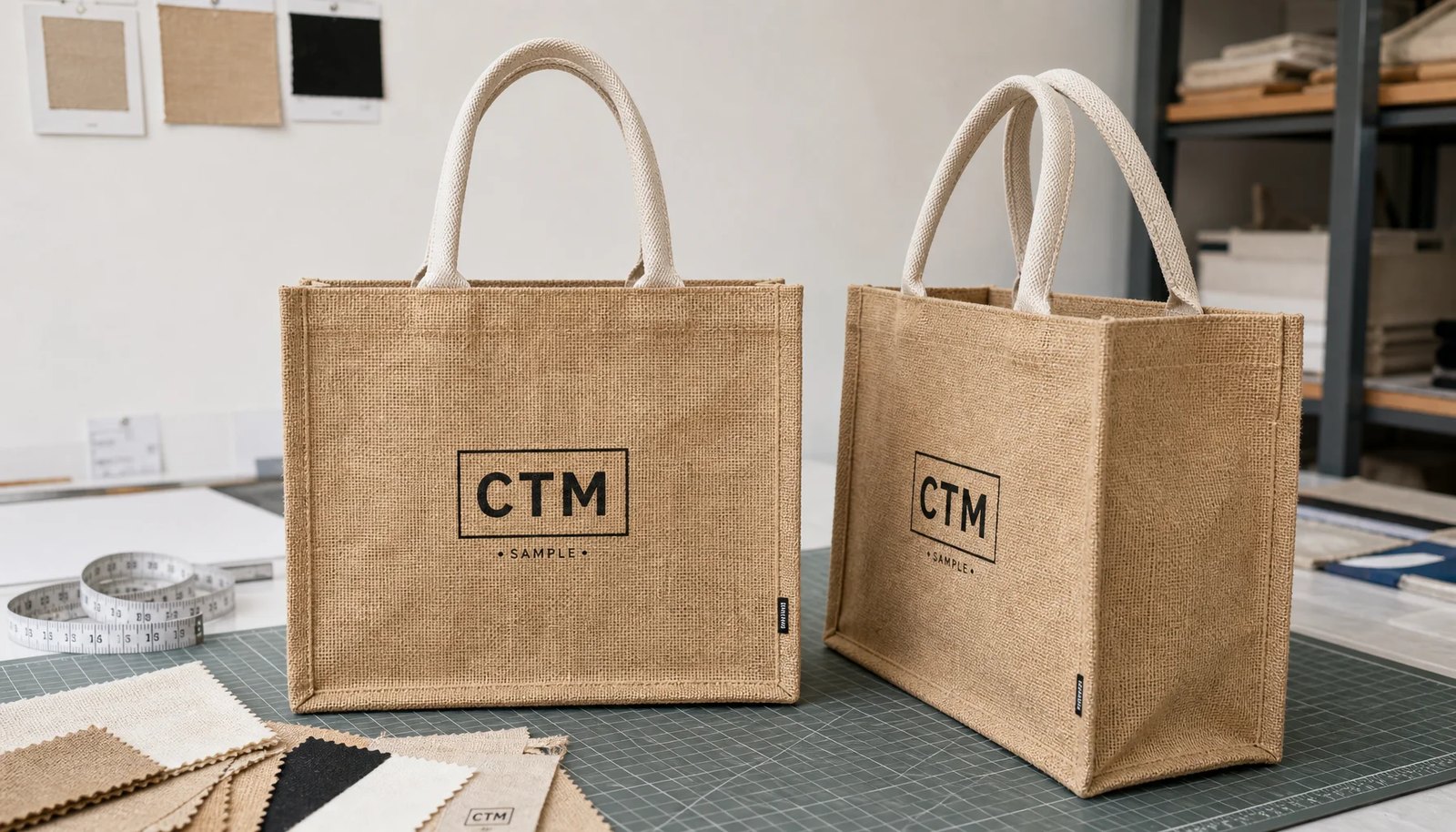
Define the Compliance Problem Before the RFQ
A university bookstore jute tote bag order looks simple until the supplier quotes start arriving with different fabric weights, handle types, print assumptions, and packing methods. One quote may use 250 GSM unlaminated jute with narrow handles, while another uses 320 GSM laminated jute with cotton webbing and reinforced stitching. Both suppliers may call the item a natural jute tote, but the retail result and landed cost are not the same.
The compliance checklist should make every supplier quote against the same usage requirement. Campus bookstores are not only giving away a light event bag; they often sell or issue a tote expected to carry textbooks, sweatshirts, drinkware, stationery, and gift items. The RFQ should therefore control strength, shelf appearance, print quality, carton labeling, and receiving accuracy.
- State the buying purpose: paid retail item, gift-with-purchase, orientation giveaway, alumni merchandise, or reusable checkout bag.
- Define the expected load: light apparel only, mixed bookstore goods, or heavier textbook use.
- Set the retail presentation need: folded flat, standing gusset, hangtag, barcode label, or bulk counter display.
- Separate mandatory compliance items from nice-to-have upgrades so suppliers do not hide cost differences.
Choose Jute Fabric Weight and Construction
For bookstore totes, fabric weight is one of the first cost and performance drivers. A light promotional jute bag may use around 250-270 GSM material, while a more durable campus retail tote often sits around 280-320 GSM. Heavier fabric can improve structure and perceived value, but it increases material cost, carton weight, and freight volume. The RFQ should not simply say natural jute; it should state GSM and whether lamination is required.
Lamination changes the bag. A laminated inner layer can improve shape, reduce fraying, and help the tote stand better, but it can also affect recyclability claims and the natural handfeel. Unlaminated jute feels more traditional and breathable, but it can shed more fibers and may need tighter QC on seams and loose yarns. If the bookstore will place the tote near apparel or books, fiber shedding and odor should be controlled during sample approval.
- Common practical range: 270-320 GSM for many reusable bookstore jute totes.
- Use lamination when shape, stiffness, and cleaner interior are more important than a fully natural feel.
- Use unlaminated jute when the buyer wants a rustic texture and accepts more fiber variation.
- Write fabric tolerance into the purchase order; avoid vague terms like premium jute without GSM.
Size, Gusset, and Handle Decisions
A jute tote for a campus bookstore should be sized around the actual merchandise mix. A flat tote may look cheaper and ship compactly, but it is less useful for hoodies, boxed gifts, and drinkware. A side and bottom gusset improves capacity and shelf presence. For many bookstore programs, buyers consider finished sizes around 35-40 cm wide by 35-42 cm high, with an 8-15 cm gusset depending on the expected load.
Handle specification affects both comfort and failure risk. Cotton webbing handles are common for better handfeel and a cleaner brand appearance. Narrow jute handles can match the bag body but may feel rough under heavier loads. The handle drop should be written clearly because short handles limit shoulder carry, while longer handles can make the bag drag or fold badly when displayed.
- For hand-carry totes, define handle drop and handle width, not only total handle length.
- For shoulder carry, confirm the handle drop on a physical sample with the expected bag load.
- Require cross-stitch or box-stitch reinforcement where the handle joins the bag body.
- Set finished dimension tolerance by panel, gusset, and handle drop instead of accepting overall size only.
Print Method and Artwork Limits on Jute
Jute is a coarse woven surface, so artwork that works on cotton canvas may not print cleanly on jute. Solid screen printing is usually the most reliable choice for campus logos, bookstore names, and simple mascot graphics. Fine type, thin outlines, gradients, and small registration details can break up over the weave. The supplier should review the artwork before quoting and state what will be simplified.
If the design needs more color or smoother detail, a cotton patch, printed laminated panel, or heat transfer may be considered. These options can improve logo clarity but change the style and cost of the bag. A campus buyer should approve a strike-off before bulk production, especially when brand color matters. Pantone color matching on natural jute is approximate unless the print surface is treated or a patch is used.
- Best for screen print: one to three solid colors, bold type, simple linework, and moderate logo size.
- Risky on raw jute: small QR codes, thin serif text, photo images, gradients, and tight multi-color registration.
- For exact branding, consider a cotton canvas patch or woven side label instead of printing tiny details on jute.
- Include print size, position, Pantone reference, and acceptable placement tolerance in the RFQ.
MOQ Logic Behind Supplier Quotes
MOQ is rarely only about the bag body. For jute tote bags, MOQ can be driven by fabric purchasing, handle color, print setup, label production, carton marks, or the supplier's cutting line efficiency. A factory may accept a lower quantity if the buyer uses standard natural jute and stock cotton handles. Custom dyed jute, special handle color, private woven labels, or multi-color printing usually increase the practical MOQ.
Buyers comparing suppliers should request the MOQ reason, not just the MOQ number. A quote for 500 pieces may be possible with stock material and simple print, while a quote for 2,000 pieces may be required for a custom fabric or handle program. If the bookstore plans annual replenishment, it can be smarter to approve a stable standard spec and run repeat orders than to redesign every semester.
- Lower MOQ route: standard natural jute, stock handle, one-color screen print, neutral carton marks.
- Higher MOQ route: custom dyed material, custom woven label, nonstandard handle, retail barcode packing.
- Cost trap: splitting one design into many small colorways can raise setup cost and slow production.
- Quote comparison should show setup charges, sample charges, and whether they are refundable after bulk order.
Supplier Evidence That Matters
A compliance checklist should collect evidence that proves the supplier can make this exact product, not just any bag. Useful evidence includes photos of similar jute tote production, stitch detail photos, print workshop capability, fabric stock information, packing examples, and final inspection reports. A supplier that cannot explain fabric GSM or print limitations may still quote low, but the buyer carries the risk later.
For distributors and importers, the supplier's documentation discipline is as important as the sample. University bookstore orders often involve internal approvals, campus brand rules, and receiving requirements. A factory that can provide clean spec sheets, carton data, and approval photos makes the order easier to manage across merchandising, logistics, and finance teams.
- Request production photos from previous jute tote runs with similar handles and gussets.
- Ask for a written specification sheet showing material, size, print method, packing, and tolerance.
- Require sample photos before dispatch and bulk production photos before final inspection.
- Confirm whether the supplier has experience with bookstore, retail, promotional, or distributor packing.
Sample Approval With Acceptance Criteria
The approval sample should be a decision tool, not only a visual reference. It should use the intended jute fabric weight, correct handle material, real print method, thread color, label position, and packing method. If the first sample uses substitute material, the buyer should mark it as a construction sample only and require a pre-production sample before bulk cutting.
Sample comments should be written in measurable terms. Instead of saying make the logo higher, state the center logo position from the top seam or bottom edge. Instead of saying stronger handle, define handle width, stitch pattern, and pull-test expectation. This prevents the factory from making subjective changes that solve one issue while creating another.
- Approve physical handfeel, fabric shade, jute odor, handle comfort, and bag standing shape.
- Measure width, height, gusset, handle drop, print size, and print position on the sample.
- Rub-test the print lightly after curing to detect weak adhesion or powdery ink.
- Load-test the sample with realistic bookstore goods before approving the handle construction.
Packing Rules for Bookstore Receiving
Packing is often where a correct product becomes a receiving problem. Jute totes can absorb moisture, deform under compression, and shed fibers if packed loosely. The RFQ should define whether each unit is folded flat, packed in an individual polybag, tied with a paper band, or bulk packed in master cartons. Sustainability preferences should be balanced with warehouse protection and retail cleanliness.
Carton data is also quote data. Without carton dimensions, units per carton, gross weight, net weight, and estimated CBM, the importer cannot calculate landed cost accurately. For campus bookstore distribution, carton labels should identify SKU, color, quantity, purchase order, and destination if the order is split across multiple stores or warehouses.
- Use moisture protection when shipping natural jute by sea or storing in humid warehouses.
- Avoid over-compression that creases laminated jute or distorts gusset shape.
- Keep SKU separation strict when multiple campus logos or colorways ship together.
- Request carton photos and carton mark approval before mass packing.
Lead Time and Schedule Risk
Lead time should be broken into stages: artwork review, sample production, sample transit, sample approval, material purchasing, cutting, sewing, printing, packing, inspection, and export handover. A factory may quote bulk production as 25-35 days, but that clock often starts only after sample approval and deposit. University bookstore buyers working toward orientation week, homecoming, graduation, or holiday retail windows need this clarified early.
The highest schedule risks usually come from slow artwork approval, custom material, print rework, and packing changes after production starts. Natural jute shade variation can also create approval delays if the buyer expects a uniform fabric color. A realistic project plan includes buffer time for one sample correction and final inspection, rather than assuming the first sample and first bulk run will be perfect.
- Separate sample lead time from bulk lead time in the purchase schedule.
- Freeze artwork, print size, and packing before the factory orders material.
- Book inspection before cartons are sealed if the buyer needs detailed product checks.
- For deadline orders, avoid custom-dyed jute and complex multi-color prints unless time allows.
Compare Quotes by Landed Cost and Failure Risk
A low FOB price can become expensive if the fabric is lighter, the handle is weaker, the carton is oversized, or the print fails inspection. Buyers should compare quotes on a normalized specification: same size, same GSM, same handle, same print method, same packing, and same carton quantity. If one supplier omits setup cost or sample cost, that should be brought into the comparison.
The better decision is often the supplier with the clearest compliance control, not the lowest unit price. For campus retail, a failed tote can damage the bookstore's brand presentation and create operational trouble at receiving. A complete quote should make the product, the carton, the schedule, and the quality threshold visible before the purchase order is issued.
- Compare FOB unit price plus setup fees, sample cost, inspection cost, freight volume, and expected duty basis.
- Calculate cost per approved usable unit, allowing for inspection rejects and replacement risk.
- Give more weight to suppliers that document fabric GSM, carton data, and print limitations clearly.
- Do not approve bulk production until the sample, quote, artwork, and packing sheet all match.
Specification comparison for buyers
| Supplier option | What to verify | Commercial advantage | Buyer risk to control |
|---|---|---|---|
| Direct sewing factory | jute roll photos, lamination sample, odor-control process, handle pull evidence, and pre-shipment carton condition photos | Better sample-to-bulk control and faster production feedback | May be weaker on export paperwork or branded packing unless checked early |
| Trading company | Factory name, production photos, trim-source proof, and who owns QC decisions | Can coordinate small mixed orders and extra services | Markup can hide real factory capability and slow defect decisions |
| Specialized bag workshop | handle stitching, side gusset, lamination edge control, inner seam cover, and fiber shedding tolerance | More practical for detailed construction, trims, and repeat programs | Capacity may be limited during peak seasons |
| Low-price general supplier | laminated or unlaminated jute, cotton-jute blend, inner coating, odor control, yarn thickness, and color shade variation | Useful for simple promotional runs with loose specs | Material downgrades, weak packing, and vague inspection scope can erase savings |
| Retail-ready supplier | airing time, moisture absorber, carton liner, bundle wrap, odor separation, and warehouse ventilation before loading | Can handle labels, SKU separation, carton marks, and receiving rules | Higher unit cost must be compared against reduced warehouse work |
| Compliance-focused supplier | Fabric records, labeling review, test plan, and production traceability | Safer for retail programs and repeat brand orders | Documentation claims need evidence, not only sales language |
| Local sample room plus bulk factory | Signed sample, bulk factory handoff, first-piece photos, and deviation owner | Good for complex branding before large production | Sample room quality may not match bulk line unless handoff is controlled |
Buyer checklist before sampling
- Define bag size by use case, not only by visual preference: bookstore purchases often need a wider gusset for hoodies, books, and boxed gift items.
- State finished dimensions with tolerance, including width, height, side gusset, bottom gusset, and handle drop.
- List jute fabric GSM, lamination requirement, lining requirement, and whether natural shade variation is acceptable.
- Separate decoration requirements by method: screen print, heat transfer, woven label, cotton patch, or combination branding.
- Provide vector artwork, Pantone references, print size, print position, and whether the logo must remain readable over coarse weave.
- Require a pre-production sample using correct fabric, handle, thread color, print method, and packing method before bulk cutting.
- Set sample acceptance criteria for print registration, handle strength, stitch density, odor, loose fibers, and carton packing.
- Request supplier evidence: production photos, QC checklist, material test reports if needed, export carton specification, and previous product category experience.
- Clarify MOQ by fabric, print setup, handle color, label type, and shipping carton configuration so quotes are comparable.
- Define packing rules for bookstore receiving: units per carton, inner packing, carton marks, SKU separation, barcode labels, and moisture protection.
Factory quote questions to send
- What exact jute fabric weight will be used for this quote, and is the material laminated or unlaminated?
- What are the finished bag dimensions and allowed tolerance for width, height, gusset, and handle drop?
- What handle material, width, length, and stitching pattern are included in the price?
- Is printing completed in your factory or by an outside print workshop, and who controls print QC?
- What print method do you recommend for this artwork on jute, and what detail limitations should we expect?
- What is the MOQ for this specification, and which component drives it: fabric, handle color, printing setup, label, or carton packing?
- How many days are required for sample making after artwork approval, and how many days for bulk production after sample approval?
- Can you provide a pre-production sample with the same fabric lot, handle, logo method, and packing materials planned for bulk?
- What packing method is included in the quote: individual polybag, paper band, master carton only, or retailer-specific carton labeling?
- What carton size, carton weight, units per carton, and estimated CBM are used for freight calculation?
Quality-control points to confirm
- Fabric weight should match the approved specification within the agreed tolerance, typically verified by cutting and weighing a sample area.
- Finished bag size should stay within the written tolerance; for most bookstore totes, ±0.5 cm to ±1.0 cm is more realistic than apparel-level tolerance.
- Handle attachment should use reinforced stitching with no skipped stitches, loose threads, or weak back-tacking.
- Print position should match the approved sample, with a clear tolerance such as ±0.5 cm for logo placement on the front panel.
- Screen print should be checked for ink coverage, pinholes, smudging, crooked placement, and poor adhesion on coarse jute fibers.
- The bag should stand and fold as expected; distorted gussets cause poor shelf presentation and inefficient carton packing.
- Odor and moisture should be checked before packing because natural jute can absorb warehouse humidity.
- Metal trims, if used, should be rust-free and should not stain the fabric during sea shipment.
- Cartons should pass basic compression handling needs and include correct SKU, quantity, gross weight, net weight, and destination marks.
- Final inspection should include random carton opening, count verification, packing sequence review, and photo evidence before shipment release.