Buying Problem
Jute tote bags for natural grocers look simple in a catalog, but they create quality problems when the RFQ only says natural jute bag with logo. Natural grocery buyers usually need a bag that feels sustainable, stands neatly at checkout, carries real grocery weight, and does not arrive with odor, broken handles, or muddy print. Those requirements depend on fabric grade, lamination choice, handle construction, printing method, sewing tolerance, and packing method.
The useful inspection checklist starts before production. A final inspection cannot fix the wrong GSM, poor artwork setup, or cartons packed so tightly that every bag arrives creased. Procurement teams should write the RFQ so every supplier quotes the same construction, then use inspection criteria that match how the bag will be used in stores.
- Primary use: grocery carry, retail merchandise, subscription produce kits, or promotional giveaway.
- Expected load: define the working load, such as 5 kg, 8 kg, or 10 kg, instead of using vague wording like strong handle.
- Retail appearance: decide whether natural fiber variation is acceptable or whether front panels need a cleaner grade.
- Inspection target: separate structural defects from cosmetic jute characteristics that are normal for the material.
Fabric Specification
For natural grocer tote programs, jute fabric weight is usually the first commercial decision. A light open-weave jute may be acceptable for a low-cost event giveaway, but it will not give the same body, carrying confidence, or print surface as a denser 13 oz to 15 oz fabric. In GSM terms, many practical reusable grocery jute totes sit around 370-425 GSM before lamination, though mills and suppliers may describe weights differently.
Do not compare quotes unless each supplier states whether the weight is fabric weight, laminated fabric weight, or finished bag weight. Finished bag weight can hide differences in handle material, gusset size, and lamination. A supplier quoting a cheaper bag may simply be using a looser weave with more visible gaps, which affects strength, print edge, and perceived value on a natural grocery shelf.
- Request fabric weight in oz and GSM, then keep one unit as the commercial control in your PO.
- Approve a physical swatch for weave density, color tone, fiber hairiness, and hand feel.
- For heavier grocery use, avoid very open weave jute unless the bag has reinforcement and the buyer accepts rustic appearance.
- Write tolerance into the spec, such as fabric weight to match approved swatch within plus or minus 5 percent.
Lamination Choice
Lamination changes the bag more than many buyers expect. A light PP lamination on the inside can improve structure, reduce shedding into groceries, and help the bag stand upright. It also gives a smoother backing for sewing and can make the tote feel more finished. For retail display and checkout use, laminated jute often looks more stable and packs more consistently.
The tradeoff is policy and claim risk. Some natural grocers prefer unlaminated jute because they want to avoid plastic content. Others accept lamination because the bag has a longer usable life and better cleanliness. The RFQ should not let suppliers choose silently. Quote laminated and unlaminated versions separately if your team has not decided, because the material, compliance review, hand feel, odor profile, and inspection points are different.
- Laminated jute: better structure, cleaner inside, less fiber shedding, easier shape control.
- Unlaminated jute: stronger natural material story, softer hand feel, more breathable, more prone to fiber dust.
- Inspection for lamination: bubbles, peeling, cracking at folds, uneven gloss, trapped dirt, and delamination near stitch holes.
- Compliance note: do not make recyclability or plastic-free claims until your internal legal or sustainability team confirms the exact construction.
Construction Details
A grocery tote fails where the load concentrates: handle attachment, side seams, bottom corners, and the top hem. For jute, the sewing setup matters because the fabric can fray, shift, or split if the needle, thread, and seam allowance are poorly matched. The strongest-looking bag in a sample photo may still fail if the handle stitch box is too small or placed too close to the top edge.
For natural grocers, cotton webbing handles are a common upgrade because they feel better in the hand than narrow jute tape. A 2.5 cm to 3.8 cm handle width is practical for most retail totes. Handle drop should match the intended use: short hand carry for checkout bags, longer shoulder carry for market totes. Keep the handle drop tolerance tight enough that bags hang evenly when displayed.
- Use a boxed or cross-stitch handle reinforcement rather than a single horizontal stitch line for grocery loads.
- Specify seam allowance and require no open seams, skipped stitches, broken threads, or loose thread nests.
- For boxed-bottom totes, inspect corner alignment because a twisted bottom makes the bag lean and reduces usable capacity.
- Set a simple load test, such as carrying the intended weight for a defined time without seam opening or handle distortion.
Print Method
Screen printing is usually the most stable option for jute tote bags with one to three solid colors. It works well for natural grocer logos, produce icons, local market wording, and simple campaign graphics. The print result depends on the jute surface. Coarse unlaminated jute will not hold tiny type like coated paper, and ink edges will look more textured. That is not always a defect, but it must be approved on a real sample.
Heat transfer can give sharper detail on some laminated surfaces, but it may look less natural and can add cost. Embroidery is possible for premium bags, but dense embroidery on jute can pucker the panel and is slower for bulk orders. Woven labels are useful when the buyer wants a cleaner brand mark without heavy ink coverage, especially on rustic jute.
- Keep small text larger than usual and avoid thin reverse lines on coarse jute.
- Use Pantone references, but approve actual printed color because natural jute changes perceived tone.
- Define print placement from bag edges, not only centered on front panel.
- Inspect for ink bleeding, pinholes, missing strokes, ghosting, heavy smell, wrong print size, and poor registration.
Sample Approval
A jute tote sample should prove the production method, not just the shape. Many early samples are made from available fabric, available handles, and a manual print. That can be useful for layout, but it is not enough for approval if the order will use a different jute grade, final handle tape, or bulk printing screen. For importers, the safest approval path is fabric swatch, construction sample, then pre-production sample.
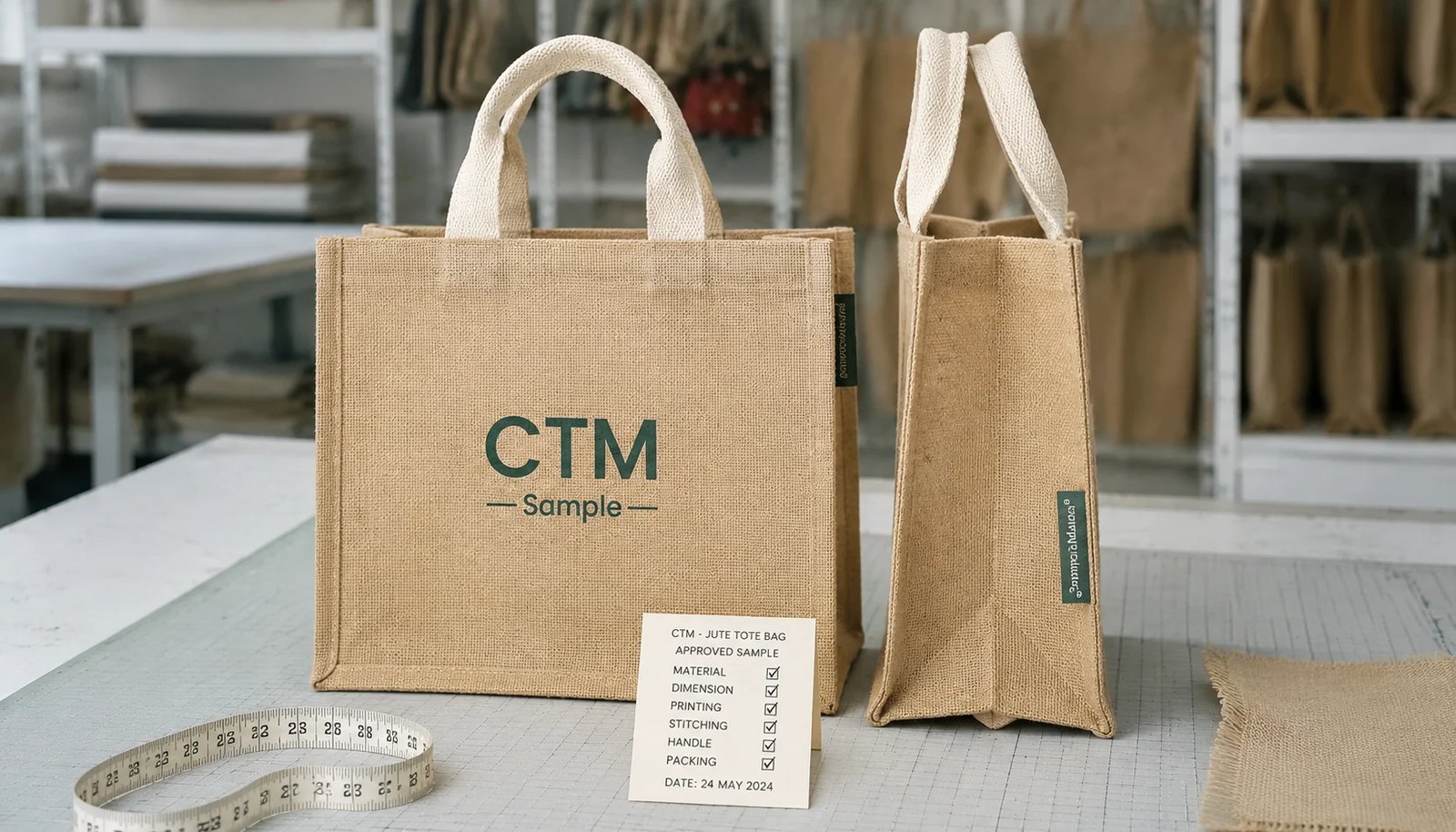
The pre-production sample should use the confirmed fabric weight, lamination, handle material, thread, final dimensions, and final print process. Mark it as the approval sample and keep one signed set with the buyer and one with the factory. At final inspection, the inspector should compare production against this physical sample, not only against PDF artwork.
- Measure finished width, height, gusset, handle drop, handle width, and print position on the sample.
- Cut a small hidden area or use supplier swatches to verify fabric weight when material substitution is a concern.
- Rub the print after curing to check obvious smearing, flaking, or weak adhesion.
- Pack several samples in the proposed carton method to see whether creasing, odor, or deformation appears after compression.
MOQ And Cost
MOQ for jute tote bags is driven by more than bag quantity. Fabric roll availability, lamination setup, handle color, print screens, label weaving, and carton packing all affect the minimum efficient run. A buyer requesting five handle colors and ten store-specific logos may meet the total quantity but still create small production lots with extra setup charges.
When comparing quotes, separate the bag base cost from changeover cost. A low unit price can become expensive after screen charges, sample fees, special packing, split shipments, label changes, and inland freight are added. For distributors and multi-store natural grocers, it is often cleaner to standardize one bag body and change only the printed artwork or paper hangtag.
- Ask for price breaks at realistic quantities, such as 1,000, 3,000, 5,000, and 10,000 pieces.
- Separate costs for fabric upgrade, lamination, handle upgrade, print colors, woven label, hangtag, and individual packing.
- Clarify whether MOQ applies per size, per color, per artwork, or per shipment.
- Compare CBM and carton weight because freight can change the landed cost more than a small unit price difference.
Inspection Thresholds
Jute has natural variation, so QC standards must distinguish normal character from defects. Small slubs, slightly uneven fiber tone, and minor hairiness are part of the material. Oil stains, mold spots, strong damp odor, broken yarns across the logo area, open seams, and print mistakes are not normal rustic character. If this distinction is not written, inspection arguments become subjective.
Use an AQL plan if your company already applies one, but add jute-specific defect descriptions. Critical defects should include safety hazards, sharp foreign matter, mold contamination, and severe chemical odor. Major defects should include wrong size outside tolerance, handle failure, open seams, wrong logo, severe stains, laminate peeling, and cartons damaged by moisture. Minor defects can include small loose threads, slight shade variation within approved range, or small back-panel slubs away from the logo.
- Set size tolerance before production, commonly plus or minus 5 mm to 10 mm depending on bag size.
- Define print tolerance for position, color, registration, and acceptable edge texture.
- Use a load test that reflects actual groceries, not an unrealistic one-second pull only.
- Photograph defect examples during sampling so the factory, inspector, and buyer judge the same standard.
Packing And Freight
Jute absorbs moisture and odor more easily than synthetic nonwoven bags. Packing must protect the bags without trapping dampness. Over-compressed cartons can create hard creases, distorted gussets, and a musty smell after sea freight. Natural grocer buyers often care about store-ready presentation, so carton packing is part of product quality, not just logistics.
Flat packing is common, with a fixed number of bags per export carton. The carton should be strong enough for stacking, but not so heavy that warehouse teams mishandle it. Inner polybags may protect against moisture, but some buyers avoid extra plastic. If the buyer rejects polybags, moisture control and clean carton storage become more important.
- Confirm pieces per carton, carton size, gross weight, net weight, and CBM before placing the order.
- Use desiccant or moisture-control measures when shipping to humid routes, subject to buyer packing policy.
- Require clean export cartons with correct marks, PO number, SKU, quantity, and country of origin marking as needed.
- Inspect cartons for dampness, crushing, odor transfer, incorrect assortment, and mixed artwork before shipment.
Lead Time Risk
Lead time risk usually sits in material preparation and print approval. Jute fabric shade can vary by batch, laminated fabric may need additional processing time, and custom handle colors or woven labels may not be available immediately. Artwork delays also matter because screen setup cannot start until final files, print size, and placement are confirmed.
A practical schedule separates sample development, approval time, material booking, bulk production, inspection, and shipping. Do not treat factory lead time as starting from the first inquiry. It usually starts after deposit, artwork approval, and sample approval, depending on supplier policy. For seasonal natural grocery promotions, build in time for one sample correction instead of assuming the first sample will be final.
- Typical development path: swatch approval, sample making, sample review, pre-production sample, bulk production.
- Critical path items: jute grade, lamination, handle tape, print screens, woven labels, and carton artwork.
- Schedule risk increases when the order has multiple sizes, multiple logos, special labels, or strict sustainability packaging rules.
- Reserve inspection time before vessel closing so failed lots can be sorted or repaired without missing shipment.
Specification comparison for buyers
| Spec decision | Recommended option | When it fits | Buyer risk to check |
|---|---|---|---|
| Jute fabric weight | 13 oz to 15 oz jute, roughly 370-425 GSM before lamination | Reusable natural grocery totes carrying produce, pantry goods, and boxed items | Low GSM can look open-weave and collapse; verify actual fabric weight from cut swatch, not only finished bag weight |
| Inside finish | Light PP lamination or unlaminated jute depending on store policy | Lamination improves structure and print hold; unlaminated jute fits stricter plastic-reduction programs | Lamination changes recyclability claims and odor behavior; require buyer approval before quoting both options as equal |
| Handle construction | Cotton webbing 2.5-3.8 cm wide with cross-stitch reinforcement | Comfortable hand carry for grocery loads and better retail appearance than thin jute tape | Handles fail before body fabric on heavy loads; inspect stitch density, bartack area, and pull strength |
| Print method | Screen print for 1-3 spot colors on jute or laminated jute | Natural grocer logos, local produce graphics, and store event messaging | Fine text and small QR codes lose sharpness on coarse jute; approve artwork at actual size |
| Bottom structure | Boxed bottom with 10-18 cm gusset and reinforced side seams | Standing totes for checkout counters, farmers market kits, or retail merchandise displays | Weak corner alignment causes leaning bags and poor shelf presentation; measure finished gusset width on samples |
| MOQ logic | MOQ based on fabric roll, print setup, and handle color, not only bag quantity | Bulk store programs, distributor replenishment, and multi-location grocery launches | Small split-color orders create hidden setup cost; compare quote lines for fabric, handle, and print changeovers |
| Packing method | Flat packed in export cartons with moisture control and carton strength matched to bag weight | Sea freight, warehouse storage, and retail distribution where crushed corners create complaints | Over-compressed jute creases and holds odor; confirm carton quantity, carton size, and ventilation before shipment |
| Inspection level | AQL inspection with critical, major, and minor defect definitions agreed before production | Importers needing consistent store-ready presentation across cartons | Generic inspection reports miss jute-specific issues such as loose fiber, laminate bubbles, odor, and handle twisting |
Buyer checklist before sampling
- Define the intended grocery load in kilograms and the expected use cycle before choosing jute GSM, handle width, and seam reinforcement.
- State whether the bag must be laminated, unlaminated, or quoted both ways with separate compliance and cost notes.
- Provide finished dimensions as width x height x gusset, with tolerance in millimeters, instead of sending only a reference photo.
- Approve actual jute swatches because natural color, weave openness, fiber hairiness, and odor vary by batch.
- Set the print artwork at actual size and include Pantone references, minimum line width, and acceptable registration tolerance.
- Require a pre-production sample using bulk fabric, bulk handle material, and the final print process before mass cutting.
- Specify handle attachment method, stitch pattern, thread color, and minimum pull-test requirement.
- List major defects that trigger rejection, including broken seams, misprinted logo, heavy odor, severe stains, laminate peeling, and incorrect size.
- Confirm carton packing quantity, inner polybag policy, moisture control, carton markings, and pallet limits for destination warehouse handling.
- Request quote breakdown by bag size, GSM, lamination, handle type, print colors, sample cost, tooling or screen charge, packing, and lead time.
Factory quote questions to send
- What jute GSM or ounce weight are you quoting, and can you provide a cut fabric swatch from the same grade before sampling?
- Is the quoted fabric laminated or unlaminated, and what is the lamination thickness or finish if laminated?
- What finished size tolerance can you hold for width, height, gusset, and handle drop after sewing and pressing?
- What handle material, width, weight, and reinforcement stitch pattern are included in the price?
- For our artwork, do you recommend screen print, heat transfer, embroidery, woven label, or a combined method, and why?
- How many print colors and screens are included, and what extra cost applies for color changes or store-location artwork splits?
- What is the MOQ for one design, one size, one handle color, and one print version, and how does the price change at higher quantities?
- Will the pre-production sample be made with bulk fabric and final print setup, or is it a salesman sample using available materials?
- What inline and final inspection steps do you perform for jute odor, stains, loose fibers, lamination bubbles, seam strength, and carton moisture?
- What carton quantity, carton dimensions, gross weight, and CBM per export carton are you quoting for freight planning?
Quality-control points to confirm
- Fabric weight must match approved swatch within agreed tolerance, typically plus or minus 5 percent for jute fabric lots.
- Finished bag size should stay within agreed tolerance, commonly plus or minus 5 mm to 10 mm depending on bag size and construction.
- Handle drop must be consistent across the inspected sample set because uneven handles make bags look defective at retail checkout.
- Side seams, bottom seams, and handle patches must show no skipped stitches, broken threads, loose thread ends longer than the agreed limit, or open seams.
- Print position should stay within approved placement tolerance, with no heavy ink bleeding, missing ink, ghosting, or unacceptable color deviation.
- Natural jute smell is expected, but strong chemical, mold, or damp odor should be treated as a major defect.
- Stains, oil marks, mold spots, heavy discoloration, and foreign fibers on the front logo area should be classified more strictly than small back-panel slubs.
- Laminated bags should be checked for bubbles, peeling at seam folds, cracking, and delamination near stitched areas.
- Cartons should be dry, clean, export grade, correctly marked, and not overloaded beyond warehouse handling limits.
- Random finished bags should pass a practical load test using the buyer's intended grocery weight and carry duration.