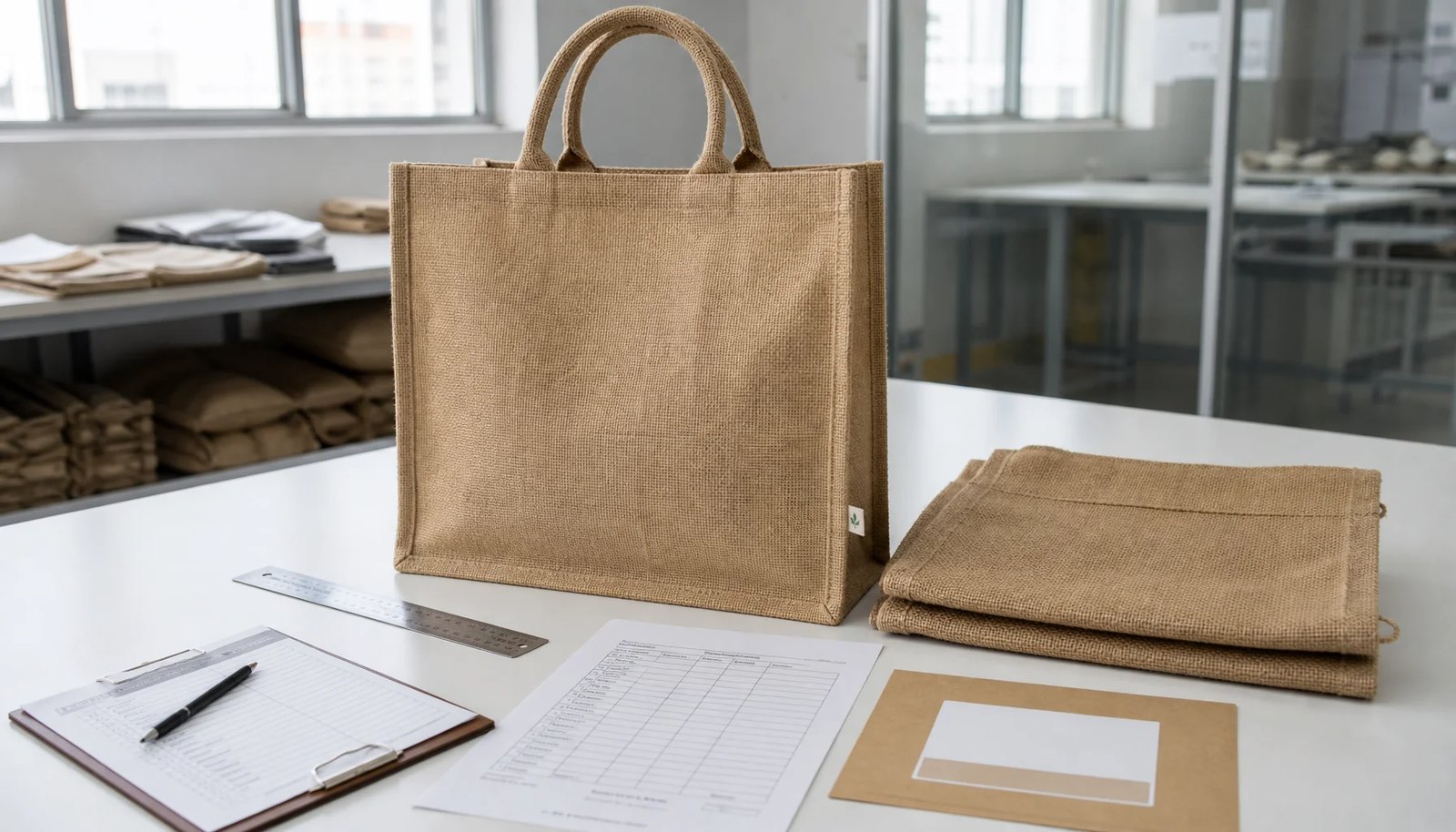
Start with the box program, not the bag catalog
A jute tote for a subscription box is not a generic carry bag. It has to fit a defined cavity, fold the same way every time, survive warehouse handling, and arrive looking consistent when the customer opens the box. The commercial risk is usually not the tote by itself. It is the mismatch between the tote and the pack-out workflow: wrong thickness, awkward handles, rough print, odor, or a shape that slows kitting.
The first buyer decision is how the bag will be used in the program. A flat insert needs predictable fold behavior and low cubic volume. A premium gift item needs cleaner stitching, tighter print control, and better cosmetic standards. A reusable consumer bag needs stronger handle construction and more attention to load performance. Those are different products even if they share the same outer dimensions.
Write the failure condition before you request pricing. State what would make the tote unusable: it does not fit the box, it springs open too much, it sheds fibers, it looks inconsistent under retail lighting, or it creates odor or dust problems in the fulfillment center. When the supplier sees the actual failure mode, it can quote the right construction instead of guessing from a catalog image.
- Define whether the tote is an insert, gift-with-purchase item, retail add-on, or reusable consumer bag before requesting pricing.
- Name the failure mode up front so suppliers do not optimize for the wrong thing.
- Treat repeatability as the sourcing goal, because one good sample does not prove bulk control.
Turn the tote into a measurable spec
Write the spec around the subscription box, not around the supplier's standard size. Give the factory finished width, finished height, gusset depth, handle drop, and the largest product combination the tote must carry. If the bag has to sit beside other items in the carton, include the cavity dimensions or a simple pack drawing. That removes guesswork and stops a bag that looks right on paper from failing in pack-out.
For jute bags, gsm is only one part of the build. Buyers often start around 300-320 gsm for lighter promotional inserts and 340-400 gsm when the bag needs more structure or a more premium hand feel, but that is only a starting point. Ask for weave density, yarn thickness, seam allowance, and whether the bag is laminated, lined, or left raw inside. Two bags with the same gsm can fold, print, and carry very differently.
Print instructions should be equally exact. Specify the print method, color count, logo size in millimeters, exact placement, and whether artwork must avoid seams, gussets, or stitch lines. If color matters, reference the Pantone value or the approved digital file, and say whether minor shade variation is acceptable. The more exact the spec, the easier it is to compare quotes on the same product and avoid disputes after approval.
- State print area in millimeters instead of vague labels like front logo or large branding.
- Call out handle width, handle drop, and reinforcement method so every supplier quotes the same construction.
- If the bag must stay flat enough for machine packing, say so in the RFQ rather than assuming the factory will infer it.
Request compliance evidence that matches the exact order
Compliance documents only matter when they match the exact build. A generic certificate does not prove the bag you are buying was made with the same jute weight, ink, lining, adhesive, or trim that appeared in the sample. For procurement, the useful file set is the one that connects one approved sample to one production method and one factory lot. That is what gives the paperwork commercial value.
For U.S. and Canada programs, ask whether the supplier can support a material declaration, country-of-origin statement, and, where relevant, testing for restricted substances or labeling rules. If the bag is sold to children, the bar changes and you may need CPSIA-related documentation and age-graded compliance. For the EU or UK, ask for a REACH SVHC declaration, confirmation against Annex XVII where relevant, and any buyer-specific restricted-substance list. If your retailer asks for it, a Prop 65 statement may also be required for California distribution. These are not universal requirements; they are market and channel requirements that must be matched to the exact SKU.
If the tote includes coating, lamination, printed inks, labels, or adhesive-backed components, ask for SDS files and the exact scope of any test report. A report on a similar style is not enough if the construction changed. The question is not whether the supplier has a compliance folder. It is whether the folder proves the bag you are ordering is the one that was reviewed.
- Request the exact bill of materials for the sampled construction, not a generic catalog sheet.
- Ask whether the print ink, lining, label, and adhesive come from the same qualified source used on the sample.
- Keep sample approvals, inspection notes, and packing photos so the bulk order is traceable to the approved reference.
Compare supplier models on control, not just price
The right sourcing route depends on order pattern, not seller preference. A direct sewing factory usually makes sense for repeat programs, custom sizes, and tighter control over cutting, printing, and final packing. A trading company can be practical when you are combining several products into one subscription shipment and want a single point of coordination. A local decorator or kitting partner may work for very small runs, but the unit cost is usually higher and the control over fabric build is thinner.
If the subscription program is likely to repeat, ask who actually owns the formula for the bag after the first order is done. The supplier that owns the spec, the sample reference, and the production records is easier to manage over time than a seller who only brokers the first quote. For recurring box cycles, continuity matters as much as the first sample appearance. Procurement should think in terms of handoff risk, not only order placement.
Do not compare suppliers only by who replied first or who gave the lowest headline number. Compare who controls the factory, who approves engineering changes, who signs off on the golden sample, and who answers when the bulk shipment drifts from that sample. A low quote from a weak process is not a saving if it creates rework, delayed fulfillment, or customer complaints.
- Ask where cutting, stitching, printing, and final packing actually happen.
- Confirm whether the person quoting you can approve engineering changes or must relay them to another site.
- Use the sourcing route as part of the compliance checklist, not as a sales preference.
Read the quote like a landed-cost document
A usable quote should separate the main cost buckets: fabric, cutting, sewing, print setup, labels, lining, packing, cartons, and export terms. If those lines are collapsed into one figure, you cannot compare suppliers fairly and you will not know where the cost moved when the spec changes. In jute, small changes in fabric weight, handle reinforcement, or print area can materially change yield and labor, so the quote should show the assumptions behind the number.
The lowest quote is often the one with the most omissions. Sample charges, screen or plate setup, carton changes, moisture protection, and inland freight can appear later if they were not discussed upfront. Ask the supplier to quote against the finished size, approved artwork, and agreed packing format. That is the only way to compare landed cost instead of chasing a low ex-factory price that grows after award.
A stronger RFQ also asks the supplier to declare assumptions. Does the price assume one-color print, no lining, standard handle length, and stock carton size? Is the waste allowance based on normal cutting yield or a custom size with higher offcut risk? If two suppliers are far apart on price, those assumptions are often the real explanation. This is where procurement keeps the program honest.
- Separate the quote into unit price, sample cost, setup cost, packing cost, and shipping terms.
- Check whether the quote assumes one-color print, no lining, and a stock-size bag unless your RFQ says otherwise.
- Ask the supplier to state any waste allowance, material yield, or MOQ assumption used in the price.
Use the sample stage to prove fit, finish, and pack-out
The first sample should be production-relevant, not a hand-finished presentation piece. It should use the same or a close production-equivalent fabric, the same print method, the same handle construction, and the same packing approach you expect in bulk. Review finished size, squareness, seam neatness, handle symmetry, print placement, and the way the bag folds into the subscription box. If the sample looks good but does not fit the pack-out plan, it is not approved.
Use the sample stage to remove ambiguity before the purchase order is released. Keep one signed golden sample, photograph every side, and record the fold sequence, label position, and acceptable visual standard. If the warehouse team will kit the bag into a box, have them test the sample using the real pack-out sequence, real insert weight, and real carton dimensions. That is where problems show up: thickness, spring-back, handle placement, and awkward folds.
If the tote has options, approve the exact construction you intend to buy. A sample with a different coating, a heavier lining, or a more polished finish can create a false sense of security. The supplier should know which details are fixed, which are negotiable, and which changes require written approval. That turns sample control into a real compliance gate instead of a design conversation.
- Inspect the sample under the same lighting your retail or warehouse team will use.
- Test the bag with real insert weight, not just an empty shell.
- Approve one reference sample and one packing reference so the factory has both targets.
Set QC thresholds before bulk starts
For jute totes, the common quality misses are easy to name and expensive to ignore: uneven handle length, open seams, crooked printing, moisture marks, weak bartacks, and bags that vary too much from the approved size. Before you release the order, define which defects are major and which are minor. A structurally sound bag can still be unacceptable if it looks sloppy in a retail display or feels inconsistent across a subscription cycle.
Use an inspection plan that fits the commercial risk. AQL can work, but only if the critical defects are clearly defined. A practical starting point for consumer tote programs is AQL 0 for critical defects, AQL 2.5 for major defects, and AQL 4.0 for minor defects, then tighten the plan if the bag is retail-facing or the fit is very tight. If print alignment is the main brand risk, the inspection should emphasize artwork placement and print quality. If the bag must fit a box precisely, dimension control and fold consistency deserve more attention than minor cosmetic variation.
Escalation rules should be written before production begins. Decide when a problem can be reworked, when it must be sorted, and when it requires remake or rejection. That avoids end-of-line argument when time is tight and both sides are trying to protect margin. If the supplier understands the acceptance logic in advance, they can correct problems earlier and with less waste.
- Set a measurement tolerance before bulk production, not after the first carton arrives.
- Define the maximum allowed print misalignment and seam variation in writing.
- Reject any bag with open seams, major fraying, strong odor, oil stains, or pack-out failure.
Use tolerances that match the way the bag is used
Tolerances should reflect the role of the bag. For a box-fit-critical tote, use tighter limits on finished width and height than you would for a promotional giveaway. A practical procurement approach is to set a nominal size and then agree on a written tolerance such as plus or minus 5 mm on smaller dimensions and plus or minus 8 mm on larger panels, with the exact allowance tied to your carton cavity and packing method. The point is not the number itself; the point is that both sides sign the same number.
Do the same for print and construction. If the logo has to sit cleanly on the front panel, define the acceptable shift in millimeters and whether the logo can cross a stitch line. If handle symmetry matters, define the maximum acceptable difference in handle length and the visible twist allowed after sewing. If the bag will be folded for kitting, agree on the fold line and the acceptable folded thickness, because that determines whether the bag occupies one carton lane or forces a packaging change.
The best QC tolerances are simple enough to inspect at the line and strict enough to protect the program. They should be tied to a ruler, a sample board, and a golden sample photo set. That way, the factory can self-check before packing, and your receiving team can reject obvious deviations without needing a long debate over taste or interpretation.
- Write tolerances for finished size, print position, handle length, and folded thickness.
- Tie the tolerance to the carton cavity and the fulfillment workflow, not to generic bag standards.
- Use a ruler-ready spec sheet so factory QC and receiving can judge the same reference.
Lock packing details before the cartons are booked
Flat packing is usually the best choice for subscription-box programs because it lowers cubic volume and keeps the tote from arriving misshapen. But flat packing only works when the fold is repeatable and the bag opens cleanly at the fulfillment site. Ask the supplier to show the folded profile, carton count, and final master-carton dimensions before you confirm the order. If the folded tote is too thick, you pay for it in shipping, storage, and kitting labor.
Packing materials should protect against dust, moisture, and carton crush without creating unnecessary waste. Some buyers accept loose master-carton packing to keep cost low. Others need tissue wrap, kraft sleeves, or individual polybags because the tote is sold as a premium item or stored for a long time before use. The right choice depends on visibility in the unboxing, warehouse dwell time, and your sustainability policy.
Packing is also part of compliance because it preserves the approved appearance. If the bag is folded differently in the bulk shipment, the warehouse may have to rework it during kitting. If cartons are overfilled, the bag can crease or pick up odor. If carton marks or barcode placement are wrong, receiving staff may reject or relabel the shipment. All of those problems are avoidable when the packing standard is written before production starts.
- State the master carton count, label position, and whether barcodes are needed on inner packs.
- If you use polybags, decide whether they are acceptable for your brand and sustainability policy before sampling.
- Ask for the carton size with the actual folded bag inside, not an empty carton measurement.
Manage lead time as a sequence of gates
A realistic lead time includes sample making, sample approval, raw material readiness, printing, sewing, final inspection, and export packing. Delays usually happen because artwork changes after fabric is ordered or because the supplier starts weaving after the order is already due. For custom jute bags, the schedule becomes safer when the bag spec, artwork, and packing method are frozen before the production window opens.
Back-plan from the date the subscription box is actually packed, not the date the bags leave the factory. Freight, customs clearance, and warehouse receiving all add time, and seasonal congestion can move the calendar without warning. A supplier that gives you a short lead time but cannot explain their print setup, fabric stock position, or packing capacity is giving you a guess, not a plan.
The practical response is to build slack into the steps that tend to move: sample revisions, art approval, carton artwork, and final packing sign-off. If any of those slips, the whole box program can slip with it. Procurement should therefore ask for a milestone schedule that shows what must happen before cutting, before printing, before sewing, and before final loading. That schedule is more useful than a vague promised ship date.
- Build schedule slack for sample revisions and art approval.
- Lock the bag spec before the box finalization window closes.
- Ask the supplier to identify any long-lead steps such as custom weave, special label sourcing, or carton printing.
Specification comparison for buyers
| Supplier option | What to verify | Commercial advantage | Buyer risk to control |
|---|---|---|---|
| Direct sewing factory | jute roll photos, lamination sample, odor-control process, handle pull evidence, and pre-shipment carton condition photos | Better sample-to-bulk control and faster production feedback | May be weaker on export paperwork or branded packing unless checked early |
| Trading company | Factory name, production photos, trim-source proof, and who owns QC decisions | Can coordinate small mixed orders and extra services | Markup can hide real factory capability and slow defect decisions |
| Specialized bag workshop | handle stitching, side gusset, lamination edge control, inner seam cover, and fiber shedding tolerance | More practical for detailed construction, trims, and repeat programs | Capacity may be limited during peak seasons |
| Low-price general supplier | laminated or unlaminated jute, cotton-jute blend, inner coating, odor control, yarn thickness, and color shade variation | Useful for simple promotional runs with loose specs | Material downgrades, weak packing, and vague inspection scope can erase savings |
| Retail-ready supplier | airing time, moisture absorber, carton liner, bundle wrap, odor separation, and warehouse ventilation before loading | Can handle labels, SKU separation, carton marks, and receiving rules | Higher unit cost must be compared against reduced warehouse work |
| Compliance-focused supplier | Fabric records, labeling review, test plan, and production traceability | Safer for retail programs and repeat brand orders | Documentation claims need evidence, not only sales language |
| Local sample room plus bulk factory | Signed sample, bulk factory handoff, first-piece photos, and deviation owner | Good for complex branding before large production | Sample room quality may not match bulk line unless handoff is controlled |
Buyer checklist before sampling
- Finished bag width, height, gusset depth, and the folded profile that must fit inside the subscription box cavity or kitting tray.
- The bag's role in the program: flat insert, premium gift item, retail add-on, or reusable consumer tote, because that changes construction, finish, and QC priorities.
- Fabric construction details: target gsm, weave density, lining or lamination requirement, internal seam finish, and whether odor, dust, or fiber shedding are acceptable at all.
- Handle specification: width, drop, reinforcement method, attachment style, and the maximum expected carry weight or filled load case.
- Artwork requirements: print method, number of colors, Pantone reference, print placement in millimeters, and any seam or gusset exclusions.
- Region-specific compliance documents required by the destination market, retailer, or marketplace, including the exact test scope and the date range accepted.
- Golden sample approval rules: who signs off, which bag is the master reference, which dimensions are locked, and what changes require re-approval.
- Inspection thresholds: AQL level, major and minor defect definitions, measurement tolerances, and what counts as an automatic reject.
- Packing plan: carton count, carton dimensions with the folded bag inside, inner pack requirement, moisture protection, pallet plan, and carton marks.
- Commercial terms: MOQ by size and print color, sample cost, rework responsibility, incoterm, payment terms, and the delivery date needed at the fulfillment site.
Factory quote questions to send
- What exact fabric construction, gsm, weave density, lining or coating, and handle reinforcement are you quoting for this style, and what tolerance do you hold in bulk?
- Which steps are done in-house, and which are outsourced for cutting, printing, labels, packing, or carton work?
- Can you separate the quote into fabric, labor, print setup, packaging, carton work, and export terms so I can compare landed cost fairly?
- What is the MOQ by size, print color, label type, and packing format, and does the MOQ change if I add a woven label, sleeve, or printed carton?
- What sample type do you provide first: proto sample, pre-production sample, or top-of-production sample, and what changes are allowed before approval?
- What region-specific documents can you provide for the exact construction, such as REACH SVHC declarations, CPSIA-related paperwork if applicable, Prop 65 statements if required, material composition, or SDS for inks and adhesives?
- What inspection standard do you use in production and at final inspection, and how do you define major, minor, and critical defects for this bag?
- What are your measured tolerances for finished size, handle length, print position, and folded thickness?
- What is the full lead time from approved sample to ex-factory completion, and which step is most likely to delay the order?
- What triggers a re-quote or re-approval if I change logo placement, handle length, carton count, or finishing details?
Quality-control points to confirm
- Critical defects: mold, strong chemical odor, wet or visibly contaminated bags, open seams that affect function, missing handles, wrong artwork, or any bag outside the approved size enough to fail pack-out should be zero tolerance.
- Major defects: seam slippage, weak bartacks, crooked or incomplete print, handle twist, severe fraying, or fold size that prevents the tote from fitting the box should be limited by an agreed AQL, commonly AQL 2.5 for major defects as a starting point for consumer programs.
- Minor defects: small loose threads, slight weave variation, small shade drift, or cosmetic inconsistency that does not affect function can sit at a higher AQL, commonly AQL 4.0, if the buyer accepts it in writing.
- Finished size should be checked against a locked tolerance. A practical starting point is plus or minus 5 mm on smaller dimensions and plus or minus 8 mm on larger panels, but tighten this if the box cavity is narrow or the bag is machine-packed.
- Handle length, handle drop, and handle symmetry should be measured against the golden sample, with a typical control band of plus or minus 5 mm unless the design is highly visible or load-bearing.
- Print placement should be measured in millimeters from the agreed reference edge. A common control target is plus or minus 3 mm for front-panel logo placement, with stricter limits if artwork crosses seams or gussets.
- Fold thickness and folded shape should be checked against the actual carton plan, not a visual estimate. If the tote is packed flat, the folded bundle should not force carton overfill or crush the weave.
- Pre-shipment inspection should verify the approved construction, label position, carton marks, carton count, and moisture protection, plus a random audit of packed bags for odor, dust, and surface damage.
- If the program is retail-facing, add cosmetic checks under the same lighting used at receiving or on shelf so the supplier is not judging against a different visual standard.
- Any bag that deviates from the golden sample in a way that changes fit, appearance, or brand presentation should be stopped before packing, not discovered at the fulfillment center.