Why Exhibitor Jute Bags Need Tighter Inspection
Jute tote bags look simple, but trade show use makes the specification less forgiving. The bag is carried in crowded halls, filled with brochures, samples, catalogs, water bottles, or small promotional items, and often photographed beside a booth display. A weak handle or muddy print does not only create a product defect; it turns the brand giveaway into a visible problem during the event.
Procurement teams should treat jute exhibitor bags as functional branded packaging. The right inspection checklist covers fabric, lamination, handle strength, print durability, packing, and schedule risk. When these points are written into the RFQ before quoting, supplier prices become easier to compare and the factory has fewer gaps to interpret on its own.
- The bag must carry real booth contents, not just look acceptable when empty.
- The logo must stay readable on a coarse natural surface.
- The carton packing must protect shape until the bags reach the exhibition warehouse.
- The production plan must leave enough time for sample correction before the event deadline.
Start With Capacity And Finished Size
A practical jute tote bag specification starts with what the exhibitor will put inside. Many RFQs only say “standard tote bag” or attach a photo, which leaves the factory guessing. For a trade show, the buyer should list the largest catalog size, expected insert thickness, sample weight, and whether the bag needs to stand upright at the booth. A bag that is too shallow causes catalogs to stick out; a bag without enough gusset looks bulky when filled.
Common exhibitor jute tote sizes are around 30 x 35 x 10 cm for light literature, 35 x 40 x 12 cm for general giveaways, and 40 x 35 x 15 cm for heavier product kits. These are examples, not fixed rules. The better method is to stack the intended contents, measure the real load, then add handling clearance. Finished-size tolerance should be agreed in writing because jute and lamination can shift slightly during cutting and sewing.
- State finished width, height, bottom gusset, and side gusset separately.
- Use handle drop measurements, not only total handle length.
- Allow a realistic tolerance such as plus or minus 1 cm for main body dimensions.
- Confirm whether the bag must stand on a counter when filled.
- Send a loading photo or content list when asking for a quote.
Choose Jute GSM And Lamination With A Purpose
For exhibitor tote bags, 260-320 GSM laminated jute is usually a balanced range. It gives enough body for a structured tote without making the bag unnecessarily heavy. Lighter jute can reduce unit cost but may feel loose, shed more fibers, and distort during printing. Heavier jute can look premium, but the added weight affects freight, carton volume, and the comfort of carrying the bag all day.
Lamination matters as much as GSM. Inner clear PP lamination can stabilize the fabric, reduce lint transfer onto printed materials, and help the bag keep its shape. A heavy or glossy outer coating may change the natural look that buyers expect from jute and can make creasing more visible. The RFQ should state whether lamination is required, which side is laminated, and whether odor limits apply after packing.
- Use 240-260 GSM only for very light inserts and cost-sensitive campaigns.
- Use 260-320 GSM for mainstream exhibitor tote bags.
- Use 320-380 GSM when the bag must feel more rigid or carry heavier samples.
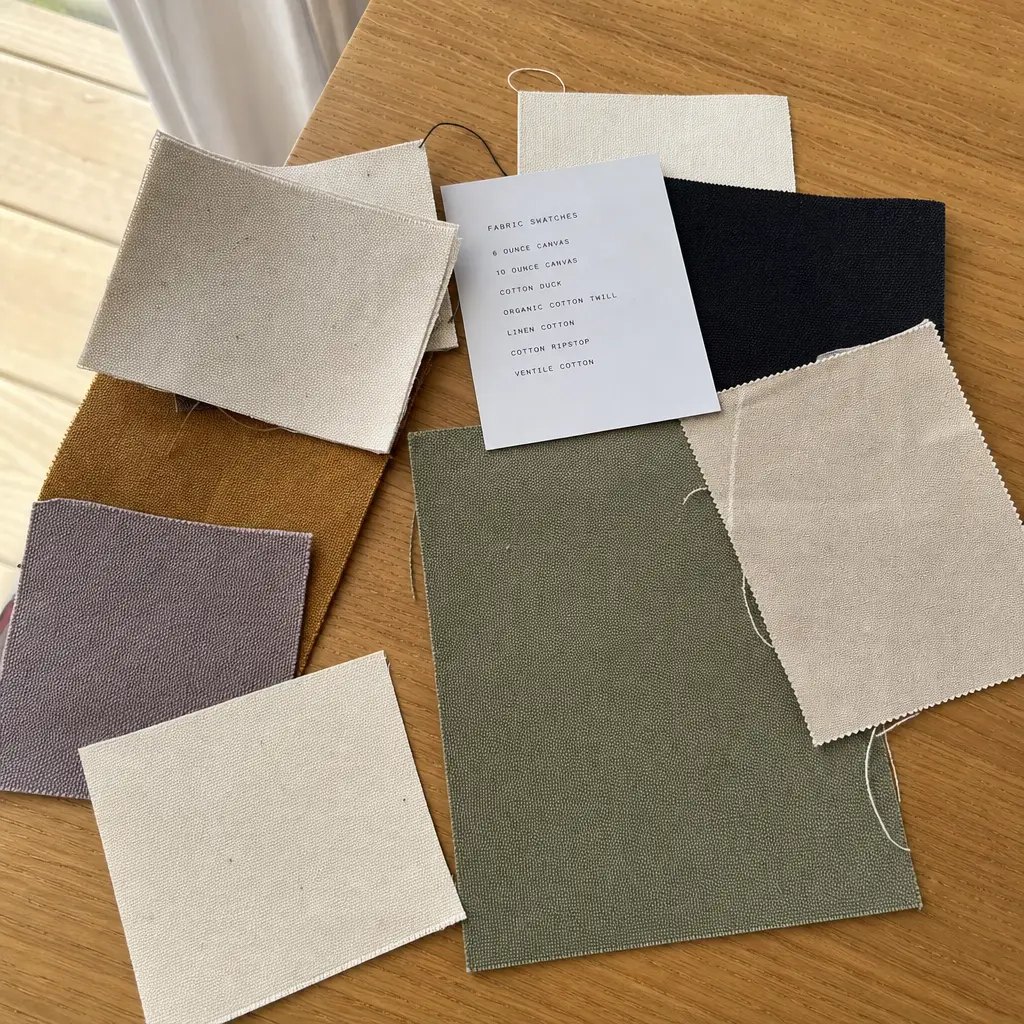
- Avoid approving fabric weight from a supplier description alone; request a swatch or sample.
- Keep one approved fabric swatch with the signed pre-production sample.
Handle Strength Is The Main Failure Point
Most real complaints on trade show totes come from handles, not from the body panel. Visitors load the bag gradually during the day, then swing it from one hand or shoulder. A handle that looks fine in photos may fail if the webbing is too narrow, the stitch density is low, or the reinforcement is only a simple straight stitch.
Cotton webbing handles are commonly used because they feel better in the hand and print-friendly jute body can stay natural. A 2.5-3.0 cm handle width is practical for most exhibitor bags. The attachment area should use X-box stitching, dense bartacks, or another approved reinforcement. The buyer should define a load test that reflects expected contents, then add a safety margin.
- Measure handle drop so the bag can be hand carried or shoulder carried as intended.
- Inspect both handle ends because one weak attachment can fail the bag.
- Look for skipped stitches, loose thread, webbing fray, and uneven attachment height.
- Test loaded bags by lifting and holding, not only by a quick pull.
- Reject samples where the handle tears the jute panel under normal load.
Print Method And Artwork Limits On Jute
Jute is a coarse fabric, so artwork that looks clean on coated paper may lose sharpness on the bag. Screen printing works well for solid logos, bold text, simple icons, and one to three spot colors. It is usually the most economical method for medium and large exhibitor orders. Heat transfer can handle finer artwork or gradients, but it changes the hand feel and must be tested for edge lifting and surface compatibility.
The buyer should not approve printing from a digital proof alone. A strike-off or pre-production sample on the actual jute fabric is important because fiber color, weave gaps, and lamination affect ink coverage. Pantone matching should be treated with realistic tolerance. Natural jute is not a bright white substrate, so light colors may look muted and fine reverse text may fill in.
- Convert logos and text to vector artwork before sending to the factory.
- Avoid very small lettering, thin lines, and complex gradients unless a sample proves they work.
- Define print size, placement from top edge and side seam, and acceptable placement tolerance.
- Run a dry rub and light scratch test on the printed sample.
- Keep the approved printed sample as the inspection standard, not only the PDF artwork.
MOQ Logic And Cost Drivers
For custom jute tote bags, MOQ is not only a factory policy. It is linked to fabric purchasing, lamination setup, screen making, cutting efficiency, labor scheduling, and export packing. A very small order can be produced, but the unit price may carry a large share of setup and handling costs. Buyers who only compare the lowest unit price often miss screen charges, sample fees, domestic trucking, or higher carton volume.
A useful RFQ asks for price breaks at several quantities, such as 500, 1,000, 3,000, and 5,000 pcs. This shows whether the supplier is pricing from available fabric stock or from a more efficient production run. It also helps distributors quote end customers with better margin control. When comparing quotes, use landed cost per usable bag, not factory unit price alone.
- Main cost drivers include jute GSM, lamination, bag size, handle material, print colors, packing method, and inspection requirements.
- Screen setup charges may be separate from unit price for small runs.
- Heavier jute can raise sea freight and courier sample costs.
- Individual polybags add labor, material, and carton volume.
- Higher reject allowance should be considered when the artwork is detailed or the delivery date is tight.
Sample Approval Before Bulk Production
A good pre-production sample should represent the bulk order, not simply show the factory’s sewing ability. It should use the intended jute GSM, lamination, handle webbing, stitching method, thread color, print method, and packing fold. If the sample is made from substitute fabric, the buyer must know that before approval. Otherwise, the approved sample becomes a weak control document.
Sample review should be practical. Load the bag with the actual exhibitor materials, carry it for a short period, place it on a table, and check whether the print remains visible and the bag keeps its shape. Measure the sample and record the dimensions. Photograph the approved sample from front, back, side, handle joint, bottom gusset, and logo close-up. These photos help avoid disputes when inspection happens weeks later.
- Approve fabric, handle, print, stitching, and shape together.
- Record actual sample dimensions and compare them with the PO spec.
- Cut open one rejected or extra sample if needed to inspect lamination and seam allowance.
- Sign or label the approved sample so it cannot be confused with earlier trials.
- Do not release bulk production until artwork placement and color are accepted.
Incoming And Inline QC At The Factory
Quality control should begin before sewing. Incoming jute rolls can vary in shade, odor, weave tightness, and surface cleanliness. If different rolls are mixed without control, finished bags may show visible color variation across panels. Cutting operators also need clear direction on grain, panel alignment, and defect avoidance because jute irregularities are more visible than on many cotton fabrics.
Inline inspection catches problems before the full order is packed. The factory should monitor panel size, seam allowance, stitch density, handle placement, and print position during production. For printed jute bags, early print checks are especially important because screen pressure, ink viscosity, and drying time can change the appearance. Rework is easier before handles are sewn and cartons are sealed.
- Inspect fabric rolls for stains, mold, heavy odor, broken yarns, and shade variation.
- Separate panels with obvious slubs or dark contamination from logo areas.
- Control stitch density and back-tacking at stress points.
- Check the first printed panels against the approved sample before continuing the run.
- Keep rejected pieces separate so they are not packed by mistake.
Final Inspection Acceptance Criteria
Final inspection should combine visual checks with functional tests. A jute tote may look acceptable in a carton but fail when loaded, or the logo may pass at arm’s length but rub off during handling. The inspection plan should include random carton selection, quantity verification, measurement checks, print review, handle strength testing, odor review, and packing inspection. For export orders, AQL can be used, with added product-specific tests written into the inspection instruction.
Defects should be classified clearly. A critical defect could include mold, unsafe sharp material, severe odor, or wrong logo. Major defects may include handle weakness, wrong size outside tolerance, heavy print misregistration, open seams, delamination, or incorrect carton quantity. Minor defects may include small loose threads or slight natural jute irregularities that do not affect use or brand appearance. The buyer and factory should agree on these standards before production starts.
- Check actual finished dimensions against the approved tolerance.
- Load-test sampled bags using the agreed weight and hold time.
- Rub printed areas with a dry white cloth to see whether ink transfers.
- Inspect cartons from different pallet positions, not only the top cartons.
- Confirm PO number, item code, quantity, and destination marks on cartons.
Packing And Moisture Control
Packing is not a small detail for jute. Natural fibers can absorb moisture, and lamination can hold creases if bags are over-compressed. For trade show orders, the bag must arrive clean, flat, and easy for warehouse staff to count. Flat packing by 25 or 50 pcs per bundle is often more practical than heavy random bulk packing. Individual polybags are not always necessary, but bundle protection and a clean export carton are important.
Carton dimensions and gross weight should be approved before shipment because they affect warehouse handling, courier cost, and booth kit assembly. Too many bags in one carton can deform the bottom gusset and handle shape. Too few bags increase freight cost. Desiccants may be useful for humid routes, but they should be used as a moisture-control measure, not as a substitute for dry materials and dry cartons.
- Specify pieces per inner bundle and pieces per export carton.
- Avoid excessive carton compression that creates permanent creases.
- Use clean liners or bundle bags when cartons may face mixed warehouse conditions.
- Confirm carton burst strength for heavier jute bags.
- Record carton size and gross weight for landed-cost comparison.
Specification comparison for buyers
| Spec decision | Recommended option | When it fits | Buyer risk to check |
|---|---|---|---|
| Main jute fabric weight | 260-320 GSM laminated jute for most exhibitor giveaways | Works for catalogs, brochures, samples, apparel inserts, and booth visitor kits | Below 240 GSM can feel loose and shed fibers; above 350 GSM raises freight and may look too rustic for corporate branding |
| Bag structure | Laminated jute with cotton webbing handles and boxed bottom | Best when bags must stand on booth counters and carry mixed printed materials | Poor bottom gusset stitching can twist the bag and reduce usable capacity |
| Handle construction | Cotton webbing 2.5-3.0 cm wide with X-box or dense bartack reinforcement | Suitable for hand carry during full-day exhibitions | Short handles may not fit over a shoulder; weak handle joints are a common field failure |
| Print method | Screen print for solid logos; heat transfer only for fine gradients or photographic artwork | Screen print gives better cost control on medium to large exhibitor runs | Jute texture reduces fine detail sharpness; artwork must be tested on the actual fabric, not only on paper |
| Inner lamination | Clear PP lamination inside, not heavy glossy coating outside | Keeps the bag more stable, reduces lint transfer, and improves shape retention | Uneven lamination can wrinkle, crack at folds, or create odor if not aired before packing |
| MOQ planning | Use 500-1,000 pcs as a realistic starting point for custom print and export packing | Fits most single-show exhibitor campaigns and distributor replenishment orders | Very small orders may carry setup fees, local stock limitations, or weaker control over fabric batch consistency |
| Packing format | Flat pack by 25 or 50 pcs per inner bundle, with moisture protection and export carton marks | Best for warehouse receiving, booth kit assembly, and distributor onward shipment | Over-compressed packing can crease lamination and deform handles before the show |
| Inspection level | AQL inspection with added functional load, print adhesion, odor, and measurement checks | Appropriate for branded giveaways where visible defects damage booth presentation | Standard visual inspection alone may miss weak handles, ink rub-off, and incorrect carton assortment |
Buyer checklist before sampling
- Define bag size by actual booth contents, not by a catalog photo; include length, height, gusset, handle drop, and tolerance.
- Specify jute GSM, lamination type, handle material, handle width, and reinforcement method in the RFQ.
- Send final artwork as vector files with Pantone or physical color references, and state maximum acceptable color deviation.
- Approve a pre-production sample made from bulk-intended fabric, handle webbing, lamination, and printing method.
- Test the sample with the real catalog weight, giveaway items, and expected carry time.
- Set acceptance criteria for seam strength, handle pull, print adhesion, odor, color shade, loose fibers, and bag shape.
- Require carton packing details, inner bundle quantity, polybag use, carton dimensions, gross weight, and shipping marks before order confirmation.
- Compare supplier quotes using landed cost per usable bag, including setup charges, sampling, inland freight, carton volume, and expected reject allowance.
- Lock final shipment schedule backward from the event date, including sample approval, production, inspection, customs, inland delivery, and buffer time.
- Keep a signed sample, artwork proof, carton mark, and final PI together as the inspection reference set.
Factory quote questions to send
- What jute GSM, lamination type, and fabric width will be used for this quotation?
- Is the quoted fabric natural jute, blended jute, or jute-look material, and can you provide a fabric swatch from current stock?
- What is the exact finished bag size, gusset size, handle drop, and measurement tolerance?
- Which handle material and width are included, and how will the handle joints be reinforced?
- Which print method is included in the unit price, how many colors are quoted, and what setup charges apply?
- Can the pre-production sample be made with the same fabric batch, lamination, handles, and print method as bulk production?
- What is the realistic MOQ for this specification, and how does the unit price change at 500, 1,000, 3,000, and 5,000 pcs?
- What packing method is quoted, including pieces per carton, carton size, gross weight, and whether each bag or bundle uses poly protection?
- What is the production lead time after sample approval, and how much time is needed for artwork proofing and material preparation?
- What inspection standard will you accept before shipment, and can defective pieces be reworked or replaced before delivery?
Quality-control points to confirm
- Fabric weight should match the approved GSM range, with no obvious thin zones, broken yarns, oil stains, mold marks, or heavy shedding.
- Finished size should stay within the agreed tolerance, commonly plus or minus 1 cm for main dimensions and plus or minus 0.5 cm for handle width.
- Handle pull strength should be tested using the agreed load, with no seam tearing, webbing slippage, or broken stitches.
- Bottom gusset and side seams should lie straight, with no twisted panels, skipped stitches, exposed raw edges, or uneven seam allowance.
- Print should match approved artwork placement and color standard, with no serious bleeding, cracking, misregistration, pinholes, or ink rub-off.
- Lamination should be even and bonded, without bubbling, delamination, sharp creases, strong chemical odor, or visible contamination.
- Cartons should protect the bag shape, avoid excessive compression, and carry correct item code, quantity, PO number, carton number, and destination marks.
- Random carton checks should confirm correct quantity, assortment, label position, and absence of moisture damage before release.