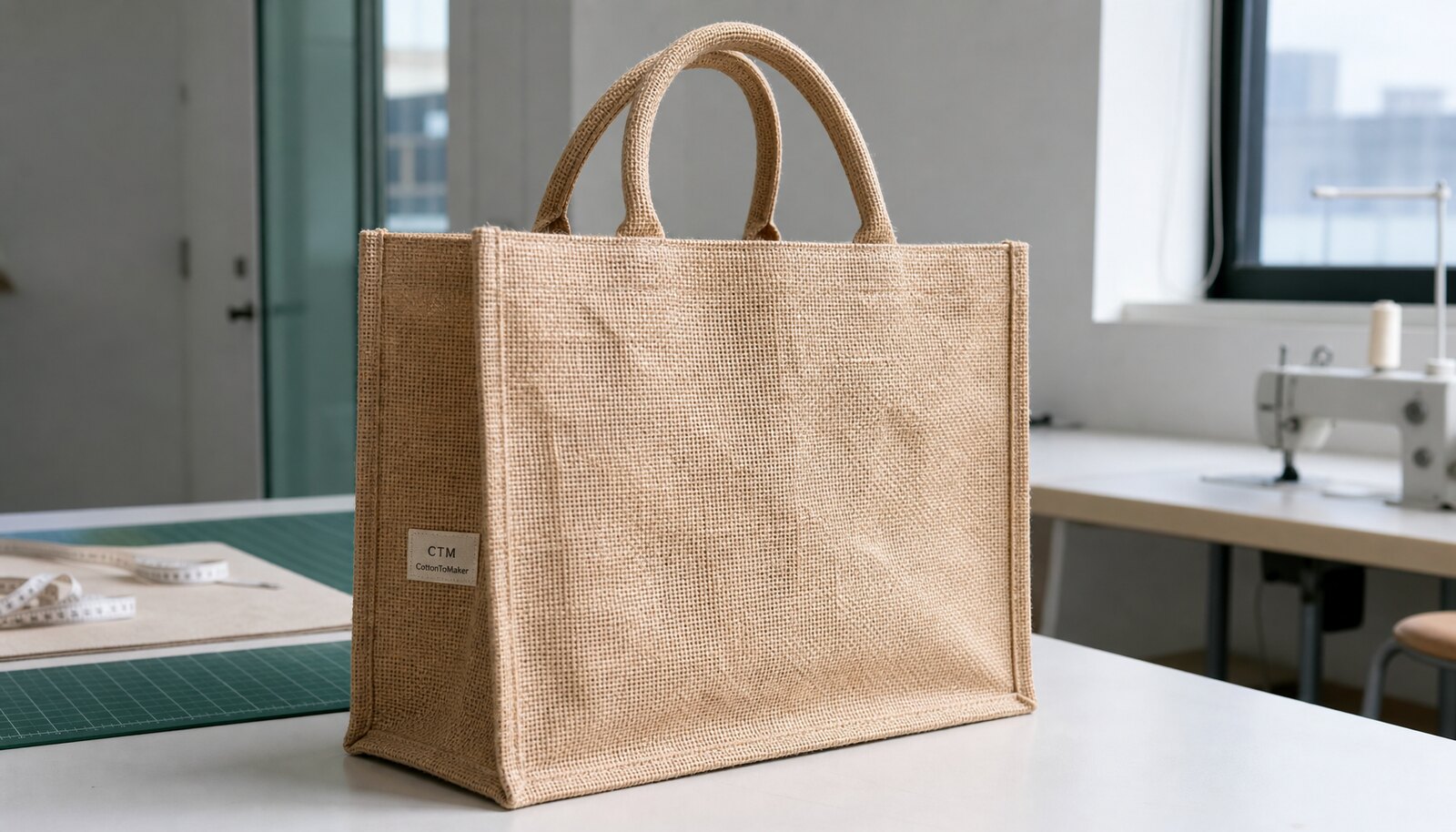
Why corporate-gift jute bags fail when buyers treat them like simple shopping bags
Jute shopping bags for corporate gifts sit in a different category from a basic promo tote. The bag is part of the gift presentation, so the buyer is not only paying for carrying capacity. The bag must look neat on arrival, keep its shape in transit, carry a logo cleanly, and survive handling by staff, distributors, or recipients who may keep it rather than discard it.
That changes the spec conversation. A bag that looks acceptable at a distance can still fail if the fabric is too thin, the handle length is awkward, the logo prints too close to the seam, or the packing method crushes the surface before the gift set is assembled. Procurement teams that define use case first usually get cleaner quotes and fewer sample revisions.
- Corporate gifting usually needs a more presentable finish than mass giveaway bags.
- The bag may be paired with notebooks, bottles, hampers, brochures, or apparel inserts.
- Presentation defects often matter more than pure load rating.
- A quote should reflect the final use, not only the raw bag size.
Start with the right bag structure, not just the logo position
For most corporate gift programs, a natural jute body in the 250-300 GSM range is the practical starting point. Below that, the bag can look floppy, especially if it carries a rectangular gift box or a stack of printed materials. Above that range, the bag becomes heavier, harder to sew, and more expensive to ship, while also looking less refined if the finish is too stiff. If the gift program is premium, buyers can move to a laminated inner layer or a heavier base cloth, but the cost should be justified by the contents and the brand image.
The handle choice matters as much as the body. Cotton webbing handles or jute-cotton blend handles usually give the best balance of comfort and appearance. Pure jute handles can work, but they feel rough in hand and often require tighter control on twist, edge finishing, and reinforcement. For corporate gifts, a handle drop around a comfortable hand-carry range is usually more useful than a generic retail tote length.
- Useful size for many gift sets: medium tote format with gusset for boxes or brochures.
- Choose shoulder-carry only if the event format or contents justify it.
- Reinforcement at handle anchor points is not optional for heavier inserts.
- If the bag must stand upright, ask for a structured base or bottom panel.
Spec choices that change quote levels more than buyers expect
Most price differences on jute shopping bags come from a handful of inputs: fabric weight, handle type, number of print colors, closure features, and packing labor. A 1-color screen print on a plain open-top jute bag is a very different manufacturing job from a magnetic flap bag with multi-color artwork and individual tissue wrapping. Buyers sometimes compare those quotations side by side and assume the higher one is inflated, when in fact the operations are not equivalent.
The safest RFQ format is to separate must-have specs from flexible specs. For example, list the size, approximate GSM, handle material, and artwork size as fixed, then indicate whether closure style and retail packing are optional. That helps suppliers quote one base version and one upgraded version, which gives procurement a real comparison instead of a bundle of uneven assumptions.
- GSM affects handfeel, body, and freight weight.
- Print color count drives setup cost and registration risk.
- Closures and linings add labor, sewing time, and reject points.
- Retail packing can add more cost than the bag itself on low-volume orders.
How to compare supplier quotes without getting trapped by incomplete pricing
For corporate gifting, the quote should be read as a system price, not just a unit bag price. One supplier may quote a low bag cost but exclude handle reinforcement, print setup, master cartons, or export packing labels. Another may price higher but include a pre-production sample, carton marks, and a cleaner lead time. If the buyer does not normalize the quote lines, the cheapest option often becomes the most expensive once corrections are added.
A useful comparison method is to convert each supplier quote into landed production value before freight: bag body, handle, print, packing, and sampling. Then add the likely hidden items: approval sample courier, carton test, overrun allowance, and any surcharge for special artwork or rush timing. That makes the risk visible and helps internal stakeholders understand why a mid-priced factory may be the better procurement choice.
- Compare quotes at the same artwork size and same print method.
- Make sure all suppliers are quoting the same packing basis.
- Ask whether the quoted MOQ is a hard minimum or a price break point.
- Check whether color matching or Pantone matching is included.
Supplier route comparison: direct factory, trading company, or local converter
For jute shopping bags for corporate gifts, the sourcing route changes both cost structure and control. A direct factory usually offers better technical clarity on fabric, stitching, and print. That matters when the bag must match a brand standard or a campaign deadline. A trading company can help if the order includes mixed product categories, but the buyer should know that the technical chain is longer and responsibility can blur when a print issue or seam failure appears.
Local converters or regional decorators can be useful for very fast turnaround or small distribution runs. The tradeoff is often unit cost and limited control over jute fabric sourcing. If the campaign requires repeatability across multiple seasons, a direct factory route generally gives cleaner results. If the purchase is a one-off event with urgent local delivery, convenience may outweigh the higher cost.
- Direct factory: best for repeat programs, better control of fabric and QC.
- Trading company: useful for mixed-category sourcing, but confirm technical ownership.
- Local converter: useful for urgent or low-volume needs, but check fabric consistency.
- For any route, insist on a production sample matched to final bulk materials.
Product-specific comparison table: which sourcing route fits the job
This is the comparison most buyers actually need before issuing an RFQ. Corporate gift bags are judged on appearance, repeatability, and timing, so the sourcing route should match the program risk. A factory quote may look harder to manage at first, but it is often easier to audit when artwork, fabric, and packing must all align.
Use the table below to decide whether you need the lowest admin effort, the strongest technical control, or the best balance of both. The right route changes with volume, artwork complexity, and how visible the bag will be to the recipient.
- Write decisions in measurable language, not only descriptive wording.
- Ask for sample photos plus one physical approval sample for important orders.
- Keep quotation, sample approval, and inspection notes tied to the same spec version.
Sample approval: the stage where most jute bag orders are saved or lost
A sales sample is not enough for a corporate gift order. The sample must reflect the final fabric weight, handle material, print method, and packing method, or the buyer is approving the wrong product. For jute, a small shift in weave density or ink coverage can make the finished bag look significantly more rustic or less refined than the approved sample.
A practical approval flow is reference sample, pre-production sample, then bulk release. On a first order or a premium campaign, many buyers also keep a sealed gold sample that the production line and final inspector can reference. The important point is not formality; it is preventing a last-minute substitution of thinner fabric, different handle tape, or a looser print outline.
- Match sample fabric to the same GSM and finish promised in the PO.
- Verify logo placement against the actual bag seam and gusset layout.
- Check color against the approved artwork under normal indoor light.
- Test one packed sample with the actual gift insert if possible.
QC thresholds that matter for corporate gifting, not just bulk transport
A jute shopping bag for corporate gifts has to pass visual and functional QC before it ever reaches the recipient. Size tolerance matters because gift inserts may not fit if the gusset is short or the opening is tight. Stitch quality matters because a visible loose thread or crooked seam reads as poor brand quality, even if the bag still carries weight. Print quality matters because the logo is often the only branded element on the bag.
Set acceptance criteria before production starts. For example, define acceptable size variation, maximum allowable print misalignment, what counts as a visible stain, and whether minor jute fiber shedding is normal or rejectable. Jute is a natural material, so a degree of texture variation is expected, but uneven construction and weak reinforcement are not. If the bag will be handed out at a client event, those defects become brand defects.
- Size and gusset measurements should be checked on a sample from each carton zone.
- Handle stitching should be tested by pull, not only visual inspection.
- Logo edges should not feather excessively into the jute weave.
- Carton counts and packing labels should match the purchase order exactly.
Packing and carton strategy for gifting programs
Packing is where many corporate gift orders lose presentation value. If the bags are shipped flat and compressed without a clear packing plan, the jute surface can crease, the handles can deform, and the final opening experience becomes less premium. On the other hand, over-packing each bag individually may look good but can add unnecessary labor and freight cost, especially for large event orders.
The best packing method depends on who assembles the gift. If the bags are filled at destination, bulk pack in master cartons with clear carton marks is usually most efficient. If the bags are delivered retail-ready to offices or distributors, individual polybags or tissue wrap may be justified. Buyers should make sure the quote specifies whether packing is included per piece or by carton only, because this can change both the labor and the carton dimensions.
- Bulk pack is usually better for destination assembly.
- Individual wrapping is better for premium presentation but adds cost.
- Ask for carton size and gross weight before approving freight estimates.
- Make sure carton labeling supports warehouse receiving and case allocation.
Lead time planning: where jute orders slip and how to protect the schedule
The standard lead time for a custom jute bag order depends on sample approval, fabric availability, print complexity, and packing requirements. The schedule usually slips for one of four reasons: artwork revisions after sample approval, late confirmation of the final quantity, changes to handle or closure details, or added retail packing after the factory has already planned bulk production. The bag itself is simple; the coordination is what takes time.
To protect the launch date, build a small buffer between sample approval and the customer-facing event. If the order is for a trade show or corporate campaign, give the factory a frozen spec sheet and one decision owner on the buyer side. The best production schedules are the ones that do not keep changing after the approval sample is signed off.
- Freeze artwork early, especially print size and color count.
- Confirm packing requirements before the pre-production sample is made.
- Keep a backup plan if a special closure or lining is delayed.
- Ask the supplier where the longest internal bottleneck is: weaving, printing, sewing, or packing.
Specification comparison for buyers
| Spec decision | Recommended option | When it fits | Buyer risk to check |
|---|---|---|---|
| Bag body weight | 250-300 GSM jute fabric | Corporate gifts where the bag must look substantial and hold moderate weight without sagging | Too light and the bag looks cheap; too heavy can raise cost, stiffen sewing, and reduce print clarity |
| Handle type | Cotton webbing or jute-cotton blended handles | When the bag will be carried for events, retail handouts, or employee gifting | Pure jute handles can feel rough; check handle twist, shoulder comfort, and reinforcement stitch density |
| Print method | 1-2 color screen print or heat transfer for fine logo detail | When the artwork is simple and the order volume supports setup cost | Fine lines, gradients, or tiny text can blur on textured jute; request strike-off approval on actual fabric |
| Closure option | Open top for gifting inserts or Velcro/magnet flap for premium sets | When the bag is used with catalogs, gift boxes, or higher-value contents | Closures add cost and sewing complexity; weak alignment can cause rejection at final inspection |
| Lamination | No lamination for a natural look; light inner lamination only if moisture resistance is needed | When the buyer wants a rustic corporate image or basic protection for packed gifts | Over-lamination can make the bag stiff and reduce eco appeal; verify odor and crease behavior |
| MOQ route | Standard factory MOQ for repeat artwork; higher MOQ for custom size or special handles | When the buyer wants the best balance of price and production efficiency | Low-MOQ quotes may hide high unit price, limited color options, or weak QC support |
| Supplier route | Direct factory source for repeat programs; trading company only when combining multiple categories | When schedule, cost control, and customization matter more than one-stop convenience | Trading routes can add margin and blur technical responsibility; confirm who approves samples and who owns defects |
| Packing method | Bulk packed in polybag or master carton with clear carton marks | When shipping volume matters and gifting boxes are packed separately at destination | Retail-ready packing needs more labor and can change carton count, carton size, and sea freight cost |
| Sample approval level | Pre-production sample matched to final fabric, handle, print, and packing | When the order is for a campaign, brand event, or client-facing corporate gift | A loose sales sample is not enough; production fabric shade and print registration can differ materially |
Buyer checklist before sampling
- Final bag size in cm or inches, including gusset depth and handle drop
- Jute fabric GSM, backing or lamination requirement, and acceptable color range
- Handle material, width, length, stitch pattern, and reinforcement points
- Logo artwork in editable vector format with print colors called out by Pantone or factory equivalent
- Target order quantity, split sizes if any, and expected repeat order volume
- Packing requirement: bulk pack, individual polybag, tissue wrap, or retail carton
- Required sample stages: reference sample, pre-production sample, and gold seal if needed
- Target ship date, destination port or delivery location, and acceptable production buffer
Factory quote questions to send
- What GSM jute fabric do you propose, and is that based on finished weight with lamination or base fabric only?
- Is the quoted price for direct factory production, and who controls sample approval and final QC release?
- What are the exact handle materials, lengths, and reinforcement stitches included in the quote?
- How many print colors are included, what is the setup charge, and what changes if the logo is moved or resized?
- What is the MOQ by size and by print design, and how much does the unit price change at 500, 1,000, and 3,000 pieces?
- What packing method is included in the quote, and are carton marks, barcode labels, or tissue wrap extra?
- What is the standard lead time after sample approval, and what parts of that timeline can slip if artwork is revised late?
- What inspection standard do you use for size tolerance, print alignment, stitch strength, and odor/appearance issues?
Quality-control points to confirm
- Bag dimensions within agreed tolerance, especially width, gusset, and handle drop
- Fabric appearance consistent across cartons, with no excessive fraying, oil marks, or heavy color variation
- Handle attachment secure, with reinforcement stitching aligned and no loose thread bundles
- Print registration correct, with logo centered where specified and no major pinholes, smudges, or cracking
- Seams straight and tight at side gussets, bottom panel, and stress points
- Odor acceptable after unpacking, especially if lamination, glue, or ink is used
- Carton count, packing list, and label information matching the PO
- Pre-shipment sample or gold seal matching production output before bulk release