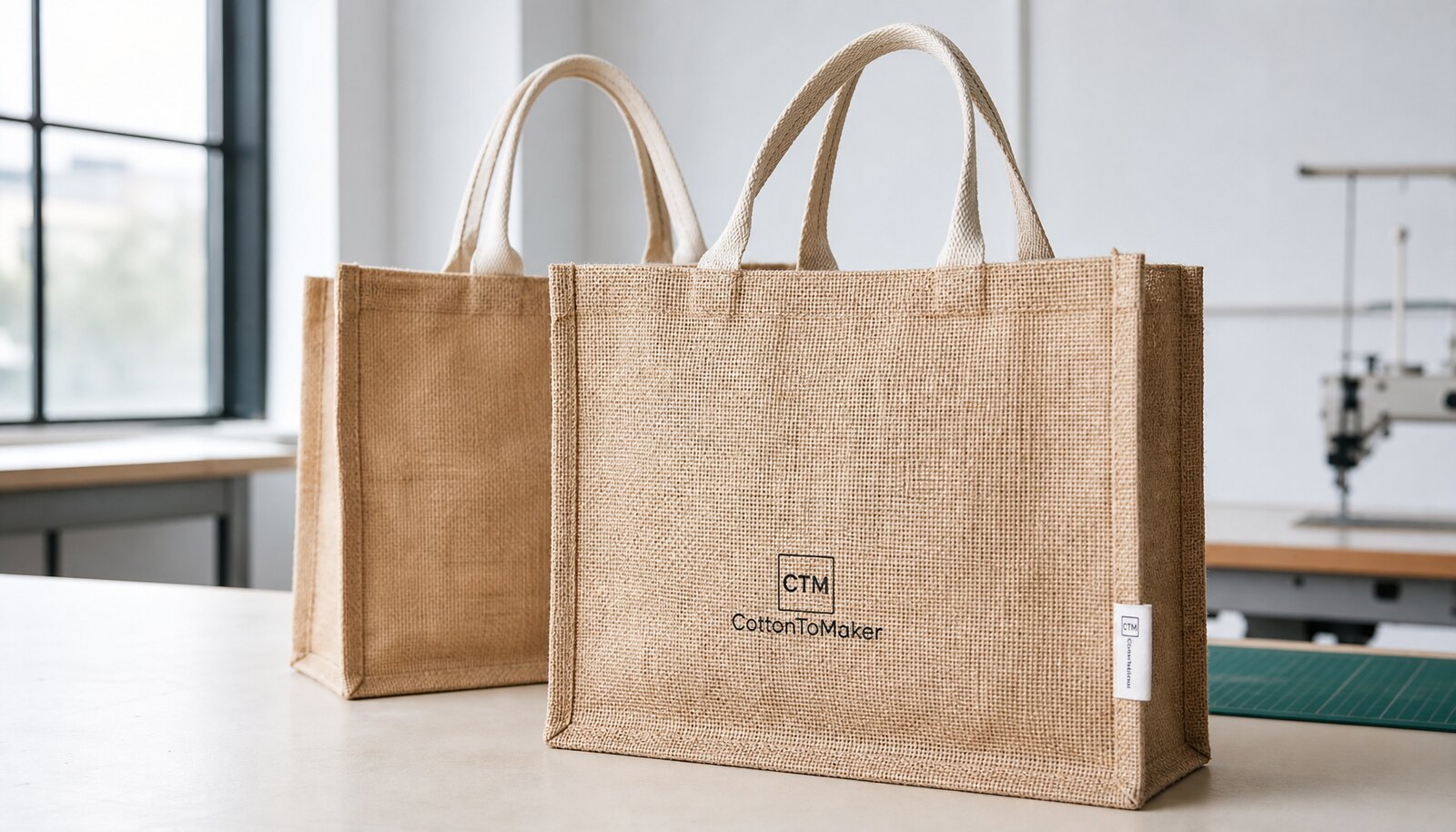
Why Jute Works for a Launch, and Where It Breaks
Jute shopping bags are a strong choice for a brand launch when the bag itself is part of the first impression. The fiber has visual weight, the bag usually stands better than a thin promo tote, and the natural texture photographs well in retail and event settings. That matters when the buyer wants the bag to signal quality before the customer even opens it. The limitation is that jute only looks premium when the construction is right. If the body is too soft, the bag twists. If it is too heavy, the freight and unit price climb for no real gain.
A launch bag should be designed around the actual contents, not the marketing story. A press kit, welcome set, or retail purchase carry bag each puts different stress on the seams and handles. Jute also behaves differently from cotton or nonwoven. The weave is coarse, the surface can absorb ink, and moisture control matters during packing and shipping. Buyers should define what variation is acceptable in the fiber itself and what counts as a defect before they ask for a quote.
- Best fit: launch kits, premium retail carry bags, and branded gift sets that need structure.
- Less suitable: wet grocery use, very fine-detail artwork, or programs that need an ultra-soft fold.
- If the bag will be photographed, focus on body shape, handle finish, and logo clarity rather than only on low cost.
Lock the Bag Structure Before You Price It
Before comparing suppliers, lock the geometry. The same logo can look thin on a shallow bag and crowded on a tall one. Common launch sizes are around 30 x 35 x 15 cm for compact kits and 35 x 40 x 15 cm for retail shopping use, but the right size depends on what will sit inside the bag. Ask for finished dimensions rather than cut dimensions, and specify exactly how handle drop is measured so every quote uses the same baseline.
For most launch orders, 350 to 400 gsm jute is the practical middle ground. Around 300 to 330 gsm works for a light giveaway or short-use carry bag, while 450 to 500 gsm is better when the bag needs a stiffer retail feel or repeated use. Lining or lamination can improve body shape, but it adds material, labor, and thickness. A base insert can keep the bag upright, but it also changes fold behavior and carton count. Decide early whether the brand story favors raw texture or a more finished retail look.
- Ask the supplier to quote both 350 gsm and 400 gsm so you can see the cost break.
- Use a base board only when the contents need a flat bottom or upright shelf presentation.
- Do not approve size from artwork alone; review a physical sample with the target contents inside.
Choose the Branding Method That Will Survive the Weave
Jute is not a good substrate for overly complex decoration. The weave is coarse, the surface absorbs ink, and small copy can fill in. For most launch programs, one- or two-color screen print on a flat panel is the safest choice. It gives predictable cost, the logo reads from a distance, and the factory can reproduce it with standard equipment. If the logo has thin strokes or tiny text, simplify it or move that detail onto a sewn patch before bulk production starts.
Heat transfer and heavy full-coverage effects usually age poorly on jute because they can look forced on the rough fiber surface. A woven label or sewn side tag can add a more refined retail finish, but it should support the bag, not replace a clear front logo. For any print method, request a strike-off or pre-production sample on the same fabric lot. The buyer needs to see registration, edge sharpness, and ink soak in daylight, not just on a PDF.
- Keep line weights generous so the logo stays readable after print soak and folding.
- Specify exact logo placement with dimensions, not only a visual mockup.
- Approve color on a physical swatch or strike-off, especially if the launch uses a brand-critical shade.
Compare Supplier Routes Before You Compare Unit Price
Quote comparison starts with the supplier route, because the same bag spec can mean very different control points. A direct factory is usually the best fit when you need custom size, control over GSM, and the ability to adjust handle reinforcement or packing. A trading company is useful when the launch includes multiple items or when one contact point matters more than factory directness, but the buyer should know whether the factory is named and whether there is an extra margin layer. A stockist with in-house printing can move faster, but the bag body may be fixed and the weave quality can be less consistent.
For a fixed launch date, some buyers combine a stock blank bag with local decoration. That only works if the blank body is already proven and the freight math still holds. The right route is the one that reduces rework, not the one with the lowest line item. A cheap unit price can disappear once setup, rejected samples, extra packing, and a second freight bill are added. That is why the comparison table below keeps the supplier route visible instead of hiding it behind a single price.
- Ask every supplier to quote the same route and the same commercial term.
- Do not compare a custom factory quote against a finished stock bag without normalizing the spec.
- Request photos of a similar bag build so you can see seam style, print coverage, and handle finish.
MOQ, Cost Drivers, and What a Real Quote Should Show
MOQ is not only a factory rule; it is the point where setup cost becomes reasonable. Jute bags need fabric cutting, handle sewing, print screens, inspection, folding, and carton packing. If those fixed costs are spread across too few pieces, the unit price rises fast. For a custom launch, a few hundred pieces only makes sense when the construction is simple and the design is locked to one color. Once you add multiple print colors, lining, or special handles, a low MOQ becomes expensive very quickly.
A useful quote should separate the cost drivers so procurement can see where the money goes. Ask for the bag body, decoration, handle reinforcement, inner lining or board, packing method, and sample charge as separate lines. If the supplier gives only one all-in unit price, it is hard to compare options or remove a feature later. For a launch run, the smarter comparison is often not between two factories, but between two structures: a lighter body with simple print versus a heavier body with a cleaner finish and lower defect risk.
- Size changes affect fabric consumption and carton density, so they should be priced explicitly.
- Every extra print color adds setup time and inspection risk.
- Individual polybags may be required for retail display, moisture control, or destination-market rules.
Sample Approval: What Must Be Signed Off Before Bulk
Do not approve jute from artwork alone. The pre-production sample should use the same fabric weight, handle tape, print method, and packing method intended for bulk. This is the only way to see how the logo sits on the weave and whether the handles pull the top edge out of shape. For launch bags, the sample should also be tested with real contents, because a nice empty bag can fail once it is loaded with boxes, bottles, or inserts.
The sample review should cover measurement, print placement, stitch quality, odor, and carton fit. A buyer can accept natural jute variation in the fiber, but not a crooked handle, smeared print, or strong chemical smell. If the supplier sends photos first, treat those as a screening step only. The approval point is the physical sample that matches the production process. Once that sample is signed off, lock the art file, the dimensions, and the packing spec so the bulk order does not drift.
- Measure finished size and handle drop against the drawing, not against the factory estimate.
- Rub the printed area with a clean cloth to see whether ink transfers.
- Load the bag with the actual launch contents and lift it several times to see whether the handle edge deforms.
- Compare the sample to the approved swatch and carton plan before releasing bulk.
QC Thresholds That Protect a Launch
Good QC on jute bags means separating natural variation from real defects. Jute fibers are irregular by nature, so small color shifts, slubs, and minor weave differences are not always rejectable. The defects that matter are the ones a buyer will see in the store or that will trigger returns: holes, stains, misshaped panels, crooked stitching, loose handle anchors, and print bleed. If the buyer wants a more premium finish, that finish should be defined in measurable terms before production starts.
For launch orders, a common inspection plan is AQL 2.5 for critical and major defects with a looser threshold for minor visual marks, but the exact acceptance level should match the retail channel. Add a load test that reflects the actual use case, not a generic lab number. If the bag is meant for bottle sets, test the handle stitch and top edge under repeated lifting. If the bag is for apparel or paper goods, test shape retention and print scuff instead.
- Reject any bag with holes, mold smell, or open seams.
- Reject handle stitches that show skipped bars or loose thread knots.
- Reject print that shifts visibly across panels or cracks on the first fold.
- Check the first carton, a middle carton, and the last carton from the bulk run.
Packing and Shelf Readiness
Packing has a bigger impact on launch quality than many buyers expect. Jute can absorb moisture, hold odor, and pick up carton dust, so the supplier needs a packing plan that protects the bag without making the order look overpacked. Flat-folded packing is usually the default for export, but the fold direction should protect the logo and keep the handle from creasing in a way that looks cheap on shelf. If the market expects a retail-ready item, individual polybags, barcode stickers, or a belly band may be necessary.
For sea freight, moisture control is not optional. Ask whether the factory uses desiccant, carton liners, or inner polybags when shipping into humid lanes. Carton size matters too, because oversized cartons increase cubic freight and are harder to receive cleanly in a warehouse. The best packing spec is the one that keeps the bag flat, dry, and easy to count without forcing the receiving team to repack half the order.
- State carton pack count, inner pack count, and outer marks in the quote.
- Confirm whether retail polybags are required by the destination market.
- Add desiccant when transit time or humidity is high.
- Keep carton dimensions aligned with pallet handling and warehouse limits.
Lead Time, Landed Cost, and Schedule Risk
Launch schedules fail when buyers treat sample approval, bulk production, and freight as one simple date. A realistic plan often includes 7 to 14 days for sampling, 20 to 40 days for bulk after approval, and extra time for freight booking and customs clearance. Larger runs, special handles, or multiple print colors extend the window. The biggest schedule risk is late artwork change after the screens or plates are already made. That forces either a rework charge or a compromise on the logo.
Landed cost should be compared on the same basis across suppliers. Ex-works price is only one line. Add packing, inland freight, export documents, ocean or air freight, duty, local receiving, and any reprint or repack risk. A slightly higher factory price can still be the better buy if the supplier has a cleaner sample process and a lower defect rate. For a launch bag, the cheapest quote is often the one that creates the most hidden labor on arrival.
- Ask for EXW, FOB, and DDP separately if your team compares across sourcing routes.
- Include freight cubic weight in the comparison, not just unit price.
- Reserve schedule buffer for artwork freeze and ship booking.
- If the launch date is fixed, reduce complexity before reducing price.
How to Compare Two Quotes Without Missing Hidden Cost
To compare quotes fairly, line them up on the same spec sheet. Bag size, GSM, print colors, handle build, packing, and delivery term must be identical. If one supplier quotes 350 gsm with flat-fold bulk packing and another quotes 400 gsm with individual polybags, the lower price is not the same product. The right comparison is total cost per sellable unit, not the first number on the page.
For brand launches, the decision should be driven by how much variation the buyer can tolerate at receiving. If the bag must look premium on camera, pay for a more controlled route and a cleaner sample process. If the bag is mostly a giveaway and the event date is fixed, prioritize speed and packing reliability. Either way, make the supplier show the same data in every quote so procurement can compare apples to apples.
- Use one spec sheet for every supplier, with no hidden changes between quotes.
- Compare total landed cost per sellable unit, not just ex-works price.
- Count rework, repacking, and delay risk as part of the sourcing decision.
- If the launch is photo-heavy, pay more attention to finish consistency than to a small unit-price difference.
Specification comparison for buyers
| Spec decision | Recommended option | When it fits | Buyer risk to check |
|---|---|---|---|
| Supplier route | Direct factory | Custom size, custom print, and a launch order that needs control over fabric and packing | Confirm export experience, sample ownership, and who signs off defects |
| Supplier route | Trading company | Multi-SKU launch, bundled sourcing, or when one contact point matters more than factory directness | Check whether the factory is named and whether margin layers hide spec drift |
| Supplier route | Stockist with in-house printing | Rush launch or a small opening order with limited design changes | Verify blank-bag consistency, print adhesion, and whether the stock is truly available |
| Supplier route | Local decorator using imported blanks | Very tight timeline when domestic delivery is more important than the lowest factory price | Check blank bag quality, freight cost, and the risk of reprint if the blanks vary |
| Fabric weight | 350 to 400 gsm jute | Standard launch bags that need a premium look without overspending on weight | Lighter bags can sag; heavier bags increase cost and cubic freight |
| Branding method | 1 to 2 color screen print | Logo-led launch programs with clean artwork and a flat print panel | Fine lines can fill in on coarse weave, so approve on production fabric |
| Construction | Reinforced handle stitching plus a base insert | Bags carrying bottles, boxed sets, or heavier retail contents | Weak handle anchors and no base support lead to returns and complaints |
| Packing route | Flat-fold bulk pack with desiccant | Ocean freight, retail receiving, or humid transit lanes | Loose packing raises moisture risk, odor, and carton damage |
Buyer checklist before sampling
- Finished bag size, gusset, handle drop, and target load are fixed before RFQ.
- Fabric weight, lining or lamination, and any base insert are decided in writing.
- Logo file, print area, print colors, and Pantone target are ready for quote comparison.
- Packing spec is defined: flat-fold, polybag, insert card, barcode sticker, and carton count.
- Launch date, ship term, destination port or warehouse, and required buffer are agreed internally.
- Target MOQ and any acceptable overrun or under-run range are approved by the buyer team.
- Sample approval owner, QC standard, and defect tolerance are assigned before bulk starts.
- Every supplier is being compared on the same spec sheet and the same commercial terms.
Factory quote questions to send
- What exact GSM, weave, and finishing will you use for this bag?
- Is your quote based on finished size or cut size, and what tolerance do you hold?
- What print method will you use, and how many setup charges are separate?
- What is the MOQ by size, color, and logo version?
- What packing format is included, and can you quote retail packing separately?
- What sample will you provide before bulk, and what is the lead time?
- What quality standard and load test do you apply to handle stitches and seams?
- Can you quote EXW, FOB, and DDP on the same spec sheet?
- What moisture protection do you include for sea freight or humid destinations?
- Can you show a photo of a similar jute bag you have already produced?
Quality-control points to confirm
- Verify finished size, gusset, and handle drop against the approved drawing.
- Check fabric weight and batch consistency against the approved swatch.
- Inspect stitching at handle anchors, side seams, and base corners for skipped stitches or loose thread ends.
- Confirm print placement, edge sharpness, and no visible smear, bleed, or blocking.
- Reject bags with holes, stains, mold smell, open seams, or delamination if the bag is lined.
- Perform a load test with the actual launch contents and repeat the lift several times.
- Confirm packing count, carton marks, carton strength, and moisture protection before shipment.
- Inspect the first carton, a middle carton, and the last carton from the bulk run.