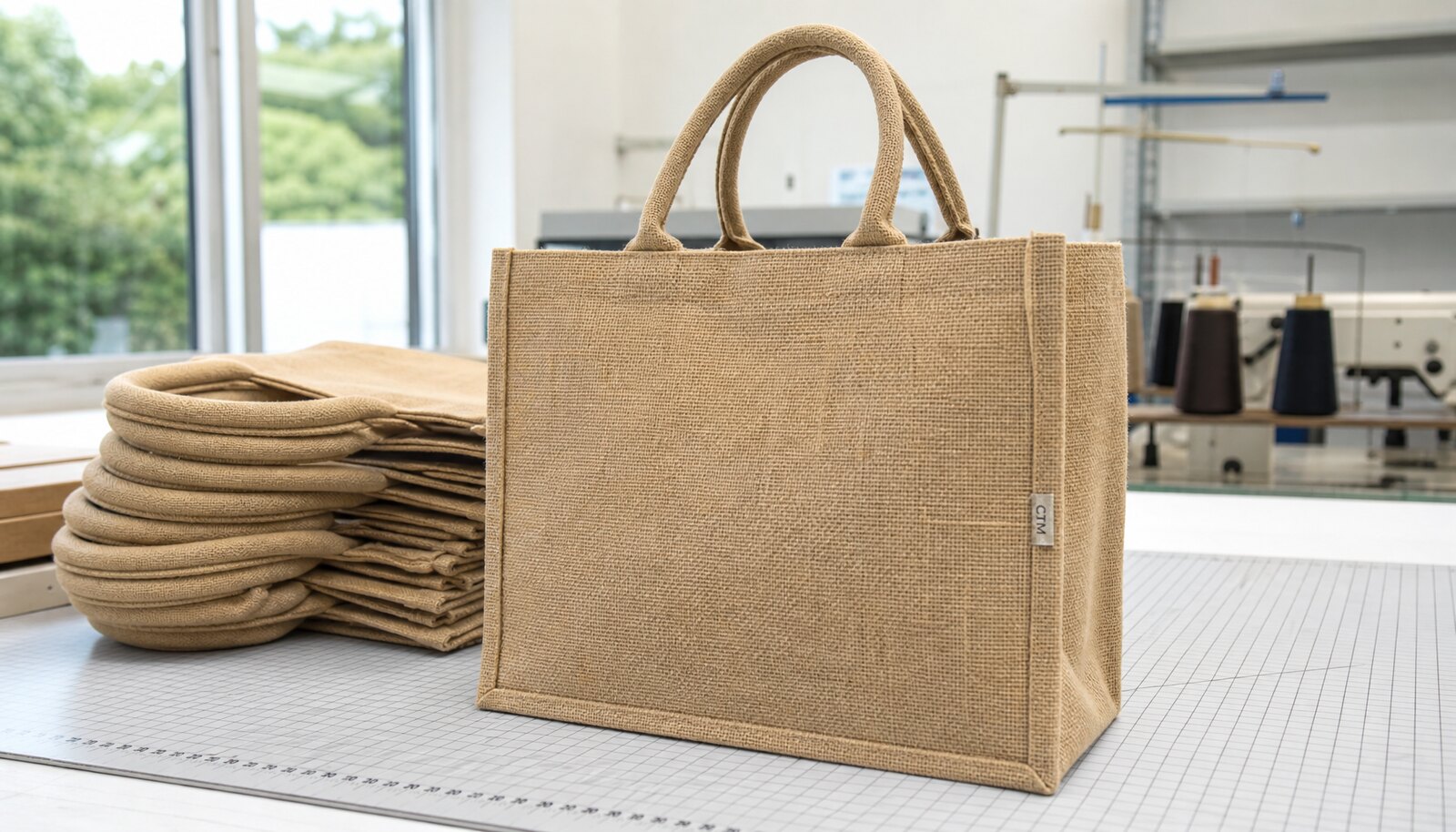
What trade show exhibitors really need from jute promotional bags
Trade show buyers usually do not need jute bags as a fashion accessory. They need a working event item that can carry brochures, sample packs, a notepad, and perhaps a bottle or small product sample while still looking decent after several hours of foot traffic. That means the RFQ should focus on capacity, durability, print visibility, and delivery timing rather than only on a visually appealing render or an aspirational marketing description.
The common sourcing mistake is to ask for a “jute promotional bag” without defining the event use case. A registration bag for handouts, an executive gift bag, and a heavier sample tote all require different construction choices. If the buyer does not state what the attendee will carry, the supplier can quote a bag that is either too light for practical use or too heavy and expensive for a giveaway program.
There is also a brand-risk issue. At a show, the bag becomes a moving billboard. If the handles are uncomfortable, the bag collapses, or the logo is lost in the texture, the bag stops doing marketing work the moment the visitor leaves the booth. A good RFQ reduces that risk by naming the use case, target load, print requirements, and what quality looks like when the bag is empty and when it is filled.
Start with the bag construction, because structure determines cost and usability
Many quote gaps come from buyers starting with the artwork instead of the bag build. Construction decisions are what change material yield, sewing steps, labor time, and carton volume. A flat pouch-style bag may look inexpensive on paper, but once the buyer adds side gussets, a structured base, and a reinforced top edge, the quote moves materially. For trade show work, a gusseted tote is usually the safer baseline because it opens more easily at the booth and better accepts brochures or product samples.
Buyers should define the construction in measurable terms. Bag width, height, gusset depth, handle drop, top hem, and base reinforcement should be written into the RFQ. If the supplier has to infer those details from a reference image, the quote is less reliable and the risk of sample mismatch is higher. A drawing or dimensioned spec sheet is much better than a loose description such as “medium tote.”
Handle construction is often underestimated. Cotton webbing handles are generally more comfortable for repeated carrying, while jute webbing can match the natural look but usually needs stronger stitch control and better reinforcement. If the bag will be carried across a large venue, handle comfort matters more than a small savings in material cost. Buyers should also ask how the handles are attached: bar-tack, cross-stitch, box stitch, or another reinforcement pattern. That detail affects both durability and appearance.
Fabric weight, weave, and finish: why GSM alone is not enough
For most event-oriented bags, a mid-weight jute build is usually the practical starting point, but the exact sweet spot depends on structure and finish. A bag can feel sturdier at a lower GSM if the weave is tight and the construction includes backing or lamination. The same numeric weight can feel soft and creased if the weave is open or the finishing is minimal. That is why a single GSM number should not be treated as a universal quality guarantee.
A buyer-friendly RFQ should ask for the full fabric description: weight range, weave density, finish, backing, and whether the bag is natural, coated, or laminated. Natural non-laminated jute gives the most straightforward eco look and is often the easiest choice for simple branding. Laminated or coated versions can improve structure and help certain printing approaches, but they also change the hand feel and visual character. If the event brand wants a rustic natural look, that should be stated explicitly so the supplier does not propose a glossy finish by default.
Trade show use also creates a practical durability question. A bag that must hold catalog inserts, a notebook, and a water bottle needs enough structure to resist sagging at the base and at the handle points. However, over-specifying fabric weight can add unnecessary freight cost because jute is bulky and carton cube rises with heavier constructions. Procurement should therefore ask the supplier to quote at least two viable build options, then compare them on usable strength, appearance, and landed cost rather than on GSM alone.
Printing on jute: choose the method that fits the artwork and the surface
Screen printing is still the most common option for jute promotional bags because it works well for bold logos, one- or two-color artwork, and controlled cost. On textured natural fiber, it usually offers the best balance of visibility and price when the brand mark is simple. The limitation is that jute texture can break up fine lines or small type, so what looks crisp on a computer screen may not reproduce cleanly on the bag. That is why artwork should be reviewed in context of the actual substrate, not just in a flat PDF.
When the logo has fine detail, gradients, or small legal text, buyers should evaluate whether the artwork needs simplification or a different print method. Transfer printing, digital transfer, or a woven label may solve a detail problem, but these alternatives can change durability, feel, and cost. A good supplier will not promise that every print method works equally well on every jute build. Instead, they should explain what can be achieved on the specific fabric and show a physical or near-production reference.
The RFQ should also define print placement. Many print issues are really placement issues: a logo falls too close to a seam, gets distorted on a gusset, or sits too low relative to the handle. Buyers should provide a print-safe area, note whether the logo goes on one side or both, and state any required centerline or top-edge clearance. This prevents the supplier from quoting a low price on a layout that would be hard to manufacture consistently.
Comparison table: how supplier route, spec choices, and landed cost change the buy
A procurement quote should not be judged by unit price alone. For jute bags, the route to market can change quality control, MOQ, sample timing, and the amount of oversight the buyer needs. The table below is meant to help procurement teams compare the sourcing logic rather than chase the lowest line item.
The key point is that two offers with the same unit price can deliver very different outcomes once setup charges, packaging, freight cube, and inspection risk are included. A direct factory may produce a better repeat program, while a trading company may be useful for urgent consolidation or mixed-category shipments. The right decision depends on how much control the buyer needs and how much risk the event team can absorb.
MOQ and pricing logic: understand what actually drives the minimum
MOQ for jute promotional bags is rarely arbitrary. It is usually tied to raw material purchase, cutting efficiency, print setup, and the supplier’s willingness to hold inventory or break a production batch. A simple one-color bag in one size can often be produced more efficiently than a multi-size or multi-color order, even if the total piece count is the same. If the buyer knows this, the RFQ can be written to reduce avoidable complexity.
The cleanest way to improve MOQ flexibility is to standardize the base construction. Keep the same fabric, handle style, and body shape across events, then vary only the print if necessary. If different regions need their own logo lockups or event dates, ask whether the base bag can remain unchanged while the print is swapped. That approach is often easier for the factory and reduces the chance that each version is treated as a completely separate order.
Procurement should also ask how pricing changes as quantity rises. A useful quote should show at least a few volume tiers, ideally with the breakpoints visible. This lets the buyer see whether the supplier is passing through a true production efficiency or simply protecting margin at the requested volume. It is also worth asking whether the MOQ is based on total pieces, per color, per artwork version, or per delivery destination, because those answers are not always the same.
What a useful factory quote must include beyond the unit price
A strong RFQ forces the supplier to quote the actual cost drivers. For jute bags, that means fabric spec, handle material, print setup, sample charges, packing format, carton dimensions, and the shipping term. If those elements are missing, the first quote may be attractive but incomplete. Buyers then discover the real cost later through add-ons or rework charges. That is the opposite of procurement control.
Compare quotes on the same basis. Ask every supplier to use the same destination, same Incoterm, same carton assumptions, and same sample requirement. If one supplier quotes ex-works and another quotes delivered to a warehouse, the numbers are not directly comparable. The RFQ should ask the supplier to identify what is included and what is excluded line by line, especially if the order will be sent to a 3PL, fulfillment center, or exhibition logistics partner rather than to the buyer’s own warehouse.
It also helps to ask for the cost of common variations before the quote is finalized. Examples include a second-side print, a different handle color, an extra label, or a change in carton marks. Those are the kinds of changes that marketing teams often request after procurement thinks the spec is settled. If the supplier has already priced the common variants, the buyer can make faster decisions without reopening the full quote process.
Sample approval: inspect the bag the way an attendee will use it
The pre-production sample is the best chance to catch problems before they become bulk waste. For trade show use, that sample should be judged as a working object, not as a display sample. Hold it, fill it, walk with it, and check whether the bag stands reasonably well when set down. A photo is useful for record keeping, but it cannot replace a physical evaluation of handle comfort, seam behavior, and the way the print sits on textured jute.
The sample should also reflect actual production packing. If the supplier intends to ship bags flat-folded, the buyer needs to see that exact fold on the sample. Some jute surfaces crease permanently if over-compressed, so what looks acceptable in a tabletop sample can arrive with heavy fold marks if the carton strategy is different. The safest approval process is to review the exact production sample, the exact print method, and a carton mock-up or packing description before giving sign-off.
A simple approval checklist can prevent expensive misunderstandings. Measure the bag dimensions. Verify the handle drop. Load it with a realistic brochure pack or bottle. Check print alignment against the art file. Examine thread quality at stress points. Confirm that the sample represents the final packing style. If any of those details are off, the sample should be revised before bulk production begins.
Packing, cartonization, and shipping: the hidden drivers of landed cost
Jute bags are bulky compared with many promotional items, which means packing is a real cost factor and not a minor logistics detail. Flat packing reduces carton cube and often lowers freight cost, but only if the bag still arrives without visible crushing or sharp fold lines. If the supplier over-compresses the bags to maximize carton count, the client may save on freight and lose on presentation quality. Procurement should therefore set a packing standard, not just accept the factory’s default method.
The RFQ should specify carton count, inner bundle count, label format, and whether palletization is required. If the bags will go to an exhibition logistics partner or a 3PL, carton marks should identify SKU, size, color, print version, quantity, and destination clearly. This reduces receiving errors and makes it easier for the warehouse team to reconcile the shipment against the purchase order. If barcode or compliance labels are needed, that should be stated before production starts so the supplier does not treat it as a rush change.
Destination terms matter too. A low factory quote can become a high landed-cost order if inland trucking, export documentation, consolidation fees, or destination delivery are not included. Ask the supplier to quote the same commercial term across all bidders and to identify the cost of each logistics layer. That allows procurement to compare not just bag cost, but actual event-ready cost. For trade show programs, the cheapest FOB unit often is not the cheapest bag on the booth floor.
Lead time planning and supplier verification: reduce the chance of show-day failure
Event buying is schedule-sensitive, so lead time needs to be split into realistic stages. Sample lead time is not the same as bulk production lead time, and neither one includes freight booking, customs movement, or warehouse receiving. A procurement team that only asks for one total lead time may not notice where the risk is hiding. The RFQ should therefore request separate dates for sample readiness, sample approval to bulk start, bulk completion, and shipment readiness.
Supplier verification should be part of the sourcing process, not an afterthought. Ask who actually makes the bags, who buys the fabric, who prints, and who performs final inspection. If the quote comes from a trading company, request clarity on the factory name, the production site, and whether the supplier can show photos or video of a similar current order. If the quote comes from a factory, ask for evidence of recent comparable work and a contact point for quality follow-up. The goal is not to distrust the seller; it is to confirm that the quoted spec is truly producible and repeatable.
A useful due-diligence step is to request documentation instead of broad promises. Ask for a recent inspection checklist, packing photos, or a shipment reference from a similar bag type. Review the sample against the approved spec and check whether the supplier’s claim about capacity, print quality, and packing discipline matches the evidence. For time-critical trade show orders, that level of verification is often more valuable than a long sales presentation. It tells procurement whether the supplier can actually deliver a repeatable event item on schedule.
Specification comparison for buyers
| Spec decision | Recommended option | When it fits | Buyer risk to check |
|---|---|---|---|
| Fabric weight / construction | 250–300 GSM jute, with the exact value tied to whether the bag is flat, gusseted, laminated, or reinforced | Trade show giveaways that must carry brochures, a notebook, a water bottle, or sample packs without looking flimsy | A GSM number by itself is not enough; dense weave, backing, coating, and finishing can make two bags at the same weight feel very different. Ask for construction photos and a measured sample, not just a description |
| Bag structure | Gusseted tote with stitched base, side gussets, and reinforced top edge | Exhibitors that want the bag to stand open on a booth table, pack easily, and hold rigid collateral | Flat construction can reduce cost, but it also reduces volume and makes loading harder. Check whether the bag will collapse when empty or when brochures are inserted |
| Handle type and reinforcement | Cotton webbing handles or jute webbing handles with bar-tack or cross-stitch reinforcement | When comfort matters because visitors will carry the bag across a show floor or through a conference venue | Thin folded jute handles can feel rough and may stretch or distort if stitch density is weak. Confirm handle drop, stitch count, and reinforcement location |
| Print method | 1–2 color screen print for simple logos; transfer print only when artwork detail demands it and the substrate supports it | When the artwork is bold, the brand wants high visibility, and the print area is large enough for the weave texture | Small text, gradients, and hairline details can blur on natural jute. Ask the supplier to show a real production reference on similar fabric, not only a digital proof |
| Supplier route | Direct factory for repeat programs, custom sizes, and tighter production control; trading company for bundled categories or small trial orders | When procurement values either factory-level spec control or easier multi-item consolidation | A trading quote may hide subcontracting, while a direct factory may have stricter MOQ and less flexibility. Verify who owns the process and who performs final inspection |
| MOQ logic | Set MOQ by size, fabric color, and print version; negotiate one artwork across multiple delivery destinations if the base spec is identical | When the event program includes multiple shows, multiple regional teams, or staggered delivery windows | Low MOQ can carry extra screen charges, fabric loss, or less efficient carton packing. Ask for the exact cost elements that change as volume rises |
| Sample stage | Physical pre-production sample with actual fabric, print, handles, and packing method | When marketing, procurement, and event operations all need sign-off before production starts | Photo approval alone can miss handle feel, true color on jute, fold behavior, and carton fit. Require the sample to represent the exact bulk spec |
| Packing method | Flat-packed in export cartons with a labeled bundle count; palletized only when the warehouse or 3PL requires it | When shipment is going to an event warehouse, fulfillment center, or consolidated logistics hub | Over-compression can cause permanent creases; loose packing raises cube and freight cost. Confirm carton size, bag count, and folding method before production |
| Lead time planning | Separate sample lead time from bulk production lead time; build in buffer for artwork approval, inspection, and freight booking | When the trade show date is fixed and there is no room for schedule slip | Artwork changes after sample approval often reset screens or setup and can push the order past the event deadline |
Buyer checklist before sampling
- Confirm bag size, gusset depth, handle drop, and target load before requesting quotes.
- State whether the jute should be laminated, coated, or left natural, and explain why that finish matters for the event use case.
- Provide final artwork in vector format and note the number of print colors, minimum line thickness, and any small text that must remain readable.
- Request the actual fabric weight or GSM range, plus construction details such as weave density, backing, and edge finish.
- Specify whether the quote must include sample cost, screen or plate charges, carton labeling, export cartons, and any secondary packing.
- Set carton count, inner bundle format, and pallet preference if the bags go to a 3PL, distributor, or exhibition logistics partner.
- Ask for a pre-production sample and bulk production lead time separately, then add buffer time for internal review and freight booking.
- State target order quantity by SKU and whether pricing needs to be broken out by size, color, print version, and delivery destination.
- Require photos or video of stitching, print alignment, handle reinforcement, and carton labeling before shipment.
- Ask the supplier to identify all exclusions clearly, including artwork revisions, rush fees, and rework policy if the first sample misses spec.
Factory quote questions to send
- What is the exact fabric specification, including GSM, weave type, finish, and whether the bag is laminated, coated, or natural?
- What are the bag dimensions, gusset depth, handle length, handle drop, and reinforcement method on the quoted style?
- How many print colors are included in the unit price, and what are the setup charges for screens, plates, or transfer tooling?
- What is the MOQ by color, size, and print version, and can one artwork be spread across multiple size variants without resetting MOQ?
- What sample type will you provide: stock sample, pre-production sample, or a fully made-to-order sample built to the final spec?
- What is the production lead time after sample approval, and what factors could extend it, such as raw material sourcing or seasonal bottlenecks?
- How are the bags packed per carton, what carton size is used, and can you print carton marks, SKU codes, or barcodes?
- What inspection standard do you use for stitching, print registration, measurement tolerance, and appearance defects on jute?
- Can you share photos or video of a recent similar jute bag order showing seams, handles, print result, and shipping cartons?
- Who performs final inspection, and can you provide a report or checklist showing the acceptance criteria used before shipment?
Quality-control points to confirm
- Fabric weight matches the approved range and the bag uses the same construction across body panels, gussets, and base pieces.
- Stitching is even, with no skipped stitches, broken thread, loose ends, or missed reinforcement at handle attachment points.
- Handle length and placement match the approved drawing within the agreed tolerance so the bag hangs correctly and carries comfortably.
- Print color is within the agreed shade tolerance and remains readable on the natural jute background without heavy bleeding or smearing.
- Logo placement stays centered within the approved tolerance, and front/back print positions match when a double-sided design is ordered.
- Seams are straight, corners are fully closed, and edge finishing does not expose excessive fraying or loose fiber.
- No oil stains, heavy odor, glue marks, dampness, insects, or visible contamination appear on finished goods or cartons.
- Carton count, bundle count, and SKU labeling match the packing list and purchase order before shipment is released.
- Measurement checks are performed on a defined sampling plan, not only on a few hand-picked bags, so variation can be detected.
- Shipping cartons survive normal handling without crushing the bags or breaking the handles during a simple drop or compression check.