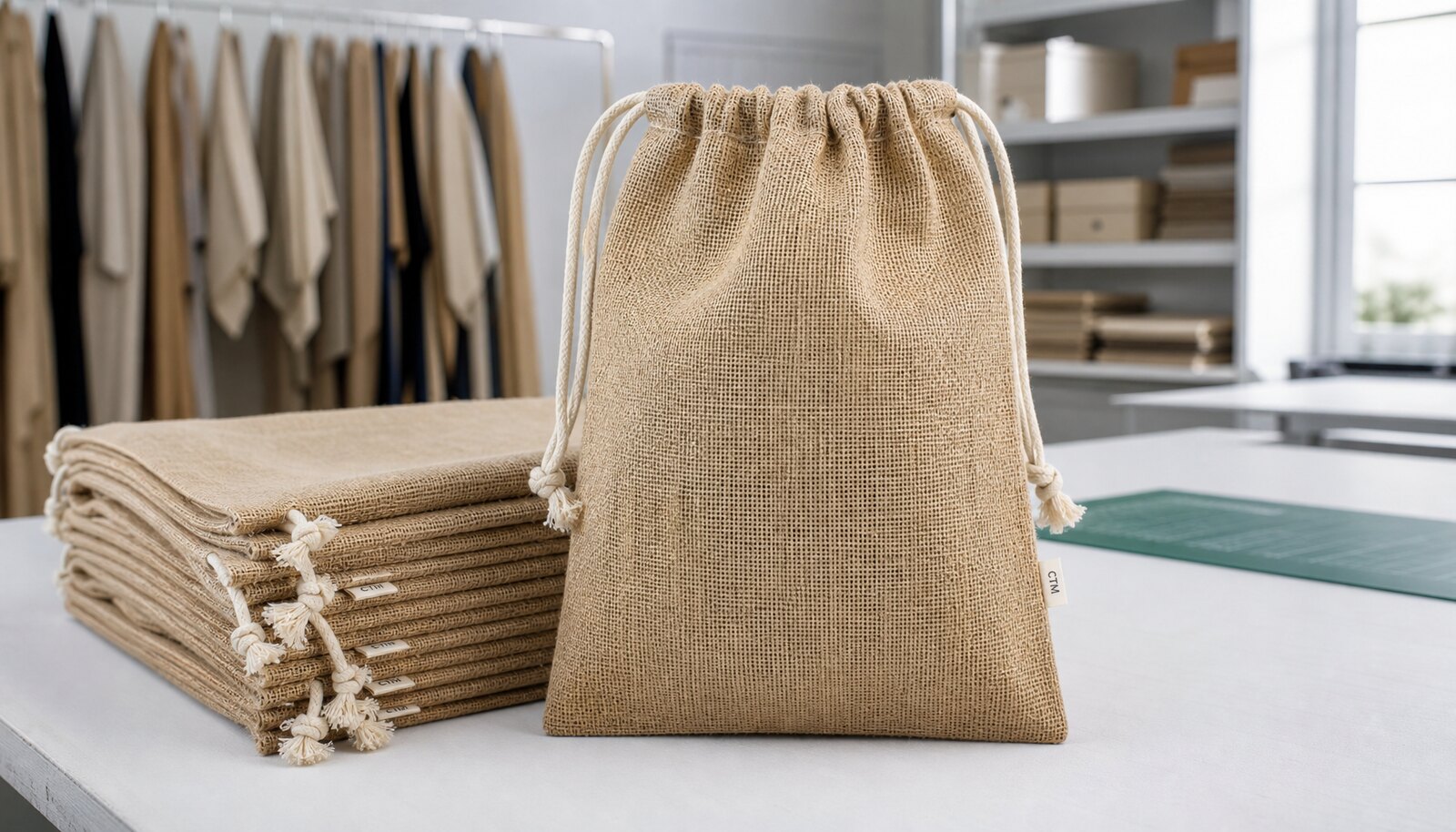
Where jute drawstring bags fit in retail packaging
Jute drawstring bags for retail work best when the bag is part of the product presentation, not just an afterthought. They are used as secondary packaging for candles, tea, skincare sets, accessories, small gifts, and specialty goods where the buyer wants a natural look with more structure than a thin cotton pouch. The material gives the bag enough body to feel premium, while the drawcord makes it easy for the end customer to reopen and reuse it.
For retail buyers, the key advantage is not simply the material story. It is the combination of presentation, protection, and repeat use. A well-made jute pouch can hold a product cleanly on shelf, reduce the need for extra wrapping, and carry branding in a way that feels intentional. That can be useful for both direct-to-consumer programs and wholesale retail packs where the pouch becomes part of the sellable set.
The sourcing mistake is to treat every jute bag as the same simple commodity. Retail programs need repeatable sizing, predictable print behavior, and enough seam strength to survive repeated handling on a shelf or in transit. A pouch that looks fine in a product photo can still be a poor retail buy if the bag collapses, the print turns muddy, or the closure feels weak in hand.
There is also a practical merchandising angle. Retail teams often need the bag to sit upright, display a logo clearly, and pack into master cartons without wasting too much cube. Those needs affect the choice of gusset, fabric stiffness, and closure style. A bag that is pleasant to hold but impossible to stack can increase warehouse cost faster than it improves shelf appeal.
For procurement teams, the real question is not whether jute is attractive. It is whether the construction supports the use case at a cost that leaves margin intact. That means defining the product it must hold, the shelf effect you want, and the acceptable tradeoff between natural texture, print sharpness, and packing efficiency.
- Best fit: small gifts, accessories, candles, tea, wellness items, artisanal products, and reusable retail pouches
- Best value: programs where the bag is reused by the end customer and supports the brand experience
- Poor fit: highly detailed artwork, very small type, or products that need a perfectly smooth print surface
- Poor fit: products that require an airtight seal, high moisture barrier, or long-term crush protection
Start with the product dimensions and load profile
The right way to spec a retail jute bag is to start from the item it must hold. Measure the product itself, then add clearance for insertion, removal, and visual presentation. If the item is rigid, sharp-edged, or unusually tall, the bag needs extra allowance at the opening and enough seam structure to keep the pouch from deforming.
A useful spec sheet should define the finished width, height, and whether the bag has a gusset or a flat profile. Flat pouches are simpler and cheaper, but a gusseted construction can improve volume and shelf shape. The choice should be driven by the product shape, not just by the lowest quote.
Load profile matters as much as dimensions. A small pouch for jewelry has very different demands from a bag that holds a candle tin or a multi-piece gift set. If the bag is expected to be handled frequently, reused by the customer, or packed tightly into outer cartons, the seam allowance, thread strength, and cord channel all need more attention.
If the product is bulky but light, the bag may need more opening width even if the actual weight is low. If the product is heavy but compact, the seams and bottom corners matter more than the overall pouch volume. Those are the cases where procurement teams get the best result by sharing a sample unit with the factory rather than relying on a line drawing alone.
One practical habit: tell the supplier what the bag should feel like in use. For example, “easy insert, snug close, should stand upright on shelf” is not a style preference; it is a manufacturing cue. It tells the supplier whether the bag needs tighter tolerances, a firmer base, or a wider opening finish.
- Use exact finished dimensions in the RFQ, not only a reference photo or style name
- Add clearance for rigid items so the bag does not strain at the seams
- State whether the bag must stand upright, lie flat, or only function as a soft pouch
- Share the actual product or a dummy sample when the fit is critical
Material and construction choices that move cost and performance
Jute looks straightforward, but the bag can change a lot depending on weave density, yarn thickness, finishing, and whether the fabric is backed or left natural. The gsm number is a useful starting point, but it does not tell the full story. Two suppliers can quote the same gsm and still deliver very different hand feel, stiffness, and print behavior.
For many retail pouches, a mid-range jute specification is practical because it keeps the bag presentable without making it overly rigid. Lighter constructions can work for small accessories, but they may collapse or show weave variation more visibly. Heavier constructions can improve shape retention, though they usually increase cost and can make sewing slower. A buyer should ask how the supplier balances appearance, weight, and stitchability rather than assuming heavier is always better.
If the bag must retain a cleaner silhouette, ask whether the supplier uses any backing, inner treatment, or reinforcement. Some programs need a raw natural texture, while others need a more controlled surface for branding. The point is to define the finish in terms that the factory can actually make and inspect.
A few factory-side checks help here. Ask whether the fabric lot is consistent across the order, whether the yarn sheds heavily during cutting, and whether the supplier trims loose fibers before packing. Those details matter more on shelf-facing retail bags than they do on plain storage pouches. If you are buying a premium-looking retail set, the factory should be able to show you where they remove weak yarns, how they keep cut edges clean, and what they do when one roll of fabric looks different from the rest.
If the bag will be reused often, the construction around the cord channel deserves special attention. A bag can look strong in the hand and still fail at the mouth after repeated opening and closing if the channel stitching is too close to the edge or the cord tension is too high.
- Do not buy on gsm alone; ask for weave density, yarn type, and finishing details
- Heavier fabric improves shape retention but can raise cost and reduce sewing speed
- If the bag will be reused often, test channel reinforcement and seam durability, not only appearance
- Ask the factory how they control fabric lot consistency and loose-fiber trim
Branding on jute: choose the method that matches the design
Screen printing is usually the most efficient branding option for jute drawstring bags for retail when the logo is bold and the design is simple. It works well for one or two colors, clear shapes, and medium-size artwork. The limitation is detail. Fine lines, tiny text, and gradients often lose clarity because the woven surface interrupts the ink edge.
When the brand story matters more than pure decoration, a sewn label or woven label can be the better choice. It gives the logo a cleaner finish, especially when the bag itself is coarse or intentionally rustic. Embroidery can also work, but it adds labor and may distort the bag surface on smaller formats. For most retail buyers, the strongest tradeoff is a simple print plus one sewn label, rather than trying to force everything into print.
A useful way to decide is to look at three things: how much information the logo must carry, how much abrasion the bag will see in retail handling, and how much tolerance you have for visual variation. If the bag will be handled many times before purchase, a label often ages better than fine ink detail. If the bag is a launch item with a short promotional life, print may be the faster and more economical route.
The important sourcing detail is to approve the branding method on the actual jute base. A logo that looks clean on a digital proof may behave very differently on woven fabric. Ask the supplier for a strike-off or pre-production sample with the final artwork size, color, and placement. That single sample will usually save more time than a round of email revisions.
Also ask for the ink type or label spec when you compare suppliers. Some quotes will include a basic print that works on natural fibers but has limited opacity. Others will include a denser ink system or a more finished label. If you do not separate those options, you can end up comparing a premium finish with a bare-bones one and calling the difference “price” when it is really scope.
- Use screen print for simple marks and price-sensitive programs
- Use woven or sewn labels when the finish must look more premium or more durable
- Avoid small text, hairline rules, and full-coverage graphics unless the factory shows a proven sample
- Ask what ink, thread, or label construction is included in the quote
How quote structure changes the real unit price
The quoted price for a jute bag often hides more variation than buyers expect. A supplier can give two quotes that look close on paper but include very different scopes. One may include only the sewn bag, while another includes print setup, label application, inner packing, and carton marks. If those differences are not lined up before comparison, the cheapest number is not actually the cheapest buy.
The main cost drivers are fabric weight, cut waste, print complexity, branding accessories, and packing method. Custom sizes usually raise waste and can affect MOQ. Multiple print colors add setup and risk. Individual polybags, insert cards, and barcode labels add labor and carton volume. A buyer should ask suppliers to break those costs out in writing rather than burying them in a single headline price.
This matters for margin planning. Retail buyers are not only buying a bag; they are buying a usable line item that still fits freight, warehousing, and shelf economics. A supplier who explains the cost structure clearly is often easier to work with than one who promises a low piece price but leaves important items unspecified.
There are also quote items that procurement teams should ask for explicitly because they are easy to overlook. Sample cost, artwork preparation, screen charges, label tooling, carton printing, and test fees can all affect the first order. On a low-MOQ launch, those charges may be more important than a small change in piece price. If a supplier cannot show which charges are one-time and which repeat on reorder, the quote is not yet ready for approval.
For planning, it helps to separate unit cost from landed cost. Freight for jute can be meaningful because the bags are bulky relative to their value, especially if they ship in retail-ready cartons or with inner wrapping. One supplier may look expensive on ex-factory terms but still come out better once cube, pallet space, and warehouse handling are included.
- Ask for line items on fabric, sewing, print, label, packing, and setup
- Compare like with like: same size, same artwork, same packing scope, same QC scope
- Treat unusually low quotes as a scope check, not a win
- Ask for sample cost and whether it is credited back on bulk orders
- Confirm whether freight, cartons, and export docs are included or excluded
Comparison matrix: what each spec choice does to cost, appearance, and risk
When buyers are comparing jute bag quotes, the fastest way to avoid confusion is to match each spec choice with its practical effect. The table below is not a generic decision tree; it is a way to spot where cost and risk move together, so you can see which tradeoff is worth paying for and which one is not.
For example, a heavier fabric may feel better in hand, but it can slow sewing and increase freight. A more complex label can improve shelf presentation, but it also adds setup time and another failure point. A retail-ready packing format may make receiving easier at your warehouse, but it usually increases labor and carton volume. Those are the details that should shape the supplier conversation.
A more concrete way to compare supplier tradeoffs
The right sourcing route depends on how stable the specification is and how much coordination your team wants to own. Direct factory sourcing usually gives the most visibility into fabric, sewing, and packing, especially on repeat orders. Trading houses or consolidators can be useful when the order includes multiple packaging items or when you need one contact point for several factories. Local converters can help when sample speed matters more than raw unit price.
The decision is not about which route is universally best. It is about which route gives you the control you need for the specific retail program. If you are launching a new style, you want more sampling support and clearer traceability. If the style is already approved and demand is steady, the lowest landed cost matters more.
A practical comparison should also include service behavior. Ask how quickly the supplier answers revision requests, whether they can confirm carton dimensions before mass production, and whether they can keep the sample and bulk order on the same revision number. In jute sourcing, inconsistency often starts as a communication problem before it becomes a sewing defect.
When a supplier route looks cheaper, ask what work your team will absorb. A trading house may be easier to manage but could add another layer between you and the factory. A direct factory may price better but require tighter RFQ discipline. A small workshop may be flexible on samples but struggle to repeat the exact same label placement across a larger order. Those are the tradeoffs that matter in practice.
For procurement teams, the best outcome is not the lowest quote in isolation. It is the route that gives you predictable bulk quality, clear accountability, and the least surprise during shipment and receiving.
- Write decisions in measurable language, not only descriptive wording.
- Ask for sample photos plus one physical approval sample for important orders.
- Keep quotation, sample approval, and inspection notes tied to the same spec version.
- Compare supplier communication speed as part of vendor selection, not only price.
Write the RFQ so suppliers can quote the same scope
A useful RFQ for jute drawstring bags should remove guesswork. The supplier should not need to infer whether you want bulk packing, retail-ready packing, or label application from a product photo. The better the RFQ, the fewer revision rounds you will need, and the easier it will be to compare several suppliers on the same basis.
Include the finished dimensions, expected product fit, fabric weight target, closure style, artwork file, print colors, label requirements, packing format, and delivery location. Also ask the supplier to state what is excluded. Setup fees, carton printing, sample charges, lab tests, and inland freight are common places where a quote can look complete but still be missing material costs.
If the order is for retail distribution, add the downstream requirements. Tell the factory whether the bags are going directly to a 3PL, to store backstock, or into consumer-facing packaging. That affects carton strength, pack count, barcode placement, and whether the carton needs inside protection from dust or moisture. It also affects how the factory should bundle the bags, because a tight bundle for export may not be ideal for a warehouse that re-picks by SKU.
A procurement team should also ask for the supplier’s assumptions in writing. For example: are they assuming standard natural jute color, a standard cord color, one print position, and no special odor control? If yes, that needs to be visible in the quote. Hidden assumptions are one of the most common reasons retail bag orders slip later.
For order control, use one specification revision and label it clearly. If the size, artwork, or packing changes after quoting, the supplier should re-issue the quote or confirm the delta. That avoids confusion when the PO, sample, and carton marks do not match.
- Use one specification revision per order and label it clearly
- State the product dimensions that must fit inside the bag
- Ask suppliers to disclose excluded costs and optional charges separately
- Tell the supplier where the goods will go after receipt so packing can match the channel
Supplier verification: confirm origin, traceability, and subcontracting
When sourcing jute bags, it is worth verifying more than the final sample. Ask who sources the jute fabric, who cuts and sews the bag, who applies print or labels, and who performs final packing. If multiple parties are involved, you want to know where responsibility changes hands. That makes it easier to resolve quality issues and to understand what the supplier can actually control.
Useful verification questions are practical, not theatrical. Ask whether the supplier can show a bill of materials for a prior similar order, how they trace production batches, and whether the same factory makes the sample and the bulk order. If they use subcontractors for print or packing, ask how they control revision changes and how they prevent mix-ups between artwork versions.
You should also ask what the factory does when materials vary. Jute is a natural fiber, so some variation is normal. The issue is whether the supplier has a process for lot matching and whether they will hold a finished bag sample against the accepted standard when the next order is reordered. If they cannot explain that process clearly, repeatability may be weak even if the first shipment is acceptable.
If your retail program has compliance requirements, ask for the documents that match the actual product and market rather than generic certificates. The buyer should check what is relevant for the destination market, then request only what supports that requirement. That keeps the order focused and avoids paperwork that looks official but does not help the sourcing decision.
A final verification point: ask who owns the corrective action if an issue shows up after the first production run. A supplier that can describe a root-cause process, rework rules, and replacement responsibility is usually easier to manage than one that only promises “good quality” without explaining how problems are corrected.
- Ask who owns fabric sourcing, sewing, printing, and final packing
- Request batch traceability details for the materials used in the sample and bulk order
- Confirm whether any steps are subcontracted and how revisions are controlled
- Ask how the factory handles material variation and reorders against the approved sample
QC that catches real failures before shipment
Quality control on jute bags should be built around the failures that actually matter in retail: size drift, seam weakness, cord failure, print misalignment, odor, contamination, and packing errors. A good inspection plan starts with the signed sample and turns it into measurable checks. The more precise the checks are, the less room there is for argument after shipment.
Use the approved sample to define the tolerances. On a small pouch, a few millimeters of deviation can change the fit enough to affect presentation. On a larger retail bag, the visual problem may be less about a tiny measurement difference and more about uneven seams, crooked labels, or a bag that will not close smoothly. Because of that, the inspection should mix measurement, function, and visual review.
A practical workflow is simple: approve the sample, inspect the first bulk output, then do a pre-shipment check on random cartons before release. If the bag has a critical print or a retail label, inspect those points more tightly than the less visible seams. If the bag will carry meaningful weight, add a load or hang check at the intended use level rather than relying only on appearance.
For higher-value programs, it is worth setting the AQL and defect list before production starts. Many buyers use AQL 2.5 for major defects and 4.0 for minor defects, but the exact target should depend on the channel and the customer impact. The supplier should know what counts as major versus minor. For example, a broken drawcord channel, missing label, or off-position logo is not the same as a tiny fiber variation.
Carton sampling should be specific as well. Ask the inspector to pull from different cartons, not just the top layer of a pallet. Include at least one lower-stack carton if the goods are palletized, because compression damage and moisture issues often show up there first. If there is a carton count or barcode issue, confirm both the pack count and the retail readout before release, not after receiving.
A good factory can usually show you how they test. That may include a seam pull test, a basic cord cycling check, measurement against a template, and visual inspection under standard lighting. If the factory cannot explain its internal check method, the buyer should assume the process is less controlled than the sample suggests.
- Check dimensions against the approved sample, not against a vague drawing
- Test the drawcord for smooth movement, secure closure, and obvious fray resistance
- Inspect for seam integrity, print registration, odor, dust, stains, and carton count
- Write rejection criteria before production starts so the supplier knows the pass/fail line
- For AQL-based programs, define major and minor defects in writing before mass production
- Sample cartons from different stack positions, including lower cartons when palletized
Specification comparison for buyers
| Supplier route | Best for | Main upside | Main tradeoff | Buyer check before quoting |
|---|---|---|---|---|
| Direct factory | Repeat orders with stable specs | Lowest path on mature programs and clearer control over sewing, print, and packing | Requires the buyer to manage spec discipline and supplier coordination | Confirm who owns fabric sourcing, cutting, sewing, printing, inspection, and carton packing |
| Trading house / consolidator | Mixed-item retail programs or buyers who need one point of contact | Simplifies communication when several packaging items must ship together | Less visibility into the actual factory and sometimes less control over production changes | Ask which factory makes the sample, which factory makes the bulk, and whether any steps are subcontracted |
| Local sample converter | New design development, urgent sampling, or small test runs | Fast iteration and easier sample adjustments | Unit cost is usually higher and scale options may be limited | Check whether the sample construction can be duplicated in bulk without changing materials or methods |
| Small workshop | Very low volumes or highly customized hand-finished presentation bags | Flexible on small edits and special presentation details | Higher risk of inconsistency, weaker documentation, and limited capacity | Require a physical sample, written tolerances, and a clear packing plan before ordering |
| Material | laminated or unlaminated jute, cotton-jute blend, inner coating, odor control, yarn thickness, and color shade variation | Before price comparison | Different cloth weights, backing, or certification claims make quotes hard to compare | |
| Construction | handle stitching, side gusset, lamination edge control, inner seam cover, and fiber shedding tolerance | Before sampling | Weak stress points create returns and failed inspections | |
| Decoration | screen print, transfer patch, cotton label, or embroidery selected for rough fiber texture and ink holdout | Before artwork approval | The wrong method can crack, bleed, pucker, or fail on the chosen fabric | |
| MOQ | Base MOQ plus change drivers | During quote review | Custom colors, trims, and packing can change minimums |
Buyer checklist before sampling
- Define the retail use case first: product pouch, gift bag, reusable secondary packaging, or shelf display bag. The use case determines size, stiffness, closure detail, and how much finish quality you need.
- Specify finished dimensions, not just a product photo. Add the exact item dimensions and the clearance needed for insertion and removal.
- State fabric weight in gsm and ask the supplier to confirm weave density, yarn thickness, and any backing or finishing treatment. If you want a more structured look, say so explicitly.
- Choose the closure style and cord material. Confirm cord diameter, color, channel construction, and whether the opening is reinforced.
- Lock the branding method before quoting. Screen print, woven label, sewn side label, and embroidery are not interchangeable in cost or appearance.
- Ask for a line-item quote that separates fabric, sewing, print, label, packing, and any setup or tooling charges.
- Request a physical pre-production sample or strike-off on the same jute base before bulk approval. Photo approval alone is weak for textured fabric.
- Define packing rules: bulk pack or retail-ready pack, inner quantity, carton marks, barcode placement, and whether cartons need moisture protection.
- Ask the supplier how they control odor, loose fibers, seam alignment, and print registration before shipment.
- Confirm the inspection method before production starts. If your team uses AQL, say so; if not, define a simple pass/fail standard in writing.
Factory quote questions to send
- What exact jute construction are you quoting, including gsm, weave type, yarn thickness, and any backing or finishing treatment?
- What are the finished dimensions, seam allowance, and closure details included in your price?
- Is the price based on screen print, woven label, sewn side label, or embroidery, and what changes if we switch methods?
- What is the MOQ per size, per artwork, and per color, and do those minimums change for labels or special cord colors?
- What packing format is included in the quote: bulk, individual polybag, retail hangtag, inner pack, or fully retail-ready carton packing?
- What setup charges are included or excluded, such as screen making, label weaving, carton print, artwork preparation, or sampling?
- Can you provide a sample approval process and a clear production timeline from artwork sign-off to shipment?
- Which QC checks do you perform before shipment, and can you share a recent inspection summary or measurement sheet for a similar bag?
- How do you verify raw material origin and batch traceability for the jute fabric and cord?
- Do you source all components in-house, or are print, labels, or packing handled by subcontractors?
Quality-control points to confirm
- Finished dimensions should match the approved sample within an agreed tolerance band. A practical target is +/- 3 mm on small pouches and +/- 5 mm on larger formats, but the supplier should confirm what they can hold consistently.
- Use a go/no-go template or measuring fixture for key dimensions if the order is large or the bag has a precise retail fit. That is more reliable than measuring only a few pieces by hand.
- Seam lines should be straight, even, and free of skipped stitches, open ends, or loose thread tails longer than a short trim allowance.
- The bottom seam and side seams should hold under a simple load test at the intended use weight without popping, distortion, or obvious stretch at the corners. For higher-risk programs, test at 1.5x the intended load for a short hold period.
- The drawcord must move smoothly through the channel, close securely, and not slip out during repeated open-close checks. The supplier should define how many cycles they use in their internal test.
- Cord ends should be sealed or finished cleanly so they do not fray excessively in packing or during retail handling.
- Print should be aligned to the approved position, with no major misregistration, patchy coverage, smearing, or ink bleed across the woven surface.
- Logo legibility should be checked on the actual jute base, not only on artwork proofs, because coarse weave often changes how small text reads.
- Surface condition should be acceptable at packout: no visible oil stains, adhesive marks, heavy dust, or unusual odor.
- Carton counts and inner pack counts should match the packing list, and all barcode labels or retail marks should be readable and correctly positioned.