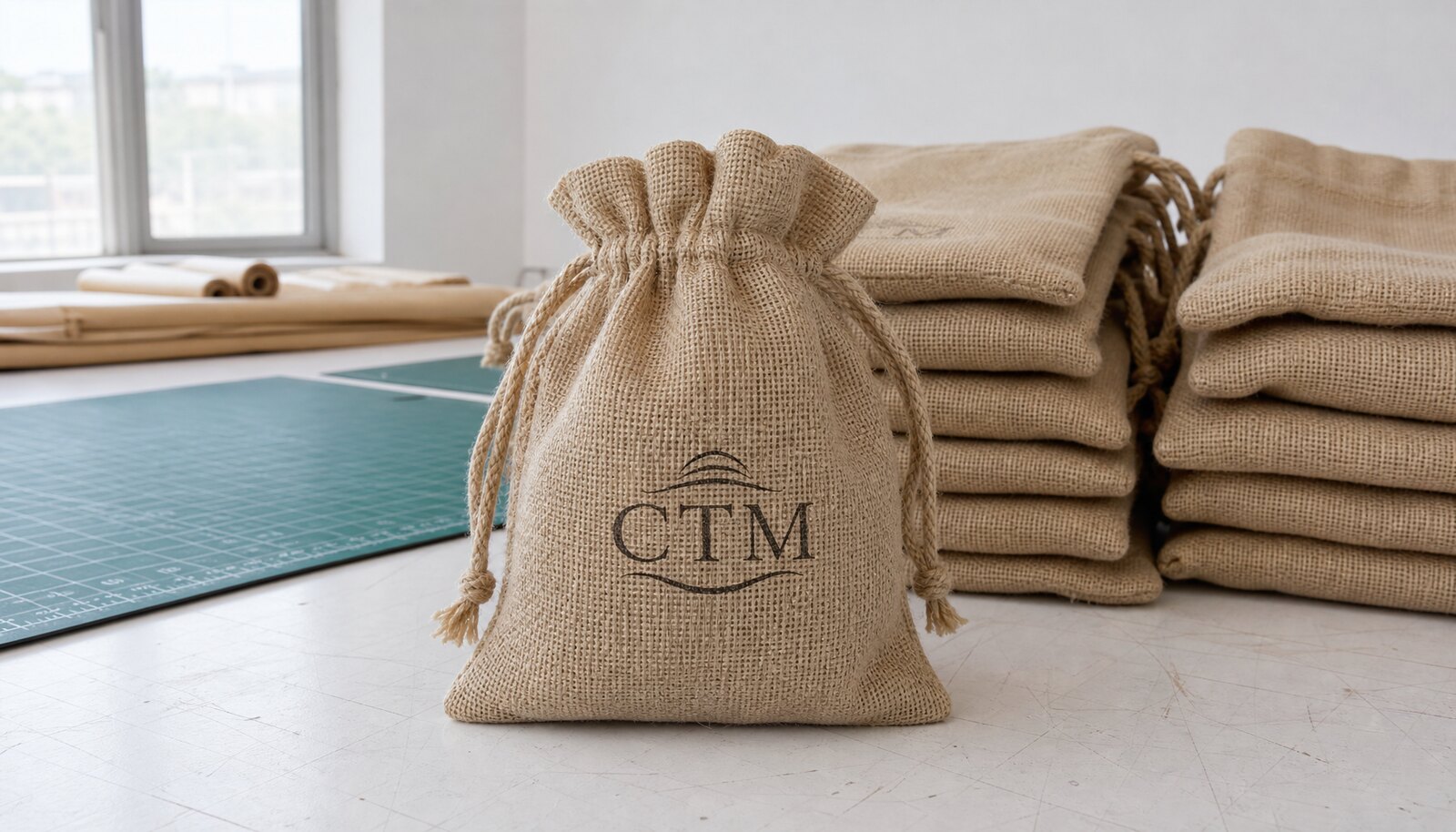
Why hotels buy jute drawstring bags in the first place
Hotels usually choose jute drawstring bags when the bag has to look natural, feel sturdy, and carry a simple branded message without turning into a packaging project. For amenity kits, spa handouts, welcome gifts, and in-room retail sets, jute is useful because it is visually distinctive, holds shape better than very light cotton, and can be produced in a straightforward one-color decoration format. The buying decision is less about whether jute looks good in a photo and more about whether the bag works with the actual contents, the packing line, and the property’s brand standard.
That is why procurement teams often care about repeatability more than novelty. If the same hotel group needs bags across several sites, the real value is getting a bag that looks the same from order to order, packs the same way on site, and behaves the same on arrival. A naturally textured material can still be a controlled product if the size, closure, print placement, and carton rules are all written down instead of left to interpretation.
Jute also fits a practical brand story. It signals a more grounded, less plastic-heavy presentation, which can be useful for wellness programs, spa positioning, or hospitality brands that want a natural look. But if the bag is used only as a decorative wrapper and fails on closure, seam strength, or cleanliness, the brand message is lost. Buyers should treat the bag as part of the guest experience and part of the logistics system, not just as decoration.
- Best use cases: amenity kits, spa gifts, room welcome packs, seasonal gifts, and small retail merchandise.
- Less suitable use cases: oily products without inner protection, sharp-edged items, wet items, or contents that can stain the fiber.
- Buy for the contents first, then choose the bag structure.
- Ask whether the bag is expected to be seen once, handled repeatedly, or reused by the guest after checkout.
Start with the contents, not the catalog photo
The most common sourcing mistake is starting with the look of the bag and only later asking whether the contents fit. For hotel procurement, the correct sequence is the opposite: list the contents, measure the pack-out, and then size the bag around the contents. A bag for two slippers, a soap bar, and a card is a very different specification from a bag that must hold a bottle, a jar, and a folded leaflet. If the contents are heavy, uneven, or hard-edged, the bag should be chosen as a container, not as a soft accessory.
This matters because jute does not stretch in a forgiving way like knitted fabrics or elastic pouches. If the fit is too tight, the cord channel can distort, the seams can bow, and the print can sit awkwardly on the finished bag. If the fit is too loose, the bag looks careless, the guest presentation suffers, and the bag may use more material than necessary. A modest fit allowance of around 10–15% is often more useful than choosing a generic standard size.
For hotel groups, this is also where standardization saves money. Once the packing list is known, one bag size can often cover a family of amenities with only minor variation in fill level. That lets procurement consolidate reorders, simplify warehouse stock, and avoid multiple SKUs that differ by just a few centimeters.
If your use case includes a mix of properties, write the actual contents into the RFQ. The supplier should be able to say whether the same bag works for all sites or whether one property needs a different closure, lining, or carton configuration. That small step often prevents the largest downstream issue: buying a bag that fits one program but not the next.
- List the exact contents and their dimensions before asking for quotes.
- Check whether the contents include bottles, corners, metal parts, or powder products.
- Use the bag as a packing solution, not a shape alone.
- For multi-property groups, decide whether the same bag spec can serve all sites or whether one exception is worth a separate SKU.
Choose the right jute structure before you quote
For most hotel programs, a jute drawstring bag in the 250–350 gsm range is the practical starting point. That weight gives enough body for a neat look and enough durability for normal gift use without pushing the price too high. When the bag must hold heavier contents, such as small bottles, ceramic items, or a denser spa set, move toward 400 gsm or add a lining. The extra material cost is often easier to defend than dealing with split seams or a bag that collapses on the shelf.
The lining decision matters as much as the jute weight. Unlined bags are fine for dry, low-risk contents and keep the unit cost down. A cotton or nonwoven lining helps when the bag contains small parts, coated items, or anything that can snag on the weave. It also improves the internal feel, which matters if the bag is meant to be presented to guests rather than handed out as a disposable wrap. Lining can also reduce visible fiber transfer to light-colored contents, though it does not eliminate the need to check for lint or loose threads.
Cord choice deserves similar attention. A soft cotton cord is often comfortable and visually consistent with the natural look of the bag. A thicker cord can feel more premium and can reduce the chance of cutting into the mouth seam under repeated pulls. But an oversized cord can make the bag hard to cinch cleanly if the channel is not sized correctly. Ask the supplier to show how cord thickness, channel width, and stitching pattern work together rather than assuming any cord will work in any bag.
If the bag is intended for a guest-facing premium set, do not think only in terms of raw material. Shape retention, mouth opening, and how the bag looks when partially filled are equally important. A well-chosen structure can make a simple printed logo appear much more premium than a more expensive print on a weak bag.
- 250–300 gsm: light amenity sets, sample gifts, lower-cost hotel programs.
- 300–350 gsm: the most balanced option for general hotel use.
- 400 gsm or lined: heavier contents, better shape retention, higher-end presentation.
- Ask the supplier to confirm the usable internal size after seams and lining are included.
Print method and branding limits on jute
Jute is not a smooth print surface, so the logo artwork must be designed around the material. For most hotel buyers, a one-color screen print is the most reliable and economical route. It holds up well, keeps setup simple, and gives you a predictable result on a textured surface. If the logo has fine text, gradient shading, or multiple colors, the quote will change quickly and the risk of muddy detail rises. On jute, simpler art usually looks more premium than overly detailed art that prints poorly.
The practical design rule is to think in bold shapes and clear spacing. Thin lines, tiny subtext, and narrow letter spacing can disappear into the weave or become uneven at the edges. If a logo includes a small tag line, the buyer should ask whether the line can be omitted or moved to a sewn label. Sometimes the best way to protect brand quality is to simplify the print and use another branding element where the material can support it.
When the bag is part of a higher-end guest experience, consider a woven label or a small sewn-on patch instead of forcing the whole logo into a complex print. That is often a better use of budget, especially if the brand mark must stay sharp across repeat orders. Heat transfer can work for small runs or complex graphics, but it should be treated as a special option, not the default for large hotel orders. It can also introduce a look that feels too smooth relative to the natural texture of the bag.
Buyer-side artwork control helps here. Ask the supplier to confirm the print size in millimeters, the exact placement from seam to print edge, and the approved color standard. If the brand color matters, use a reference such as a physical swatch, Pantone target, or previously approved sample rather than a vague description like 'dark green' or 'natural beige'.
What actually drives the unit price
Two quotes for the same-looking jute drawstring bag can differ for very practical reasons. Fabric weight, lining, cord quality, stitch count, print color count, and packing method all change labor and material use. MOQ logic also matters. A supplier may offer a low entry quantity only by using standard sizes, a stock cord, or simplified packing. Another supplier may quote a better-looking custom bag, but the price includes the correct materials and a more realistic production setup.
A useful procurement habit is to separate one-time charges from recurring charges. Setup charges, screen or plate fees, sampling fees, and artwork fees should be identified as first-order costs. The recurring unit price should then be compared on repeat order assumptions. This matters because a low first-order quote can still be poor value if it bakes in hidden extras or if the repeat price rises sharply after the initial run.
Lead time also has a cost, even when it is not on the invoice. If the hotel opening date is fixed or the distributor needs stock before a seasonal window, a slower supplier can be more expensive than a slightly higher-priced one. Late bags can trigger emergency freight, partial shipments, or substitute packaging. In that sense, the real unit cost includes the cost of timing, not just the cost of making the bag.
The best comparison is a landed unit cost for the approved spec. That means the same size, the same print method, the same pack count, the same carton assumptions, and the same delivery term. If you compare one quote on ex-factory and another on CIF, or one with lining and one without, the numbers are not really comparable. Procurement value comes from consistent assumptions, not from chasing the lowest headline price.
- Main cost drivers: GSM, lining, cord type, print colors, size, and packing complexity.
- Low MOQ often means higher unit cost, fewer color options, or stock-component substitutions.
- Price should be compared on the same finished size and same decoration method.
- Separate setup charges from repeat-order unit price.
- Treat lead time as a commercial variable, not just a schedule note.
Supplier routes: factory, trading company, or local converter
The best supplier route depends on how much control you need. A direct factory is usually the best option when the bag has a custom size, custom print, or repeat hotel rollout. You get clearer material control and better visibility on production steps. A trading company can help when the order includes mixed products or multiple packaging items in one shipment, but the buyer must be careful that the quote remains technically accurate. A local converter may be useful for urgent repeat orders or a very small initial run, but the price per piece is usually higher.
For hotel procurement, the most common mistake is comparing a direct factory quote with a trading company quote as if they were the same route. They are not. Ask who controls fabric purchase, who prints, who packs, and who accepts responsibility if the bag does not match the approved sample. The supplier route changes both cost and accountability, especially when there is a defect and the buyer needs a clear corrective action path.
Qualification should be practical. Ask for product photos of the actual type of bag they have made, not just a company brochure. Request evidence that they can handle the specific closure, print method, or lining you need. If they are quoting a custom bag with a premium finish, ask how they will control batch consistency. A supplier who cannot explain how they manage material lot matching, in-line inspection, and final carton checks is not yet ready for a sensitive hotel program.
For repeat programs, also ask whether the supplier retains the approved sample reference and production records. When reorders are placed months later, a factory that can refer back to the original sample and lot notes is far less likely to drift in size or print position. That kind of operational discipline is often more valuable than a small price difference at the quotation stage.
- Direct factory: better for custom spec control and repeat orders.
- Trading company: useful for consolidation, but clarify technical ownership and QC responsibility.
- Local converter: suitable for urgent reorders, usually not the lowest cost.
- Ask for real product photos and evidence of similar construction, not generic product lists.
- Match supplier route to order complexity, not just to target price.
What a serious RFQ should include for this product
A strong RFQ for jute drawstring bags for hotels gives the supplier enough detail to quote one correct version, not three vague ones. Start with finished size, target GSM, lining requirement, cord type, print method, artwork size, and carton pack count. Add the exact contents the bag must hold and whether the bag is for guest-facing presentation or internal distribution. That tells the factory whether to prioritize appearance, strength, or packing speed.
A useful RFQ also names what is non-negotiable. For example, if the brand cannot accept loose lint on guest-facing bags, say so. If the hotel wants the drawcord to be easy for older guests to open, say so. If the bag must stand upright in a welcome tray, say so. These are small commercial details, but they change how the factory chooses materials and stitch patterns.
If you want apples-to-apples pricing, state your commercial terms too. Quote by ex-factory, FOB, or CIF only if you know which one the buying team will use for comparison. Ask suppliers to separate one-time charges from recurring charges. That makes it much easier to compare repeat order cost versus first-order cost. It also prevents a hidden problem: a supplier quoting a lower unit cost while quietly shifting some costs into tooling, sampling, or special packing.
For multi-property programs, include a note about version control. One approved artwork file, one approved size sheet, and one retained sample should be named clearly. That reduces the chance that a reorder is based on an old email chain or a remembered version that no longer matches brand needs.
- Required RFQ fields: size, GSM, lining, cord, print method, color count, pack count, carton specs, lead time.
- Add usage context: amenity set, spa gift, welcome pack, retail item, or distributor stock.
- Ask for separate lines on setup charges, sample charges, and unit price.
- Request a photo or video of the actual material roll before mass cutting when possible.
- Name the approved artwork file and sample reference date so reorders stay controlled.
Sample approval: the stage that prevents the expensive mistakes
For jute products, a digital proof is not enough. The pre-production sample should use the final fabric, final cord, final print method, and final size. That is the only practical way to see how the artwork sits on the weave and whether the bag closes cleanly after stuffing. If the sample looks good only when empty but behaves badly when loaded, the bulk order will repeat that problem.
A useful sample approval is more than a visual sign-off. The buyer should load the actual contents, pull the cord several times, inspect the mouth opening, and look at print placement from normal guest viewing distance. If the order will be repeated across properties, keep the approved sample sealed and referenced by date, size, and artwork version. That avoids arguments later about which version was approved.
This stage is also where simple failure cases surface. A bag may be the correct width but too shallow once the seam allowance is added. A print may be centered on the cut piece but appear too high once the top channel is folded. A cord may feel fine when new but bind after the first pull because the channel stitching is too tight. These are not dramatic failures; they are exactly the kind that appear in production if no one checks the sample with real use in mind.
If the supplier is reluctant to sample with final materials, treat that as a warning sign. A serious order should not be approved from a placeholder fabric if the real fabric, real cord, or real lining is still undecided. That kind of shortcut often creates a mismatch between the approved look and the delivered product.
- Approve final size, final GSM, final cord, final print, and final packing together.
- Test the bag with the real contents, not empty.
- Keep one signed reference sample for repeat production.
- Do not approve bulk from a PDF alone when the weave or print finish matters.
- Check the bag from a guest-handling distance, not only at close inspection.
Packing details that affect hotel handling and landed cost
Packing is often treated as a minor detail, but it changes damage risk, warehouse handling, and carton cost. Bulk packing is the lowest-cost route for distributor stock and hotel back-of-house supply. If the bags are guest-facing retail items or need a polished first impression, a simple insert card or clean individual polybag may be justified. The key is to avoid overpacking by habit. Every extra layer increases labor and volume, and with jute bags, volume is already valuable because the material does not fold flat as easily as film or paper.
Carton design matters more than many buyers expect. A carton that is too weak can crush corners and create a poor presentation even if the bags inside are fine. A carton that is too large wastes freight space and can let the bags shift, which leads to wrinkling and edge distortion. Ask the supplier for carton dimensions, gross weight, and pack count before confirming. If the goods are being distributed to multiple hotel sites, consistent carton labeling can save time in receiving and sorting.
For buyer teams managing landed cost, it helps to ask whether the bags are compressed during packing or stacked loosely. Compression can reduce carton volume but may leave stronger crease marks. Loose stacking protects shape better but increases freight volume. There is no single correct answer; the right decision depends on whether the bags are sold retail, placed in rooms immediately, or stored in a warehouse before use.
If the order is imported, also ask about palletization and carton stacking limits. Jute bags are not delicate, but badly stacked cartons can still deform the product or make receiving inefficient. The packing spec should support how the hotel or distributor will actually handle the goods after arrival.
- Use bulk packing for cost-sensitive hotel supply programs.
- Use individual polybag protection only when appearance or cleanliness matters.
- Confirm carton count, carton size, outer marks, and stack strength.
- Avoid oversized cartons that invite crushing or mixed packing errors.
- Ask whether the bags are compressed, semi-compressed, or loose packed.
QC thresholds to write into the order file
Good jute bags fail for predictable reasons: weak seams, poor drawcord stitching, uneven print, and excess fiber shedding. These are not mysterious defects; they are preventable when the acceptance criteria are written clearly. Set a size tolerance, a print position tolerance, and a simple seam-strength expectation before bulk starts. If the bag is for hotel guests, also define what counts as unacceptable lint, loose thread count, or visible contamination.
A buyer-friendly QC plan should go beyond 'check the bags on arrival.' Ask the supplier what inspection standard they use, and if possible specify a buyer AQL approach for critical, major, and minor defects. Many procurement teams use a normal inspection plan with tighter attention on appearance and functional failures for guest-facing bags. The exact AQL number can vary by program, but the key is to define the defect categories in advance so the factory knows what will be rejected and what can be corrected.
The most useful QC checks are practical, not abstract. The cord should move smoothly without tearing the channel. The print should stay readable and not look washed out against the natural jute background. The bag should hold the actual contents without pulling the bottom seam crooked. If any one of these fails, the product may still be 'within factory standard' but not suitable for guest presentation.
If you need stricter control, add a few very specific checks. For example, require consistent stitch spacing along the mouth channel, no visible skipped stitches on the load-bearing seams, and no loose threads longer than a simple written limit. On a drawstring bag, the mouth opening and drawcord action are part of the product function, not cosmetic extras, so they should be inspected as carefully as print quality.
- Check size, print alignment, and seam consistency on first pieces and random cartons.
- Rub-test print and inspect for transfer or premature cracking.
- Look for loose fibers, frayed cord ends, and contamination before packing.
- Use the approved sample as the visual reference, not a generic tolerance sheet alone.
- Define defect categories in advance: critical, major, and minor.
- Consider a buyer AQL approach for appearance and function, especially on large orders.
Specification comparison for buyers
| Spec decision | Recommended option | When it fits | Buyer risk to check |
|---|---|---|---|
| Jute weight | 250–350 gsm for general amenity use; 400 gsm if the bag carries heavier contents or needs a firmer feel | Hotels using the bag for slippers, soaps, sachets, gift sets, or in-room retail kits | Too-light jute can look weak, distort after printing, or show uneven weave; too-heavy jute raises cost, slows stitching, and can increase carton weight |
| Lining choice | Unlined for low-cost dry items; cotton or nonwoven lining for products with small parts, sharp edges, or premium presentation | Amenity kits, welcome kits, spa packs, and retail packs that include jars, metal items, or higher-value contents | Unlined bags can shed fibers, snag contents, and look less refined; lining adds cost, lead time, and can reduce internal usable size |
| Closure style | Single drawcord channel with cotton cord for basic use; double drawcord or thicker cord for premium presentation and better hold | Hotel rooms, spa kits, welcome gifts, and retail sets where quick open-close matters | Weak cord stitching is a common failure point; thin cord can cut into the mouth seam after repeated pulls or overstuffed packing |
| Print method | 1-color screen print for logo-led branding; heat transfer only for small runs or complex artwork; woven label or patch for premium presentation | Standard hotel branding, distributor programs, and multi-property rollouts | Jute surface texture limits fine detail; overly small text, gradients, or thin lines often print poorly and trigger rework |
| Bag size | Sized to the actual contents with 10–15% fit allowance, not to a generic catalog dimension | Buyer already knows the pack-out list and wants the bag to feel tailored to the contents | Oversized bags increase material cost and look loose; undersized bags slow packing, distort print placement, and can split at seams |
| MOQ route | Standardized sizes and one-color print for lower MOQ; custom size, lining, and multi-color print for higher MOQ | Test orders, seasonal hotel programs, and new property launches | Low MOQ can hide higher unit cost, limited color options, or stock-component substitutions; custom requests should be priced separately by component |
| Packing method | Bulk packed with polybag protection and carton labels for cost control; individual insert cards only when the bag is guest-facing retail | Warehouse distribution, hotel procurement, and importer consolidation | Overpacking increases labor and carton volume; underpacking creates dust, crease marks, and transit damage |
| Supplier route | Direct factory for custom specs; trading company for mixed-product consolidation; local converter for urgent small repeats | Buyers balancing price, speed, and order complexity | Different routes give different accountability for materials, print tolerance, and lead time; compare like-for-like and name the responsible party |
| Quality tolerance | Define seam strength, drawstring smoothness, print alignment, color shade, and fiber shedding limits before approval | Any program where repeat orders must match approved samples | Without written acceptance criteria, suppliers may ship within their own factory standard, not the buyer’s standard |
Buyer checklist before sampling
- Confirm the exact contents the bag must hold, including dimensions, weight, and whether any item has sharp edges, glass, or liquid leakage risk.
- Lock the target fabric weight, lining requirement, cord type, and print area before requesting quotes.
- Request a physical pre-production sample with the final material, final size, final print, and final packing method.
- Compare supplier quotes on the same basis: bag size, GSM, print colors, cord type, lining, carton quantity, and delivery terms.
- Set acceptable tolerances for size, print position, color shade, seam quality, and dust/fiber shedding in writing.
- Ask the supplier to explain whether material is from stock lots or reserved batch production, and how shade variation will be controlled across the order.
- Verify carton packing details for hotel or distributor handling: carton strength, label format, piece count, inner protection, and compression resistance.
- Ask for production lead time, sample lead time, and any time lost to artwork approval, material sourcing, or lining/cord procurement before confirming the order.
- If the order is for multiple properties, confirm whether one approved sample will cover all sites or whether each site needs its own packaging label, language, or artwork version.
- Set a re-order rule now: what can stay the same, what can change, and which changes require a fresh sample approval.
Factory quote questions to send
- What jute GSM are you quoting, and is that weight before or after any lining, coating, or washing process?
- Is the quoted size finished size or cut size, and what tolerance do you allow on width, height, and gusset if used?
- What print method is included, how many colors are allowed, and what is the charge for artwork setup, plate making, or screen preparation?
- Does the MOQ change if we add lining, a thicker cord, a woven label, a patch, or a larger print area?
- Can you supply a pre-production sample using the final fabric, final cord, final print, and final packing format before bulk approval?
- What carton pack count, carton size, outer mark format, and palletization option are included in the quote?
- What is the production lead time after sample approval, and what factors most often delay it?
- How do you control shade variation, fiber shedding, stitch consistency, and print registration across the order?
- What inspection standard do you normally ship to, and can you support buyer-specified AQL or third-party inspection?
- If a batch fails on arrival, what is your remedy process for replacement, credit, or corrective production?
Quality-control points to confirm
- Measure finished size against the approved spec and allow only the agreed tolerance on width, height, and gusset depth if applicable.
- Check at least a representative sample from start-up, mid-run, and packed cartons so you can catch drift rather than only end-of-line defects.
- Inspect drawcord pull action on multiple samples; the cord should slide smoothly without tearing the channel, cutting into the seam, or fraying at entry points.
- Check seam strength at the bottom and side seams, especially where the bag will carry weighted amenity sets, bottles, jars, or hard-edged items.
- Verify print alignment, color density, and edge clarity on the jute surface; small text should remain readable at normal viewing distance.
- Rub-test the print lightly and inspect for excessive powdering, cracking, or transfer to adjacent bags.
- Check for fiber shedding, loose threads, contamination, and odor before packing.
- Confirm carton count, barcode or shipping mark placement, and bag compression level so the goods arrive creased as expected, not crushed beyond recovery.
- If possible, run a simple pull test on the drawcord and a filled-bag lift test using the actual contents or a weight equivalent.
- Keep one signed reference sample, one retained bulk carton sample, and one sealed approval note tied to the artwork file version.