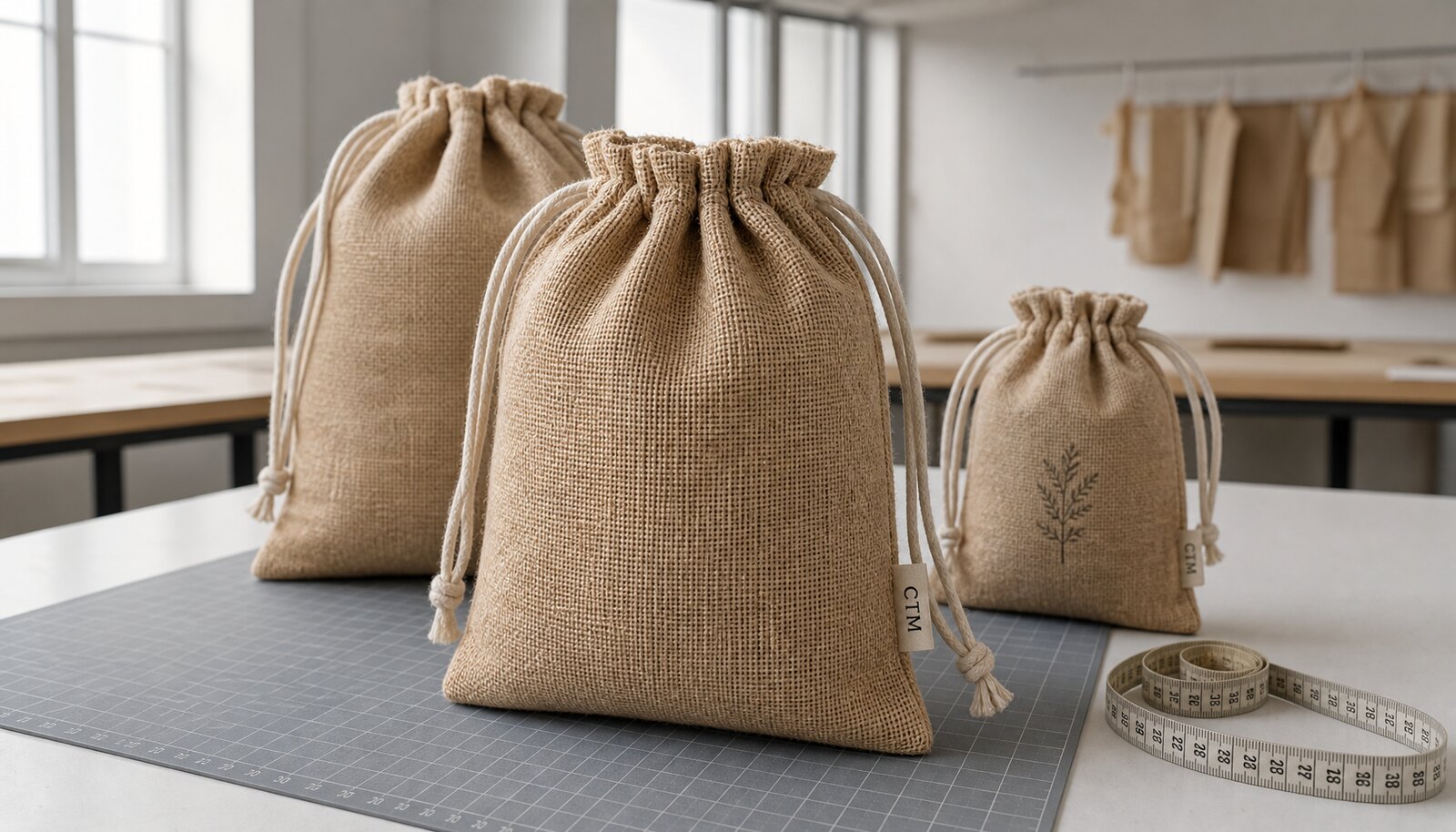
1. What Ecommerce Buyers Actually Need From Jute Drawstring Bags
For ecommerce, a jute drawstring bag is not just a packaging accessory. It has to survive picking, packing, parcel transit, and customer unboxing without looking rough or collapsing in the box. That means the buying question is not simply "Can you make a jute bag?" The real question is whether the bag will stay presentable at the target price, with the right print clarity, closure strength, and carton efficiency for your channel.
Most buyers use these bags for gift sets, subscription inserts, branded merchandise, seasonal packaging, or reusable retail presentation. The specification should match the channel. A bag that looks acceptable on a shelf may still fail ecommerce if it sheds fibers into the carton, arrives wrinkled, or creates extra repacking labor at the 3PL. Start by defining the bag's role in the order flow, not just its visual style.
A procurement spec is stronger when it ties the bag to an actual operating scenario. For example, a gift-bundle bag may need better appearance and less dust, while a fulfillment bag for a soft-goods kit may need slightly stronger seams and a flatter fold. A subscription insert may prioritize low weight and compact packing, while a premium add-on bag may justify heavier fabric and more controlled branding. These are different purchase problems even if they all use the same jute family.
Buyers should also decide how much of the unboxing experience the bag itself needs to carry. If the bag is seen only after the outer mailer is opened, the customer may forgive minor weave variation. If the jute bag is the first branded item the customer touches, then smell, stitching, print clarity, and feel become much more important. That distinction changes the spec, sample, and inspection standard.
In short, the best ecommerce jute bag is the one that fits the downstream workflow. It should be easy to receive, easy to pack, easy to label, and easy to resell or reuse. That sounds simple, but it is exactly where many buyers lose margin: a bag that is technically acceptable but operationally annoying.
- Decide whether the bag is meant for display, protection, gifting, or resale.
- Match the spec to parcel shipping, not only to shelf appearance.
- Treat print durability and carton efficiency as part of the product, not afterthoughts.
- Define the bag's role in the order flow before asking for quotes.
- Separate premium unboxing requirements from plain transit requirements.
2. Size, Fabric, and Closure Choices That Change the Quote
The biggest cost swing comes from size and fabric weight. A small 15 x 20 cm pouch in 250 gsm jute behaves very differently from a 30 x 40 cm gift bag in 350 gsm. For ecommerce, many buyers begin in the 250-300 gsm range when the bag carries light goods, promo items, or sits inside another parcel as a branded insert. Move toward 320-400 gsm when the bag needs a firmer hand, better shape retention, or a more premium retail feel.
Use gsm as a guide, not as a shortcut. On jute, weave density, yarn thickness, finishing, and moisture content can make two fabrics with the same gsm feel quite different. That is why procurement teams should ask for a fabric swatch or lab-style description, not just a weight number. If the supplier cannot explain the fabric construction clearly, the gsm figure alone is not enough to control the result.
Closure design matters almost as much as fabric. A simple drawcord in cotton works for most reusable ecommerce bags, but the cord channel should be reinforced so it does not tear after repeated opening. If the buyer wants a cleaner premium look, a sewn top channel with even cord tension usually performs better than a loose top hem. Eyelets can help with cord movement, but they add labor and need clean reinforcement around the punch area.
Finished size should always be specified separately from cut size. Buyers often compare quotes that are not actually comparable because one factory quoted the open cut dimensions while another quoted the completed usable size. Ask for both if needed, but use only one as the commercial standard in the RFQ. Also define acceptable tolerance in writing. For ecommerce, a bag that is off by too much can cause carton fit problems, especially when the bag is part of a kit or gift set.
One more point on size planning: do not over-fragment the range before demand is proven. A single size with a controlled color palette usually produces better pricing and less inventory risk than three nearly identical variants. If you need multiple SKUs, distinguish them by genuine functional differences rather than cosmetic ones that make the sourcing process more complex without improving sell-through.
- Use 250-300 gsm for light, cost-sensitive ecommerce packs.
- Use 320-400 gsm when the bag must feel premium or resist collapse.
- Specify finished size, not only cut size, and define size tolerance in the RFQ.
- State whether the cord should be cotton, polyester, or blended, and require the cord length in the spec sheet.
- Ask for a fabric swatch or detailed construction description, not just a gsm number.
3. Supplier Routes and What Each One Is Good For
Buyers often compare suppliers only on unit price, but for jute drawstring bags the sourcing route is just as important. A direct factory may give tighter cost control and better control over sewing and packing, which matters when you are ordering repeated ecommerce SKUs. A trading company or sourcing agent can help when you need wider factory access or do not have the time to manage sample chasing, but quote transparency becomes more important. Small workshops can be useful for local tests or short-run launches, though consistency is usually the tradeoff.
The best route depends on order maturity. If you are testing a new SKU, a responsive intermediary may reduce development effort. If the SKU is already proven and you need stable replenishment, a direct factory with the right print and packing setup usually wins on total landed cost and execution. The supplier should be able to show not just sewing capability, but also how they handle artwork approval, fabric batching, line inspection, and carton control.
Procurement buyers should also verify identity. Ask for the legal company name, manufacturing address, and business registration that matches the invoice entity. If a supplier says it is a factory, check whether the address is a real production site or only an office. If it is a trader, ask which factory will actually make your order and whether you can see evidence from that facility: machine floor photos, recent inspection reports, and the production processes relevant to your bag type.
Country-of-origin matters more than many teams expect. It can affect duty, shipping time, communication, and the ease of resolving disputes. Buyers should not treat origin as a proxy for quality, but they should treat it as a risk variable. Some regions may be more competitive on labor cost, while others may offer better proximity or faster sample turnarounds. What matters is whether the supplier can consistently meet the same construction and packing standard over time.
A practical sourcing route decision is this: use the simplest route that still gives you enough control. If your internal team is small, a well-managed trader may be safer than an under-supported direct factory. If you have a strong procurement function and a repeat program, a direct factory often gives better traceability and a cleaner path for improvement on the second and third order.
- Ask who controls cutting, printing, and final packing.
- Compare sample speed, production transparency, and export packing capability.
- Use a small test order first when the supplier has not proven ecommerce packing discipline.
- Verify the supplier's legal identity and the actual manufacturing site.
- Treat country of origin as a practical risk factor, not a marketing label.
4. Comparison Table: Sourcing Options by Buyer Priority
The table below is useful when your team is deciding whether to buy from a direct factory, an agent, or a small converter. For ecommerce, the cheapest quote is not always the best route if it creates repacking labor, print inconsistency, or a higher defect rate at receiving. Use the decision row that matches your channel pressure, then validate the risk item in the sample and production plan.
The main lesson is that sourcing route changes more than price. It changes communication speed, sample fidelity, packing control, and how much hidden work your team will have before the bags are ready to launch. Treat that as part of the comparison, not as a separate operational issue.
As a rule of thumb, the landed-cost gap between a clean direct factory quote and a trader quote may be small or even reversed once you account for the extra back-and-forth, but the reverse can also happen if the factory cannot handle packing or documentation well. The right answer is not a fixed sourcing theory. It is the route that gives the lowest total cost for your actual team and shipment profile.
- Compare total execution cost, not just ex-factory price.
- Use the route that matches your internal bandwidth and QC maturity.
- Require clear ownership for sampling, printing, packing, and shipment docs.
- Judge the route by landed cost per sellable bag, not by unit quote alone.
5. Print and Branding Choices That Hold Up in Ecommerce
Jute has a coarse weave, so fine artwork can disappear fast. That is why many buyers get better results with one or two strong colors, heavier line weights, and simpler logo geometry. Screen print is usually the most practical choice for repeat ecommerce orders because it holds up well on flat panels and can be quoted cleanly by factories. Heat-transfer labels or woven labels can work when the brand wants a more polished presentation, but they should be tested on the actual fabric because surface roughness can affect adhesion and edge lift.
Logo placement should be fixed before quoting, not after sample review. If the print sits too close to a seam or drawstring channel, the usable print area shrinks and the artwork may warp. Buyers should also define acceptable color variation, especially on natural jute where the base tone varies across rolls. If you need a tight brand color, ask for a strike-off on the same batch of fabric that will be used in production, not just on a cleaner display sample.
For ecommerce, the safest approach is usually a design that survives imperfect viewing conditions. This means clear contrast, simple lines, and adequate margin from edges and seams. Fine fonts below a practical minimum size often become the first problem during print approval. If the brand really needs detailed artwork, consider moving some complexity to a label or tag rather than forcing every element into the jute print field.
Print quotes should identify more than just the number of colors. Ask what is included in setup: screens, plates, artwork prep, ink matching, and any changeover cost if the order has multiple SKUs. If the supplier gives a very low base quote but then adds cost for every extra step, the quote is not actually cheaper. Procurement teams should normalize the quote by using the same artwork size, same number of colors, and same print location across suppliers.
Finally, think about durability in the way the bag will be handled. A bag that is folded, boxed, and handled many times may need better abrasion resistance than a bag that is only used once for a gift insert. If the bag will be reused by the end customer, ask the supplier how the print performs after repeated flexing and rubbing on a coarse weave. Even if the factory cannot provide formal test data, the answer will tell you whether they understand the actual use case.
- Favor bold artwork over fine text.
- Confirm print size, position, and color count in writing.
- Use the same fabric batch for strike-off and production whenever possible.
- Reject samples that rely on a different cloth quality than the mass order.
- Ask what print setup and changeover charges are included.
6. MOQ Logic, Pricing Bands, and Hidden Cost Drivers
MOQ should be negotiated around print setup, fabric usage, and carton packing efficiency, not as a random number. For jute drawstring bags, the factory may split MOQ by size, print color, and fabric type. A single logo color on one standard size can usually support a lower MOQ than multiple sizes with different artworks. If you are managing ecommerce launches, it is better to simplify the SKU stack and order deeper on fewer variants than to spread volume too thin and pay for extra setup across many small lots.
Hidden cost often comes from labor rather than raw material. Reinforced seams, eyelets, extra lining, custom woven labels, and special packing can move the quote materially. So can one-off artwork changes and rushed lead times. When comparing quotes, make sure every supplier is pricing the same spec set: fabric gsm, finished size, cord type, print colors, folding method, packing unit, and carton specification. If those are not identical, unit price comparisons are meaningless.
A useful way to think about price bands is by complexity, not by bag name. A basic one-color, one-size pouch may sit in a lower pricing band because the factory can batch efficiently. Add a second color, a different cord, a branded label, or a more demanding carton arrangement, and the price jumps from setup and handling more than from the textile itself. Buyers should ask suppliers to quantify each change, even approximately, so they understand whether a spec change is worth the margin hit.
If the supplier will not break down cost drivers, request an alternative quote with two or three tiered options. For example: base spec, improved spec, and premium spec. This makes the tradeoff visible and helps procurement align with merchandising. A common mistake is asking for one quote and then negotiating blindly on total price. A better process is to ask the supplier to show where the cost changes when gsm changes, when print colors increase, or when the bag is packed individually versus bulk packed.
For ecommerce, the lowest nominal MOQ is not always the best business decision. A slightly higher MOQ can be safer if it improves unit cost, reduces setup changeovers, and gives you enough inventory to avoid stockouts during a campaign. The procurement task is not to minimize MOQ at all costs. It is to choose the MOQ that balances launch risk, carry cost, and re-order flexibility.
- Use one size first unless the channel proves demand for multiple variants.
- Track cost by setup fee, fabric usage, labor, packing, and freight impact.
- Ask suppliers to quote both MOQ and a target replenishment quantity.
- Request tiered pricing so spec changes are easy to evaluate.
- Treat rush orders as a cost driver, not just a delivery preference.
7. Sample Approval: What to Test Before You Release Production
Sample approval is where many orders go wrong, because buyers approve a nice-looking hand sample that is not the actual production build. For jute bags, the approved sample should use the real fabric weight, actual drawcord, and final printing method. If the sample is printed differently from the mass order, you are approving the wrong thing. The sample should also be evaluated after folding, packing, and sitting for a few days, because some bags look fine immediately but crease badly or shed fibers after handling.
The test plan should cover both appearance and use. Open and close the cord repeatedly, inspect the seam ends, check the top hem for symmetry, and confirm the bag sits flat in the inner pack without crushing the print. If the bag is going into ecommerce parcels, fill it with the planned product weight and confirm the bag maintains shape and the cord does not dig into the fabric. Keep one signed sample as the production reference and insist that the factory keeps a matching control sample on the line.
For procurement teams, the sample should be approved against measurable criteria, not just visual preference. Measure width and height flat on a table, record the cord length from seam exit to end, and check the print position relative to the top edge and centerline. If the bag has more than one colorway, compare the samples side by side and look for dye or fabric shade variation that could create a mismatched set inside the same ecommerce order.
It is also worth separating approval into two steps when the order is custom: first the construction sample, then the print strike-off or decorated sample. That prevents a pretty printed sample from hiding weak construction. Ask the supplier to note exactly what changed between prototype and mass production. If they substituted any component, even a minor one, require written approval before release. This is especially important when the supplier is a trader working with multiple factories or when the order is being moved between production lines.
The best sample approval process feels a bit strict, but that is the point. A few extra minutes in the sample stage can save a full carton rejection later. For ecommerce buyers, that is especially valuable because the defect is not just cosmetic. It can lead to extra labor, delayed launch dates, and a poorer unboxing experience that is hard to recover from.
- Approve the sample only after testing the actual material and print process.
- Check pull strength at the cord channel and stress points.
- Keep an approved reference sample at both buyer and factory sides.
- Record measurements and compare them to the RFQ, not to memory.
- Use a two-step approval if construction and print are both custom.
8. Packing, Cartons, and Ecommerce Handling
Packing is where a jute bag becomes either a clean ecommerce item or a warehouse problem. Buyers should define whether each bag is folded individually, packed in an inner polybag, or shipped loose in bulk. For retail-ready or 3PL-driven ecommerce, a simple inner bag and clear size label usually prevents counting errors and keeps dust off the product. If the order will be rebagged later, do not over-spec a retail carton that only adds cost and handling time.
Carton planning matters because jute is bulky. If the bags are packed too loosely, freight cost goes up quickly; if they are compressed too hard, creases and print damage increase. Ask for carton dimensions, gross weight, and packing quantity before confirming the order. For mixed-SKU programs, insist on clear carton marks and SKU separation so the warehouse does not have to open and sort cartons manually. That is especially important for ecommerce replenishment, where one packing mistake can create downstream fulfillment delays.
Good carton specs do more than prevent errors. They also help with receiving, storage, and damage control. Ask suppliers to state master carton labels, inner pack count, carton stackability, and whether the cartons are suitable for palletization. If your warehouse uses FBA or a 3PL, make sure the outer marking format matches their receiving rules. A small mismatch in carton labeling can create delays that cost far more than the carton itself.
For ecommerce use cases, do not forget the handling experience during packing. If the bag arrives heavily creased, the warehouse may need to re-press, re-fold, or re-pack units before they can be sent out. That hidden labor is easy to miss when comparing quotes. Ask the supplier to show how the bag looks after the chosen fold method and inner packing process. If the bag is supposed to be premium, the pack-out should look premium too. If it is supposed to be lean and operationally simple, the carton arrangement should reflect that with minimal waste and clear labeling.
In the quote review, packing is one of the first places to catch hidden cost. A supplier who cannot give you carton dimensions, gross weight, and pack count should not be treated as quote-comparable. Those details are not administrative extras. They are what the fulfillment team will actually receive.
- Define folding method and inner pack quantity before PO release.
- Request carton dimensions and gross weight with the quote.
- Use clear carton labels for size, color, SKU, and quantity.
- Avoid loose mixed packing unless the buyer team has already approved it.
- Check palletization and warehouse compatibility before final approval.
9. Lead Time, Freight Timing, and Schedule Risk
A realistic lead time for jute drawstring bags includes sampling, artwork confirmation, production, packing, and shipping. For a straightforward order, sample development may take about a week, production another few weeks, and export packing plus booking time after that. If the design has multiple print colors, special labels, or a new cord specification, add time for strike-offs and re-approval. Buyers who build the calendar only from factory sewing time usually miss the real critical path.
It is safer to think in ranges than in a single promised number. A simple repeat order may move much faster than a first-time custom design, while a new supplier or a busy season can extend the timeline. Ask each supplier what changes the lead time: artwork revisions, fabric sourcing, print setup, seasonality, or carton availability. If they cannot explain where the schedule risk lives, they probably do not have a stable planning system.
Schedule risk is usually caused by late artwork, unclear packing instructions, or fabric mismatch between sample and bulk order. Jute is a natural material, so some variation is expected, but it should stay within the approved band. Ask for a production checkpoint with in-line photos before the bags are fully finished. That gives you a chance to catch print placement errors, cord issues, or carton mislabeling before the entire lot is packed and ready to move.
Freight timing also matters for ecommerce launches. Sea freight can be cost-effective, but it should be booked with buffer because a bag order may be small in value yet still time-sensitive if it is tied to a product launch or seasonal campaign. Air freight may be justified for a narrow launch window or urgent replenishment, but only if the margin can absorb it. Buyers should not make the shipping decision after production is complete; it needs to be part of the sourcing plan.
The most useful schedule question is not "How fast can you ship?" It is "What has to go right for you to ship on time?" That answer reveals whether the supplier is controlling the process or just quoting optimistic dates.
- Build time for artwork, strike-off, production, QC, and freight separately.
- Treat revised artwork as a schedule change, not a minor revision.
- Request progress photos at cutting, printing, sewing, and packing stages.
- Ask what factors extend lead time before you approve the PO.
- Align shipping mode with the launch window, not only with freight cost.
10. Landed-Cost Comparison and Final RFQ Structure
When you compare quotes, reduce everything to landed cost per sellable bag. That means ex-factory price, print setup, packing material, carton cost, inland handling, freight, duty, and the labor to rework or relabel if the bag arrives wrong. A cheap quote with weak packing or inconsistent print often becomes expensive after receiving. Ecommerce buyers feel this immediately because a bad bag affects not just one unit sale, but the whole launch batch and warehouse workflow.
Your RFQ should force comparable answers. State the finished size, gsm, cord type, logo size, print colors, packing method, carton target, sample requirement, and required lead time. Then ask suppliers to quote the same structure across each size or colorway. The cleanest quote is the one that makes tradeoffs visible. If one supplier is cheaper because they omitted packing or used a lower gsm fabric, that should be obvious before the PO is issued, not discovered at inbound inspection.
A good RFQ also asks for proof, not just promises. Request the supplier's legal company name, factory address, export authority, sample lead time, production lead time, and a list of documents they will provide before shipment. If the supplier is a trader, ask for the factory identity and clarify whether the factory can be audited directly. If you are dealing with a direct manufacturer, ask what departments handle printing, packing, and final QA. That tells you whether the production chain is in one place or spread across several subcontractors.
A supplier comparison should also include compliance and verification checks. At minimum, buyers should ask whether the supplier can provide a business registration, export documentation, commercial invoice template, packing list format, and any relevant test report or material declaration they already hold. For some markets, you may also need REACH-related statements, azo dye information, or general product safety documentation depending on the intended use and destination. The key is not to assume. Ask for the exact paperwork before you issue the PO.
Finally, keep the quote structure readable. One table, one spec sheet, one sample plan, one packing plan. If every supplier answers the same framework, procurement can compare price with fewer hidden assumptions. That is the real purpose of a strong RFQ: not to collect the lowest number, but to make the decision defensible.
- Compare on landed cost per acceptable unit, not ex-factory price alone.
- Use a single RFQ template so every supplier quotes the same spec.
- Require the supplier to list what is included and what is excluded.
- Request legal, export, and factory identity documents before award.
- Ask for the exact compliance paperwork needed for your destination market.
Specification comparison for buyers
| Spec decision | Recommended option | When it fits | Buyer risk to check |
|---|---|---|---|
| Supplier route | Direct factory with in-house cutting, sewing, printing, and packing | Best for repeat ecommerce SKUs, custom print, and tighter cost control | Confirm whether the factory actually controls print and final packing, not just sewing |
| Supplier route | Trading company or sourcing agent with audited factory network | Useful when you need fast quoting across several mills or limited procurement bandwidth | Watch for quote padding, unclear factory identity, and sample-to-production drift |
| Supplier route | Small workshop or local converter | Works for low test volume, local distribution, or urgent regional launches | Risk of uneven stitch quality, weak carton control, and limited scale |
| Fabric weight | 250-300 gsm jute for light ecommerce accessories | Suitable for gift packaging, light retail bundles, and small promotional orders | Too thin bags can deform, fray at the top edge, or show print distortion |
| Fabric weight | 320-400 gsm jute for retail-ready drawstring bags | Best for premium ecommerce presentation and better handfeel | Heavier fabric raises unit cost and may require more careful stitching at seams |
| Closure type | Cotton drawcord with reinforced eyelets or sewn channel | Good for reusable retail bags and higher perceived value | Weak cord channel or rough eyelets can cause tearing after repeated opening |
| Print method | 1-2 color screen print or heat-transfer label on flat panel | Good for logo-driven ecommerce branding and repeatable artwork | Check ink adhesion on coarse jute and allow for fabric texture loss in fine type |
| Packing route | Bulk inner poly + export carton with size labels and carton marks | Best for FBA, 3PL, and palletized ecommerce distribution | Missing size labeling or mixed SKUs create receiving errors and repack costs |
| Commercial route | One size with 2-3 colorways and standardized trim | Fits assortment planning for online bundles and seasonal merchandising | Avoid too many variants before demand is proven; it inflates MOQ and inventory risk |
Buyer checklist before sampling
- Confirm target use case: gift bag, product bag, subscription insert, or retail tote alternative.
- Lock finished size, fabric gsm, cord length, and logo placement before requesting quotes.
- Ask each supplier to state whether pricing includes printing, packing, and export cartons.
- Request pre-production samples made with the actual fabric, cord, and print method.
- Set AQL or acceptance limits for stitch defects, print alignment, odor, and measurements.
- Specify carton quantity, carton size, gross weight target, and master carton labeling.
- Compare lead time separately for sample, production, and sea freight or air freight.
- Request photos or videos of mass production, in-process QC, and final packing before shipment.
Factory quote questions to send
- What jute fabric gsm do you recommend for this size and use case, and what is the cost difference between 250, 300, and 350 gsm?
- Is the quoted price based on finished size or cut size, and what tolerances do you allow on length and width?
- Which print method is included, how many colors are included, and what is the setup charge per color or screen?
- Does the price include drawcord, eyelets, side seam reinforcement, and internal seam finishing?
- What is your MOQ per size and per print version, and can mixed colors share the same fabric and print setup?
- What is the sample cost, what type of sample will you send, and how many days after artwork approval?
- How are the bags packed per inner polybag and per export carton, and can you provide carton dimensions and weights?
- What is your standard production lead time after sample approval, and what changes it?
- What QC documents can you provide before shipment, such as inline photos, final inspection report, or carton count list?
- Can you provide the factory legal name, business license, export registration, and the actual manufacturing address for this product line?
Quality-control points to confirm
- Finished size within agreed tolerance, usually plus or minus 0.5 to 1 cm for small bags and plus or minus 1 to 2 cm for larger formats.
- Jute fabric free from broken yarns, excessive slubs, oily marks, mildew smell, and visible contamination.
- Stitching straight and secure at stress points, especially top hem, side seams, and drawstring channel.
- Drawcord length consistent across samples, with smooth pull action and no premature fraying.
- Print registration aligned within the approved artwork tolerance and no ink bleed through the weave.
- Carton count and SKU labeling matching the packing list, with no mixed size leakage between cartons.
- Sample approval based on actual production fabric and actual print method, not a cleaner substitute sample.
- Drop test and squeeze test for bags intended to ship with soft goods or fragile ecommerce bundles.
- Use AQL 2.5 for major defects and 4.0 for minor defects as a starting point unless your channel requires stricter receiving rules.
- Major defects should include open seams, broken drawstring channel, missing print, wrong size beyond tolerance, strong odor, or contamination that could affect resale.