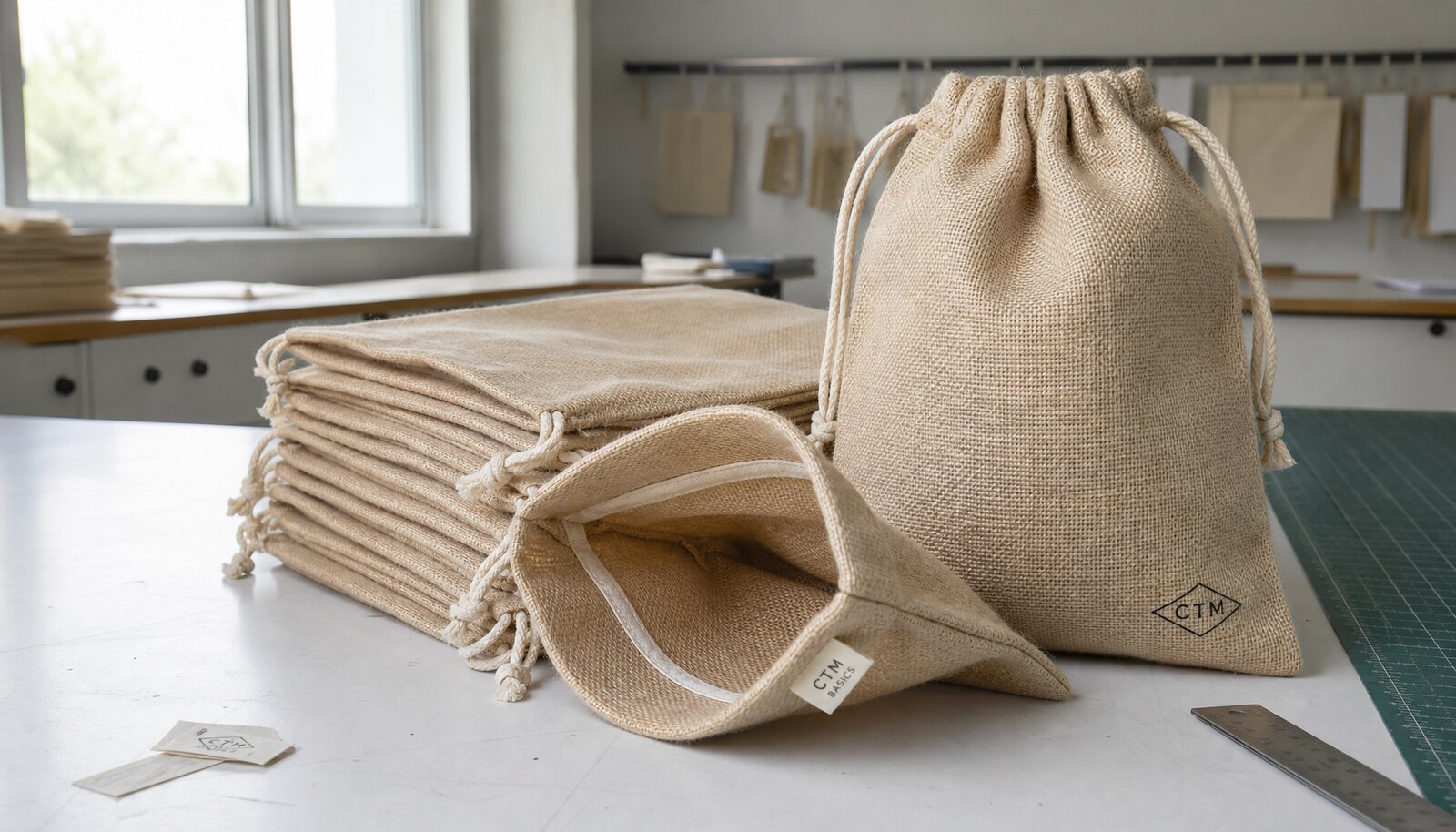
Why jute drawstring bags need a different buying spec than cotton pouches
Jute drawstring bags are bought for a different job than cotton or canvas pouches. The buyer usually wants a natural look, stronger shelf presence, and a lower-cost way to package gifts, accessories, or small retail items. That means the right spec is not just about size and logo placement. It is about how the weave behaves, how much structure the bag keeps when filled, and whether the closure survives repeated handling in the warehouse or at retail.
The most common buying mistake is to treat jute like a generic packaging fabric. Jute has a rougher surface, a more open weave, and more visible variation from roll to roll. If the quote does not lock in GSM, lining choice, cord construction, and print method, you can receive a bag that looks acceptable in a flat sample but performs poorly in production. A good RFQ for jute drawstring bags should be built around the use case first and the decorative details second.
- For display packaging, shape and logo clarity matter more than carrying comfort.
- For resale or repeated handling, seam strength and cord durability become critical.
- For premium gift sets, lining and clean internal finishing usually justify the higher cost.
Choose the base construction before you compare supplier quotes
The first quote comparison should start with fabric weight and construction, because those two items drive most of the real cost difference. For basic jute drawstring bags, 250-300 GSM can work when the bag is light duty and the appearance is intentionally rustic. If the bag must stand up better, resist abrasion, or carry a more premium impression, move into the 300-400 GSM range. Once you go thicker, sewing difficulty and freight weight both rise, so the quote must reflect that change clearly.
Lining is the other major choice. Unlined bags are cheaper and faster to produce, but they can shed fibers and look rough when the inside is visible. A cotton or nonwoven lining gives a cleaner finish and helps the bag hold contents without snagging, but it adds sewing labor and material cost. Buyers often only compare the unit price of lined versus unlined, without noticing that the lined version may reduce returns, improve presentation, and protect the contents during fulfillment.
- Ask for the exact GSM, not just “heavy” or “thick” jute.
- Request a lined and unlined quote using the same dimensions to isolate the cost delta.
- If the bag must be printed, confirm whether the fabric surface is suitable for your artwork before approving the final base spec.
The supplier route changes your risk, not just your unit price
With jute drawstring bags, factory route matters because the bag is simple only on paper. A factory with its own sewing and printing line can control batch consistency better than a trading-only source that outsources each stage. That usually improves communication on GSM, stitch density, and print placement, and it gives you a clearer path when a sample needs revision. If you are planning repeat orders, supplier stability often matters more than a slightly lower initial quote.
For smaller launches, some buyers start with stock-base customization to reduce MOQ pressure. That can work if the bag size is standard and the logo is simple. The tradeoff is limited control over exact shade, lining, and drawcord details. For larger retail programs, a direct factory quote is usually safer because you can lock the construction, carton pack, and inspection standard at the source. When quotes look too similar, the real difference is usually hidden in the supplier route, not the numbers on the first page.
- Direct factory: better for repeat programs, tighter QC, and more predictable lead time.
- Trading route: useful only if the buyer values lower entry barriers over process control.
- Stock-base customization: acceptable for testing demand, but not ideal for strict brand consistency.
A practical comparison of sourcing options for jute drawstring bags
When comparing suppliers, do not limit the discussion to price per piece. Compare the source route, whether the supplier controls sewing and printing, and what it means for risk after approval. The same artwork can behave differently on a rough jute surface depending on the ink, mesh, and curing method. The same bag size can also cost more if the maker has to slow down production for lining, eyelets, or heavier cord.
Use the table below to compare the route that fits your order size and product positioning. The goal is to avoid a quote that is cheap on paper but expensive once you factor in rework, freight waste, or failed packing at the warehouse.
Print method choice: what works on jute and what often fails
The surface of jute is not forgiving. If your artwork has thin strokes, small type, or tight registration, a screen print may still be the best cost option, but the design has to be simplified for the weave. One-color or two-color logos usually give the most dependable result. For detailed branding, a woven label, sewn patch, or heat transfer can preserve the logo better than trying to force fine artwork directly onto the fabric.
The mistake to avoid is approving artwork on a smooth digital proof without testing it on an actual jute swatch. Natural fibers absorb ink unevenly, so solid areas may look slightly mottled and small text may close up. If the branding is important, ask the factory to show line thickness, safe clear space, and the maximum print area they can hold without distortion. This is especially important on curved or folded pouch fronts where the visible area is smaller than the flat pattern.
- Screen print is usually the best value for simple branding at scale.
- Heat transfer can work for more detail, but it may not suit a fully natural look.
- Woven or sewn labels are often better when the brand mark must stay sharp and premium.
MOQ logic: how bag size, print colors, and construction move the minimum order
MOQ for jute drawstring bags is driven by setup time, not only by raw material. If the bag uses a standard size, one-color print, and unlined construction, the factory can usually keep the minimum lower. Add lining, multiple colors, or a custom drawcord, and MOQ rises because each step requires extra cutting, machine time, and sometimes separate material sourcing. This is why a quote should always tie MOQ to the full spec, not to a vague range.
For buyers managing launch risk, it helps to think in three layers: sample run, pilot run, and production run. A sample run proves construction and branding; a pilot run tests carton loading and fulfillment behavior; the full production run locks the approved spec. If the supplier pushes a very low MOQ but will not commit to the exact same materials in the next order, the first batch may not be a reliable basis for scaling.
- Simple unlined bags can often support a lower MOQ than lined or multi-color versions.
- Custom cord color, edge binding, or label inserts usually increase the minimum.
- Ask whether the MOQ is per size, per color, or per SKU mix across several sizes.
Sample approval should test the bag as a package, not as a flat swatch
A jute bag sample is only useful if it is judged in the same way the bulk order will be used. That means loading it with the intended product, pulling the cord repeatedly, checking the closure when full, and inspecting the print after handling. Flat samples can hide problems in the top channel, seam angle, or bag depth. A bag that looks neat on the table can still distort badly once it is filled.
Ask for a pre-production sample made from the actual bulk jute batch whenever possible. The texture, fiber tone, and print absorption can vary between lots. If the supplier sends a sample from a different roll, it may not reveal the final result. Approval should include size, stitch quality, print position, cord action, and carton-fit confirmation so the final production does not surprise your warehouse team.
- Measure finished width, height, and gusset if applicable after sewing, not from cutting dimensions.
- Test closure tension with a filled sample; the top should close without forcing the seam.
- Compare the approved sample against a written spec sheet, not against memory alone.
Packing, carton loading, and moisture control are part of the quote
Jute is a natural fiber, so packing matters more than some buyers expect. If cartons are overloaded or stored in damp conditions, the bags can pick up odor, moisture, or surface damage before they ever reach the customer. Flat packing in polybags and then into strong master cartons is usually the most practical export route, but the exact method should depend on the channel. Retail-ready packaging may need individual labels, while wholesale or distributor orders usually benefit from denser carton packing.
Carton count affects both freight and warehouse handling. A lower count per carton can reduce crushing, but it may raise volumetric cost. A higher count can save freight but increase deformation if the carton is weak or the bag shape is too bulky. The best quote will state carton size, bag count, gross weight, and whether desiccant or moisture protection is included. Those details are not minor; they often explain why two quotes with the same unit price perform very differently in transit.
- Prefer flat pack for export unless the product must arrive pre-shaped.
- Make carton count part of the approval, not an afterthought.
- For humid routes, request moisture protection and dry-storage handling notes.
Lead time and schedule risk: where jute programs usually slip
The biggest schedule risk is not sewing time alone; it is approval delay. Jute drawstring bags often need extra time for artwork testing, fabric color consistency, and finishing feedback because the material is less forgiving than smooth woven fabrics. If the buyer changes print placement after sample approval, the whole batch can move back. A realistic schedule should separate sampling, material booking, production, and packing so each stage has its own decision gate.
For seasonal retail or promotional calendars, build in a buffer for print rework and carton correction. A supplier may quote a short production lead time, but that number usually starts only after artwork and sample approval. If your internal team is slow on sign-off, the calendar shifts immediately. Buyers who manage this well usually send a complete RFQ with size, artwork, pack method, and target ship window before requesting a quote, which shortens the clarification loop.
- Treat sample approval as a schedule milestone, not a side task.
- Allow extra time if the artwork includes multiple colors or very fine details.
- If the order is tied to a launch date, specify the latest acceptable ship week in the RFQ.
Build a quote comparison that reveals real landed cost
A proper quote for jute drawstring bags should give you more than a unit price. It should show the effect of GSM, lining, print color count, packaging, and MOQ on the final cost. Once freight and duties are added, the lowest ex-factory quote is not always the lowest landed cost. For importers and distributors, the better comparison is total cost per usable bag after waste, packing, and transport are included.
If you need to compare suppliers quickly, ask each one to quote the same spec in three price bands. For example, request pricing at 3,000, 5,000, and 10,000 pieces with the same size, one-color print, and the same packing. This exposes whether the factory is giving a realistic scale discount or simply padding the small-order price. It also helps you see if the supplier can support your next reorder without changing the structure or lead time.
- Compare ex-factory price, packing cost, and freight impact together.
- Use one fixed spec across every supplier to avoid false price comparisons.
- A slightly higher unit price can be better if defect risk and freight waste are lower.
Specification comparison for buyers
| Spec decision | Recommended option | When it fits | Buyer risk to check |
|---|---|---|---|
| Jute fabric weight | 250-300 GSM for light retail use; 300-400 GSM for better shape and abrasion resistance | Gift packaging, retail pouches, product bundles, and repeat handling at shelf level | Thin fabric can show weave gaps, distort after printing, or collapse when filled |
| Inner construction | Unlined for low-cost, dry goods; cotton or nonwoven lining for cleaner presentation | Premium gifts, cosmetics, small accessories, or items that should not snag on the jute weave | Unlined bags may shed fibers and look rough if the contents are visible |
| Closure style | Cotton drawcord through folded channel with reinforced eyelets or stitched tunnel | When the bag is reused often or carries higher perceived value | Weak tunnels tear first; cord tension can deform the top opening |
| Print method | 1-color screen print for simple logos; heat transfer or woven label for detail; avoid complex full-color art on coarse jute | Brand marks, retail packaging, and promotional runs with controlled artwork | Fine lines can break on rough weave and colors may sink into natural fibers |
| Handle requirement | No handles for true pouch use; short webbing handles only if the bag will be carried like a gift tote | Retail bundles or point-of-sale packs that need easy shelf pickup | Adding handles changes sewing time, cost, and carton volume |
| MOQ route | Direct factory order for 3,000-10,000 pcs depending on size and print complexity; stock-base customization for smaller tests | Launches, seasonal promotions, and buyers who need consistent reorders | Very low MOQ often means higher unit cost, limited size control, or mixed production lots |
| Packing method | Flat pack in polybags with bulk master cartons; individual branding only when required by retail channel | Wholesale, distributor, and export shipments where carton efficiency matters | Overpacking increases freight cost and can trap moisture if jute is packed too tightly |
| Supplier route | Factory with jute sewing line and in-house printing for most bulk programs | When you need stable lead time and repeat color matching | Trading-only quotes may hide subcontracted sewing, slower response, or weaker QC ownership |
Buyer checklist before sampling
- Confirm finished size, fabric GSM, and whether the bag is lined or unlined before requesting quotes.
- Specify drawcord material, cord length, and whether the top must close fully when filled.
- State print area, number of colors, and whether artwork must sit on one side or both sides.
- Define the target use case: retail packaging, gift bag, product pouch, or reusable carry bag.
- Request pre-production samples with the actual jute batch, not a different base fabric.
- Align carton pack count, carton strength, and moisture protection with the destination route.
Factory quote questions to send
- What is the exact jute GSM you will use, and can you confirm the finished bag weight for this size?
- Is the bag sewn from one piece or multiple panels, and where are the stress points reinforced?
- What print method do you recommend for this artwork, and what line thickness is safe on jute?
- What is your MOQ per size and per print color, and how does price change at 3,000, 5,000, and 10,000 pcs?
- Can you quote both unlined and lined versions, with the same dimensions, for cost comparison?
- What sample lead time and bulk lead time can you commit to after artwork approval?
- How will you pack the bags for export: polybag, carton count, carton size, and moisture control?
- Which inspections do you run before shipment, and what defect rate triggers rework or replacement?
Quality-control points to confirm
- Finished size tolerance should be within ±0.5 cm for small pouches and ±1 cm for larger bags unless the bag design is intentionally casual.
- Jute weave should be even enough that the bag holds shape; visible holes, loose fibers, or broken strands near seams are rejectable.
- Drawcord must pull smoothly without snagging, and the channel must survive repeated opening and closing without seam splitting.
- Print should be legible from normal viewing distance; smearing, heavy ink bleed, or broken small text should fail approval.
- Stitching at corners and cord entry points should be straight and secure, with no skipped stitches or open seams.
- Cartons should arrive dry, clean, and free from odor; any dampness, mold risk, or crushed corners must be flagged before dispatch.