Start with the problem a reorder file actually solves
A jute burlap bag wholesale reorder file is not a paperwork exercise. It is the control document that keeps the second, third, and fourth order aligned with the product your team already approved. Without it, repeat quotes often drift in small ways: a slightly lighter GSM, a cheaper handle stitch, a new carton pack, a print placed a few millimeters lower, or a lead time that starts from a different trigger. Each change can look minor in an email and expensive when cartons arrive.
Jute makes this more important because the material is naturally variable. The coarse weave, fiber slubs, color tone, odor, and stiffness can shift by lot. That does not mean every variation is a defect, but it does mean buyers need a clear reference for what matters. A good file separates acceptable natural variation from avoidable production drift. It gives the supplier a fixed version to quote and gives QA a practical standard to inspect against.
- Use the file for RFQs, sample approval, PO release, and final inspection.
- Keep one current revision instead of multiple email versions and sample photos.
- Define the approved bag as a finished product, not a loose material idea.
- Make variation limits clear before production, not after a shipment is disputed.
Define the finished bag before asking for price
The first page should identify the exact bag type: shopping tote, wine bag, gift pouch, drawstring sack, retail carry bag, plant bag, or promotional event bag. Suppliers quote more accurately when the end use is clear. A bag for a candle set, grocery item, bottle, trade show giveaway, or shelf-ready retail program may all use jute burlap, but the construction and packing logic are different.
Finished dimensions should be the control point. Cut size is useful for the factory, but buyers receive and sell the finished bag. Record length, height, gusset depth, top hem depth, handle drop, closure, lining, insert, and base board. Add a realistic tolerance beside each measurement. For coarse jute, demanding paper-like precision can create unnecessary disputes; leaving tolerance blank creates bigger ones.
- State finished size in inches or millimeters, not both unless both are verified.
- Record gusset depth, top hem, closure style, and whether the bag must stand or fold flat.
- Define handle drop from the top edge to the highest inside point of the handle loop.
- List any lining, lamination, base board, insert, label, hangtag, or drawstring trim.
- Add a simple product use note so the factory understands load, display, and packing needs.
Lock fabric weight, weave, and construction details
Fabric weight is one of the fastest ways a reorder changes without looking obvious in a photo. For many standard retail and promotional jute bags, 240-280 gsm is a practical range. Lighter 200-230 gsm fabric can work for low-load event use, but it gives less shape retention and can show more stress at seams. Heavier 300-350 gsm burlap gives a firmer hand and stronger presentation, but it raises cost, sewing effort, stiffness, and sometimes print difficulty.
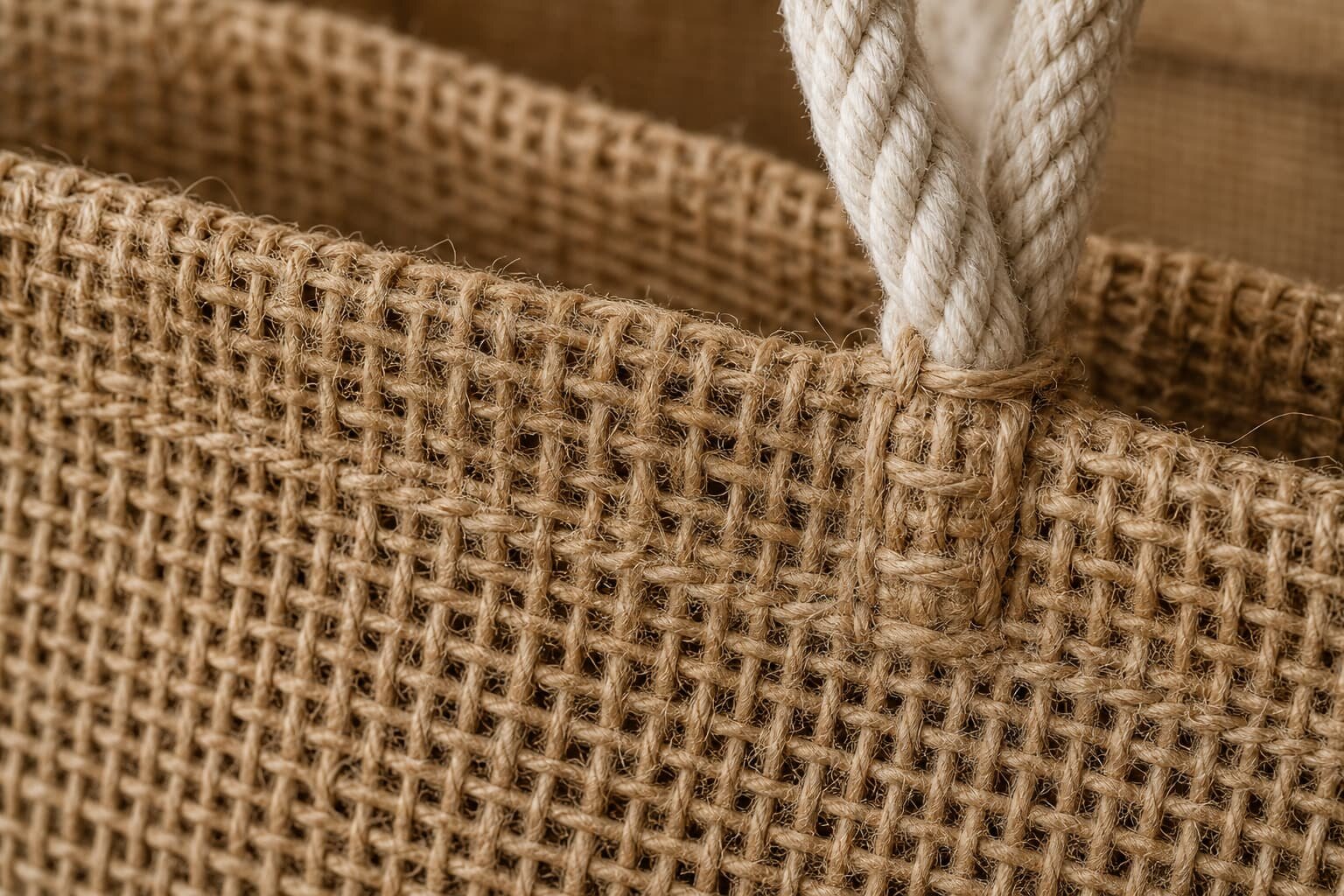
The file should include more than GSM. Record weave appearance, fabric color tone, lamination or backing, and whether the material is washed, softened, dyed, bleached, or natural. Construction details deserve the same treatment: seam type, top hem, seam allowance, reinforcement, thread color, stitch style, and handle attachment. If the first order used bar-tacks or box stitching, do not allow the repeat order to become a single stitch line because the bag silhouette still looks similar.
- Write approved GSM and acceptable tolerance or supplier standard for weighing checks.
- Attach close photos of the approved weave and color tone under neutral light.
- Record seam type, top hem depth, thread color, and reinforcement points.
- Separate body fabric, handle fabric, lining, lamination, and trim specs.
- Note any factory change in fabric source, weave width, or finish before quote approval.
Make artwork repeatable on coarse burlap
Print failures are common on burlap because the surface is uneven and open. Small type, thin lines, tight reverse spaces, and gradients rarely behave like they do on paper or smooth cotton. For repeat orders, one- or two-color screen print is often the most controllable choice for bold artwork. If the logo needs fine detail, buyers should consider simplifying the artwork or switching to a woven label, embroidery, or tag before bulk production.
The reorder file should fix the print method, ink color reference, artwork size, and placement from fixed construction points such as the top hem or side seam. Pantone references are useful, but the visual approval should be based on actual burlap because natural fiber changes color perception. Keep the signed strike-off or approved production sample as the print reference. If the supplier can reuse an existing screen, the file should say so; if a new screen is required, quote the cost and confirm the artwork revision.
- Specify screen print, heat transfer, embroidery, woven label, patch, or hangtag.
- Use actual-size artwork with placement dimensions from hem, side seam, or bag centerline.
- Require a strike-off when artwork, ink, fabric, factory, or print position changes.
- Define acceptable print issues, such as minor fiber interruption versus clogged text.
- Confirm screen reuse, setup cost, and whether old tooling matches the current artwork file.
Compare quotes with the same assumptions
A low unit price is only useful if the quote covers the same bag. One supplier may include custom cartons and barcode labels while another assumes bulk packing. One may quote 280 gsm fabric and reinforced handles while another quotes a lighter body and basic stitching. Your reorder file should become the quote matrix, so every factory answers against the same body spec, print spec, packing spec, MOQ, incoterm, and revision code.
Ask suppliers to break out costs where it helps decision-making: bag body, print, handle upgrade, lining, label, insert card, carton label, setup, sample, and freight basis. Not every factory will itemize every cent, but the request exposes what is included. Normalize incoterms before comparing. EXW, FOB, CIF, and delivered prices are not interchangeable, especially when carton cube changes because the bag is folded, flat packed, or boxed individually.
- Send the same locked file to every supplier and require the revision code on the quote.
- Compare GSM, construction, print, packing, carton quantity, and incoterm before unit price.
- Separate one-time setup charges from repeat unit costs.
- Ask whether the quote assumes existing screens, labels, dies, and artwork files.
- Check carton dimensions because a cheaper bag can create higher freight cost.
Use samples as control tools, not sales props
For a repeat order, the sample should control production. Keep a golden sample or signed sample photo set with a revision code, approval date, and notes from the last order. If the approved production bag had one correction after sampling, write that correction into the current file. Otherwise, a factory may follow an older sample that was never meant to be the final reference.
Preproduction samples are most important when anything changes: fabric lot, GSM, print screen, artwork size, handle material, lining, trim, packing, or factory. The sample review should be practical. Measure the finished bag, check the handle drop, compare print placement, inspect seams, smell the fabric, and confirm folding or packing. If a load or pull check matters, define the method. A vague instruction such as "strong handle" is not enough for inspection.
- Keep a golden sample, approved photos, and revision code together in the file.
- Mark whether each sample is rejected, approved with comments, or approved for bulk.
- Measure finished size, gusset, handle drop, and print position before approval.
- Check odor, stains, fray, broken yarns, needle skips, and loose threads.
- Do not approve bulk production from showroom photos when print or construction changed.
Set MOQ and lead time around real production drivers
MOQ is often driven by fabric sourcing, cutting efficiency, print setup, labels, lining, and packing materials. A blank jute bag may have one minimum, while the printed version has another. Custom labels, drawstrings, laminated fabric, insert cards, or retail-ready packing can push the minimum higher. The reorder file should separate these items so buyers know which requirement is controlling the order.
Lead time should also be staged. A repeat order may still need material booking, printing, drying or curing, sewing, trimming, inspection, packing, and export booking. Write the lead-time trigger clearly. If the clock starts after sample approval, do not let the quote later treat deposit receipt as the start point. For urgent replenishment, ask the factory which step controls the schedule and whether an unchanged reorder can move faster by reusing screens, labels, and approved packing instructions.
- Ask for blank MOQ, printed MOQ, trim MOQ, and packing MOQ separately.
- Confirm whether current fabric, screens, labels, and cartons are available or need reorder.
- State lead time from the exact trigger: PO, deposit, sample approval, or material booking.
- Add target ex-factory date and target ship week, not only the PO date.
- Flag any change that resets sample approval or tooling lead time.
Specify packing for receiving, storage, and freight
Packing is part of the product cost. Burlap bags can crease, absorb odor, deform under pressure, or shift inside cartons if the pack method is not controlled. The file should state whether bags are flat packed, folded, banded, individually polybagged, bundled, or packed with insert cards. If the logo must face one direction for retail unpacking, say so. If the order ships to a distribution center, barcode and carton mark rules must be written before production packs the first carton.
Carton data should include units per carton, carton dimensions, gross weight target, carton mark layout, label placement, and any moisture control. Jute can pick up dampness or warehouse smell, so route and destination matter. Do not add desiccant or extra inner bags by habit; add them when needed and quote them clearly. The goal is a pack method that protects the bag, supports receiving checks, and gives freight teams reliable cube and weight data.
- Define fold method, bundle quantity, inner bag use, and logo-facing direction.
- Record carton quantity, carton size, gross weight, and carton mark content.
- State barcode, SKU label, retail label, and master carton label placement.
- Confirm whether packing is bulk, retail-ready, DC-ready, or e-commerce prep.
- Check that carton fill does not crush handles, bend base boards, or distort print areas.
Write QC criteria that fit natural jute
A useful QC standard accepts that jute is a natural fiber while still rejecting poor workmanship. Slight color variation, slubs, and irregular fiber texture may be normal. Heavy stains, mold, damp odor, broken yarn clusters, open seams, missing reinforcement, severe print misplacement, and carton count errors are not. The file should define the difference so inspectors do not rely on personal judgment alone.
If your company uses AQL, include the inspection level, defect categories, and sample size rules. If you do not use formal AQL, still write measurable checks: finished dimensions, handle drop, print placement, stitch quality, pull check, odor check, packing count, and label match. Inspection should pull from multiple cartons and carton layers. Top-layer-only checks are weak because packing pressure, count errors, and moisture issues may appear deeper in the carton.
- Set tolerances for length, height, gusset, handle drop, and print placement.
- Classify defects such as critical, major, and minor if your inspection process supports it.
- Define acceptable natural fiber variation versus rejectable stain, odor, damage, or fray.
- Require handle reinforcement and pull or load checks when the bag carries weight.
- Verify carton count, carton marks, barcode scan, and packing list before shipment release.
Build a reorder packet that is short but hard to misread
The best jute burlap bag wholesale reorder file is not a long narrative. It is a compact packet with the right attachments. Start with a one-page spec sheet covering finished size, GSM, weave, handles, print, trim, packing, tolerance, and revision code. Add approved sample photos, strike-off images, quote basis, carton sheet, and QC criteria. If the file is too long, people skip it. If it is too vague, they fill in the blanks.
Version control is the final safeguard. Put the same revision code on the spec sheet, sample photo set, quote request, and PO line description. When anything changes, issue a new revision and identify what changed: GSM, artwork, handle, lining, packing, carton count, or incoterm. Remove or archive old files so the supplier is not choosing between versions. A clean reorder packet makes repeat buying faster because it reduces clarification loops and keeps price, product, and inspection aligned.
- Use a one-page current spec sheet as the front of the packet.
- Attach golden sample photos, print strike-off, packing sheet, and carton label rules.
- Include quote assumptions: MOQ, incoterm, setup fees, tooling reuse, and lead-time trigger.
- Keep a revision log showing what changed and what stayed fixed.
- Send the same current packet to sourcing, QA, factory sales, factory production, and inspection teams.
Specification comparison for buyers
| Spec decision | Recommended option | When it fits | Buyer risk to check |
|---|---|---|---|
| Body fabric weight | 240-280 gsm jute burlap | Standard retail carry bags, event totes, and most repeat promotional orders | A lower GSM may look similar in photos but change hand feel, drape, seam stress, and print coverage |
| Heavy-duty body option | 300-350 gsm jute burlap | Premium gift bags, heavier retail goods, or bags that need more structure | Heavier fabric increases cost, stiffness, needle pressure, and may require adjusted print settings |
| Print method | One- or two-color screen print with simplified artwork | Bold logos, repeat brand marks, and coarse weave where sharp detail is limited | Fine lines, small reverse text, and gradients can fill in; require a strike-off on actual burlap |
| Handle build | Self-fabric or cotton webbing handles with bar-tacks or reinforced box stitching | Carry bags expected to hold weight or be reused by customers | Handle drop, stitch pattern, thread, and reinforcement must be specified, not left as factory standard |
| Interior finish | Unlined for basic promo; laminated, lined, or base-supported for structure | Unlined works for giveaways; lining or lamination fits retail display and higher perceived value | Lining changes cost, sewing time, stiffness, recyclability expectations, and lead time; quote it separately |
| Closure style | Open top, drawstring, button loop, or zipper stated as a fixed construction | Open top for totes; drawstring for pouches; zipper or loop closure for gift and specialty bags | Closures affect labor, trim sourcing, inspection points, and MOQ, so they should not be treated as minor add-ons |
| Packing format | Flat pack or controlled fold with barcode label and carton marks on two sides | Distribution centers, export cartons, and retail replenishment programs | Overfilled cartons can crush handles, distort print areas, create count errors, and increase receiving disputes |
| Commercial basis | Quote on the same incoterm, carton quantity, and approved revision | Comparing suppliers or revalidating a repeat order price | EXW, FOB, and delivered quotes cannot be compared until freight scope and packing cube are normalized |
Buyer checklist before sampling
- Record finished size, gusset depth, handle drop, and measurement tolerance in one unit system.
- Lock the approved fabric GSM, weave appearance, color tone, and any lamination or backing.
- Specify handle material, width, drop, attachment point, stitch pattern, and reinforcement method.
- State the print method, number of colors, artwork size, Pantone or reference color, and placement from fixed edges.
- Attach the approved strike-off, golden sample photos, revision code, approval date, and any rejected sample notes.
- Separate blank-body MOQ, printed MOQ, trim MOQ, and special packing MOQ so the quote is not misleading.
- List packing unit, fold method, carton quantity, carton size, gross weight target, barcode rules, and carton marks.
- Define whether screens, labels, dies, inserts, or artwork files can be reused and how long the factory will keep them.
- Write the lead-time trigger clearly: deposit received, PO released, sample approved, materials booked, or another event.
- Add acceptance criteria for dimensions, print registration, stitch quality, handle pull, odor, moisture, carton count, and labeling.
Factory quote questions to send
- Is your price based on the same finished size, GSM, weave, handle construction, print method, packing, and revision code as the approved sample?
- Which items are included in the unit price, and which are separate: screen setup, label, insert card, inner bag, carton label, barcode, desiccant, or export carton?
- What is the MOQ for blank bags, printed bags, custom labels, custom packing, and any lined or laminated version?
- Can the existing screen, embroidery file, woven label, die, or artwork file be reused, and is there a storage or reset charge?
- What tolerances do you guarantee for finished size, gusset, handle drop, print position, and carton quantity?
- What lead time applies after sample approval, and what lead time applies after deposit or material booking?
- Which incoterm, carton quantity, carton size, gross weight, and loading assumption are used in this quote?
- What material or process changed from the last order, if anything, and where is that change shown in the revised file?
- Can you provide a preproduction sample or print strike-off on actual jute before bulk cutting or printing begins?
- What QC checks will you perform before packing, and can the inspection pull units from different cartons and carton layers?
Quality-control points to confirm
- Fabric GSM, weave density, color tone, odor level, and finish match the approved reorder sample within agreed limits.
- Finished length, width, gusset depth, top hem, and handle drop stay within the written tolerance.
- Handle attachment uses the specified reinforcement and passes the agreed pull or loading check.
- Seams are even, corners are secured, bar-tacks or box stitches are present where required, and loose threads are trimmed.
- Print color, opacity, edge sharpness, placement, and registration match the approved strike-off as closely as natural burlap allows.
- Artwork is not tilted, stretched, clogged, cracked, or placed too close to seams, hems, or handle stitching.
- There is no heavy stain, mold, dampness, strong odor, broken yarn cluster, excessive fray, needle damage, or visible contamination.
- Lining, lamination, base board, closure, label, hangtag, or insert card matches the approved construction and placement.
- Carton count, inner pack, barcode, carton marks, gross weight, and packing list match the PO and packing sheet.
- Inspection samples are pulled from the top, middle, and bottom of multiple cartons, not only from the easiest top layer.