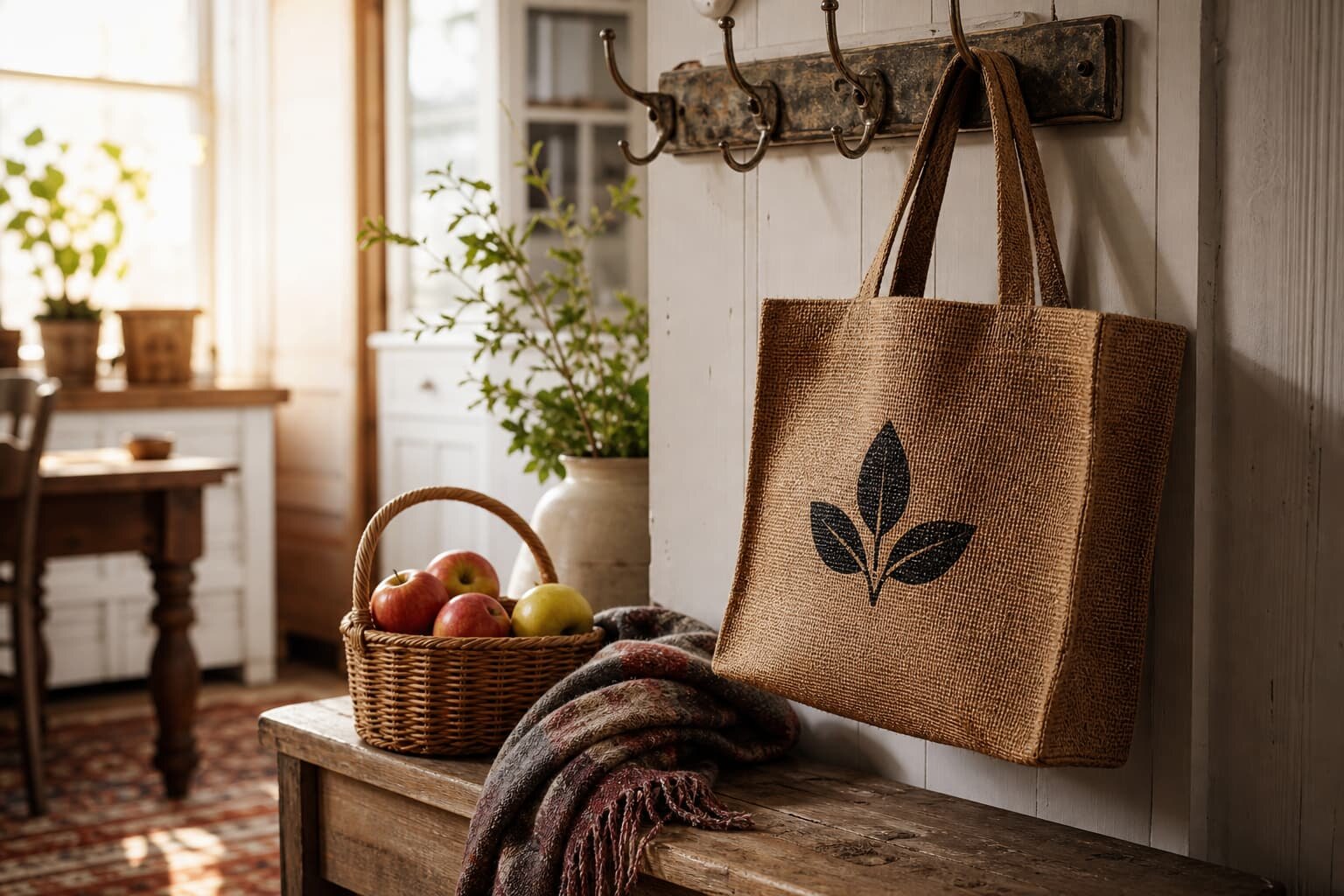
Why weave tension variance matters in jute burlap bags
Weave tension variance is not a cosmetic issue in jute burlap bags. It changes how the panel hangs, how the print sits, how the seam lays, and how the bag behaves once it is loaded. Buyers often focus on GSM because it is easy to quote, but GSM alone does not tell you whether the cloth was woven under stable tension. A loose-looking roll can still meet a weight target and still create crooked panels, wavy edges, and print drift after cutting.
The commercial problem is simple: once the fabric is unstable, every downstream process becomes harder to control. Sewing operators must force alignment, print registration becomes less predictable, and the final bag can look inconsistent even if the supplier says the order passed internal inspection. For a retail program, that inconsistency matters because the bag has to look repeatable on shelf, in cartons, and in photos. For a promotional program, it matters because weak tension control often leads to higher reject rates after packing.
- GSM tells you weight, not stability.
- Loose weave can create panel skew, edge curl, and uneven print laydown.
- A stable 280 GSM cloth can outperform an unstable 320 GSM cloth.
Set the spec so suppliers cannot quote loosely
The first buyer mistake is asking for a generic jute bag quote without defining the cloth structure. If you want to control weave tension variance, the RFQ must include fabric width, target GSM, allowed tolerance, weave type, and the intended end use. A 30 x 35 cm retail tote with a front logo and short handles needs a different cloth behavior than a wide, floppy market bag. If the bag is meant to stand upright or carry heavier contents, the acceptable tolerance must be tighter.
A strong spec also separates the visible bag requirements from the hidden production controls. Ask for finished dimensions, seam allowance, top hem construction, handle width, handle drop, and whether the body is single layer, lined, or laminated. Then add one line that matters for this topic: the supplier must state how they control fabric stability across rolls. That forces the factory to think about the cloth before they price the sewing.
- State finished size and acceptable tolerance in millimeters.
- Specify GSM and whether the cloth is raw, dyed, laminated, or lined.
- Define the intended load and retail presentation so the factory quotes the right structure.
Audit fabric before cutting, not after sewing
If weave tension variance is present in the roll, cutting will only spread the problem into more parts. The most practical audit point is the incoming fabric roll or the converted panel before the bag is sewn. Ask the factory to show width checks at the beginning, middle, and end of each roll. Then inspect whether the pattern of the weave remains visually consistent across the roll. On burlap, you are looking for density shifts, diagonal drift, edge curl, and places where the cloth opens up or tightens unexpectedly.
For buyer control, the question is not whether the fabric looks natural. It is whether the cloth can be cut into matching front and back panels with the same visual balance. If one side of the panel pulls more than the other, the bag may twist after sewing or after a few cycles of use. A tight audit should therefore include measurements at cut stage, not only the final bag stage. That is the best time to stop a bad lot before it becomes a shipment problem.
- Check roll width at multiple points, not just one sample spot.
- Look for skew, open picks, tight bands, and edge curl.
- Record which roll numbers were used for approved samples.
Choose print methods that tolerate burlap movement
Print method has a direct effect on how weave tension variance shows up on the finished bag. On a loose burlap cloth, heavy ink coverage can exaggerate texture differences, while fine text can break up if the weave shifts under the screen. For most buyer programs, 1-2 color screen print is the most practical option because it is cost-effective and easy to repeat. But it only works if the factory controls registration, screen tension, and curing on the actual production cloth, not only on a flat reference piece.
If the bag needs a premium look, some buyers consider woven labels, embroidery, or a sewn side label instead of relying on a large print area. Those options can hide some surface irregularity, but they do not solve a poor cloth base. The right question is which decoration method keeps the logo legible while respecting the material. For jute burlap, a larger solid logo area with moderate ink coverage is usually safer than fine line art on a heavily textured surface.
- Use screen print for simple logos and bold type.
- Avoid tiny copy or thin outlines on unstable cloth.
- Approve print against the real production fabric, not a smoother substitute.
Compare constructions that either hide or expose the variance
Different bag constructions respond very differently to weave tension variance. A single-layer burlap tote is the most exposed: every weave shift shows on the outside, and any distortion from sewing is easy to see. A lined or laminated build can improve structure, but it also adds cost, lead time, and possible odor or hand-feel issues. That is why buyers should compare constructions by function, not by habit. A market bag and a retail gift bag may use the same outer cloth, but their acceptable weave behavior is not the same.
The main buying decision is whether you want to control the fabric with reinforcement or accept a more natural, variable look. If the bag carries heavier goods, a turned top edge, stronger side seams, and optional lining help stabilize the shape. If the project is a low-cost promotion, the better move may be to simplify the print, keep the size moderate, and avoid extra structural features that amplify fabric variation. The structure should reduce risk, not create more quote confusion.
- Single-layer bags show variance fastest.
- Lining improves structure but increases cost and process steps.
- Simple shapes are easier to keep consistent than oversized or deep gusset bags.
Use MOQ and cost logic to judge the quote, not just the unit price
A supplier quote for jute burlap bags is usually built from more than sewing labor. The real cost stack includes fabric, cutting waste, printing, handles, reinforcement, inspection, carton packing, and sometimes lining or lamination. Weave tension variance affects several of those items because unstable cloth creates more waste and more rework. If the factory quotes a low unit price but gives you no detail on cloth control, you may end up paying for defects through higher reject rates rather than through the invoice.
MOQ logic matters here. If a factory must source a special cloth lot or slow down the line to manage tension variance, the minimum quantity may increase. That is not automatically a bad sign. A higher MOQ can be reasonable if it protects color consistency, fabric control, and print repeatability. What you want to avoid is a quote that hides these realities until the approval stage. Ask the supplier to separate fabric MOQ, print MOQ, and packing MOQ so you can see where the cost really moves.
- Request line-item pricing for fabric, print, sewing, reinforcement, and packing.
- Ask whether lower MOQ changes the cloth lot or the print setup.
- Compare quote transparency, not only unit cost.
Approve samples with measurable checks, not general comments
A sample should prove that the factory can hold weave tension variance within your buying tolerance. Do not approve a sample because it looks acceptable on a desk. Measure the sample bag flat, loaded, and folded. Check whether the front and back panels match, whether the handle placement is symmetrical, and whether the print sits where you expected after the cloth has been sewn and pressed. If the sample is made from a different cloth lot than mass production, treat it as a concept sample, not a production reference.
The best sample workflow is simple and disciplined. First sample to check look and structure. Pre-production sample to check the exact production cloth, print method, and packing method. Then a gold sample or signed reference with measurement notes attached. If the factory resists this sequence, that is a warning sign. A bag that depends on variable cloth needs more control, not less, and the sample stage is the cheapest place to find that out.
- Check the sample with load inside, not empty only.
- Match sample cloth lot to production cloth lot whenever possible.
- Keep signed photos and measurements with the approved reference.
Control packing and carton handling so the cloth stays readable
Packing may sound secondary, but jute burlap bags are sensitive to compression and crease memory. A bag with marginal weave stability can look acceptable right after inspection and then reveal diagonal creases, folded corner distortion, or handle twist after packing. That is why packing must be part of the buyer spec. State whether the bags are flat-folded, nested, or interleaved, and define the carton count per size. If the bag has a printed logo, ask how the factory prevents print abrasion during packing and transit.
For export shipments, carton design and stack height should support the bag shape rather than crush it. A strong packing method will keep the finished bag readable when the buyer opens the carton and checks the first and last units. If the carton is packed too tightly, you may mistake transport compression for fabric defect. If it is too loose, the bags can shift and rub. The goal is controlled consistency from final inspection through arrival.
- Specify fold method and carton count in the PO.
- Use interleaf or sleeve protection if the print can rub.
- Ask the factory to show how the carton will hold shape in transit.
Build the factory audit around likely failure points
The most useful factory audit is the one that checks the points where weave tension variance turns into a customer-visible defect. Start with fabric incoming inspection, then follow the cloth through cutting, printing, sewing, and packing. At each step, ask what the operator does when the cloth starts to drift. If there is no documented action for a bad roll, a misaligned panel, or a print shift, the factory is relying on operator judgment instead of process control.
Keep the audit practical. You do not need a long theoretical review. You need proof that the factory can identify which roll was used, which cutter handled it, which print setup was approved, and which carton received which batch. That traceability is what lets procurement compare suppliers fairly. One factory may charge more but provide disciplined batch control. Another may quote less but give you no batch visibility. For a jute burlap program, the second option is usually the more expensive one by the time claims are counted.
- Trace roll number to cut bundle to print batch to carton.
- Ask what happens when width or skew drifts out of spec.
- Verify that the factory can separate good stock from held stock.
Use a quote comparison method that exposes hidden risk
When you receive quotes, compare them on the same basis. A proper comparison should include fabric GSM, cloth width tolerance, weave control note, print method, number of colors, reinforcement, sample lead time, production lead time, carton count, and allowed overrun or underrun. If one quote is missing these details, mark it as incomplete rather than trying to guess the missing cost. Missing detail is often where the risk lives.
A good procurement file should make the supplier choose between clarity and ambiguity. If the supplier states a 25-35 day lead time, ask whether that includes sample approval and material booking. If the quote mentions a low MOQ, ask what changes when the order rises or falls below the threshold. If the factory says the bag is standard, ask for the exact standard reference. Standard means nothing unless you can compare it to a measured spec. That discipline turns a vague burlap bag quote into a usable sourcing decision.
- Compare only like-for-like specs.
- Treat missing process detail as a risk factor.
- Require measured data in the quote, not only product photos.
Specification comparison for buyers
| Spec decision | Recommended option | When it fits | Buyer risk to check |
|---|---|---|---|
| Fabric basis weight | 280-320 GSM burlap or jute canvas | Retail carry bags, reusable shopping bags, branded promotions | A high GSM spec does not fix loose weave or panel skew |
| Weave control target | Tighter loom setting with width and skew tolerance stated in writing | Orders where print placement and panel symmetry matter | If the factory only quotes GSM, the cloth can still drift from roll to roll |
| Print method | 1-2 color screen print with controlled curing | Simple logos on stable panels | Ink soak, registration shift, and cracking can rise on uneven weave |
| Reinforcement choice | Turned top edge, stitched side seams, optional lining or lamination | Heavier loads or boxy retail shapes | Hidden lining cost, odor, and hand-feel changes should be included in the quote |
| Packing method | Flat-folded with interleaf and consistent carton count | Export shipments that must hold shape through transit | Over-compression can telegraph weave distortion and crease marks |
Buyer checklist before sampling
- Confirm the target GSM and the acceptable fabric width and skew tolerance in the spec sheet.
- Ask for loom or roll-level control data, not only finished bag photos.
- Approve one pre-production sample made from the same cloth lot as mass production.
- Check print registration on the most visible panel, not only on a flat fabric swatch.
- Inspect seam lay, top edge stability, and handle symmetry after the bag is filled with test weight.
- Lock carton count, inner packing, and overrun or underrun tolerance before order confirmation.
- Compare lead time for sample, pre-production, and mass production separately.
- Require the supplier to state which steps are in-house and which are subcontracted.
- Reject quotes that hide reinforcement, lining, or print plate charges inside a vague lump sum.
- Document acceptance photos against a reference sample, not against memory or verbal approval.
Factory quote questions to send
- What is the exact fabric GSM, weave type, and acceptable width or skew tolerance for the cloth you are quoting?
- Is the quote based on the same cloth lot that will be used for production samples and mass production?
- How will you control weave tension variance during weaving, cutting, and sewing, and what check points are written into your process?
- Which print method is included, how many colors are priced, and what curing or drying process do you use?
- What is the MOQ by fabric color, print color count, and bag size, and where does the MOQ change if lining or lamination is added?
- What is the sample lead time, pre-production sample lead time, and mass production lead time?
- What packing specification is included, including fold method, carton quantity, polybag use, and shipping mark?
- What is the allowed overrun or underrun percentage, and how are final cartons counted against it?
- Which parts are made in-house, and which parts are outsourced to subcontractors?
- Can you provide a measured spec sheet with fabric width, bag dimensions, handle length, and seam allowance?
Quality-control points to confirm
- Measure fabric width, skew, and visible density variation before cutting the panels.
- Check that front and back panels match in weave direction and visual texture.
- Inspect print registration after curing, especially near seams and folded edges.
- Pull-test handles and side seams on a filled sample bag to expose tension-related distortion.
- Confirm stitch density, seam allowance, and top edge turn consistency on every production batch.
- Verify that packed bags stay flat and do not reveal heavy creasing or warped corners in cartons.
- Compare the approved sample against mass production by the same measurement points, not by appearance alone.
- Record defect counts by type so the factory can correct the right step instead of reworking the whole line.