The QA Problem This Checklist Solves
Jute burlap bags look simple in a product photo, but they create many small quality arguments when the RFQ is too loose. Buyers often request a natural jute tote bag with logo, then receive quotes that use different fabric weights, different lamination, different handle materials, and different packing assumptions. The cheapest quote may not be the same product at all.
A useful jute burlap bag vendor QA checklist should not only inspect finished bags after production. It should force the supplier and buyer to agree on the main risk points before cutting fabric. For import buyers, the goal is to compare quotes on equal terms, approve a realistic sample, and prevent preventable disputes over fabric stiffness, print quality, smell, stitching strength, and carton packing.
- Use the checklist before issuing the purchase order, not only before shipment.
- Attach the checklist to the RFQ so every vendor prices the same construction.
- Ask the vendor to mark any item they cannot meet before sampling starts.
- Keep the approved sample, fabric swatch, artwork proof, and carton plan in one order file.
Define the Bag Type Before You Compare Vendors
Jute burlap bag is a broad term. A wine bottle bag, laminated shopping tote, unlaminated gift pouch, small drawstring jute bag, and structured grocery bag do not share the same cost logic. If the RFQ only says jute bag, the vendor may quote the easiest available construction rather than the version your retail channel needs.
Start with the application and the expected handling. A promotional giveaway can accept lighter structure than a reusable retail shopping bag. A wine bag needs bottle fit and bottom strength. A supermarket tote needs handle comfort and carton efficiency. A gift bag may prioritize natural texture and logo appearance more than high load strength.
- State the exact style: tote, wine bag, drawstring pouch, shopper, lunch bag, or gift bag.
- Give finished dimensions as width x height x gusset, not fabric cutting dimensions.
- Define handle drop separately from handle length because buyers often confuse them.
- Tell the supplier the expected contents, such as one wine bottle, 5 kg groceries, folded apparel, or gift set packaging.
- Include the selling channel: supermarket, ecommerce gift set, trade show, wholesale distributor, or brand retail store.
Fabric Weight, Lamination, and Jute Texture
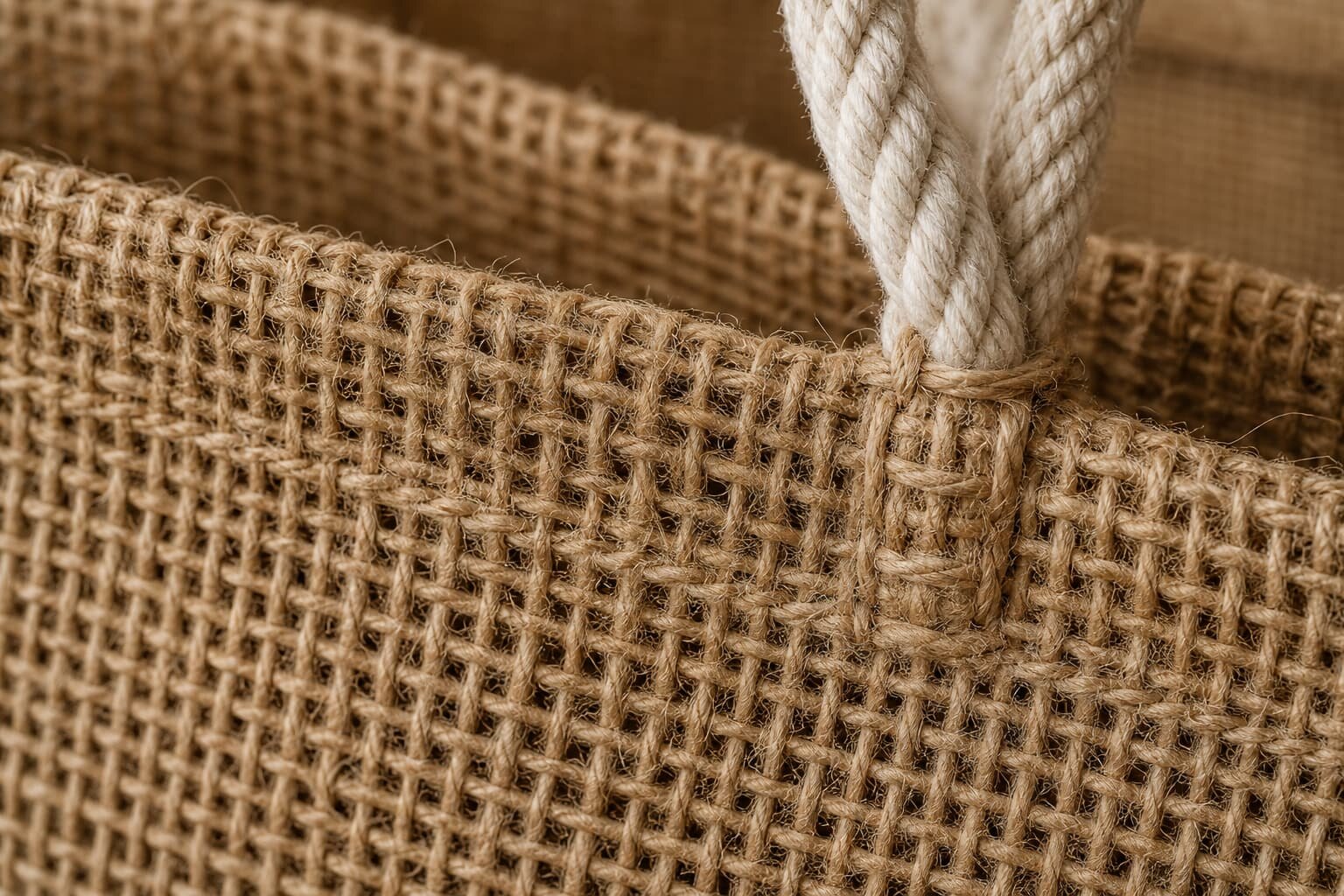
Fabric weight is one of the first QA checkpoints because it changes the entire bag. Jute can be described by oz, GSM, yarn count, or local mill reference, so the RFQ should require a measurable weight or an approved swatch. For many retail jute totes, a practical range is around 10 oz to 14 oz, roughly 280 to 420 GSM depending on construction and finishing. Lighter jute may reduce cost but can feel flimsy, show more gaps, and deform during sewing.
Lamination is another quote separator. Laminated jute usually gives the bag more body, helps the panel stand, and can reduce fiber shedding inside the bag. Unlaminated jute gives a more natural, breathable, rustic feel but may wrinkle more and shed more fibers. Neither option is always better. The risk is when one vendor quotes laminated jute and another quotes unlaminated jute without stating it clearly.
- Ask for actual GSM or oz and a real swatch before approving the price.
- Specify whether the buyer accepts natural color variation between fabric lots.
- Record whether the bag is laminated, unlaminated, dyed, bleached, or washed.
- Check odor on the sample after the bag has been closed in a carton or polybag for several days.
- Avoid approving fabric only from a photo because coarse jute texture and stiffness do not show accurately online.
Print Method and Artwork Limits on Burlap
Printing on jute is not the same as printing on smooth cotton canvas. The uneven weave, loose fibers, and natural brown base color affect logo sharpness and color brightness. Fine lines can break, small text can fill in, and light ink colors may look dull unless the design is adjusted. A vendor who says any logo is possible without reviewing line thickness, print size, and color coverage is creating risk for both sides.
Screen printing is usually the practical choice for solid logos, one to three colors, and many bulk jute bag orders. Heat transfer can be used in some cases, but adhesion and edge feel should be tested on real jute, especially if the bag will be folded, rubbed, or exposed to heat during storage. Embroidery is possible for some designs but can distort coarse fabric and raise cost. Woven labels or sewn cotton patches can be better when the artwork has small details.
- Send vector artwork and specify Pantone references, but accept that jute base color affects final appearance.
- Ask the factory to confirm minimum line width and minimum text height before sampling.
- Approve print size and position using a measured physical sample, not only a digital mockup.
- Run a dry rub test by rubbing the printed area with white cloth to check visible ink transfer.
- For multi-color logos, check registration tolerance because coarse jute can shift slightly during printing.
Stitching, Handles, and Load Expectations
Many jute burlap bag failures happen at the handle area, not the front panel. The fabric may be strong enough, but the handle stitch, thread selection, seam allowance, or reinforcement pattern may be too weak for the intended contents. A buyer who plans to use the bag for groceries or wine should not approve a sample based only on appearance.
The RFQ should describe handle material, width, handle drop, placement, and reinforcement. Cotton webbing gives comfort and a clean retail look. Jute webbing matches the natural body but can feel rougher. Rope handles can work for certain gift bags, but the attachment point must be checked carefully. For reusable retail bags, box stitch or cross stitch reinforcement is usually worth specifying.
- Define handle drop in centimeters so the bag fits hand carry or shoulder carry correctly.
- Ask for handle pull testing based on the actual product load, even if it is an internal factory test.
- Check whether handle ends are folded under or left with raw edges inside the bag.
- Specify stitch density and thread color if visible stitching affects retail appearance.
- Inspect bottom corners and gusset seams because weak corners often open before the main side seam fails.
Sample Approval Should Match Bulk Production
A jute burlap bag sample is only useful if it represents the planned bulk order. Buyers sometimes approve a beautiful handmade sample made from available fabric, then bulk production uses another weight, another handle batch, or a different print setup. The sample approval note must state which details are locked and which are still pending.
For jute, it is reasonable to approve one development sample first and then require a pre-production sample after materials are confirmed. The pre-production sample should use the actual bulk fabric, actual lamination, actual thread, actual handle, actual logo method, and actual packing fold. If the order has several sizes or SKU colors, do not assume one sample covers all risk points.
- Mark the approved sample with date, version number, fabric weight, and artwork file name.
- Measure width, height, gusset, handle drop, logo placement, and carton fold method.
- Keep one sample with the buyer and one sealed reference sample with the factory.
- Require written approval if the factory needs to change fabric lot, handle material, or print ink.
- Photograph close-ups of print, stitching, inside seams, label, and packing before signing off.
MOQ Logic and Why Cheap Quotes Can Mislead
MOQ for jute burlap bags is not only a sales policy. It is linked to fabric sourcing, lamination, dyeing, printing setup, handle production, carton packing, and line efficiency. A small plain natural jute pouch may have a different MOQ from a laminated supermarket tote with two-color print and custom label. When a vendor gives a very low MOQ, ask which specifications are standard stock and which are custom.
For quote comparison, ask vendors to price the same quantity breaks. A 1,000 piece quote and a 5,000 piece quote should not be compared without adjusting setup cost, wastage, screen charges, and packing labor. If you need mixed SKUs, clarify whether the MOQ applies per size, per artwork, per color, or per total order. This single detail often changes the real landed cost.
- Request price at two or three quantity levels, such as 1,000, 3,000, and 5,000 pieces, if relevant to your buying plan.
- Ask whether MOQ is per artwork, per bag size, per fabric color, or total shipment quantity.
- Separate one-time costs such as screen fee, sample fee, label setup, or special carton marks.
- Check whether lower MOQ uses stock fabric and higher MOQ allows custom fabric or dyeing.
- Do not approve a quote until the vendor confirms wastage allowance for printed or dyed jute.
Packing, Moisture Control, and Carton QA
Jute is a natural fiber, so packing is more than a warehouse detail. Poor moisture control can lead to odor, mildew, carton softening, or staining. Over-tight folding can crease laminated panels or damage print. Loose packing can increase carton volume and freight cost. The packing method should be part of the approved specification, not something decided at the end of production.
Import buyers should request carton size, pieces per carton, gross weight, net weight, and packing layout before shipment. If the bag goes directly to a distributor, retailer, or fulfillment warehouse, carton marks and SKU separation matter. Mixed SKU cartons may reduce packing cost but create receiving errors. Individual polybags may protect the bag but can conflict with plastic reduction targets, so this should be decided before pricing.
- Define flat packed, folded, bundled, individual polybag, or no polybag in the RFQ.
- Ask for desiccant or moisture-control method when shipping during humid seasons or long ocean routes.
- Require carton marks with PO number, SKU, quantity, destination, gross weight, and carton count if your warehouse needs them.
- Check whether export cartons are strong enough for pallet stacking and container loading.
- Ask for packed carton photos and one opened carton photo during final inspection.
Lead Time and Approval Milestones
A realistic lead time for jute burlap bag production should be broken into stages. If a vendor only states 30 days after deposit, buyers may not see where delays can happen. Artwork proofing, fabric purchase, lamination, print screen preparation, sample approval, bulk printing, sewing, trimming, QC, packing, and booking all need time. One late artwork approval can push the entire shipment.
The safest approach is to build an approval calendar into the purchase order. The factory should confirm when the buyer must approve artwork, sample, fabric, and carton marks. The buyer should also state how quickly they can respond. Many production delays are not caused by sewing capacity but by unclear approvals, revised logos, late label files, or missing shipping marks.
- Ask for lead time counted from deposit plus all approved files, not from inquiry date.
- Separate sample lead time from bulk lead time and shipping preparation time.
- Require the factory to flag peak season, holiday, or fabric mill delays before order confirmation.
- Confirm the last date for artwork changes before print screen or transfer setup begins.
- Schedule inline inspection photos before all bags are packed, when corrections are still possible.
Quote Data Buyers Should Request Line by Line
A good jute burlap bag quote should let a procurement team understand what is included. A one-line unit price is easy to read but hard to audit. When quotes arrive from several vendors, differences in fabric, lamination, print, handle, labels, packing, sample fee, and export carton can make the unit price misleading.
Ask the supplier to show the commercial assumptions. You do not need the factory's private cost sheet, but you do need enough detail to know what product is being priced. This protects both sides. If the buyer later asks for heavier fabric, a sewn label, individual polybag, or stronger carton, the factory can explain the price change against the original scope instead of arguing from memory.
- Bag size, fabric weight, lamination, handle type, print method, and number of print colors.
- MOQ, quantity breaks, sample cost, sample lead time, bulk lead time, and payment term.
- Packing method, pieces per carton, carton dimensions, carton weight, and carton marking.
- Included accessories such as hangtag, care label, woven label, barcode sticker, or insert card.
- Trade term and port, such as EXW, FOB, CIF, or DDP if the supplier offers it.
- Excluded costs such as test reports, fumigation, palletization, special inspection, or courier freight.
Specification comparison for buyers
| Spec decision | Recommended option | When it fits | Buyer risk to check |
|---|---|---|---|
| Fabric weight | 10 oz to 14 oz jute or 280-420 GSM equivalent | Retail shopping bags, wine bags, grocery totes, gift packaging | Light fabric may collapse, heavy fabric may raise freight volume and sewing difficulty |
| Inner structure | Unlaminated jute for breathable natural look; laminated jute when shape and moisture resistance matter | Unlaminated for rustic gifting; laminated for structured retail totes and supermarket bags | Lamination can crack, smell, or change recyclability claims if not specified clearly |
| Handle material | Cotton webbing, jute webbing, or padded cotton rope by load target | Cotton handles suit retail comfort; jute handles suit natural branding; rope handles suit heavier gift bags | Handle pull strength and stitch reinforcement are often underquoted |
| Print method | Screen print for solid logos; heat transfer only for controlled artwork and tested adhesion | Screen print fits simple brand marks and bulk cost control | Ink bleed, poor coverage on coarse jute, and color shift against natural fabric |
| Seam construction | Lockstitch with reinforced handle box stitch or cross stitch | Totes, bottle bags, and reusable retail bags where load is expected | Skipped stitches, weak bartacks, and rough inner seam trimming |
| Packing method | Flat packed by carton with moisture control and clear carton marks | Import orders where carton cube, shelf presentation, and warehouse scanning matter | Creasing, mildew risk, wrong carton quantity, and mixed SKU labels |
Buyer checklist before sampling
- Confirm the jute weight in GSM or oz, not only the description natural burlap.
- Define finished bag size with tolerance, gusset depth, handle drop, and load expectation.
- Ask whether the fabric is laminated, unlaminated, dyed, washed, or treated for odor reduction.
- Approve a pre-production sample using the actual fabric weight, print method, handle type, and packing fold.
- Check logo position from the finished edges, not only from a digital artwork centerline.
- Test print adhesion, rub resistance, ink coverage, and edge sharpness on real jute, not cotton canvas.
- Specify stitch density, handle reinforcement, seam allowance, and loose thread trimming standard.
- Request carton packing details including pieces per carton, carton size, gross weight, moisture protection, and SKU marks.
- Require inline photos during cutting, printing, sewing, and final packing before balance payment or shipment release.
- Compare quotes using the same MOQ, fabric GSM, lamination, print colors, packing, sample cost, and lead time assumptions.
Factory quote questions to send
- What exact jute fabric weight will you use, and can you provide a swatch with GSM or oz confirmation?
- Is the jute laminated or unlaminated, and what is the expected hand feel, odor level, and bag stiffness?
- What is the minimum order quantity for this size, fabric, handle, and print method, and what changes if we order mixed colors or mixed SKUs?
- Which print method do you recommend for our artwork on jute, and what line width or color limitations should we adjust before sampling?
- What handle material, width, length, and reinforcement stitch will be used for the target load?
- What are your finished size tolerances for width, height, gusset, handle drop, logo position, and carton quantity?
- How many days do you need for artwork proof, sample making, bulk material preparation, printing, sewing, QC, and packing?
- What packing method is included in the quote: flat pack, folded pack, individual polybag, master carton, inner carton, or retail hangtag?
- Can you share bulk production photos at fabric arrival, print approval, sewing line, and final carton stage?
- What quote items are excluded, such as sample freight, mold or screen fee, special label, fumigation document, test report, or export carton upgrade?
Quality-control points to confirm
- Fabric weight and construction match approved swatch and quote.
- Bag dimensions stay within agreed tolerance after sewing and pressing.
- Logo print is centered, correctly colored, and clean enough for coarse jute texture.
- Handle length, width, placement, and reinforcement match the signed sample.
- Seams are secure with no open stitches, broken thread, loose bartacks, or raw sharp edges.
- Jute odor, moisture, stains, and fiber shedding are within the buyer's acceptance level.
- Carton quantity, SKU mix, carton marks, and packing fold match the purchase order.
- Random finished bags pass a simple load test based on intended use.
- Labels, hangtags, care cards, or inserts are correct and placed consistently.
- Final inspection photos show both front and back panels, inside seams, handles, print close-up, and packed cartons.