Why a scorecard beats a price-only quote review
A jute burlap bag quote can look simple on paper and still hide a lot of production risk. One supplier may quote a lower unit price because the cloth is lighter, the seams are looser, the print is simpler, or the packing is basic. Another may include stronger handles, better finish, and a more stable bulk process. If you compare only the headline number, you will miss the reasons the cheaper offer becomes the expensive one after claims, delays, and rework.
A supplier scorecard gives procurement teams one controlled way to compare every offer. It forces the buyer to separate product spec, decoration method, packaging, lead time, and commercial terms before making a decision. That matters on burlap because the material is natural, the weave is uneven by nature, and small process differences can change the final look more than they do on synthetic bags. The goal is not to buy the most expensive bag; the goal is to buy the bag that performs as promised with the least surprise.
- Score suppliers on the same spec, not on their own version of the spec.
- Separate product risk from commercial risk so a low price does not hide a weak build.
- Use the scorecard to defend the award decision internally, especially when the cheapest quote is not the best fit.
Lock the bag spec before you compare factories
The fastest way to create quote confusion is to send a loose RFQ. For a jute burlap bag, define the finished size, gusset, handle drop, closure style, and whether the bag is open top, lined, laminated, or soft structure. If the buyer says only 'standard tote,' every factory will fill the gap differently. One may quote a promotional carry bag with raw edges, while another assumes a retail tote with reinforced seams and cleaner finishing. Those are not comparable offers.
Fabric weight is one of the most important decisions. A 200 to 240 GSM woven jute or burlap cloth can be enough for general retail and promo use, while 260 to 320 GSM or a laminated build suits a firmer body and better shelf presentation. Heavier is not always better, though. Extra GSM can raise cost, make folding harder, and slow sewing if the factory is not set up for thicker cloth. The right spec depends on use case, not vanity thickness.
- State exact dimensions in finished form, not only the cut size.
- Name the fabric build, GSM, and whether lining or lamination is required.
- Confirm whether the buyer wants a soft rustic finish or a cleaner retail appearance.
- Define the handle construction and closure before the supplier quotes labor.
Score the supplier on capability, not sales language
A strong scorecard usually separates the offer into material, workmanship, decoration, packing, and commercial control. Material covers the right GSM, weave consistency, and color lot control. Workmanship covers seam density, edge finishing, handle attachment, and repeatability. Decoration covers the print method, registration, and durability. Packing covers moisture protection, carton build, and count accuracy. Commercial control covers MOQ, lead time, payment terms, and the factory's ability to protect the approved sample through bulk production.
Weight those areas according to the business objective. If the bags are for a retail brand, workmanship and print quality should count heavily. If the bags are for a seasonal giveaway, MOQ logic and lead time may matter more. A practical starting point is to give product quality the highest weight, commercial terms the second tier, and packing the third tier. What matters is not the exact formula but that every supplier is scored with the same rubric and every quote has to prove itself against real acceptance criteria.
- Use one scoring sheet for all suppliers and one approved sample for the whole comparison.
- Reward factories that explain process limits instead of promising everything.
- Penalize missing data more than you think; incomplete quotes often signal weak process control.
Choose the construction that matches the buyer use case
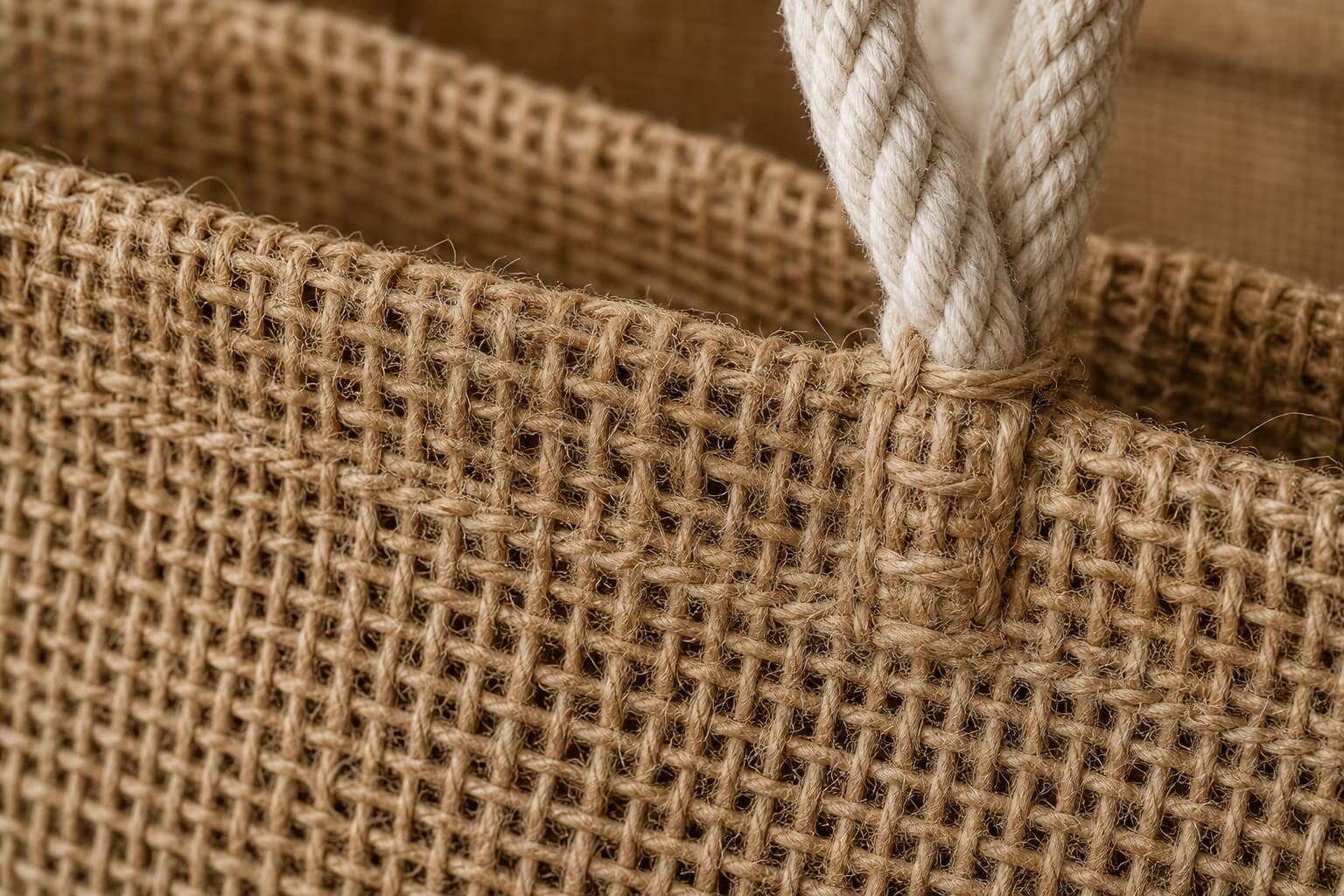
Not every jute burlap bag should be treated as the same product family. A simple open-top tote for a trade show needs different engineering from a premium gift bag or a structured retail carry bag. The construction choice drives cost, appearance, and production yield. A self-fabric handle may be fine for a light promotional bag, but a cotton webbing handle with bar-tacks usually gives better carry strength and a cleaner finish for retail. Likewise, an unlined rustic bag looks authentic but can shed fibers more easily than a lined or laminated build.
Print method is another decision that changes the quote and the risk. Screen print is usually the most stable choice for one to three solid colors, especially on larger repeat orders. Heat transfer or digital transfer can help on smaller runs or when the artwork changes more often, but the buyer should check rub resistance and whether the finish looks too smooth for the burlap surface. If the logo includes thin lines or fine text, the buyer should ask the factory to show how much detail the fabric can actually hold before bulk begins.
- Use screen print for durable logo work and repeat programs.
- Use transfer methods only when the run is short or the artwork is too complex for screens.
- Ask for handle pull expectations and seam reinforcement details on every quote.
- Request a side-by-side sample if the supplier offers more than one construction option.
How to read the quote line by line
A useful factory quote should separate the cost drivers instead of hiding them inside one lump sum. Look for the bag body, print setup, sample fee, packaging, carton charges, and any label or hangtag cost. Ask whether the quoted price includes one or both sides of printing, whether screens or plates are included, and whether the label is stitched, woven, or simply inserted. The same bag can be quoted very differently depending on how the factory handles setup and finishing. If the buyer does not force a line-item structure, the real comparison stays muddy.
Also check the quote for the commercial rules that usually create disputes later. The supplier should state the MOQ by size, color, artwork, and material combination. They should also state overrun and underrun tolerance, lead time after sample approval, and whether the sample fee is deductible from the purchase order. If the factory uses multiple incoterms or shipping methods, ask them to quote in the same basis across suppliers so freight does not distort the comparison. A clean quote should let procurement see the true cost of change, not just the base unit number.
- Demand one quote format from all factories so the numbers can be compared directly.
- Separate setup costs from unit costs so the buyer knows what is one-time and what repeats.
- Check whether the quoted carton data matches the shipping method you plan to use.
- Flag any quote that omits MOQ, sample policy, or lead time as incomplete.
Use samples to catch what the drawing cannot show
For jute burlap bags, a sample is not just a visual approval. It is the first chance to check whether the fabric feels too coarse, whether the print sits cleanly on the weave, and whether the sewing line stays straight when the material is handled by real operators. A good sample review should include size measurement, color matching, print placement, stitch quality, handle attachment, and the way the bag stands or collapses after folding. If a factory cannot produce a sample that reflects the quote, the bulk order will usually drift even more.
The best buyers compare the pre-production sample against a simple acceptance list. Check the finished dimensions, seam allowance, bar-tacks, label position, odor, and edge finishing. If there is a lining or coating, inspect whether it bubbles, wrinkles, or peels at stress points. If the artwork has fine detail, rub the print and bend the bag to see whether ink cracks or sheds. Ask the factory to confirm in writing that bulk production will follow the approved sample, not just the artwork file, because on burlap the file alone does not control the final result.
- Approve size, color, print, and construction together; do not approve them separately and hope they match.
- Keep one physical approved sample with the buyer and one with the factory.
- Use the sample to confirm practical things like fold behavior, odor, and handle feel.
- Reject samples that look good in photos but do not match the agreed build.
Set MOQ and lead time rules around the real production steps
MOQ on jute burlap bags is usually driven by fabric rolls, print setup, sewing efficiency, and packing labor. If the buyer asks for multiple sizes, multiple print locations, or mixed colors, the MOQ can rise quickly because the factory has to split cutting and sewing time. A smart RFQ asks for MOQ by size and artwork and then asks the supplier what part of the MOQ comes from raw material order size, not just factory policy. That helps procurement see whether a lower MOQ is real or just a marketing number that disappears once artwork is fixed.
Lead time should also be broken into steps. Sample development may take several days to two weeks depending on artwork and finishing. Bulk production then depends on material availability, print setup, sewing load, and packing. For many custom burlap programs, a realistic bulk window is often several weeks after sample approval, but the exact timing changes with season, order size, and added features such as lining or custom labels. The important point is to ask what the factory needs to start, what blocks the schedule, and which step is the usual bottleneck. That is far more useful than a single optimistic date.
- Ask for MOQ per size, per artwork, and per color, not one blended answer.
- Separate sample timing from bulk timing in the PO planning calendar.
- Challenge any lead time that does not explain material booking and print setup.
- Confirm whether rush orders change the MOQ or only the cost.
Packing and carton details should be part of the score
A jute bag can pass sampling and still fail in packing. Burlap is vulnerable to moisture, crushing, and dirty handling if the cartons are weak or the bags are packed too loosely. For export orders, ask whether the factory uses inner polybags, moisture protection, desiccant, or bulk separators. For retail programs, ask whether the bag is folded consistently and whether the label stays visible after packing. If the bag has a heavier print or laminate, check whether the carton stack creates marks or sticking. These issues are often small on paper and expensive once the goods reach the warehouse.
Carton data should also be part of the scorecard because it affects freight, storage, and receiving. The quote should show pieces per carton, gross weight, carton size, and carton marks. If the order is large enough to palletize, ask the supplier to state whether the cartons are pallet friendly and what stack height they recommend. Buyers often forget that a low unit price can disappear if the packing is inefficient, cartons are oversized, or the warehouse rejects the delivery because the cases are hard to handle. Packing is not a side note; it is part of the product.
- Check whether the bag needs moisture protection for the destination route.
- Verify carton counts against warehouse handling limits.
- Make sure carton marks match the SKU and PO format used by your receiving team.
- Confirm that bulk packing will not crush a structured bag shape.
How to turn the worksheet into a supplier award decision
Once the scorecard is filled out, use it to separate acceptable suppliers from risky ones before you debate price. A factory should not win the business if it missed a hard requirement such as size tolerance, print method, packing format, or lead time. Those are pass-fail items. After that, compare the remaining suppliers by score and commercial fit. This keeps the conversation grounded in business risk, not personality or the strength of the sales pitch. Procurement teams can then explain why a slightly higher offer is actually the lower-risk choice.
It also helps to keep the scorecard tied to the first order and the repeat order. Some suppliers can handle a first sample well but struggle with repeat consistency, while others are slower at sampling but stronger in production control. If the program is likely to reorder, weigh repeatability heavily. If the order is a one-time seasonal promotion, speed and packing simplicity may matter more. The worksheet should make those tradeoffs visible so the award is aligned with the real business plan.
- Use pass-fail gates for critical specs before any weighted score is applied.
- Do not let a low price override a failed sample or missing process data.
- Keep the worksheet as part of the PO file so future reorders start from the same standard.
- Review the scorecard after the first shipment to improve the next RFQ.
Common jute burlap buying mistakes the scorecard prevents
The most common mistake is assuming all burlap looks the same. It does not. The weave, fiber mix, surface hairiness, and finish can vary enough to change the appearance and performance of the bag. Another common problem is approving artwork before the factory confirms the print method. Fine detail that looks clean on a screen can blur or break on rough jute. Buyers also get caught by vague wording such as 'standard quality' or 'same as previous,' which leaves the factory too much room to substitute materials or finishing methods that do not match the original intent.
A second group of mistakes happens after approval. Some buyers forget to lock packing, carton size, or carton mark rules, so the shipment arrives in a format the warehouse cannot receive smoothly. Others assume the quote includes every small item and later discover separate charges for screens, labels, or sample revisions. The scorecard fixes these risks by forcing each decision to be written down before award. On a natural material like jute, that discipline is the difference between a clean program and a costly learning curve.
- Do not rely on vague terms like standard or premium without a GSM and construction spec.
- Do not approve artwork before the print method is confirmed.
- Do not leave packing, carton data, and label format out of the RFQ.
- Do not compare unit prices without checking what is excluded from the quote.
Specification comparison for buyers
| Spec decision | Recommended option | When it fits | Buyer risk to check |
|---|---|---|---|
| Fabric weight | 200 to 240 GSM woven jute for standard retail totes | General shopping bags, promo programs, and light gift packaging | Too-light cloth can fray, show uneven print, and lose shape quickly |
| Fabric weight | 260 to 320 GSM or laminated build for a firmer body | Premium retail, structured gift bags, and better shelf presentation | Higher GSM can raise cost, stiffness, and sewing difficulty |
| Print method | Screen print for one to three solid colors | Logo-driven programs with repeat orders and stable artwork | Check ink adhesion, cure quality, and whether fine lines will hold on rough jute |
| Print method | Heat transfer or digital transfer for short runs with more color | Samples, seasonal designs, and lower-volume artwork changes | Confirm wash/rub durability and whether the finish looks too smooth for burlap |
| Handle build | Self-fabric or cotton webbing with bar-tacks | Reusable bags that need better load carry and cleaner appearance | Handle twist, stitch density, and pull strength are common weak points |
| Packing format | Bulk packed with moisture protection, or individual polybag if retail requires it | Export shipping, warehouse handling, and retail-ready programs | Check carton weight, crush marks, and mildew risk in humid lanes |
Buyer checklist before sampling
- Confirm finished size, gusset, handle drop, and tolerance before the quote is compared.
- State the exact fabric type and GSM, including whether the bag is laminated, lined, or unlined.
- Lock the print method, color count, and artwork placement before sample approval.
- Ask for a pre-production sample and compare it to the approved sample, not only the artwork file.
- Define packing spec, pcs per carton, carton dimensions, and carton marking format.
- Request MOQ by size, color, artwork, and material combination instead of a single blanket MOQ.
- Ask for lead time separated into sample, material sourcing, production, and packing stages.
- Set acceptance criteria for seams, bar-tacks, print registration, odor, and shade consistency.
- Confirm overrun and underrun policy in writing.
- Check whether tooling, screens, labels, and sample fees are included or charged separately.
Factory quote questions to send
- What exact GSM, weave, and finish are you quoting, and is that based on finished fabric or raw cloth?
- Which print method will you use, how many colors are included, and what setup or screen charges apply?
- What is the MOQ for this exact size, artwork, and construction, not just for the bag family in general?
- Can you provide a pre-production sample before bulk and state what will be matched to it during production?
- What are the finished size tolerances you can hold for body width, gusset, handle drop, and seam allowance?
- What is included in the unit price: bag body, lining, label, polybag, carton packing, and carton marks?
- What is your lead time after sample approval and deposit, and what steps usually cause delay?
- What overrun or underrun range do you apply on custom jute orders?
- How do you test handle strength, seam durability, and print rub resistance on this style?
- Can you quote the same spec on an alternate fabric weight so we can compare cost and performance?
Quality-control points to confirm
- Verify fabric GSM and weave consistency against the approved swatch or pre-production sample.
- Check finished dimensions, gusset depth, handle length, and seam allowance on the first production lot.
- Inspect stitching density, bar-tacks, and reinforcement at handle attachments and high-stress corners.
- Review print alignment, color density, edge sharpness, and cure or rub performance on the final sample.
- Smell-test for strong chemical odor if lamination, coating, or heavy ink coverage is used.
- Confirm that labels, side tags, and woven branding sit in the correct location and are secure.
- Count pieces per inner pack and carton, then verify carton marks, SKU, and PO references.
- Check moisture protection and storage condition before shipment, especially for humid routes.
- Compare random bulk pieces to the approved sample for shade, texture, and construction drift.
- Record any rework, overrun, or packing exceptions before the shipment is released.