Why a Supplier Readiness File Matters for Jute Bags
A jute burlap bag supplier readiness file is not a decorative document. It is the working control file that helps a buyer compare quotations on the same basis before money is spent on samples, tooling, or bulk fabric. Jute bags look simple, but the quote can change sharply depending on fabric GSM, lamination, handle type, print method, packing, and whether the order uses stock fabric or custom fabric.
Procurement teams often lose control when they send only a bag photo and rough dimensions. One supplier may quote 240 GSM open-weave burlap with light stitching, while another quotes 320 GSM tighter jute with cotton webbing, reinforced seams, and individual packing. Both may call the product a jute tote bag. The readiness file forces each factory to answer the same production questions so price differences become visible instead of confusing.
- Use the file before supplier nomination, not only after sample approval.
- Keep all quote assumptions in one place: material, construction, artwork, packing, testing, and shipping data.
- Update the file whenever sample comments change the cost or production method.
- Share the same version with sourcing, merchandising, quality, logistics, and the supplier.
Start With the Real Bag Function, Not the Product Name
The word burlap is used loosely in buying conversations. Some buyers mean a rough natural jute promotional tote, some mean a laminated grocery bag, and others mean a small drawstring pouch for candles, coffee, cosmetics, or wine. A supplier cannot quote correctly until the use case is clear. The readiness file should describe what the bag must carry, how it will be displayed, how long it should last, and whether it touches retail product directly.
For example, a wine bottle jute bag needs a different bottom structure and handle strength than a flat jute pouch used for dried lavender. A grocery-style jute tote may need lamination for a cleaner interior and better shape retention. A rustic unlaminated gift bag may accept more fiber variation but still needs controlled stitching and odor. The more clearly the function is written, the easier it is to reject a cheap quote that is built for the wrong job.
- State expected load, such as 2 kg gift set, 5 kg grocery use, or single 750 ml bottle.
- Define whether the bag is reusable, single-event packaging, retail packaging, or transit packaging.
- Clarify if the bag will contact food packaging, cosmetics, apparel, glass, or printed paper inserts.
- Note display needs: standing on shelf, hanging on peg, folded in carton, or packed inside a kit.
Lock the Fabric Specification Before Comparing Prices
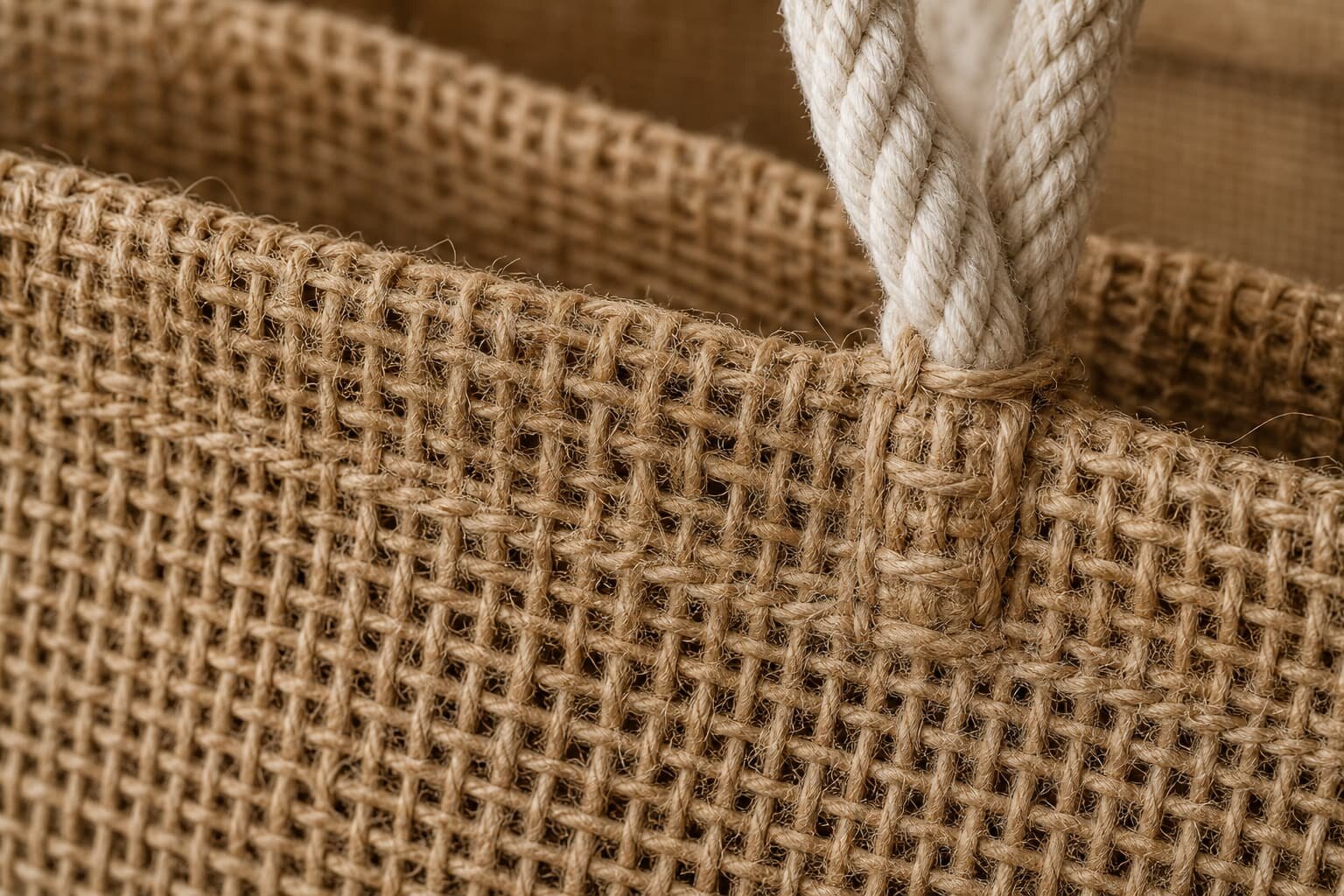
Fabric is usually the largest cost driver in a jute burlap bag, and it is also the easiest place for quotes to become unequal. A readiness file should list the requested GSM, weave appearance, color tone, lamination status, and acceptable variation. Natural jute is not a flat paper-like material; it has slubs, shade movement, and visible yarn irregularity. That natural look is acceptable only when buyer and factory agree what level is commercial.
For many promotional and retail jute bags, 260-320 GSM is a practical starting range. Lighter weights can reduce cost and carton weight but may feel weak, shed more, or fail to stand neatly. Heavier fabric improves body and perceived value but increases material cost, sewing difficulty, and freight cube. If the design needs structure, do not depend only on GSM; gusset construction, lamination, and seam layout also affect shape.
- Ask the supplier to quote actual GSM and tolerance, not only words like standard jute.
- Decide whether natural color variation is acceptable or whether a shade band must be approved.
- Specify laminated or unlaminated fabric; do not let the supplier choose silently.
- Keep a physical swatch or approved sample cutting as the shade and texture reference.
- If dyed jute is used, ask about rubbing, odor, and colorfastness risk before bulk approval.
Choose Construction Details That Match the Load
Most jute bag failures come from construction shortcuts, not from the center of the fabric panel. Handles pull out, bottom seams open, drawcord channels fray, or side gussets twist because the design was not specified. Your readiness file should include finished size, gusset, seam type, seam allowance, handle material, handle drop, reinforcement method, thread color, and closure details. A sketch with dimensions is often more useful than a lifestyle photo.
For tote bags, handle attachment deserves special attention. Cotton webbing is comfortable and prints a cleaner brand impression, but jute tape may look more natural. Rope handles can suit wine or gift bags but need proper anchoring. For pouches, the drawstring channel must be wide enough for smooth closing and strong enough not to tear after repeated pulling. If the product carries heavy items, request a simple load test and define pass or fail before mass production.
- Set handle drop in centimeters and confirm whether it fits hand carry or shoulder carry.
- Define reinforcement: cross stitch, box stitch, bar tack, extra patch, or folded seam.
- Confirm stitch density and avoid overly loose stitching on open jute weave.
- For drawstring pouches, specify cord material, cord diameter, knot finish, and channel height.
- For wine bags, check bottle fit with real bottle dimensions, not only nominal capacity.
Decide the Print Method Based on Jute Surface Reality
Jute is coarse, uneven, and absorbent. Fine artwork that looks perfect on coated paper may look broken on burlap. The readiness file should include vector artwork, print size, placement, Pantone reference, number of colors, minimum line thickness, and whether the buyer accepts texture showing through the ink. For most simple logos, screen printing is the practical method. It is economical for bulk orders and works well with bold shapes, but it has limits on fine detail and small text.
If the artwork has gradients, tiny letters, photographic detail, or strict brand color requirements, a woven label, cotton patch, heat transfer on a patch, or sewn brand tag may be safer than direct printing on jute. This is not only a design decision; it affects MOQ, setup cost, sewing time, and inspection criteria. The best supplier answer is not always the cheapest print method. It is the method that can be repeated consistently on the selected jute.
- Approve print on the actual production fabric, not on a smoother substitute.
- Measure placement from bag edges, seam lines, or gusset fold, not by eye.
- Avoid thin reversed-out text unless the supplier proves it on a real sample.
- Ask whether ink curing time affects odor, packing schedule, or color rub risk.
- Keep one signed print standard for color, opacity, edge quality, and position.
Understand MOQ Logic Before Negotiating Too Hard
MOQ for jute burlap bags is rarely just a sales number. It usually comes from fabric roll purchase, cutting efficiency, print screen setup, machine changeover, labor planning, and packing requirements. A supplier may accept a low MOQ using stock jute and simple printing, but a custom dyed fabric, special lamination, multiple sizes, or complex retail packing can raise the practical minimum. Buyers get better answers when they ask what drives the MOQ instead of only asking for a lower number.
The readiness file should separate total order quantity from quantity per size, per color, per artwork, and per packing version. This matters when a distributor wants 5,000 bags split across five logos or three sizes. The total looks large, but each production version may be inefficient. If the factory can gang print or cut several sizes from the same fabric lot, cost may improve. If each version needs separate setup, the quote should show that.
- Ask for MOQ by fabric type, print design, bag size, and packing style.
- Clarify whether assorted artworks can share the same fabric purchase.
- Check if sample cost is credited after bulk order or treated separately.
- Request price breaks at realistic quantities, such as 1,000, 3,000, 5,000, and 10,000 pieces.
- Do not approve a low MOQ if it depends on leftover fabric you have not inspected.
Build a Sample Approval Path That Prevents Bulk Surprises
A jute bag sample can be misleading if it is made from convenient stock fabric, hand-cut panels, or a slower sample-room sewing process. The readiness file should state what type of sample is being approved: reference sample, sales sample, pre-production sample, or shipment sample. For a first bulk order, the most important approval is a pre-production sample made with intended fabric, construction, print method, and packing approach.
Sample comments should be written as measurable corrections. Instead of saying make the logo higher, write logo center 95 mm below top edge, tolerance plus or minus 5 mm. Instead of saying stronger handle, write 30 mm cotton webbing, box stitch with cross reinforcement, minimum load test requirement. This makes the supplier's production file clearer and gives the inspection team a standard to check.
- Check finished size after the sample is filled or shaped, not only flat on a table.
- Rub printed areas by hand and with a dry white cloth to check obvious transfer.
- Smell the inside of laminated bags after they have been sealed overnight.
- Fold and unfold the bag to observe lamination cracking or print stress.
- Photograph approved sample details with a ruler for factory and QC reference.
Quote Data That Must Be Visible, Not Hidden in Unit Price
A clean jute burlap bag quote should show more than unit price. Procurement needs to know what is included, what is excluded, and which assumptions can change the cost. The readiness file should request material specification, bag dimensions, print method, artwork setup charges, sample charges, packing method, carton details, lead time, payment terms, trade term, quote validity, and expected production loss allowance if relevant.
Hidden quote gaps cause problems later. A supplier may quote without individual polybags, without barcode labels, without pallets, without testing, or without export carton strength suitable for your shipping route. Another supplier may include these items and look more expensive. When the quote table is standardized, buyers can compare landed cost and risk, not only the first unit price.
- Request carton dimensions, pieces per carton, gross weight, and net weight.
- Ask whether print screens, artwork revisions, labels, hangtags, and inner packing are included.
- Confirm Incoterm, loading port, quote validity, and currency.
- Separate sample lead time from bulk production lead time.
- Ask what specification changes trigger new pricing before approving sample comments.
Packing and Moisture Control Are Not Afterthoughts
Jute is sensitive to moisture, odor, dust, and compression. A good bag can arrive commercially unacceptable if packed wet, stored near strong-smelling goods, or crushed in weak cartons. The readiness file should define packing at piece, bundle, inner carton, master carton, and pallet level if pallets are needed. For some buyers, individual polybags are required for retail cleanliness. For others, bundle packing with paper separation is more sustainable and cost-effective.
Moisture control should be discussed before shipment, especially for long sea freight routes or humid seasons. The factory should use dry cartons, avoid packing immediately after wet processes, and consider desiccants when appropriate. If laminated jute is used, the inside must be clean and free from trapped odor. If unlaminated jute is used, buyers should expect some natural fiber smell but not mildew, chemical odor, or damp carton smell.
- Specify pieces per inner bundle and per export carton.
- Define whether bags are folded, flat packed, stuffed, or pressed.
- Check if folding creates permanent marks across the printed logo.
- Use carton markings that match PO, SKU, color, size, quantity, and destination needs.
- Inspect carton dryness, odor, and crushing before final shipment approval.
Lead Time Planning for First Bulk Orders
Lead time for jute burlap bags should be planned by stage: material sourcing, sample making, artwork approval, print setup, cutting, sewing, finishing, inspection, packing, and booking. First orders take longer because every detail is being confirmed. A supplier who gives only one short lead time without listing assumptions may be depending on stock fabric, open production capacity, or simplified packing. That may be fine, but the buyer should know the basis.
The readiness file should show approval deadlines on the buyer side as well. Delayed artwork files, late sample comments, changing carton marks, or undecided packing instructions can push the factory schedule. For seasonal retail or event programs, add a decision calendar. If the order has multiple bag sizes or artworks, confirm whether production runs in parallel or one after another.
- Ask when the lead time starts: deposit, artwork approval, material approval, or sample approval.
- Confirm whether fabric is in stock or must be woven, laminated, dyed, or purchased.
- Add time for sample courier, buyer review, lab testing if required, and final inspection.
- Do not book retail launch dates based only on an unapproved sales sample.
- Request early warning if material, print, or packing approval is on the critical path.
Specification comparison for buyers
| Spec decision | Recommended option | When it fits | Buyer risk to check |
|---|---|---|---|
| Fabric body | 260-320 GSM natural jute or burlap | Retail gift bags, wine bags, promotional totes, and reusable packaging where rustic texture is part of the design | Low GSM may collapse, shed more fiber, or expose contents; ask for actual measured GSM and tolerance |
| Inner treatment | Unlaminated for breathable use; PP laminated for cleaner interior and moisture barrier | Unlaminated fits dry goods and natural branding; laminated fits grocery, gift sets, cosmetics, and export packing with cleaner handling | Lamination can crack at folds or create odor if rushed; confirm lamination thickness and curing time |
| Printing | Screen print for simple logos; heat transfer or cotton patch for detailed artwork | Screen print works for 1-3 color brand marks; patch or label works when jute surface is too open for fine detail | Fine lines can break on coarse jute; approve print on production fabric, not only digital artwork |
| Handle construction | Cotton webbing, jute tape, or padded rope depending on load and look | Cotton webbing gives comfort; jute handles keep a natural appearance; rope suits bottle or gift packaging | Handle attachment is often the first failure point; require stitch pattern, thread count, and load test |
| Side and bottom design | Gusseted bottom with reinforced seams for totes; flat style for light gift pouches | Gussets improve usable volume for retail and grocery; flat styles reduce cost and carton cube | Poor gusset symmetry causes twisted shape and unstable shelf presentation |
| Packing method | Individual polybag only when needed; otherwise inner bundle plus export carton with moisture control | Bundle packing fits wholesale and promotional orders; individual packing fits retail distribution or kit assembly | Jute absorbs moisture and odor; require dry cartons, desiccant plan, and ventilation controls |
Buyer checklist before sampling
- Define bag type, size, gusset, handle style, closure, and intended load before asking for price.
- State fabric GSM, lamination requirement, color expectation, and acceptable natural fiber variation.
- Send vector artwork with print size, placement dimensions, Pantone reference, and minimum line thickness.
- Request a pre-production sample made with intended fabric, handle, thread, print, and packing method.
- Ask the supplier to quote MOQ by fabric purchase, printing setup, stitching line efficiency, and packing format.
- Confirm carton size, pieces per carton, estimated gross weight, moisture protection, and pallet loading if required.
- Set acceptance criteria for size tolerance, print position, stitch quality, odor, shedding, stains, and handle load.
- Require quote validity, production lead time by stage, sample lead time, and what changes trigger requotation.
- Keep approved sample, artwork file, packing photo, and inspection checklist in one readiness file.
- Do not release deposit until open questions on material, print, packing, and shipment terms are closed in writing.
Factory quote questions to send
- What exact jute or burlap GSM are you quoting, and what tolerance should we expect in bulk production?
- Is the fabric unlaminated, laminated, dyed, bleached, or treated, and can you share close-up sample photos?
- What is the minimum fabric purchase quantity behind your MOQ, and can mixed sizes or prints share the same fabric lot?
- Which print method do you recommend for our artwork on coarse jute, and what line width or color limits apply?
- Will the pre-production sample use production fabric and production printing, or only available stock fabric?
- What handle material, width, stitch pattern, and thread specification are included in the quote?
- What size tolerance, print placement tolerance, and color tolerance are realistic for this construction?
- How will bags be packed to prevent moisture, odor transfer, crushing, and fiber contamination during export?
- What is the production lead time after sample approval, artwork approval, and deposit, and where are the bottlenecks?
- Which quote items are excluded, such as mold charges, print screens, inner bags, labels, testing, pallets, or documentation?
Quality-control points to confirm
- Measure finished size at top width, bottom width, height, side gusset, bottom gusset, and handle drop.
- Check actual fabric weight against the approved GSM range using cut swatches or supplier test records.
- Inspect jute surface for heavy slubs, holes, oil marks, mildew spots, strong odor, and excessive loose fiber.
- Verify print color, opacity, edge sharpness, artwork size, and placement against the signed sample.
- Pull-test handles and closures using a load higher than the intended use weight, with the test method recorded.
- Check seam allowance, stitch density, skipped stitches, loose threads, and reinforcement at stress points.
- Confirm lamination bond, fold resistance, and inside cleanliness if laminated jute is specified.
- Review packing quantity, carton strength, carton marks, inner protection, desiccants, and moisture condition before shipment.