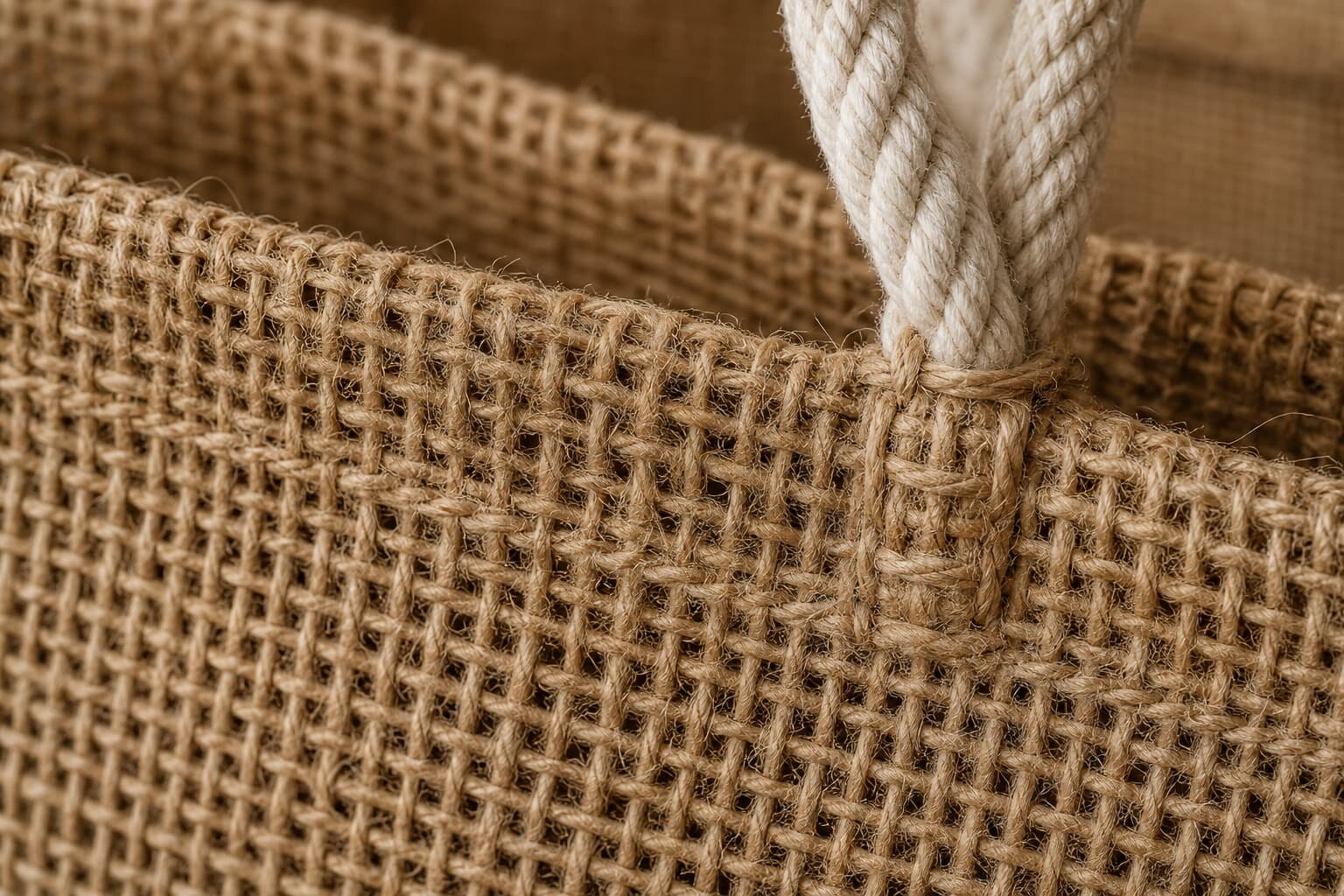
What stitch failure really means on jute burlap bags
When buyers say a jute burlap bag has a stitch failure, they are usually describing one of five things: seam pop, handle tear, top hem split, skipped stitches, or fray that works its way into the stitch line. The bag may still look acceptable on a table, but the load path is already weak. On jute and burlap, the weave is open, the fibers are coarse, and the fabric does not forgive poor thread balance the way a tighter woven fabric sometimes can. That is why a stitch review should be treated as a buying issue, not just a sewing issue.
The first RFQ mistake is asking for "strong stitching" without defining the use case. A promotional giveaway bag, a retail shopping bag, and a bottle carrier all need different seam behavior. Fabric weight matters too, but not in isolation. Many bulk quotes fall somewhere around 240 to 380 GSM, yet the real question is whether the chosen GSM matches the seam type, handle attachment, and expected carry load. If the supplier does not know the load target, they will usually price the safest low-cost construction, and that is where failure starts.
- Separate cosmetic issues from functional failures before you approve a sample.
- Define the intended load and wear pattern in the RFQ, not just the bag dimensions.
- Treat stitch strength, thread choice, fabric weight, and reinforcement as one system.
Where jute bag failures show up first
Most jute burlap failures start at the side seams, gusset corners, handle anchors, and top hem. Those are the places where stress concentrates and where the needle punches the same line again and again. If the seam allowance is too narrow, the burlap edge can shed fibers into the stitch path. If the seam is too close to the edge, the fabric opens as soon as the bag is filled. If the bag is unlined, edge finish becomes even more important because the raw weave is doing more of the structural work than the buyer may realize.
Another reason buyers miss the problem is that a bag can pass a visual check and still fail after loading. Jute reacts to moisture, storage, and repeated folding, so a seam that looked fine in the sample room can open after packing, transit, or retail handling. That is why the sample must be tested with the actual insert weight, not with an empty hand squeeze. A light gift bag may survive a simple lift test, but a retail carry bag should survive repeated lifts, corner stress, and a brief hold without stitch creep.
- Check side seams, top hem, handles, gusset corners, and label attachment points first.
- Watch for loose fibers entering the needle line at the cut edge.
- Test the bag under real fill weight, not as an empty shell.
Construction choices that change the quote
The cleanest way to compare suppliers is to ask them to quote one construction family at a time. A light promotional bag usually uses a simpler seam, modest reinforcement, and a lower fabric weight. A mid-duty retail bag often moves to a cleaner hem, more robust handle attachment, and a more controlled stitch density. A heavy repeat-use bag may need a stronger body fabric, reinforcement tape, and a box-X or bartack pattern on every stress point. Stronger thread alone does not fix weak burlap, and a thicker fabric does not fix poor needle control.
For thick jute, many factories work in the general range of 7-9 stitches per inch, but that is not a universal rule. The right density depends on fabric thickness, seam type, and whether the machine is punching through one layer, two layers, or a folded hem. Print method also affects the sewing plan. Screen print is common on burlap, but if the artwork crosses a seam or fold line, it can distort. Sewn labels, woven labels, or a small sewn patch are often a better choice when the buyer cares more about durability than a large printed graphic.
- Do not ask for the same price across light, medium, and heavy constructions.
- Match seam style to the expected load, not to the look of the bag alone.
- Keep artwork away from stitch lines unless the factory has proven that layout before.
Use one construction per RFQ line
If you want an apples-to-apples quote, do not mix seam styles, handle styles, and print methods in one vague request. Put one construction on one RFQ line and ask suppliers to price the same spec. That means the same body size, the same GSM, the same handle material, the same print placement, and the same reinforcement plan. Once those items are fixed, the supplier can quote labor, material, and packing without hiding extra cost in a broad sentence like "better stitching included."
This is also where many buyers lose cost control. If one supplier quotes a 260 GSM body with simple turn-under seams and another quotes a 320 GSM body with reinforcement tape and bartacks, the cheaper line item is not actually cheaper. The right comparison is not just unit price; it is the cost of seam life, return risk, and rework. If your retail program depends on the bag surviving repeated handling, a small upgrade in sewing detail is usually cheaper than a complaint after the shipment lands.
- Keep GSM, seam style, handle spec, print method, and packout fixed across all quote requests.
- Ask suppliers to separate base bag, reinforcement, print, and packaging costs.
- Treat hidden sewing upgrades as a risk, not a free improvement.
What your RFQ must say to get a usable quote
A usable RFQ for jute burlap bags should read like a production brief, not a marketing note. Include finished size, fabric weight, weave style, bag shape, handle length, handle width, handle material, reinforcement points, logo method, logo size, print location, and whether the bag needs lining or a top hem. Add packing requirements too, because a bag packed flat, folded, or nested can change how the seams are stressed in carton. If the supplier quotes without these details, you will compare incomplete numbers and miss the real cost drivers.
The most important RFQ detail for stitch failure review is the intended use. A bag for seed packets is not the same as a bag for bottles or trade show catalogs. Tell the factory whether the bag will be carried by hand, over the shoulder, or repeatedly opened and closed. If you expect the bag to be reusable, say so. Reuse drives handle reinforcement, seam allowance, and thread choice. It also changes MOQ logic: if you split the order by color, print placement, or handle construction, the factory may need separate cutting and sewing runs, which raises the effective MOQ for each version.
- State the intended load and frequency of use in one sentence.
- List every construction choice that can affect sewing time or seam strength.
- Ask the supplier to confirm any MOQ split caused by print, color, or handle changes.
How to inspect a sample before you approve bulk
A sample is only useful if it is built from production materials and sewn with the intended construction. A hand-finished prototype can hide problems that appear later on the line. Start the review by filling the bag with the actual product or an equivalent weight, then lift, hold, set down, and repeat. Check the side seams, bottom corners, top hem, and handle anchors while the bag is loaded. If the body twists, if the seam opens, or if the handle angle shifts under weight, the stitch plan needs revision before bulk production starts.
Look closely at the inside of the bag as well. Loose thread ends, uneven seam allowance, or needle holes that open along the edge are early warnings. The best buyers separate cosmetic marks from functional defects. A small stitch mark near a hidden seam may be acceptable. A visible stitch line that cuts into the burlap fibers or a handle tack that tears when you pull it is not. If the sample fails, ask for a corrected sample and keep the defect photo set, because that record makes the next quote review much easier.
- Test the sample with real fill weight, not just by squeezing the empty bag.
- Inspect both the outside and inside of the seam path.
- Keep photo records of every rejected seam or handle issue.
MOQ, cost, and lead time: where stitch upgrades add money
Stitch upgrades usually add more labor cost than material cost. The body fabric, handle tape, reinforcement patch, thread, print, inspection, and packout all contribute to the final quote, but the labor step is what changes fastest when the construction gets stronger. A heavier GSM fabric may cost more, but it can also slow the machine and raise rejection rates if the seam is tight or the corners are bulky. That is why a supplier can be right when they say a reinforced version costs more, even if the material difference looks small on paper.
MOQ and lead time both depend on how many variables you change. One construction, one print method, one color, and one packout plan are easier to run than a multi-version order with different handle lengths or logo placements. For planning purposes, sample approval and bulk production often need different time windows, especially if the factory must adjust sewing folders, bartack positions, or print screens. Buyers should ask the factory to quote the time for each stage separately so they can see where a delay is likely to come from.
- Ask for a line-item breakdown of material, sewing, print, reinforcement, and packing.
- Do not compare a simple seam quote with a reinforced seam quote as if they are the same product.
- Confirm whether multiple colors or print positions create separate MOQ buckets.
Production QC points that catch seam problems early
Inline quality control matters because stitch failures are cheaper to stop on the floor than in a carton. The first 10 pieces should be checked for stitch path, handle position, top hem width, thread tension, and print-to-seam clearance. If the seam starts wandering or the needle holes look too close to the edge, stop the run and correct the machine setup. Buyers often focus on the finished appearance and forget the sewing line itself, but the line is what determines whether the bag survives in the field.
For pre-shipment inspection, add a simple load and handling check. A small random sample should be filled, lifted, and carried in the way the end user will carry it. Then look for seam opening, thread slippage, and handle movement. You do not need a lab to catch the most common failures. You do need a consistent acceptance rule. If one sample shows seam grin, another shows loose bartacks, and a third shows twisted hem alignment, the shipment is telling you that the sewing process is not stable enough yet.
- Check the first-off pieces before the line makes a large batch.
- Use a repeat lift or carry test that matches the bag's real use case.
- Reject samples with seam grin, loose bartacks, or unstable hem alignment.
Packing and warehouse handling can hide or create failures
A good seam can look bad after poor packing, and a weak seam can look fine until it reaches the warehouse. Jute bags are sensitive to compression, edge rub, and moisture. If the carton is overpacked, the handles and top hem can crease at the stress point. If the carton is too loose, the bags can slide and rub against each other. If the shipment spends time in a humid environment, the fabric can relax and make seam weakness appear later than the factory inspection suggested. That is why packing should be treated as part of the product, not as a separate afterthought.
For retail distribution, the fold pattern matters. If the bag is folded across a stressed seam or a printed panel, it may crack the print or push strain into the handle anchor. Ask the factory to show how the bag is folded, bundled, and cartoned. If necessary, request tissue, polybag, or dividers to keep the bag flat and dry. The goal is not fancy packing; the goal is to protect the seam quality that the sewing line already earned.
- Check carton count, fold direction, and compression level before approving packout.
- Protect stress points from rub, moisture, and sharp carton edges.
- Treat warehouse damage and sewing failure as separate problems until you prove otherwise.
Lock the approved spec so the next order does not drift
Once the sample passes, freeze the spec. Keep the approved bag, the measurement sheet, the seam photo set, the print file, and the packing sketch together as one control record. If the bag is reordered later, the factory should not be able to switch fabric weight, thread, reinforcement, or handle construction without written approval. This is the simplest way to stop slow quality drift, which is one of the most common reasons a repeat order fails even when the first shipment looked fine.
For reorders, ask the supplier to confirm any change in loom batch, thread brand, needle size, bartack position, or carton packout before production starts. Small process changes can create big stitch differences on burlap, especially when the fabric weave is loose. If the supplier wants to improve the construction, make them explain the effect on MOQ, lead time, and unit cost. That keeps the conversation commercial and stops vague quality promises from hiding a weaker seam plan.
- Keep the approved sample and measurement sheet as the control record.
- Require written approval for any change in fabric, thread, or reinforcement.
- Review repeat orders as if they were new orders, especially after a long gap.
Specification comparison for buyers
| Spec decision | Recommended option | When it fits | Buyer risk to check |
|---|---|---|---|
| Body seam construction | Turned seam with edge binding or overlock plus topstitch, usually around 7-9 SPI on thicker jute | Light to medium tote use where fray control and a clean inside finish both matter | Check seam allowance, loose fiber pullout, and whether the needle line cuts into the burlap weave |
| Handle attachment | Box-X with bartacks over a reinforcement patch | Repeated carry, bottle carry, or retail bags that will be reused more than once | Confirm patch size, stitch density, thread type, and a real pull-test result on the sample |
| Top hem finish | Double-fold hem with two rows of stitching | Open-top bags that need a tidy mouth and less edge fray | Watch for puckering on 300+ GSM fabric and uneven fold width across the panel |
| Internal reinforcement | Cotton tape or self-fabric facing at stress points | Heavy inserts, lined bags, or orders with strict seam durability targets | Make sure the added thickness does not create skipped stitches or needle breakage |
| Logo placement | Screen print away from seam lines or a sewn woven label near the side seam | When the bag will be handled often and needs durable branding | Check print-to-seam clearance and whether the artwork distorts after sewing |
Buyer checklist before sampling
- Confirm the intended load, carry frequency, and whether the bag is for giveaway, retail, or repeated daily use.
- Lock the fabric weight in GSM or oz and ask the supplier to state how it was measured on the production lot.
- Specify seam type, seam allowance, stitch density, and the exact stress points that need reinforcement.
- Approve handle material, handle length, and attachment style before comparing quotes.
- Define print method, print placement, and the minimum distance between artwork and seam lines.
- Request a sewn pre-production sample built from production materials, not a hand-finished mock sample.
- Test the sample with the intended fill weight and repeat the lift cycle several times before approval.
- Inspect the inside corners, top hem, and handle bar tacks for fray, skipped stitches, or loose ends.
- Ask for a line-item quote that separates body fabric, sewing, print, reinforcement, and packout.
- Require pre-shipment photos or an inspection report that shows seam quality on random packed pieces.
Factory quote questions to send
- What GSM or ounce weight are you quoting, and how will you verify that weight on the actual fabric lot?
- Which seam construction will you use for the side seams, top hem, and gusset corners?
- What thread type and ticket size will you use, and will it be color matched or contrast?
- How are the handles attached, and what reinforcement patch or bartack pattern is included in the base quote?
- What sample tests do you run for seam pop, handle pull, and stitch consistency?
- What is the MOQ for one construction and one print method, and what changes will split the MOQ into separate runs?
- What is the cost difference between unlined, lined, and reinforced versions of the same bag size?
- What is the normal lead time for sample approval and bulk production after sign-off?
- How do you pack and carton the bags to protect seams and handles during transit?
- Can you share a production checklist or defect photos for seam-related issues so we can compare quotes fairly?
Quality-control points to confirm
- Body fabric weight matches the approved sample and the weave is consistent across the lot.
- Side seams and gusset corners show no skipped stitches, seam grin, or visible fray at the needle line.
- Handle attachments are even, secure, and reinforced with the agreed bartack or box-X pattern.
- Top hem width is uniform and the mouth of the bag sits flat without twisting.
- Thread tension is balanced so the seam does not pucker, tunnel, or cut into the burlap fibers.
- Print placement stays clear of the seam path and does not crack or distort after stitching.
- Loose threads are trimmed and the interior has no sharp ends that can snag contents or weaken the seam.
- Carton packout keeps the bags dry, flat, and protected from compression at the stress points.