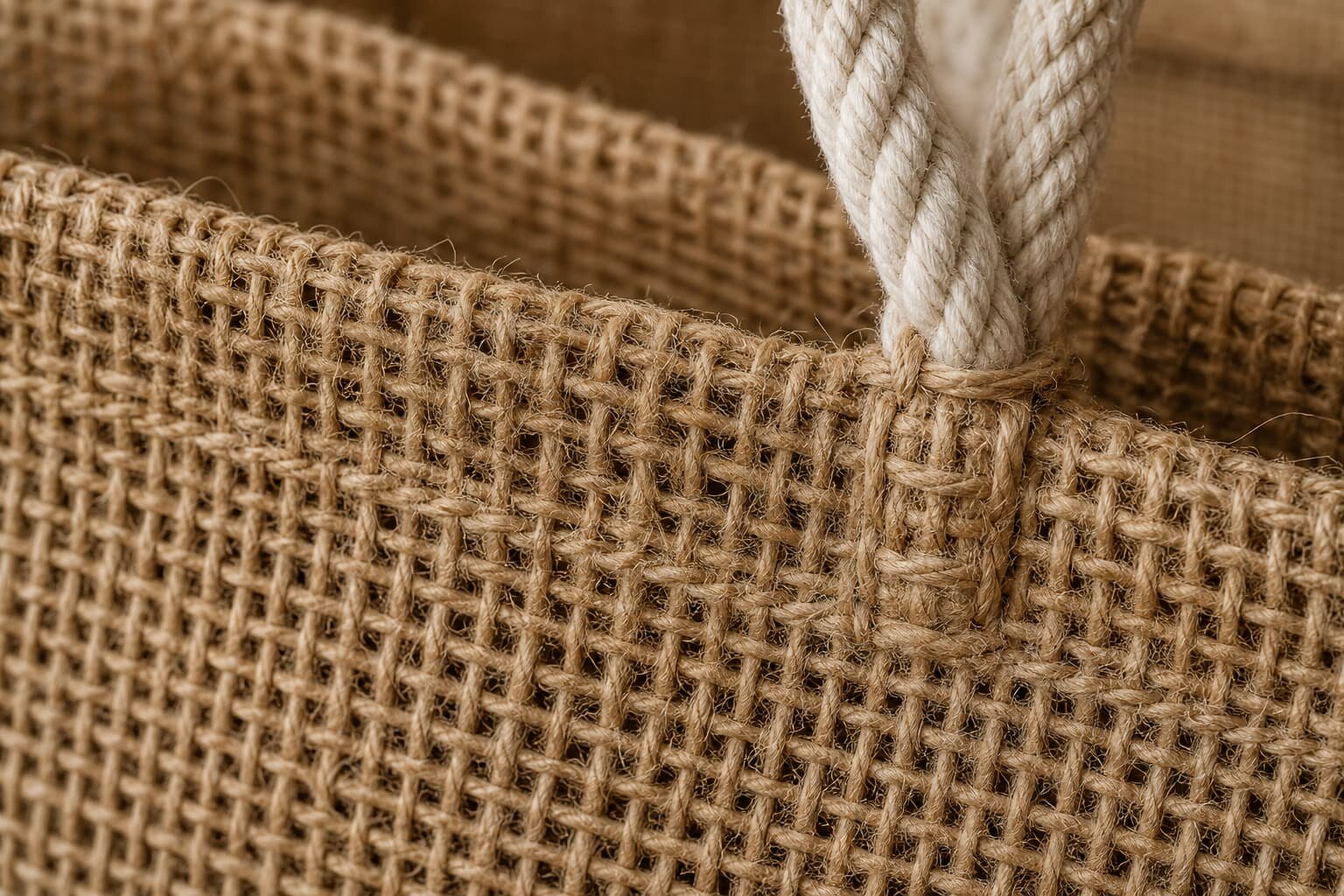
Why Seam Allowance Drift Becomes a Shipment Problem
Seam allowance drift means the distance between the stitch line and the raw jute edge is not consistent along the bag side seam. On a jute burlap bag, this is more serious than a neatness issue. Jute is coarse, open-weave, and less forgiving than cotton canvas. If the operator feeds the panel unevenly or the fabric stretches against the sewing guide, the allowance can narrow at one section and widen at another. The finished bag may still look acceptable from the front, but the weak area can open, fray, or distort after loading.
For buyers, the shipment risk appears late. Sales samples often come from a skilled sample machinist, while bulk production is sewn by line operators under speed pressure. If the RFQ only says natural jute bag, size 35 x 40 cm, logo printed, the supplier may quote a basic seam and assume normal commercial tolerance. A jute burlap bag seam allowance drift shipment memo gives both sides a practical release record before cargo leaves the factory. It does not need to be complicated, but it must define what was checked, how it was measured, and what was accepted.
- A narrow seam allowance can cause side seam fraying, especially on unlaminated burlap.
- A drifting seam can reduce finished bag width and make printed logos look off-center.
- A wide allowance can create bulky corners and uneven folding in cartons.
- A shipment memo protects the buyer when the issue is visible before dispatch but not written into the PO.
- The goal is not zero variation; the goal is a tolerance both buyer and factory can actually hold.
Define the Bag Before You Define the Tolerance
Seam allowance cannot be judged properly without knowing the bag type. A lightweight jute favor pouch, a wine bottle burlap bag, and a laminated jute grocery tote do not need the same allowance or reinforcement. Procurement teams should start by describing the finished use: retail gift packaging, supermarket promotion, reusable shopping, wine bottle presentation, or distributor blank stock. The heavier the intended load and the looser the weave, the more important the side seam construction becomes.
Fabric weight also changes sewing behavior. A 220 GSM burlap may be easier to fold but may pull out near the stitch line if the allowance is too narrow. A 300 GSM laminated jute panel holds shape better, but it can be bulky at the seam and may show creasing if over-compressed. Many quote disputes happen because one supplier priced 270 GSM unlaminated jute with a simple overlock, while another priced 320 GSM laminated jute with bound seams. Both may call it a jute burlap bag, but the production risk and cost are not the same.
- For light gift or event bags, 220-260 GSM jute may be acceptable if load is low.
- For reusable retail shopping bags, 270-320 GSM is a more common working range.
- For wine bags, seam allowance must match bottle weight and base construction, not just bag height.
- Laminated jute reduces fraying but can crack or crease if the seam is forced too tightly.
- Unlaminated burlap needs better edge control because yarns can loosen outside the stitch line.
Set Practical Seam Allowance Acceptance Criteria
A useful buyer specification should include both a target seam allowance and an allowable drift. For many standard jute burlap bags, a finished side seam allowance around 10-12 mm is practical when combined with overlock or internal edge binding. A wider allowance may be needed for heavy loads or coarse loose-weave burlap. A very tight 5 mm allowance may look efficient on paper, but it leaves little margin when fabric yarns move during sewing or trimming.
The acceptance rule should be measurable. Instead of writing good sewing or straight seam, state where the factory should measure and what is allowed. For example: measure inside side seam allowance at 5 cm below the opening, center height, and 5 cm above the bottom seam. No measured point below 8 mm. Maximum drift within one side seam 3 mm. No exposed loose yarns outside the overlock. This gives QC staff a way to approve or hold goods without arguing from photos alone.
- State target seam allowance, minimum seam allowance, and maximum drift within one seam.
- Measure both left and right side seams because operator feed can vary by direction.
- Measure after sewing and trimming, not only on cut panels before assembly.
- Use millimeters, not vague terms such as small, normal, or strong.
- Add a visual rule for frayed edges, skipped stitches, and raw yarns extending beyond the seam.
How Seam Drift Affects Size, Print, and Retail Presentation
Buyers usually notice seam allowance drift when finished bags do not stack cleanly or the logo appears shifted. The root cause may be sewing, not printing. If the artwork was printed on a flat panel before sewing and the side seam later consumes more fabric on one side, the visible front panel becomes narrower or uneven. The logo may still be printed in the correct position on the panel, but it will not look centered on the finished bag.
This is why print placement should be referenced from the finished bag centerline or finished seam line, not only from the raw cut edge. For jute bags, common print methods include screen printing, heat transfer on laminated jute, and sometimes embroidery or sewn labels. Screen printing is cost-effective for simple solid logos, but the rough weave can soften edge detail. If the seam allowance drifts and the print is close to the side seam, the visual defect becomes more obvious. Good RFQs leave enough side margin for production reality.
- Keep logos away from side seams unless the design intentionally wraps or bleeds.
- For screen printing on jute, allow realistic edge softness because the weave is coarse.
- For laminated jute, confirm whether ink, heat transfer, or label application is suitable.
- Ask whether print is completed before sewing or after sewing; most flat panel printing is before sewing.
- Check print centering on finished samples, not just printed cut panels.
Sample Checks That Prevent Bulk Sewing Surprises
A buyer should not approve a jute burlap bag sample based only on front appearance. Turn the bag inside out, photograph both side seams, and measure the allowance in several places. If the bag has gussets, check where the side seam meets the bottom fold, because bulk and fabric movement often increase at corners. If the bag has cotton webbing handles, also inspect whether handle stitching pulls the jute panel and affects the top seam alignment.
For production orders, the most useful control point is a pre-production sample made from bulk fabric, bulk thread, bulk handle material, and the actual print method. A showroom sample may use cleaner fabric or hand-selected panels. The pre-production sample should represent the factory's intended mass production process. Procurement teams should keep one approved physical sample and require the supplier to keep a matching sealed sample at the sewing line. The shipment memo should refer back to that sample, not to an old catalog photo.
- Check seam allowance on the salesman sample, pre-production sample, and random bulk pieces.
- Ask for inside seam photos before full production if you cannot attend inspection.
- Confirm thread color and stitch density because loose thread can make seam drift worse.
- Record sample measurements in the approval email, not only by saying sample approved.
- If the first sample has borderline seam allowance, do not assume bulk will improve without a correction note.
MOQ and Quote Logic Behind Better Seam Control
Tighter seam control has a cost. It may require slower sewing speed, a guide plate, better operator training, more in-line checking, or seam binding. A factory may accept a small MOQ for a simple unprinted burlap bag, but the MOQ can increase when custom fabric GSM, dyed jute, laminated material, cotton handles, or multi-color printing is involved. Buyers should not ask for premium seam control while comparing only the lowest unit price.
A proper quote should show the drivers that affect both price and quality. Fabric weight, lamination, cutting loss, handle type, print method, seam reinforcement, packing quantity, and inspection requirement all matter. If Supplier A is cheaper, ask whether they included binding tape, overlock, print setup, sample cost, export carton, and moisture protection. Seam allowance drift is often a symptom of a quote that was pushed too low for the construction required.
- Small MOQ may be possible for stock natural jute, but custom GSM or dyed burlap usually changes the minimum.
- Screen printing cost depends on color count, print area, screen setup, and whether both sides are printed.
- Binding tape adds material and labor but gives a cleaner internal seam for premium bags.
- Heavier GSM increases fabric cost and carton weight, affecting both product and logistics cost.
- A cheap quote without seam details is not equal to a quote that includes measured seam acceptance.
Build a Shipment Memo That QC Can Actually Use
The shipment memo should be short enough for the factory to complete but specific enough to support release. It should include PO number, item name, approved sample date, fabric GSM, print method, finished size, seam allowance criteria, inspection quantity, defect summary, packing method, carton count, and photo list. For a jute burlap bag seam allowance drift shipment memo, the key section is the measurement record. Ask the factory to measure multiple random pieces and show inside seam photos with a ruler.
The memo should not replace third-party inspection when the order value or retail risk is high. It is a factory declaration and buyer communication tool. However, it is very useful for repeat orders, distributor replenishment, and lower-volume custom programs where a full inspection is not always used. If the memo shows drift outside the agreed tolerance, the buyer can hold shipment, request sorting, approve with concession, or negotiate rework before the goods are loaded.
- Include measured values, not only pass or fail.
- Require photos from random cartons, not only one perfect sample from the sample room.
- List any corrective action taken during sewing, such as guide reset or operator retraining.
- Separate major defects from minor visual variation so the decision is commercially balanced.
- Make the memo due before balance payment, booking confirmation, or cargo handover.
Packing and Lead Time Details Buyers Often Miss
Jute bags can be damaged by poor packing even when sewing is acceptable. Over-compression can crease laminated panels, bend handles, and distort side seams. Loose packing can create abrasion between printed panels. For printed jute bags, ask whether the factory will use interleaving paper, inner polybags, or bundle packing. For export cartons, specify carton strength, carton marks, quantity per carton, and whether desiccant is needed for humid routes or storage conditions.
Lead time should allow for material preparation, printing, drying, sewing, trimming, inspection, and packing. Buyers sometimes approve a late sample and still expect the original ship date. That creates pressure on the sewing line and increases the chance of seam allowance drift. A practical schedule gives the factory enough time to set the sewing guide, run an initial batch, inspect it, and correct the line before completing the full order. If the shipment memo is required, reserve time for photo review and possible sorting.
- Ask for lead time counted from sample approval and deposit or artwork confirmation, not from first inquiry.
- Reserve extra time for multi-color printing, large ink coverage, or humid weather drying conditions.
- Avoid packing too many jute bags per carton if it crushes seams or handles.
- Confirm whether cartons are packed flat, folded, bundled, or individually polybagged.
- Request carton photos before shipment, including open carton view and carton mark view.
Common Mistakes That Create Disputes After Arrival
The most common buyer mistake is approving a beautiful outside photo without inspecting the inside seam. The second is using finished size tolerances without linking them to seam allowance. A bag can technically fall within size tolerance but still have a weak seam at one point. Another common mistake is changing fabric GSM or lamination after sampling without asking how the change affects sewing. Coarser or stiffer material may require a revised seam setup.
Factories also make avoidable mistakes. They may cut panels correctly but sew too fast, use inconsistent edge trimming, or allow operators to follow the fabric edge instead of a fixed guide. In jute, the raw edge is not always straight because the weave can shift. If the operator chases the edge, the seam line may wander. The buyer's RFQ and shipment memo should push the factory toward measuring from the stitch line and finished edge, not trusting visual alignment alone.
- Do not approve bulk based on one top-layer carton sample.
- Do not allow print placement approval before confirming final seam construction.
- Do not compare quotes if one includes bound seams and another uses simple overlock.
- Do not ignore minor fraying on samples; it usually becomes worse in bulk handling.
- Do not accept vague repair promises without a second inspection or photo record.
A Buyer-Friendly Workflow From RFQ to Release
A strong sourcing workflow starts with a clear RFQ: finished size, fabric GSM, lamination, color, handle material, seam type, print method, artwork size, packing, MOQ target, and required shipment memo. Ask suppliers to quote the same specification and identify any proposed alternative. If a supplier suggests a lower GSM or different seam, treat it as an alternate quote, not the same product. This makes comparison easier for procurement, merchandising, and quality teams.
After quote selection, approve a pre-production sample with written measurement data. During production, request first-batch photos before the factory completes the full quantity. Before shipment, review the memo and random inspection photos. If the goods meet the agreed tolerance, release is straightforward. If there is limited drift but no functional risk, the buyer can make a commercial decision with evidence. If there is narrow seam allowance, fraying, or print distortion, the buyer has grounds to request sorting, rework, discount, or remake before shipping.
- RFQ stage: define construction and acceptance criteria before asking for price.
- Sampling stage: measure seam allowance and print position on the finished bag.
- Production stage: check first-batch sewing before the full line repeats the same error.
- Pre-shipment stage: require memo photos, measurement record, carton details, and defect notes.
- Repeat order stage: reuse the approved memo as a baseline but recheck when fabric batch changes.
Specification comparison for buyers
| Spec decision | Recommended option | When it fits | Buyer risk to check |
|---|---|---|---|
| Side seam allowance | 10-12 mm finished seam allowance with overlock or bound internal edge | Standard retail jute shopping bags, wine bags, and promotional burlap totes | If allowance drifts below 7 mm after trimming, the seam may fray or burst under load |
| Fabric weight | 270-320 GSM laminated or unlaminated jute depending on structure | Reusable grocery bags, gift bags, brand packaging, and distributor stock programs | Lower GSM may stretch during sewing and exaggerate width variance after filling |
| Seam construction | Lockstitch plus overlock for light bags; binding tape for premium or heavy-load bags | Overlock fits cost-sensitive programs; binding fits gift, wine, and retail presentation bags | Quotes may look cheaper because binding tape, extra labor, or seam reinforcement is omitted |
| Print placement | Reference print from finished seam line, not raw cut edge | Logo bags where side margin and front panel centering matter | If print is aligned to cut panels, seam drift can shift visible logo position after sewing |
| Sampling approval | Measure seam allowance on pre-production sample, pilot run, and packed goods | Any order above sample quantity, especially repeat distributor orders | A nice salesman sample does not prove the bulk sewing line is holding the same guide setting |
| Packing method | Flat pack with interleaving for printed panels; avoid over-compression of coarse jute | Export cartons for retail bags, gift packaging, and bags with large ink coverage | Compressed cartons can deform side seams and make borderline seam drift more visible during unpacking |
Buyer checklist before sampling
- State the finished bag size, acceptable tolerance, and whether dimensions are measured empty, flat, and after light hand smoothing.
- Specify fabric weight in GSM, lamination status, handle material, handle drop, seam type, and required seam allowance range.
- Ask the factory to confirm whether print placement is measured from the finished seam, bag centerline, or panel cut edge.
- Require pre-production photos showing inside side seams with a ruler at top, middle, and bottom positions.
- Set an acceptance rule for seam allowance drift, for example no more than 3 mm variation within one side seam and no exposed loose jute yarns.
- Ask for carton packing method, units per carton, compression level, carton size, gross weight, and moisture protection method.
- Include a shipment memo requirement before balance payment or cargo release, covering seam checks, size checks, print alignment, and packing photos.
- Confirm whether any repair, re-trim, or re-sewing is allowed, and whether repaired goods must be separated and labeled for buyer review.
- Compare supplier quotes using the same seam construction, not only the same bag size and GSM.
- Keep an approved sample, sealed pre-production sample, and shipment memo photos in the same quality file for future repeat orders.
Factory quote questions to send
- What finished seam allowance range will you hold on the jute burlap bag side seams, and how will it be measured during production?
- Is the quoted bag made from laminated or unlaminated jute, and what is the confirmed fabric weight in GSM before cutting?
- Will the side seam be lockstitched, overlocked, taped, or bound, and is that construction included in the quoted price?
- How do you control seam allowance drift on coarse jute fabric during sewing: folder, guide plate, operator marking, or manual alignment?
- What is your MOQ for this construction and print method, and does the MOQ change if we require tighter seam tolerance or binding tape?
- Can you provide pre-production sample photos showing seam allowance at the top, middle, and bottom of both side seams?
- For printed bags, will artwork placement be measured from the finished bag centerline, the side seam, or the cut panel edge?
- What is your normal production lead time after sample approval, and how many days should be reserved for drying, inspection, and packing?
- How many pieces per carton will you pack, and will printed panels be interleaved or protected against ink rub and seam distortion?
- What quote data can you provide separately for fabric, printing, handle, seam reinforcement, packing, inland cost, and export carton?
Quality-control points to confirm
- Measure finished bag width and height after smoothing the bag flat, not by pulling the jute fabric under tension.
- Check side seam allowance at top, middle, and bottom; record both left and right seams because drift often appears on only one side.
- Inspect for loose jute yarns caught outside the stitch line, especially where the seam allowance narrows near the bag mouth.
- Confirm stitch density and thread tension are consistent; loose stitches on open-weave burlap can move under handling.
- Check print position after sewing, not only before sewing, because seam allowance drift changes visible panel width.
- Test handle attachment and side seam together with a practical loading check based on intended use, not only visual inspection.
- Compare bulk pieces against the approved pre-production sample for seam shape, corner squareness, and side panel symmetry.
- Review carton packing pressure; over-tight packing can crease laminated jute and make side seam distortion more obvious.
- Require clear shipment memo photos of measured seams, carton labels, packed cartons, and random selected finished bags.