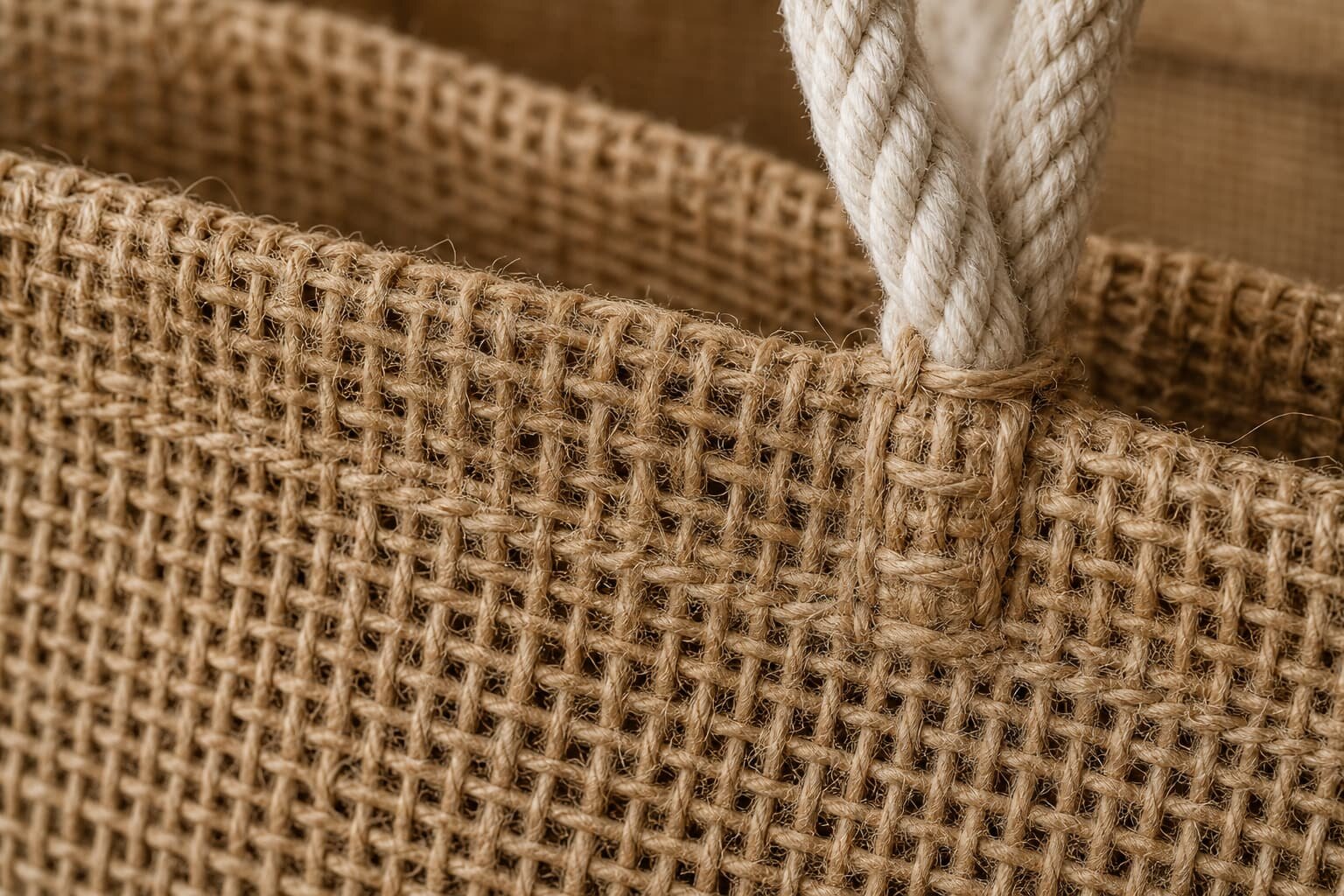
Why Seam Allowance Deserves a Separate Audit
A jute burlap bag seam allowance audit is not a cosmetic check. It is a structural buying control. Jute is a coarse woven fabric with thicker yarns and more movement than smooth cotton canvas. If the factory trims the allowance too close, the seam may look acceptable on the table but start opening at the corners, top hem, or gusset after packing and retail handling.
Many importers compare jute bag quotes by size, GSM, handle type, and print method, then assume the sewing construction is equal. It is not. Two suppliers can quote the same 35 x 40 x 15 cm jute tote in 300 GSM fabric, but one may use a 12 mm allowance with a protected raw edge while another may use 6 mm to save fabric and sewing time. The first bag may carry groceries cleanly; the second may show fraying after one or two uses.
- Audit seam allowance before bulk cutting, not after the shipment is packed.
- Treat seam allowance as a quoted specification, not a hidden factory habit.
- Check the inside of the bag because outside photos rarely show the risk.
- Separate seam allowance tolerance from finished size tolerance in the purchase order.
Define the Bag Size Before You Audit the Seam
The first mistake is auditing seam allowance without confirming which size the factory has quoted. For jute burlap bags, suppliers may describe size as finished outside dimensions, flat panel size, or approximate usable capacity. These are not the same. A buyer ordering retail gift bags or grocery totes needs the finished size after sewing, folding, and top hemming.
If the supplier calculates fabric consumption from cut panel size but the buyer approves only finished size, arguments can start when the pre-production sample arrives smaller than expected. The seam allowance consumes fabric. A wide top hem, deep gusset, and reinforced bottom all reduce the usable interior if they were not planned at the drawing stage. The audit should therefore start with a clear size drawing.
- State bag width as finished flat width across the front panel.
- State height excluding handle unless handle height is specifically included.
- State gusset depth as finished side or bottom depth after sewing.
- State handle drop separately from handle length.
- State whether size tolerance is plus or minus 5 mm, 10 mm, or another agreed range.
Recommended Seam Allowance by Bag Area
There is no single seam allowance that fits every jute bag, but common buying ranges are practical. For many 260-320 GSM natural jute totes, a side seam allowance around 10-12 mm gives enough fabric for stable sewing and edge protection. Bottom seams and gusset joins often need equal or slightly stronger control because the load concentrates there when the bag is filled.
Top hems usually require more material than side seams. A 25-35 mm folded top hem helps stabilize the bag mouth and provides a stronger base for handle stitching. For small lightweight giveaway pouches, a narrower hem may be acceptable. For supermarket totes, wine carriers, jar bags, or structured retail bags, the top hem should not be reduced just to save fabric.
- Side seam: commonly 10-12 mm finished allowance for standard totes.
- Bottom seam: commonly 12-15 mm where load and corner stress are higher.
- Top hem: commonly 25-35 mm depending on handle type and bag size.
- Gusset seam: keep allowance even on both sides to prevent twisting.
- Drawstring burlap pouches: casing allowance must suit cord diameter and opening smoothness.
Fabric Weight, Weave, and Lamination Change the Sewing Risk
Jute fabric weight is often quoted in GSM, but GSM alone does not guarantee seam strength. A 300 GSM open-weave jute can fray more easily than a tighter 280 GSM cloth. Natural burlap texture is part of the product appeal, yet that same open structure means the raw edge needs proper overlock, binding, or folding. Buyers should ask for a fabric swatch and inspect weave density, not only rely on the GSM number in a quote.
Laminated jute behaves differently from unlaminated jute. A laminated backing can reduce fraying and improve structure, but it can also crack or crease if folded too sharply during packing. Laminated fabric may need different needle settings and seam handling. If a supplier switches from unlaminated to laminated jute to improve print surface or stiffness, the seam allowance and folding plan should be checked again.
- 260-280 GSM: often used for lighter promotional bags and simple retail packaging.
- 300-320 GSM: common for stronger shopping totes and private label jute bags.
- Higher GSM: useful for structure, but sewing bulk and carton volume increase.
- Lamination: improves shape and print surface but needs packing and crease review.
- Dyed jute: check color fastness and shrink behavior before approving seam tolerances.
Print Placement Must Respect the Seam Allowance
A seam allowance audit is also a print placement audit. On jute burlap bags, logos are often screen printed, heat transferred, sewn as a cotton patch, or applied as a woven side label. If artwork is positioned using the cut panel edge instead of the finished edge, the logo may shift after sewing. On gusset bags, the printed front panel can look centered while the filled bag shows the artwork too close to one fold.
Natural jute has an uneven surface, so print clarity is already less precise than on smooth cotton canvas. A buyer should protect the brand area by defining a safe distance from side seams, bottom folds, top hem, and gusset creases. For basic one-color screen print, a 15-25 mm safe area is often practical, depending on bag size and artwork detail. For small text, QR codes, or fine lines, jute may not be the best surface unless a cotton panel or label is added.
- Screen print: economical for simple logos, but avoid tiny type on rough burlap.
- Heat transfer: can work on prepared panels, but test adhesion and surface flatness.
- Cotton patch print: useful when the logo needs sharper detail than jute allows.
- Woven label: good for repeat branding, but placement must avoid seam bulk.
- Embroidery: possible on some constructions, but may distort open jute weave.
Sample Approval: What to Measure and Photograph
A good jute bag sample approval should include more than front and side beauty photos. Ask the factory to turn the bag inside out and photograph the side seam, bottom corner, top hem, and gusset join with a ruler visible. If the supplier is confident in its construction, this request is normal. If the factory avoids inside photos, the buyer should slow down approval.
For private label or distributor programs, approve a sample made with the same GSM, same handle webbing, same thread, same print process, and same packing fold planned for bulk production. A showroom sample from similar fabric is not enough for a seam allowance audit. The pre-production sample should represent the production line method, not just the sample room's best sewing operator.
- Measure seam allowance in at least three positions on each critical seam.
- Check whether raw jute edges are fully caught by overlock or binding.
- Load the bag with the intended product weight and observe corner stress.
- Photograph the printed logo after the bag is filled, not only when flat.
- Record sample measurements in the approval sheet and keep the sealed sample.
MOQ Logic and Why Low Quotes Often Cut Sewing Detail
MOQ for jute burlap bags is influenced by fabric availability, dyeing, lamination, handle material, print setup, and carton packing efficiency. A simple natural jute tote with common cotton webbing handles may have a lower MOQ than a dyed jute bag with custom rope handles and a woven label. When buyers push a low MOQ with a customized structure, factories may try to control cost by simplifying sewing details.
A quote that is much lower than other offers may not be wrong, but it needs explanation. The saving may come from lighter GSM, narrower seam allowance, fewer stitches per inch, no reinforcement at the handle, cheaper thread, reduced packing protection, or looser inspection. Buyers should ask the supplier to confirm what is included rather than assuming the same construction across quotes.
- Fabric MOQ: natural stock jute is usually easier than dyed or laminated custom fabric.
- Print MOQ: screen setup and color changes affect small runs.
- Handle MOQ: custom color webbing, rope, or tape can drive minimums.
- Sewing MOQ: unusual gussets and reinforcements slow production.
- Packing MOQ: custom cartons, inserts, or retail-ready bundles add setup work.
Packing Can Hide or Create Seam Problems
A bag that passes sewing inspection can still arrive with deformed gussets or stressed seams if packed incorrectly. Jute burlap is bulky and textured. If the factory compresses too many pieces into one export carton, folded gussets can be crushed and top hems can crease sharply. Laminated jute is especially sensitive because repeated hard folding may leave visible lines.
Packing should be discussed before the final quote, not after production. The number of pieces per carton affects freight cost, carton strength, warehouse handling, and product presentation. For retail buyers, a distorted bag may be unacceptable even if the seam is technically intact. For distributors, inconsistent folding makes repacking and customer sampling harder.
- Confirm flat packing, half-fold packing, or gusset-fold packing before approval.
- Ask for carton dimensions, gross weight, net weight, and pieces per carton.
- Avoid over-compression for laminated jute or structured retail bags.
- Use inner polybags only when needed and compliant with destination rules.
- Check first carton packing photos before the full shipment is packed.
Lead Time Control From Sample to Bulk Shipment
Lead time for jute burlap bags depends on the material and customization. Stock natural jute, standard handles, and one-color screen printing can move faster than dyed jute, laminated structures, multi-panel sewing, or custom labels. Buyers should not approve bulk cutting until seam allowance, print placement, handle stitching, and packing method are all locked.
A realistic sourcing timeline includes artwork confirmation, fabric swatch approval, sample making, sample courier time, pre-production sample approval, bulk fabric preparation, cutting, printing, sewing, trimming, inspection, packing, and export documentation. If the order is seasonal or tied to a retail launch, the seam allowance audit should be completed during sampling, not pushed into final inspection when correction is expensive.
- Ask which materials are stock and which require new production.
- Separate sample lead time from bulk production lead time.
- Confirm whether printing happens before or after sewing.
- Reserve time for pre-production sample corrections.
- Do not release bulk cutting until the approved seam standard is documented.
How to Compare Quotes Using Seam Allowance Data
A useful quote comparison sheet should include more than unit price. For jute burlap bags, list finished size, fabric GSM, lamination, handle material, print method, seam allowance, seam finish, top hem width, carton packing, sample cost if any, MOQ, lead time, and inspection tolerance. This allows procurement teams to see whether a cheaper quote is truly efficient or simply thinner in construction.
When two suppliers quote different prices, ask each to mark its construction on a simple bag drawing. A factory that can explain cut size, finished size, seam allowance, and sewing sequence usually understands production risk better than a supplier that only repeats catalog dimensions. The goal is not to demand the thickest seam on every bag. The goal is to buy the right seam construction for the intended load, brand position, and retail channel.
- Compare cost by confirmed construction, not by product name only.
- Request a seam allowance line item or clear written specification.
- Check whether sample construction matches quoted bulk construction.
- Ask for carton data because packing density changes landed cost.
- Use the same inspection standard for all shortlisted suppliers.
Specification comparison for buyers
| Spec decision | Recommended option | When it fits | Buyer risk to check |
|---|---|---|---|
| Side seam allowance | 10-12 mm finished allowance with overlock or bound edge | Most retail jute totes, grocery bags, wine carriers, and promotional burlap bags | If the factory quotes only outer size, finished capacity may shrink or seams may fray after loading |
| Bottom seam construction | Folded bottom with 12-15 mm allowance, reinforced corners for heavy loads | Bags carrying bottles, jars, books, produce, or gift sets above light giveaway weight | Narrow allowance at the bottom is hard to see in photos but causes corner burst and uneven standing base |
| Gusset allowance | Separate gusset panel with consistent allowance on both sides | Boxy shopping bags, lunch bags, gift bags, and shelf-display jute bags | Uneven allowance twists the gusset and makes the printed front panel look off-center |
| Top hem allowance | 25-35 mm folded top hem depending on fabric weight and handle type | Cotton webbing handles, rope handles, or laminated jute styles needing stable mouth opening | Too small a hem makes handle reinforcement weak; too large a hem may reduce usable bag height |
| Fabric weight | 260-320 GSM jute for common totes; higher GSM or lamination for structured retail bags | Buyers needing a balance of natural texture, printability, and cost control | Heavy fabric cannot compensate for poor seam allowance; quotes must separate GSM from sewing method |
| Print placement allowance | Artwork kept away from seam lines by agreed safe distance, usually 15-25 mm | Screen print, heat transfer patch, woven label, or cotton canvas panel branding | Logos may be swallowed into the side seam or distorted when the bag is filled |
| Inspection tolerance | Define finished size tolerance and seam allowance tolerance separately | Any repeat order, private label program, or distributor stock item | A bag can pass finished size tolerance while hiding weak internal seam allowance |
Buyer checklist before sampling
- Confirm whether quoted dimensions are finished outside size, usable inside size, or cut panel size.
- Ask the supplier to state seam allowance for side seam, bottom seam, gusset seam, and top hem separately.
- Request inside-out sample photos showing the allowance, overlock, binding, and corner finish before sample approval.
- Measure the approved sample after flattening and after loading with the target product weight.
- Check whether print position was measured from finished edge or cut panel edge.
- Confirm jute GSM, lamination if used, handle material, handle stitch pattern, and seam construction in one spec sheet.
- Approve a pre-production sample made from bulk fabric, not only a showroom sample.
- Add seam allowance checks to incoming QC or final random inspection, not only visual appearance checks.
- Review export carton packing because tight compression can deform gussets and stress narrow seams.
- Keep one signed sealed sample with seam allowance notes for dispute control during repeat orders.
Factory quote questions to send
- What seam allowance will you use at side seams, bottom seam, gusset joins, and top hem after sewing?
- Are the dimensions in your quotation finished bag size or cut fabric panel size?
- What jute fabric GSM is included in the quote, and is the fabric laminated, dyed, washed, or untreated natural jute?
- Which seam finish is included: overlock, lockstitch plus overlock, bound seam, French seam, or another method?
- How far will the printed logo or label be kept from the seam and gusset fold line?
- What MOQ applies to this fabric weight, handle material, print method, and bag size combination?
- Can you provide inside-out sample photos and a short seam measurement video before bulk cutting?
- Will the pre-production sample be made from bulk fabric and actual production thread?
- How many pieces per export carton will be packed, and will bags be folded in a way that stresses the gusset seams?
- What inspection tolerance do you accept for seam allowance, finished size, handle placement, and print position?
Quality-control points to confirm
- Measure seam allowance on approved sample, pre-production sample, and random bulk pieces cut open or inspected inside-out.
- Check side seam and gusset seam symmetry so the bag does not twist when filled.
- Pull and flex the bottom corners because narrow allowance often fails there before handle stitches fail.
- Confirm overlock thread covers the raw jute edge fully; exposed jute yarns can unravel during use.
- Verify print safe area after sewing, not only on the flat cut panel before stitching.
- Measure finished dimensions under the same method agreed in the purchase order: flat width, gusset depth, height excluding handle, and handle drop.
- Check packed bags after carton compression for distorted top hems, crushed gussets, and seam puckering.
- Retain failed and passed examples with photos so the factory understands the acceptance standard before shipment.