Define the Retail Delivery Packet Before Asking for Price
A jute burlap bag retail delivery packet is not the same product as a shopping tote or a heavy promotional sack. It is usually a compact packaging bag used to hand over goods at a retail counter, present a gift bundle, hold a small product set, or add a reusable natural-fiber layer inside ecommerce packaging. The buying mistake is treating it as a generic burlap bag and asking several factories for a quick unit price without fixing the size, closure, fabric weight, print area, and packing method.
Procurement teams should start with the product journey. If the packet only moves from counter to customer, a lightweight open-mouth or drawstring style may work. If it will travel inside a courier carton, the fabric must resist creasing, print rub, and moisture transfer. If it touches cosmetics, tea, soap, apparel, or bakery gift packaging, the inside cleanliness and fiber shedding matter as much as the outside logo.
- Use the term retail delivery packet when the bag is part of product handover or gift packaging, not a load-bearing shopping bag.
- State whether the packet is primary packaging, secondary packaging, or only a branded outer presentation layer.
- Tell the supplier the packed product weight, product dimensions, and whether the packet must stand, fold, hang, or close.
- Do not compare quotes until each factory confirms the same construction style and same finished size.
Choose the Correct Jute GSM for the Product Weight
Jute burlap weight is one of the biggest cost and quality drivers. For small retail delivery packets, many buyers work around 230-280 GSM when the contents are light, such as soap bars, small cosmetics, tea packs, stationery, candles, or sample kits. For heavier boxed goods, wine accessories, larger candles, or multi-piece gift sets, 300-340 GSM gives better body and seam holding. Going heavier than needed can make the packet stiff, bulky in cartons, and more expensive to ship.
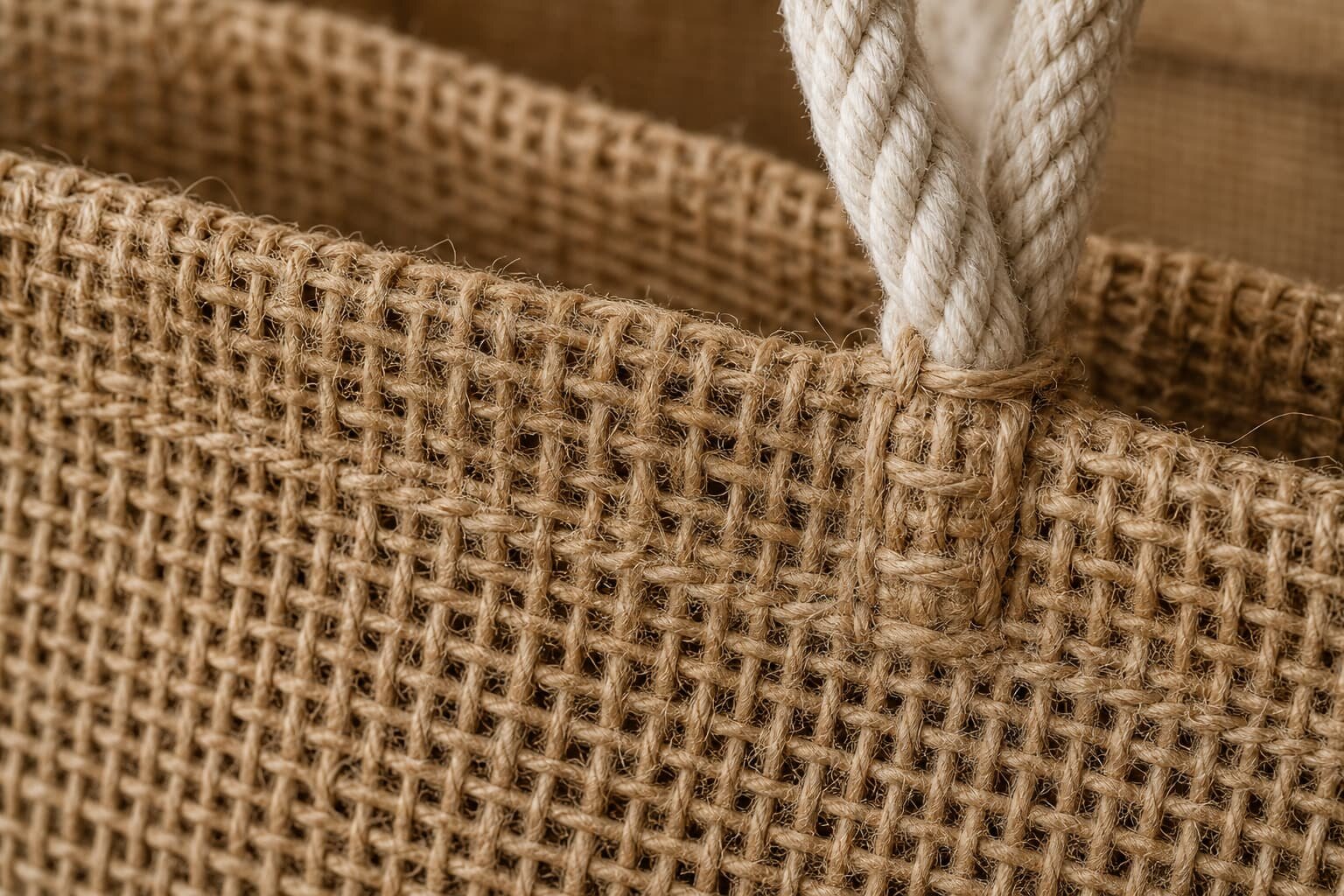
GSM alone does not tell the whole story. Loose weave jute may feel rustic but shed more fibers and distort more easily during printing. Tighter weave improves print edges and shape stability but may cost more and feel less rough. Buyers should request physical swatches for the exact quoted quality, not a random showroom sample. If the retail program has repeat orders, keep an approved fabric swatch with the PO file so the next production run is compared against a real standard.
- 230-250 GSM: suitable for very light gift packets, product sleeves, and low-load retail inserts.
- 260-280 GSM: common middle range for branded retail handover packets with simple printing.
- 300-340 GSM: better for heavier boxed goods, premium presentation, or packets that need a firmer shape.
- Ask for tolerance on GSM and shade because natural jute varies by batch and season.
- Avoid selecting the lowest GSM only to reduce unit price if the packet must carry or protect the product.
Size the Packet From the Packed Product, Not the Catalog
A catalog size can be misleading because a flat jute packet loses usable space after side seams, bottom seam, hem, drawcord channel, and fabric thickness. A packet listed as 20 x 30 cm may not comfortably fit a 20 cm tall box if there is a closure fold or drawstring at the top. The buyer should provide the product dimensions and the required clearance, then ask the factory to recommend the finished outer size and usable inner size.
For retail delivery packets, oversizing also creates problems. A bag that is too large may look cheap, wrinkle around the product, and increase carton volume. A bag that is too tight may tear at the bottom corners or make store staff struggle during packing. For repeat retail use, the most reliable approach is to make a blank size sample first, test it with the actual product, then approve print layout after the physical fit is confirmed.
- Provide product length, width, height, and packed weight in the RFQ.
- Specify whether the packet must close fully after the product is inserted.
- Ask the factory to mark finished outer size and usable inner size separately.
- Set size tolerance by product type; small packets usually need tighter control than large sacks.
- Test the packet with real retail staff if speed of packing at checkout matters.
Match Construction Style to the Delivery Channel
The simplest jute burlap retail delivery packet is a flat stitched pouch with an open mouth. It is cost-efficient and works when the product is handed over directly or inserted into another carton. A drawstring packet adds closure and a more finished gift appearance, but it adds cord cost, sewing time, and another quality point. A flap, button, Velcro, snap, or cotton lining can improve function, but each feature should solve a real retail problem rather than decorate the sample.
For heavier contents, bottom construction matters. A flat bottom seam may be enough for small goods, while a boxed bottom or small gusset helps the packet stand and reduces stress at corners. If the buyer expects the packet to carry weight like a tote, the design should be changed to a proper jute bag with handles. A retail delivery packet should not be over-specified into a miniature shopping bag unless the budget and MOQ support the extra labor.
- Open mouth: lowest complexity, best for inserts, counter handover, and products placed inside another shipper.
- Drawstring: good for gifts and kits, but check cord pull, knot security, and channel stitching.
- Gusseted packet: useful when boxed goods need a stable base or better shelf presentation.
- Lined packet: cleaner interior, but higher cost and longer sewing time.
- Handle style: only add handles if the packet must be carried independently by the consumer.
Print Method: Keep the Logo Practical on Coarse Jute
Most jute burlap retail delivery packets use one-color or two-color screen printing. Screen print is economical, durable enough for retail presentation, and suitable for bold logos. The limitation is detail. Fine type, thin outlines, small QR codes, and gradient artwork do not print cleanly on coarse jute. The buyer should send vector artwork and ask the supplier to confirm minimum line thickness and expected edge quality before approving the order.
Heat transfer, woven labels, cotton labels, or leather-look patches can be used when the logo has small details or when the brand wants a cleaner finish. These options raise the unit cost and may change the MOQ because labels or patches have their own production minimums. For a natural jute packet, a simple black, dark green, dark brown, or white print often gives the most stable result. Metallic inks and heavy ink coverage should be tested because they can crack, feel stiff, or look uneven on the fabric surface.
- Use screen print for bold logos, store names, simple icons, and single-color retail programs.
- Use sewn labels when the logo is detailed or when jute texture would make print edges unacceptable.
- Avoid small QR codes unless a printed label or hangtag is used instead of direct jute printing.
- Request print position tolerance, especially for small packets where a few millimeters are visible.
- Approve a strike-off or printed sample before bulk if the artwork is new.
Understand MOQ Logic Before Comparing Supplier Quotes
MOQ for jute burlap bag retail delivery packets is not only a factory preference. It is affected by fabric sourcing, cutting efficiency, printing setup, accessory procurement, packing labor, and export carton handling. A plain unprinted packet in a common size may be possible at a lower MOQ than a dyed, lined, drawstring packet with custom labels. If a supplier accepts a very low quantity, the unit price may include setup charges hidden inside the product cost.
Buyers should ask suppliers to separate standard MOQ, sample MOQ, trial order MOQ, and price break quantities. This makes quote comparison cleaner. For example, the factory may offer one unit cost at 1,000 pieces, another at 3,000 pieces, and a better cost at 5,000 or 10,000 pieces because cutting, printing, and carton packing become more efficient. The best quote is not always the lowest unit price; it is the one that explains what changes when quantity changes.
- Ask whether MOQ is driven by jute fabric, printing setup, cord color, label production, or carton packing.
- Request price breaks for practical buying levels instead of only one quantity.
- Separate one-time sample, artwork screen, mold, or label setup charges from the unit price.
- Confirm whether mixed artwork or mixed sizes can share the same MOQ.
- Check whether reorder pricing assumes the same fabric, same print screen, and same packing method.
Build the Quote Sheet Around Cost Drivers
A useful quote for a jute burlap retail delivery packet should show more than FOB unit price. It should identify fabric GSM, finished size, construction, print method, number of print colors, accessories, packing, carton dimensions, estimated gross weight, sample cost, lead time, and validity period. Without these fields, two quotes that look similar may represent different fabric weights, different carton packing density, or different print assumptions.
For importers and distributors, carton data is especially important. A small reduction in unit price can be lost if the packets are packed inefficiently and occupy more container or courier volume. Retail buyers should also check whether the supplier includes inner polybags, paper bundle wraps, carton labels, desiccants if needed, and retailer-specific carton marks. These details affect warehouse receiving and store replenishment, not only factory production.
- Quote line one: finished size, gusset if any, GSM, lamination or lining, and closure type.
- Quote line two: print method, colors, print size, artwork setup, and sample strike-off cost.
- Quote line three: accessories such as drawcord, eyelets, labels, buttons, hangtags, or inserts.
- Quote line four: packing quantity per carton, carton size, gross weight, and pallet note if required.
- Quote line five: sample lead time, bulk lead time, payment terms, trade term, and quote validity.
Sample Approval Should Check Use, Not Only Appearance
A jute packet can look acceptable in a photo and still fail during retail use. The sample should be packed with the actual product, opened and closed repeatedly, handled by the store or warehouse team, and rubbed against adjacent packaging. Buyers should check whether the packet sheds fibers onto the product, whether the smell is acceptable, whether the logo remains readable, and whether the seams distort when filled.
A proper sample process can use three stages. First, approve fabric and size with a blank sample. Second, approve artwork and print position with a strike-off or printed sample. Third, approve a pre-production sample made with the same material and accessories planned for bulk. For small orders, the buyer may combine stages, but the risks should be understood. Skipping sample approval is rarely worth the time saved if the packet is customer-facing.
- Check the sample in real lighting, not only under factory photo lighting.
- Insert the actual product and confirm closure, fit, and shape after packing.
- Rub the print with dry and slightly damp white cloth to screen for transfer risk.
- Smell the packet after it has been sealed in a bag for several hours.
- Keep one sealed approved sample at the factory and one with the buyer for final inspection reference.
Packing and Carton Planning Prevent Retail Complaints
Jute burlap packets can crease, shed fibers, absorb moisture, and transfer odor if packing is poorly controlled. Flat packing is common, but heavy compression can mark printed panels or bend the top hem. If the product has a premium retail presentation, the buyer should specify whether packets are folded, stacked flat, bundled with paper bands, protected in inner polybags, or separated by paper sheets. The right method depends on the brand standard and the acceptable packaging waste.
Carton planning also affects receiving accuracy. The purchase order should state pieces per inner bundle and pieces per master carton. If multiple sizes, colors, or artworks are shipped together, carton labels must prevent mixing. Importers should request carton size and gross weight before shipment booking, because jute packets may be light by weight but bulky by volume. If the warehouse uses barcode receiving or retailer routing labels, this requirement must be included before production packing begins.
- Avoid over-compression when print appearance and flat panels matter.
- Use inner bundles to make carton count audits faster at warehouse receiving.
- Add desiccants only when appropriate and agreed, especially for humid season shipments.
- Confirm carton marks include PO number, SKU, size, color, quantity, and carton number.
- Ask for packing photos before shipment if the order has multiple artworks or destinations.
Set a Realistic Lead Time With Inspection Gates
Lead time for jute burlap retail delivery packets depends on fabric availability, sample approval speed, printing capacity, accessory sourcing, sewing workload, drying time if printed, final inspection, and export packing. A simple plain packet may move faster than a lined drawstring packet with custom labels, but buyers should avoid assuming that all jute products follow the same schedule. Natural fiber materials also need moisture control before packing, especially in humid weather.
A practical schedule separates RFQ confirmation, sample development, pre-production approval, bulk material purchase, cutting, printing, sewing, QC, packing, and shipment handover. This helps buyers see which stage is waiting for factory action and which stage is waiting for buyer approval. If the retail launch date is fixed, build in time for sample revisions and final inspection instead of using the shipment date as the first quality checkpoint.
- Ask for sample lead time separately from bulk production lead time.
- Confirm whether bulk fabric will be purchased before or after sample approval.
- Include time for print drying, odor release, moisture control, and final packing.
- Schedule inspection before carton sealing if the order has high visual requirements.
- For repeat orders, confirm whether fabric, print screens, and labels are still available.
Specification comparison for buyers
| Spec decision | Recommended option | When it fits | Buyer risk to check |
|---|---|---|---|
| Fabric weight | 230-280 GSM jute for small retail packets; 300-340 GSM for heavier boxed goods | Cosmetics, tea, candles, gifts, small apparel accessories, and store handover packets | Too light may distort after packing; too heavy may look bulky and increase freight cube |
| Construction style | Flat packet with top hem, drawstring, or simple stitched open mouth | Low-cost retail delivery, counter handover, gift packaging, and promotional kits | Open-mouth packets need a closure plan if used for courier handling |
| Lamination | Unlaminated for natural feel; inner PP lamination only when dust control or moisture barrier is needed | Premium natural look or products needing cleaner interior contact surface | Lamination changes handfeel, recyclability claims, and print adhesion behavior |
| Printing method | One-color screen print for most jute packets; heat transfer only for detailed logos | Brand marks, simple store names, batch programs, and event retail packaging | Fine lines fill in on coarse jute; large ink coverage can stiffen the panel |
| Handle or cord | No handle for insert packets; cotton drawcord or jute rope for gift closure | Shelf delivery packets, retail checkout bags, gift bundles, and subscription packaging | Cord color, thickness, knot security, and pull strength must be checked on samples |
| Packing method | Flat packed in export cartons with inner polybag or paper bundle protection | Bulk shipment to warehouses, stores, or co-packers | Poor compression can crease print area, shed fibers, and create carton count disputes |
Buyer checklist before sampling
- Confirm the packet use case: in-store handover, ecommerce insert, gift bundle, product sleeve, or courier outer packaging.
- Specify finished size with tolerance, not only approximate product size; include usable internal space after seams and hem.
- Choose jute GSM based on product weight, desired stiffness, and freight cube instead of selecting the lowest quote.
- State whether the packet needs lamination, cotton lining, dust reduction, food separation, or only natural burlap texture.
- Limit artwork to print methods that suit coarse jute; request a print strike-off before bulk if the logo has small text.
- Define closure details: open mouth, drawcord, button, flap, Velcro, or stitched top; include cord material and color.
- Request sample checks for odor, fiber shedding, seam strength, size accuracy, print position, and packing appearance.
- Ask for carton packing data: pieces per inner bundle, pieces per master carton, carton size, gross weight, and barcode label.
- Separate sample lead time, bulk production lead time, and packing time in the purchase order schedule.
- Require quote data by line item so fabric, printing, accessories, packing, sample charges, and freight assumptions are visible.
Factory quote questions to send
- What jute GSM and yarn density are included in this quote, and can you provide a swatch before sampling?
- Is the quoted size measured as finished outer size or usable inner size after seams, hem, and drawcord channel?
- Which print method is included, how many colors are allowed, and what is the minimum printable line thickness on this jute?
- Does the quote include lamination, lining, inner paper, drawcord, rope, metal eyelets, buttons, or only the basic jute packet?
- What MOQ applies to the fabric, printing, dyeing if any, and accessories, and what surcharge applies below standard MOQ?
- How many pieces are packed per carton, what is the carton size, and will the packets be compressed during packing?
- What sample types are offered: fabric swatch, blank size sample, printed sample, pre-production sample, and sealed sample?
- What tolerance do you apply for size, GSM, print position, color shade, and carton quantity?
- How do you control jute odor and moisture before packing, especially during humid season production?
- Can the factory provide production photos of cutting, printing, stitching, final QC, and carton packing for this order?
Quality-control points to confirm
- Finished size should be measured flat after sewing, with allowance clearly agreed for width, height, gusset if any, and drawcord channel.
- GSM should be checked by fabric swatch or cutting weight, because visual comparison alone does not prove fabric strength.
- Print should be reviewed for broken edges, ink bleeding, color shade, logo placement, rub resistance, and panel distortion.
- Seams should be checked at stress points, especially side seams, bottom corners, drawcord channel, and any handle attachment.
- Odor and moisture should be inspected before carton sealing; damp jute can develop smell, mildew marks, and customer complaints.
- Fiber shedding should be reviewed against the product application, especially for cosmetics, food gifts, apparel, and light-colored products.
- Packing should protect printed panels from abrasion and prevent mixed sizes, mixed artwork, and short carton counts.
- Carton markings should match the buyer PO, SKU, destination, quantity, carton number, and any retailer routing requirement.