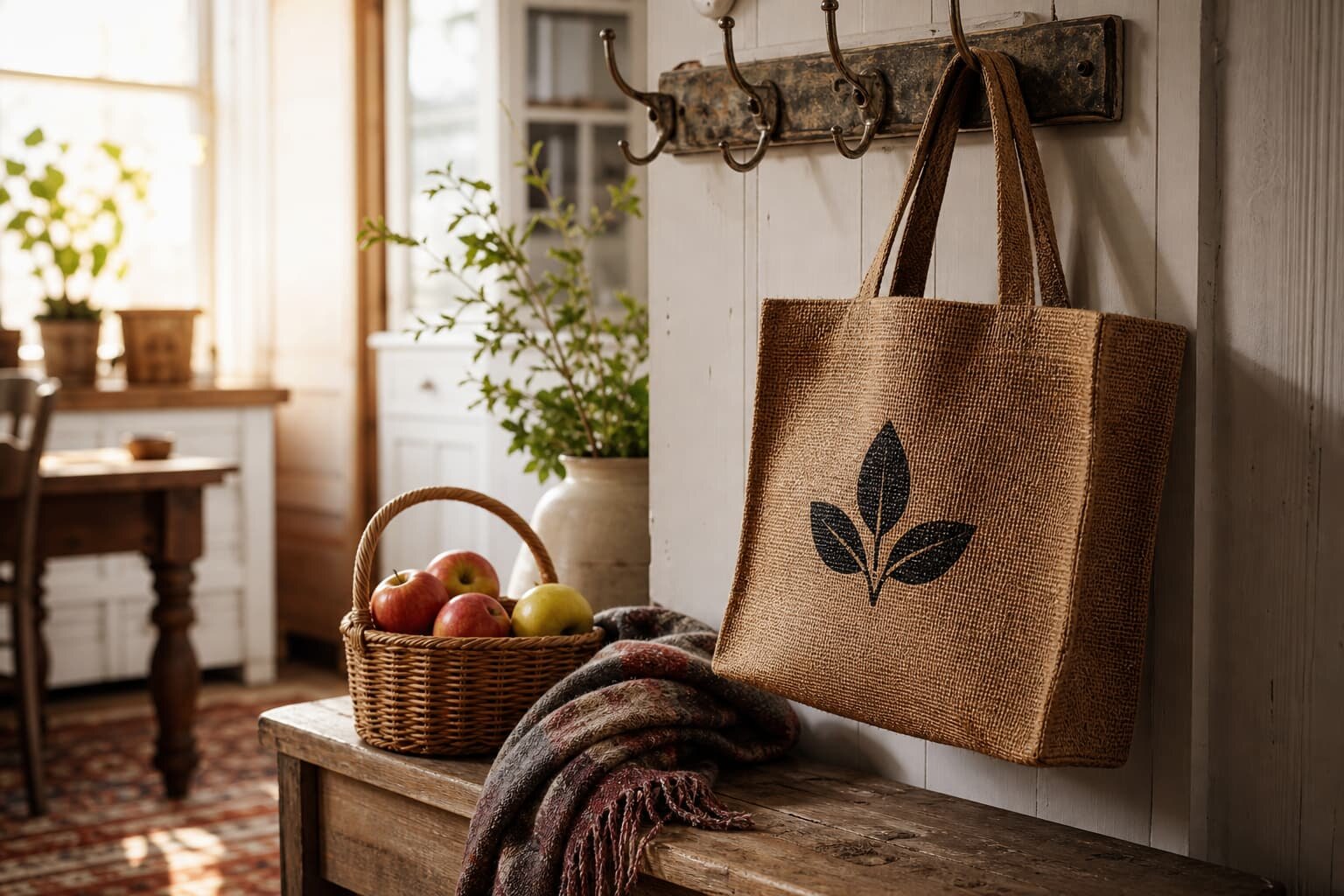
Why the private label handoff causes most jute bag mistakes
A jute burlap bag private label handoff is the point where a buyer's brand requirements meet the factory's production limits. If the handoff is vague, the factory will still quote, sample, and produce, but it may make silent assumptions about fabric weight, logo size, handle quality, label placement, and packing. Those assumptions are where many cost differences and shipment disputes begin.
For procurement teams, the goal is not to write a beautiful RFQ. The goal is to give the supplier enough controlled information to quote the same product you expect to receive. Jute is less uniform than cotton canvas or non-woven fabric. It has open weave, natural slubs, fiber color variation, and a rougher print surface. That means private label details must be locked earlier, especially if the order will be sold through retail, distributor, or brand channels.
- Do not send only a product photo and logo file; include construction and packing details.
- Separate design preference from production requirement so the factory knows what is fixed.
- Ask the supplier to list assumptions in the quote, not after sampling.
- Keep one approved version of the artwork, label, and bag spec to prevent mixed instructions.
Define the bag body before discussing price
The first handoff item is the finished bag structure. A jute bag quote should state width, height, and gusset in the same measurement format the factory will use for cutting and sewing. A bag described only as medium size or grocery size is not enough. Even a 1 cm change in gusset or height can affect fabric consumption, carton packing, and the way the bag stands on shelf.
The body fabric should be described by weight and finish. Many buyers use the words jute and burlap interchangeably, but suppliers may interpret them differently depending on region and fabric source. A practical RFQ should state the target GSM or ounce range, whether the bag is laminated, and whether the handfeel should be soft, stiff, rustic, or structured. If the bag must support heavier goods, ask for finished bag weight and handle reinforcement details, not just fabric GSM.
- Common retail jute bag range: about 280-360 GSM or 13 oz to 16 oz equivalent, depending on weave and finish.
- Unlaminated jute gives a natural look but is less moisture resistant and may shed more fiber.
- Laminated jute holds shape better and protects contents, but it changes texture, odor, and sustainability claims.
- A wide gusset improves capacity but can make the front print panel look distorted if artwork is placed too low.
Choose the private label method that matches the surface
Private label branding on jute is not the same as printing on smooth canvas. The open weave can break fine lines, absorb ink unevenly, and make small type difficult to read. For many brand programs, a bold screen print in one or two colors is the safest option. If the logo has gradients, small registered colors, or detailed illustrations, the factory may recommend heat transfer, a sewn patch, or a woven label instead.
The handoff should include the full labeling system, not only the front logo. A private label jute burlap bag may include a front print, side woven label, inside care label, hangtag, barcode sticker, and carton mark. Each element has a different supplier chain and approval timing. Woven labels and hangtags often require separate lead time before bulk sewing, so they should be approved with the pre-production sample, not added after bulk cutting.
- Use vector artwork for screen printing and specify Pantone colors, print width, and print position from seams.
- Avoid very small text on rough jute; ask the factory to confirm minimum readable letter height.
- For a premium retail look, combine a simple front print with a small woven side label.
- For distributor orders, make barcode and SKU labels part of the RFQ so packing can be costed correctly.
Control MOQ by component, not by total order quantity
Jute bag MOQ is not only a sewing line question. The real MOQ is usually driven by fabric roll availability, dyeing or finishing, print setup, label production, and packing materials. A 3,000 piece order in one size and one logo may be straightforward. The same 3,000 pieces split across three sizes, two logo colors, and four label versions can behave like a much smaller and more expensive order for the factory.
A good buyer handoff asks the factory to break MOQ by decision point. This makes quote comparison easier and prevents the supplier from hiding extra setup cost inside a higher unit price. It also helps importers plan launch quantities and reorder strategy. If a brand wants several private label versions for different retailers, the RFQ should show whether the bag body is common and only labels change, or whether print, handle color, and packing also change.
- Ask for MOQ per bag size, fabric color, print design, handle color, and woven label version.
- Request the setup cost or surcharge for small print color splits instead of accepting a blended quote.
- Keep the bag body common across retailers when possible and change hangtag or barcode only.
- Confirm whether leftover labels or printed fabric will be stored, scrapped, or charged.
Build the RFQ around quote data buyers can compare
A useful quote for private label jute bags should show what is included and what is not included. If one supplier includes woven label, inner packing, export carton, and sample cost while another only quotes the blank bag with print, the lower unit price is not a fair comparison. Procurement teams should request line-item clarity even if the final commercial quote is presented as one unit price.
The RFQ should also ask for assumptions on tolerance, packing count, carton size, and lead time. These details influence landed cost and warehouse handling. For example, a bag packed flat in 25 piece bundles may reduce carton count, but too much compression can crease laminated jute or mark fresh ink. A heavier carton may reduce freight volume but create receiving problems if it exceeds the buyer's warehouse weight limit.
- Quote data to request: unit price, sample fee, print setup, label cost, packing cost, carton details, and Incoterm.
- Technical data to request: fabric GSM, size tolerance, print tolerance, handle length tolerance, and load test method.
- Logistics data to request: pieces per carton, carton dimensions, gross weight, net weight, and estimated CBM.
- Approval data to request: sample timeline, strike-off timeline, bulk production timeline, and inspection window.
Use samples to approve the whole bag, not isolated parts
Many sampling problems happen because buyers approve the fabric swatch, print strike-off, label, and bag shape separately. That can work for early development, but it is not enough for production release. A jute burlap bag private label handoff should require a pre-production sample that combines the actual body fabric, print method, handle construction, label placement, and packing method in one finished item.
The sample should be reviewed like a production standard, not a design suggestion. Check whether the bag stands as expected, whether the front print sits level after the gusset opens, whether the handle drop is comfortable, and whether the side label is visible but not caught in the seam. If the jute has a strong smell, excessive fiber shedding, or obvious shade difference from the approved swatch, raise it before bulk fabric is cut.
- Ask the factory to mark sample version, date, fabric GSM, print method, and label version on the sample record.
- Review print rub resistance after normal handling, especially for dark ink on rough natural jute.
- Check if the top hem hides or distorts inside labels, care labels, or handle reinforcement stitching.
- Approve one physical sample or clear photo set as the shipment comparison standard.
Prevent artwork and print mistakes before bulk production
Jute printing needs realistic artwork rules. Thin lines, tight registration, large solid ink blocks, and small reversed-out text can all look weaker on burlap than on a digital proof. Buyers should ask the supplier to comment on print risk before sampling. A factory that only says all artwork is possible may not be giving enough production guidance.
For screen print, specify the print size, location, color reference, and acceptable variation. The print position should be measured from fixed points such as the top seam, side seam, or bag center. If the bag has a gusset, the front panel can shift slightly during sewing, so large logos close to the edge need extra caution. For heat transfer or patch labeling, confirm adhesion, edge lifting risk, and whether the result feels appropriate for a natural jute product.
- Set print placement tolerance, for example plus or minus 5 mm, if the retail presentation requires consistency.
- Request a strike-off on actual bulk jute because paper proof color does not predict ink behavior on weave.
- Avoid placing important text across seam folds, gusset edges, or heavy weave knots.
- Confirm whether ink curing time affects packing schedule, especially for tight lead time orders.
Specify handles and seams as load-bearing parts
For a reusable jute shopping bag, handles are not decoration. Handle material, width, length, stitch pattern, and reinforcement determine whether the product feels retail-ready or disposable. Cotton webbing handles are common because they feel better in hand than raw jute rope for many shopping applications. Jute handles can look more rustic, but they may feel rougher and vary more in thickness.
The handoff should state the expected use. A wine gift bag, supermarket bag, and fashion boutique bag need different reinforcement logic. If the buyer does not define load expectation, the factory may use a standard construction that looks fine in photos but fails when loaded. Ask for the handle attachment method, stitch density, and any load test the factory can perform. Even a simple hanging weight test with photos is better than no standard.
- Define handle drop, not just handle length, because drop controls carrying comfort.
- Request reinforced cross stitch or box stitch where handles meet the bag body for heavier usage.
- Check that handle color and material match the brand look and do not bleed onto natural jute.
- Inspect stress points at the top hem, especially if the bag is laminated and harder to sew cleanly.
Plan packing so branding survives export handling
Packing is part of the private label handoff because it affects how the branded bag looks when the buyer receives it. Jute bags are often flat packed, but the number per bundle, fold direction, and carton pressure can create creases or print transfer. If the product will go directly to retail stores or promotional kits, the packing method should protect presentation quality, not only reduce freight volume.
The RFQ should include inner bundle count, individual polybag requirement if any, carton marking, barcode placement, moisture protection, and maximum carton weight. Natural jute can absorb moisture and odor during storage, so cartons should be clean, dry, and suitable for export. If sustainability positioning matters, avoid automatic use of individual polybags unless the distribution route requires them. Instead, discuss paper bands, bulk poly liners, or recyclable packaging options where practical.
- Use flat packing with consistent fold direction so warehouse teams can count and re-pack easily.
- Avoid packing printed bags before ink is fully cured, especially with dark or heavy screen print.
- Confirm carton marks include PO number, SKU, size, quantity, gross weight, and destination if required.
- Ask for packed carton photos before shipment when the order has retailer-specific labeling.
Set a lead time workflow with approval gates
Lead time for private label jute bags should be treated as a workflow, not one single number. Sampling, artwork correction, label procurement, fabric preparation, printing, sewing, inspection, and packing each need time. When a supplier quotes 25 or 35 days, ask when that clock starts. In most cases, it should start after deposit, final artwork approval, and approval of the production sample or strike-off.
Procurement teams can reduce delay by sending complete files and deciding who has approval authority. If marketing approves artwork, quality approves construction, and logistics approves carton marks, the handoff should identify each approval owner before sampling begins. Delayed label approval or barcode correction can hold a finished sewing line even when the bag body is ready.
- Ask for lead time separated into sample, pre-production approval, bulk production, inspection, and shipment readiness.
- Confirm whether woven labels or custom hangtags add separate procurement time.
- Lock final artwork before screen setup to avoid re-making screens or charging extra setup cost.
- Build an inspection window into the schedule before vessel booking or courier collection.
Specification comparison for buyers
| Spec decision | Recommended option | When it fits | Buyer risk to check |
|---|---|---|---|
| Body fabric weight | 13 oz to 16 oz jute or 280-360 GSM burlap equivalent | Retail shopping bags, gift bags, event merchandise, supermarket promotions | Light jute can collapse or distort under print pressure; confirm actual GSM tolerance and finished bag weight |
| Inner lamination | Unlaminated for natural look; PE laminated for grocery or moisture resistance | Unlaminated fits eco retail and gifting; laminated fits heavier goods and damp handling | Lamination changes handfeel, odor, recyclability claims, and fold behavior during packing |
| Logo method | Screen print for solid logos; heat transfer only for fine multi-color artwork | Screen print works for most private label branding on jute texture | Fine text may break on open weave; request strike-off on actual jute, not paper |
| Handle construction | Cotton webbing sewn into top hem or full wrap handles for heavier loads | Standard retail bags and reusable shoppers | Short stitch bite or weak reinforcement causes handle pull-out during load testing |
| Private label position | Woven side label or printed front panel with optional inside care label | Brand owners needing visible ownership without complicated sewing | Label artwork, fold direction, and seam position must be approved before bulk cutting |
| MOQ logic | Set MOQ by fabric roll, print setup, and label production, not only bag quantity | Mixed size orders, seasonal programs, distributor replenishment | Small color splits increase setup waste and quote variance |
| Packing style | Flat packed 10-25 pcs per inner bundle, master carton by weight limit | Export orders needing clean warehouse receiving and barcode control | Over-compression creases jute and can transfer ink if curing is rushed |
| Sample approval | Pre-production sample with fabric, print, handle, label, and packing shown together | Private label handoff before deposit or before bulk production release | Approving fabric swatch and logo separately can miss real alignment and sewing conflicts |
Buyer checklist before sampling
- Define finished bag size as width x height x gusset, with tolerance and whether dimensions are measured flat or expanded.
- Specify jute or burlap fabric weight in GSM or oz, including acceptable tolerance and whether lamination is required.
- Confirm handle material, width, length, color, reinforcement method, and target load use.
- Provide logo files in vector format with Pantone references, print size, print position, and minimum text height.
- Decide whether the private label is screen printed, woven label, cotton label, inside care label, hangtag, or a combination.
- Request a strike-off or pre-production sample on actual bulk fabric before approving mass production.
- State packing method, carton marks, barcode needs, inner bundle count, and maximum carton weight.
- Ask the factory to quote MOQ by size, color, print version, and label version instead of one blended total only.
- Confirm lead time split for sampling, label procurement, bulk fabric preparation, printing, sewing, inspection, and packing.
- Keep an approval record showing sample date, version number, changes requested, and final signed production standard.
Factory quote questions to send
- What exact jute fabric weight will be used for the quoted bag, and what is the normal GSM tolerance in bulk production?
- Is the fabric laminated or unlaminated, and does lamination affect folding, odor, printing, or claimed recyclability?
- What is the minimum order quantity by bag size, fabric color, print design, and private label type?
- Which print method do you recommend for our artwork on jute, and what line thickness or text size should we avoid?
- Can you provide a print strike-off on actual jute fabric before making the full pre-production sample?
- How are handles attached, what stitch density is used, and what load test standard can you perform for approval?
- Are woven labels, cotton labels, hangtags, and barcodes made in-house or outsourced, and how much extra time do they add?
- What quote items are included separately for fabric, printing, label, sample, packing, carton, inland freight, and export documents?
- What are the main causes of production delay for this bag type, and which approvals do you need from us before bulk cutting?
- What inspection points will be checked before shipment, and can you share photos of packed cartons, labels, and random finished bags?
Quality-control points to confirm
- Check finished dimensions against the approved sample, including gusset depth and handle drop.
- Verify fabric weight, weave appearance, lamination status, smell, and color shade under consistent lighting.
- Inspect print position, color density, curing, edge sharpness, and ink adhesion on the actual jute surface.
- Pull test handles and review reinforcement stitches at stress points, especially near the top hem.
- Confirm private label placement, orientation, spelling, barcode readability, and hangtag attachment method.
- Review sewing quality for skipped stitches, loose threads, seam twisting, uneven top hem, and gusset alignment.
- Test packing count per inner bundle and carton, carton strength, carton marks, and moisture protection.
- Compare bulk goods with the signed pre-production sample before approving shipment.