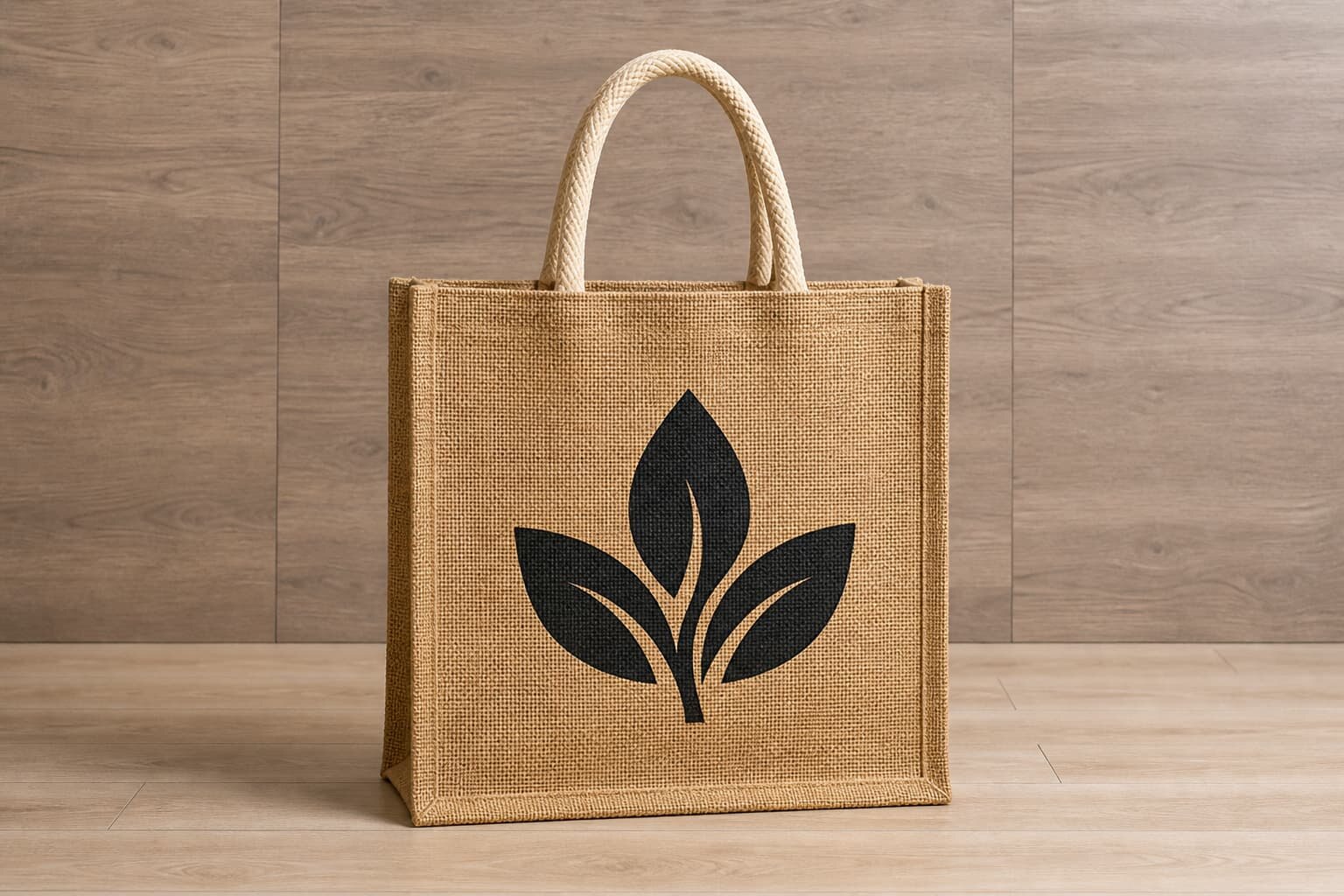
Why Logo Placement Fails on Jute Burlap Bags
A logo placement audit is needed because jute burlap bags are not cut and sewn like paper shopping bags. Jute has an open weave, natural yarn thickness variation, and visible slubs. After cutting, sewing, turning, pressing, handle attachment, and packing, the finished front panel may not sit exactly like the flat artwork file. If the buyer only approves a mockup with the logo centered on a rectangle, the factory still has to decide where to place the print screen or label on a material that moves during production.
Most logo complaints on jute bags are not caused by bad artwork. They come from unclear measurement references. The supplier may center the logo on the cut panel, while the buyer expects it centered on the finished face of the bag. On a gusseted tote, those two centers can be different after side seams and bottom folding. On a wine bag, the handle hole or cotton drawcord may change the visible area. A practical audit converts design preference into measurable production rules before bulk cutting starts.
- Do not write only "logo centered on front" in the RFQ.
- Define whether the front panel includes or excludes side gusset folds.
- Use millimeter measurements from finished edges and handle stitch points.
- Request sample photos with a ruler, not only a flat digital proof.
- Treat jute weave variation as normal, but logo skew and wrong position as controllable defects.
Start the Audit From the Finished Bag, Not the Artwork
For procurement teams, the safest starting point is the finished bag drawing. Ask the factory to confirm finished width, height, gusset, handle drop, seam allowance, and front printable area. Then place the logo inside that finished printable area. This avoids a common mistake: approving a logo location on the cut fabric panel before sewing. A 380 x 420 x 120 mm jute tote does not have the same visible front as a flat 500 mm cut panel, because part of the fabric becomes side gusset and seam allowance.
The audit should also consider how the bag will be used. A logo that looks balanced when the bag is flat may sit too low when the bag is filled, especially on softer 240 GSM jute. A logo placed too high can fight with the handle stitch box or cotton webbing. If the bag will hang on a retail hook or be photographed for ecommerce, the visible logo zone becomes more important than mathematical center.
- Measure logo distance from finished top edge to logo top.
- Measure distance from left finished side seam to logo left edge.
- Measure distance from bottom seam or base fold to logo bottom.
- Check clearance from handle stitch box, rivets, pockets, drawcord channels, and gusset folds.
- Confirm the logo remains visible when the bag is folded, bundled, or filled.
Fabric Weight and Weave Change the Placement Decision
Jute burlap fabric weight directly affects print sharpness and how confidently a supplier can hold logo position. Lighter jute around 220-240 GSM is more flexible and may distort more during handling. Mid-weight 270-300 GSM jute is common for promotional totes and gives better panel stability. Heavy 320-350 GSM jute can make a bag feel premium, but thick yarn and uneven surface may reduce fine print clarity. The best fabric for the logo is not always the heaviest fabric; it depends on artwork detail and bag structure.
Weave density also matters. Loose weave burlap can make small letters break, especially in screen printing. A simple block logo may still look acceptable, while thin serif text or a QR code may fail. If the buyer needs detailed branding on a rough jute bag, a sewn cotton label, woven label, or laminated jute panel may be more reliable than direct print. The RFQ should not separate fabric specification from logo specification because the two decisions affect each other.
- For simple one-color logos, 270-300 GSM natural jute is often a practical balance.
- For large retail bags carrying weight, confirm whether 320 GSM or heavier jute is needed.
- For fine text, avoid direct print on very open weave burlap unless the supplier proves it by sample.
- For natural jute, approve print color on actual fabric because the brown base changes the final tone.
- For laminated jute, confirm whether the logo is printed on lamination film, fabric, or a sewn label.
Choose the Logo Method Before Comparing Quotes
Quote comparison becomes unreliable if one supplier prices screen printing, another prices heat transfer, and a third includes a sewn woven label. Each method has a different setup cost, MOQ logic, production risk, and inspection standard. For jute burlap bags, screen printing is usually the most economical for solid logos in bulk. It works well for simple brand marks, large text, and one to three colors. However, the screen must be aligned to the bag panel, and ink behavior must be tested on the selected jute.
Heat transfer can deliver cleaner detail, but it may not bond equally well on rough jute and can look less natural if the film sits on top of the weave. Embroidery is possible but can pucker loose burlap and is usually better for heavier canvas than open jute. Woven or cotton labels are useful when the logo is small, detailed, or repeated across several bag sizes. Labels also allow branding to stay consistent even when the bag fabric varies slightly by batch.
- Screen print: best for solid logos, lower unit cost at volume, needs ink and curing control.
- Heat transfer: better detail, but test adhesion and surface feel on rough jute.
- Embroidery: premium appearance, but risk of puckering and thread distortion on loose weave.
- Woven label: consistent small branding, but needs label MOQ and accurate seam placement.
- Cotton patch label: good for natural packaging style, but patch size and stitch line must be approved.
Set Placement Tolerance That a Factory Can Actually Control
A useful logo placement audit includes tolerance. Without tolerance, every inspection becomes an argument. For many jute tote bags, a direct printed logo tolerance of plus or minus 5 mm from the approved sample is realistic when the bag is sewn and printed with normal production handling. For larger bags, rougher weave, or hand-fed printing, a wider tolerance may be needed. For sewn labels, plus or minus 3 mm may be achievable if the label is inserted into a seam with a guide, but only if the sewing line is stable.
Tolerance should cover position and angle. A logo can be the right distance from the edge but still look crooked. The buyer can specify that the logo baseline should be parallel to the finished top edge within a stated degree or visual limit. In practice, many buyers use measurement plus approved sample comparison. The factory should retain one sealed pre-production sample on the production floor and one with the buyer or inspection company.
- For screen print on jute totes, consider plus or minus 5 mm as a starting discussion point.
- For labels sewn into side seams, consider plus or minus 3 mm if the seam guide is controlled.
- For small pouches, use tighter visual approval because a 5 mm shift looks larger on a small face.
- For gusseted bags, measure after the bag is opened and flattened in the agreed inspection position.
- For multi-size orders, approve separate placement dimensions for each size.
Sample Approval Should Prove Production, Not Decoration Only
A buyer sample should prove that the factory can reproduce the bag and logo together. A loose piece of printed jute fabric is not enough because it does not show how sewing, handle position, gusset folding, and packing affect the final appearance. The pre-production sample should be made with the quoted fabric weight, handle material, stitch method, print method, and packing fold. If the sample uses substitute fabric or hand placement, it should be marked clearly as a reference sample only.
Ask the supplier to photograph the sample in a way that supports approval. The photo should show the full bag, close-up logo detail, and ruler measurements from key reference points. If the logo uses more than one color, require photos under neutral lighting and confirm whether the supplier will match Pantone, CMYK reference, or a physical color swatch. On natural jute, exact color matching is difficult, so the acceptance rule should focus on approved visual sample and reasonable batch consistency.
- Request one full finished sample, not only printed fabric.
- Ask for ruler photos showing top, side, and bottom distances.
- Check logo position after the bag is filled lightly if retail display matters.
- Compare print sharpness over yarn knots and uneven weave.
- Seal and reference the approved sample for bulk production inspection.
MOQ Logic Behind Logo Placement and Branding Costs
MOQ for jute burlap bags is not only about sewing quantity. Logo method can drive MOQ more than the bag itself. Screen printing has screen setup and ink mixing time, so a factory may accept a moderate MOQ for one color but increase the minimum for multi-color artwork. Woven labels may require a separate label supplier MOQ, often higher than the number of bags in a trial order. Heat transfer may have film setup or sheet layout constraints. If buyers ignore this, quotes will appear inconsistent even when suppliers are calculating correctly.
For distributors and importers, the best RFQ separates base bag MOQ from logo MOQ. Ask whether the supplier can use stock jute fabric, stock handles, or existing bag patterns, and then ask what changes when logo placement is customized. A small order with a large centered screen print may be less efficient than a larger order with a small sewn label, depending on setup. This information helps buyers decide whether to standardize one logo size across SKUs or approve different artwork placements for each bag style.
- Separate bag sewing MOQ, fabric dyeing MOQ, print setup MOQ, and label MOQ.
- Ask if logo setup cost is charged once per artwork, per color, per size, or per position.
- Confirm whether left and right side printing counts as one setup or two.
- For repeat orders, ask whether screens, label files, and placement jigs are retained.
- For mixed colors or sizes, confirm whether the supplier will combine quantities for MOQ.
Packing Can Damage an Approved Logo
Many logo audits stop after printing, but packing can change the final result seen by the retailer. Jute is abrasive, and printed ink can rub against another rough surface inside the carton. If bags are packed before the ink is fully cured, logo transfer or sticking can occur. If the fold line crosses a thick printed area, the logo may crack or show a permanent crease after long sea shipment. These problems are not solved by good artwork; they require packing instructions.
For screen printed jute totes, ask how long the factory waits between printing and packing. For large solid logos, consider tissue separation or packing with printed faces inward, depending on the ink and carton pressure. For sewn labels, check that the label does not sit exactly on a fold edge. For retail-ready bags, carton size and compression matter because a low-cost tight carton may save freight but create wrinkles on the logo panel.
- Confirm curing or drying time before folding and carton packing.
- Avoid folding directly through large printed logo areas when possible.
- Use tissue or paper separation when ink coverage is heavy or dark.
- Specify carton quantity and compression limit for retail-facing orders.
- Inspect logo appearance after one packed carton is opened, not only before packing.
Lead Time Risks in Logo Placement Approval
Logo placement approval affects lead time because the factory should not print bulk panels until the buyer approves position. A realistic timeline separates artwork checking, sample making, sample courier time, buyer approval, material preparation, printing, sewing, finishing, inspection, and packing. If the buyer sends artwork late or changes logo size after sampling, the production calendar shifts. This is especially important before seasonal promotions, trade shows, and retail launch dates.
A practical RFQ asks the supplier to show where logo approval sits in the production schedule. Some factories print before sewing; others sew blank bags first and then print on finished panels. Printing before sewing can improve productivity but increases placement risk after seams and gussets are formed. Printing after sewing better reflects the finished panel but may be slower and harder for certain bag shapes. The buyer should know which workflow is quoted.
- Ask whether printing happens before sewing or after sewing.
- Confirm sample lead time separately from bulk lead time.
- Do not release bulk printing until logo placement is approved in writing.
- Build time for revised sample if logo position, size, or method changes.
- For repeat orders, ask if the previous approved placement record can shorten approval time.
Quote Data Buyers Should Request and Compare
A strong supplier quote for jute burlap bags should include more than unit price. It should state fabric GSM, finished size tolerance, handle material and length, logo method, logo size, logo position, number of colors, setup charges, sample cost, MOQ, packing method, carton quantity, estimated carton size, gross weight, and lead time. Without these details, the lowest quote may simply exclude the controls needed to keep the logo consistent.
When comparing suppliers, look for technical clarity. A factory that asks about logo clearance, print area, and jute GSM is usually thinking about production risk. A quote that only says "custom logo included" is not enough for a brand buyer. If two prices differ, ask what is included in logo setup and inspection. Sometimes the higher quote includes a pre-production sample, better packing, and realistic tolerance control. Sometimes it is only a higher margin. The data lets procurement challenge both situations.
- Require finished size and logo placement tolerance in the quote.
- Request logo size in millimeters, not only artwork percentage.
- Confirm number of logo colors and whether each color needs a separate screen.
- Ask for carton packing details because freight and damage risk affect landed cost.
- Compare sample policy and revision cost before approving the cheapest supplier.
Specification comparison for buyers
| Spec decision | Recommended option | When it fits | Buyer risk to check |
|---|---|---|---|
| Logo position reference | Measure from finished bag edges and handle stitching, not from fabric cut panels | Most bulk jute tote and wine bag orders where cutting and sewing tolerance affects final layout | Logo may look centered on fabric before sewing but shift after side seams, gusset folding, or handle attachment |
| Front logo height | Keep main logo at least 45-60 mm below handle stitch box on standard totes | Retail gift bags, promotional shopping bags, supermarket reusable bags | Handle reinforcement may visually crowd the logo or cover it when the bag is folded for packing |
| Print method | Screen print for solid one to three color logos on 240-350 GSM jute | Cost-controlled bulk orders with simple brand marks and high repeatability | Heavy ink deposit can bleed into loose weave if mesh count, ink viscosity, and drying are not controlled |
| Label alternative | Sewn cotton or woven side label for small logos or detailed marks | Premium packaging bags, small pouch sizes, artwork with fine text | Label position can twist or sit unevenly unless seam allowance and label fold size are specified |
| Artwork approval | Approve a physical pre-production sample with ruler photos, not only a digital mockup | Any order where logo position is brand-critical or multiple bag sizes are ordered together | Digital proof ignores weave irregularity, shrinkage, sewing tolerance, and folding marks |
| Packing method | Flat pack with logo facing inward or protected by tissue for heavy ink coverage | Printed jute totes shipped in cartons for retail distribution | Ink scuffing, logo transfer, or crease marks can appear if bags are compressed before full curing |
Buyer checklist before sampling
- Define logo placement using finished bag dimensions, not artwork center points alone.
- State bag size, gusset size, fabric GSM, handle length, and whether measurements are before or after sewing.
- Require the supplier to mark logo distance from top edge, side seam, bottom seam, and handle stitch box.
- Ask for a physical sample photo with ruler placed horizontally and vertically against the finished bag.
- Confirm whether the logo is screen printed, heat transferred, embroidered, sewn as a label, or combined with lamination.
- Check if the print area crosses seams, gussets, folds, pockets, rivets, or handle reinforcement.
- Set placement tolerance in millimeters, usually tighter for labels and wider for direct jute printing.
- Approve ink color on actual jute fabric because natural jute color can darken or mute artwork.
- Confirm drying or curing time before packing, especially for large solid print areas.
- Specify carton packing direction so the printed logo does not rub against rough jute surfaces during transit.
Factory quote questions to send
- What is the finished bag size tolerance and logo placement tolerance you will guarantee in bulk production?
- Will the logo be positioned from the finished top edge, cut panel edge, center line, or handle stitch reference?
- What jute fabric weight and weave density are included in the quote, and does it suit the selected print method?
- Can you provide a pre-production sample with ruler photos before cutting bulk fabric?
- Is the quoted MOQ based on bag sewing quantity, print setup quantity, label weaving quantity, or material purchase quantity?
- How many print screens, label molds, or embroidery programs are included in the quoted logo cost?
- What artwork file format and minimum line thickness do you require for clean output on burlap?
- How will you control logo alignment when the same logo is used on different bag sizes?
- What packing method will protect the printed or sewn logo from creasing, scuffing, or transfer?
- What is the lead time for sample approval, bulk material preparation, printing, sewing, inspection, and packing?
Quality-control points to confirm
- Measure logo position on finished bags after sewing, trimming, pressing, and packing simulation.
- Check at least top, side, bottom, and handle-reference distances against the approved sample.
- Inspect logo skew by comparing the logo baseline to the finished top edge, not to the irregular jute yarn line.
- Review print coverage on high and low points of the jute weave, especially around thick yarn knots.
- Check ink bleeding, broken lines, pinholes, and color shift caused by natural jute fiber variation.
- Confirm labels are sewn into the seam straight, with no exposed raw edge unless intentionally specified.
- Test whether folding or carton pressure leaves permanent marks across the logo area.
- Separate acceptable fabric slubs from logo defects so inspectors do not reject normal jute character incorrectly.
- Record pass or fail with photos and measurements, not only written comments.
- Hold shipment if logo placement drift appears across sewing lines, shifts, or carton batches.