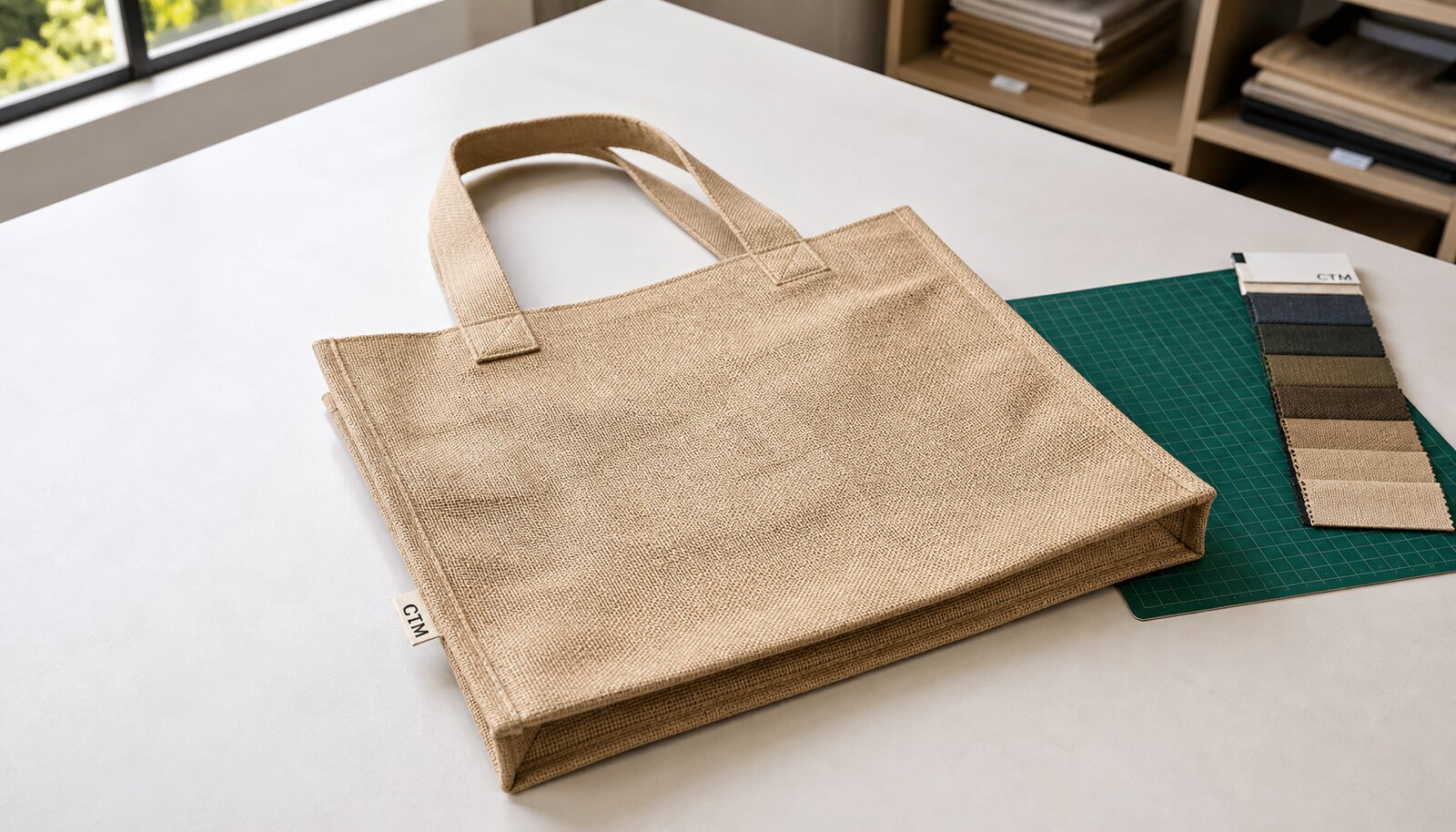
What the memo actually authorizes
A jute burlap bag line release approval memo is the document that gives the factory permission to move from approved sample to bulk production. It should not read like casual email approval. It should clearly say which style, size, fabric weight, print version, and packing version are allowed to enter cutting, printing, sewing, and packing. If that data is not frozen, the factory will fill the gaps with assumptions, and those assumptions usually cost the buyer time and money.
For natural-fiber bags, the memo matters even more because jute and burlap are not as forgiving as smooth synthetic substrates. Fabric shade can move from lot to lot, rough weave can change print appearance, and stitching bulk can change the finished measurement. A short, controlled memo prevents the most common commercial mistake: the buyer approves a sample, but the bulk order follows a different version of the same bag.
- Treat the memo as a production release, not a courtesy note.
- Tie the memo to a sample code, artwork version, and quote revision.
- Do not release bulk when the factory still has open questions on size, print, or packaging.
Lock the spec before you ask for approval
The fastest way to get a clean quote is to make the bag spec measurable. For a jute burlap bag, that usually means body size, gusset depth if any, handle material, handle drop, fabric weight in oz and gsm, print method, label type, and pack configuration. Many mills and factories still talk in different units, so if the supplier uses ounces and your sourcing team uses gsm, put both on the memo and ask the supplier to confirm the conversion in writing.
A natural weave does not hide vague instructions. If the handle length is missing, the factory may choose a carry length that feels wrong on shelf. If print placement is open, the logo can move far enough to break retail consistency. If the fabric weight is not fixed, one quote may look cheap because it uses lighter cloth, while another looks expensive because it is actually the more durable build. The memo should force every important choice into one version.
- Specify body dimensions and tolerance in the same document.
- State fabric weight in oz and gsm so quote comparisons are fair.
- Record handle width, length, and reinforcement type.
- Call out lining, lamination, closure, and label type if any are included.
Use quote comparisons to expose hidden cost drivers
If a supplier sends only one line unit price, the quote is incomplete for buyer review. A usable quote for a jute burlap bag should separate fabric, cutting, sewing, print, labels, packing, cartons, and any tooling or setup cost. That detail matters because the same bag can look cheap on paper and still become expensive once screen setup, label sewing, and carton materials are added. The release memo should match the quote structure so the bulk order does not drift away from the approved costing model.
MOQ logic also needs to be visible. A one-color screen print on a standard bag often supports a lower MOQ than a two-color print with reinforced handles, inside lining, and individual polybags. If the supplier says the MOQ stays the same after you add complexity, ask how they are handling screen setup, material consumption, and line changeover. The memo should note which features are locked so the supplier cannot later claim that the order was quoted against a different build.
- Ask the factory to show unit cost, setup cost, and packing cost separately.
- Check whether the quote includes screens, plates, labels, and carton materials.
- Confirm what happens to MOQ when you add print colors or change handle type.
- Require a revised quote if the release memo changes after approval.
Approve the right sample, not a lookalike
The sample that triggers release should be made from production fabric and production components whenever possible. A hand sample made from substitute cloth can hide problems that show up immediately in bulk, especially on burlap and jute where the weave, stiffness, and fiber direction affect both sewing and print quality. If the bulk order is built on a counter sample or a pre-production sample, make sure the memo identifies that sample as the approved benchmark, not just an example of appearance.
A proper sample check is not limited to the front view. The buyer should inspect front, back, inside, handle attachment, label position, and any carton or unit pack element that appears in the final shipment. If the supplier sends only photos, the release package should still identify the sample code, the artwork file name, and the date of approval. That gives both sides one reference point when a dispute starts later.
- Check sample size against the signed tolerance sheet.
- Confirm the print looks right on actual burlap texture, not on substitute fabric.
- Verify handle drop, shoulder comfort, and reinforcement at the stress points.
- Save photos of the approved sample from multiple angles.
Set acceptance criteria the factory can measure
A line release memo should include acceptance criteria that an inspector can actually use. For many jute burlap bag programs, a body size tolerance around 1 cm on smaller bags and a slightly wider window on larger bags can be practical, but the exact number should be agreed before production. The same applies to print placement, handle length, and top edge straightness. If the team does not agree the numbers in advance, the factory and buyer will each judge the bag differently after bulk starts.
Natural fiber also needs a clear defect policy. Some slub, surface fiber, and shade movement are part of the material. The buyer should decide in advance what is normal and what is rejectable. A stain, hole, broken seam, missing bartack, or unreadable logo is a defect. A mild shade swing within the approved swatch may be acceptable. Put that logic in the memo so the inspector does not waste time guessing whether the issue is natural variation or a production fault.
- Define the allowed tolerance for body size, handle drop, and print position.
- State which natural variations are acceptable and which are not.
- Include seam quality, reinforcement, and top hem requirements.
- Use the same acceptance rule for every carton in the lot.
Control print and brand placement
Print is one of the easiest places for a jute burlap bag to go wrong because the surface is rough and absorbent. Screen print still works well for bold logos and simple text, but the buyer should ask for a strike test on production fabric if the artwork has fine lines, small type, or a critical brand color. A good memo states the print method, the number of colors, the exact placement, and the approved file version. Without that, a factory can shift the logo slightly and still claim the print is close enough.
If the brand wants a cleaner look, a sewn woven label or side label can be a better choice than forcing detail into the print. That is especially true for premium retail programs where the bag must look consistent across stores. The memo should state whether the logo belongs on the body, the handle, the side seam, or the label itself. If the buyer wants a Pantone match, the memo should say whether the factory is matching to ink, thread, or woven label color, because those are not the same production decision.
- Test the print on the actual burlap weave before bulk release.
- Do not approve small type without checking legibility at arm's length.
- Confirm whether the logo is printed, woven, stitched, or sewn as a label.
- Fix the brand color reference in the memo to avoid later debate.
Freeze packing and carton data
Packing errors can create a claim even when the bag itself is fine. A jute burlap bag that is folded too tightly can hold crease lines, and a bag packed while still carrying moisture can develop odor by the time it reaches the buyer. The release memo should state the pack count per polybag or sleeve, whether ventilation holes are allowed, and whether desiccant is needed for the route. If the product is retail-ready, the memo should also say whether the bag can be folded with tissue or must stay flat for shelf presentation.
Carton marks are part of the same release file. The style number, color, quantity, carton sequence, gross weight, net weight, and handling marks should match the approved PO and artwork. If the order needs barcode labels or country-of-origin text on the unit pack, that should be frozen before cutting begins. Many disputes start because the buyer thinks carton text is a packaging detail, while the factory treats it as a later step. The memo should remove that gap.
- Confirm pack count per inner pack and master carton.
- State whether polybags, kraft sleeves, or no unit pack are allowed.
- Lock carton text, barcode position, and sequence numbering.
- Check that packed goods are dry and odor-free before shipment.
Tie lead time to real steps, not promises
The best release memos break lead time into stages. A useful file shows when the sample was approved, when fabric was booked, when print screens were made, when cutting started, when sewing and printing finished, when packing began, and when final inspection is scheduled. That structure makes it obvious where the order is slipping. A single vague promise like 'four weeks production' is not enough for a buyer managing launch dates or retail delivery windows.
For jute and burlap bags, schedule risk usually comes from fabric availability, screen making, artwork approval, or packing changes. The buyer side can slow the factory just as much as the factory can slow the buyer, so the memo should identify which approvals are still pending and who owns them. If artwork, carton marks, or pack count are still changing, the factory may have to pause the line or rework finished bags. That is why the memo should only release the line after the last open dependency is closed.
- Write the production schedule by stage instead of using one lump lead time.
- Mark which approvals are buyer-controlled and which are factory-controlled.
- Track the critical path for fabric, print setup, sewing, packing, and inspection.
- Do not start bulk if artwork or carton data is still changing.
Use the memo to stop MOQ and price drift
MOQ and price are not fixed just because the supplier gave a first quote. For a jute burlap bag, small changes to fabric weight, print colors, handle type, or pack count can change the economics of the whole run. If the buyer changes the bag after the quote, the factory may need a different material lot, extra setup, or a longer line changeover, and that can raise the unit price or make the original MOQ unrealistic. A good release memo makes those changes visible before bulk starts.
This is where a simple change-control rule pays for itself. Any change to size, GSM, print placement, print color count, handle build, label type, or packing count should trigger a revised quote and a new approval before cutting. If the buyer keeps the memo and the quote in the same file, it becomes much easier to compare suppliers and stop a factory from quietly substituting a cheaper spec. In practice, that is one of the biggest ways to protect margin on a jute bag program.
- Treat size, GSM, print colors, and handle build as price-sensitive variables.
- Require a revised quote for any spec change after approval.
- Keep a version history so buyers can see why the price moved.
- Use the memo to prevent unapproved substitutions in bulk production.
Release only when the file is complete
A strong line release file is short enough for production to use and detailed enough to stop confusion. It should bring together the approved sample reference, the latest quote, the artwork file, the packing spec, the carton mark file, and the QC standard in one package. If even one of those pieces is still open, the file is not ready for bulk release. That discipline matters because jute burlap bags are often sold on tight seasonal calendars, and the buyer cannot afford avoidable rework once the line is moving.
The practical rule is simple: do not let the factory start until the release memo can answer the questions that cause rework. Which fabric? Which print? Which pack count? Which carton text? Which version of the artwork? Which sample is the reference? If the memo cannot answer those questions in plain language, it is not a release memo yet. It is a draft.
- Make the memo the single source of truth for bulk start.
- Stop the line if the approved sample, quote, and artwork do not match.
- Use one revision number for the full release package.
- Treat missing packing or carton data as a production risk, not an admin task.
Specification comparison for buyers
| Spec decision | Recommended option | When it fits | Buyer risk to check |
|---|---|---|---|
| Fabric weight / GSM | 10-12 oz or about 340-410 gsm for most retail and promo bags; 12-14 oz or about 410-475 gsm for heavier carry | Use 10-12 oz when you want lower cost and lighter handfeel; use 12-14 oz when the bag needs more structure | Confirm the supplier is using the same GSM conversion and that heavier cloth does not push sewing, print, and MOQ beyond the quote |
| Print method | 1-color screen print for simple logos; 2-color screen print only when registration is easy; woven or sewn label for premium branding | Use screen print for bold artwork and short text; use a label when the weave is too rough for fine detail | Check ink strike-through, edge bleed, registration tolerance, and whether the artwork needs a test strike on production fabric |
| Handle build | Self-fabric handle for low cost, cotton webbing for better comfort, jute rope for a rustic look | Self-fabric suits promotional runs; webbing suits retail or shoulder carry; rope suits gift or lifestyle positioning | Verify handle length, bar-tack strength, fray control, and loaded carry performance |
| Inside treatment | Unlined for simple dry goods; light lining or lamination for cleaner appearance and better shape | Unlined fits price-sensitive orders; lined or laminated fits premium retail or moisture-sensitive products | Check odor, seam bulk, delamination risk, and whether the added layer changes lead time or MOQ |
| Packing format | Flat-pack in polybag or kraft sleeve, then master carton; palletize for long-haul export if needed | Flat-pack suits ecommerce and retail distribution; palletized cartons suit mixed freight or longer transit | Confirm pack count, moisture control, crease risk, and whether the carton quantity matches the release memo exactly |
Buyer checklist before sampling
- Confirm the exact body size, handle drop, and tolerance in the same unit system the factory uses.
- Lock the fabric weight in oz and gsm, and note the accepted shade range for natural jute.
- Approve the artwork file version, print method, print position, and number of colors.
- Match the approved sample code to the bulk BOM, not just the appearance of the sample.
- Verify handle material, length, reinforcement method, and the expected carry load.
- Freeze packing count per inner pack and master carton, including any polybag or sleeve requirement.
- Check carton mark text, barcode placement, and any country-of-origin wording before release.
- Ask the factory to state the production start date only after all approvals are on file.
- Set an overrun and underrun tolerance in writing before cutting begins.
- Require pre-production photos of fabric, print, label, and packed cartons before line release.
Factory quote questions to send
- What fabric weight are you quoting, and what gsm conversion are you using for that weight?
- Does the unit price include screen setup, plate making, label cost, and packing materials?
- Which print method is included, and how many colors are covered in the base quote?
- What is the MOQ by style, color, and print version, and what changes if we split colors?
- Which handle option is priced, and what reinforcement do you use at the handle attachment?
- Are polybags, desiccant, inner cartons, and master carton marks included or separate?
- What sample stage is included before bulk release, and what sample code will appear on the memo?
- What line items change if we adjust size, fabric weight, print placement, or carton count?
- What is your overrun and underrun policy for this bag style?
- What is the full lead time after sample approval, and which steps are buyer-controlled?
Quality-control points to confirm
- Fabric weight matches the agreed spec and the batch stays within the accepted shade window.
- No holes, tears, oil spots, damp odor, or visible contamination on the fabric surface.
- Body dimensions, handle drop, and gusset depth stay within the written tolerance.
- Seam lines are straight, seam allowance is even, and stress points are reinforced consistently.
- Handle attachment passes a tug check and the stitching density is uniform at both ends.
- Print position matches the approved artwork and does not drift between panels or cartons.
- Ink coverage is clean with no major bleed, cracking, or unreadable fine text.
- Edges are trimmed neatly and fray is within the agreed natural-fiber allowance.
- Label, barcode, and carton mark text all match the purchase order and release memo.
- Packed quantity per inner pack and master carton is exact, dry, and traceable by lot.