What a line release file really controls
A jute burlap bag factory line release signoff file is not a brochure, a mood board, or a loose email thread. It is the document that tells the factory, in one place, exactly what has been approved for production. For buyers, that matters because burlap bags are easy to describe and surprisingly easy to misbuild. A supplier can keep the outer look close while quietly changing GSM, handle construction, print method, or packing. Once the line starts, those small changes become your problem at inspection, at receipt, or during a claim review.
The file should tie together the approved sample, the artwork version, the measurement sheet, the packing plan, and the named approver. It should also show the date, revision number, and what was frozen versus what remains open. That is how procurement teams keep RFQs honest and avoid the common gap between a quote and the real order. If the buyer cannot point to the exact approved line release version, the factory will rely on habit, and habit is where production drift starts.
- Use the file to freeze the current version before cutting starts.
- Keep one dated photo set of front, back, side, and bottom views.
- Record who approved the sample and who can approve any deviation.
Start with the exact bag spec, not the idea
The first mistake buyers make is asking for a jute bag instead of defining a jute burlap bag. The quote needs a real product definition: finished size, gusset depth, handle length, closure type, target load, and end use. A retail tote for folded apparel is not the same as a promo carry bag, and neither is the same as a wine bag or a gift sack. If the use case is unclear, the factory will fill in the blanks with its own standard build, and that standard may not match your market or your margin target.
Fabric weight is the next lock point. For a typical natural jute tote, many buyers will see quotes around 280-360 gsm, but the right number depends on the load and the structure. If the bag needs to hold weight or keep shape, a heavier outer fabric, reinforcement, or lining may be justified. If it is a light promo item, overbuilding it will only push cost up. The signoff file should also state whether the material is woven jute, burlap, laminated jute, or a blend, because those choices change handfeel, print behavior, and lead time.
- Define finished size, gusset, handle drop, and intended load before asking for price.
- State the fabric family clearly: woven jute, burlap, laminated jute, or blend.
- Separate must-have structure from optional decoration so the quote stays comparable.
Freeze the fabric and construction stack
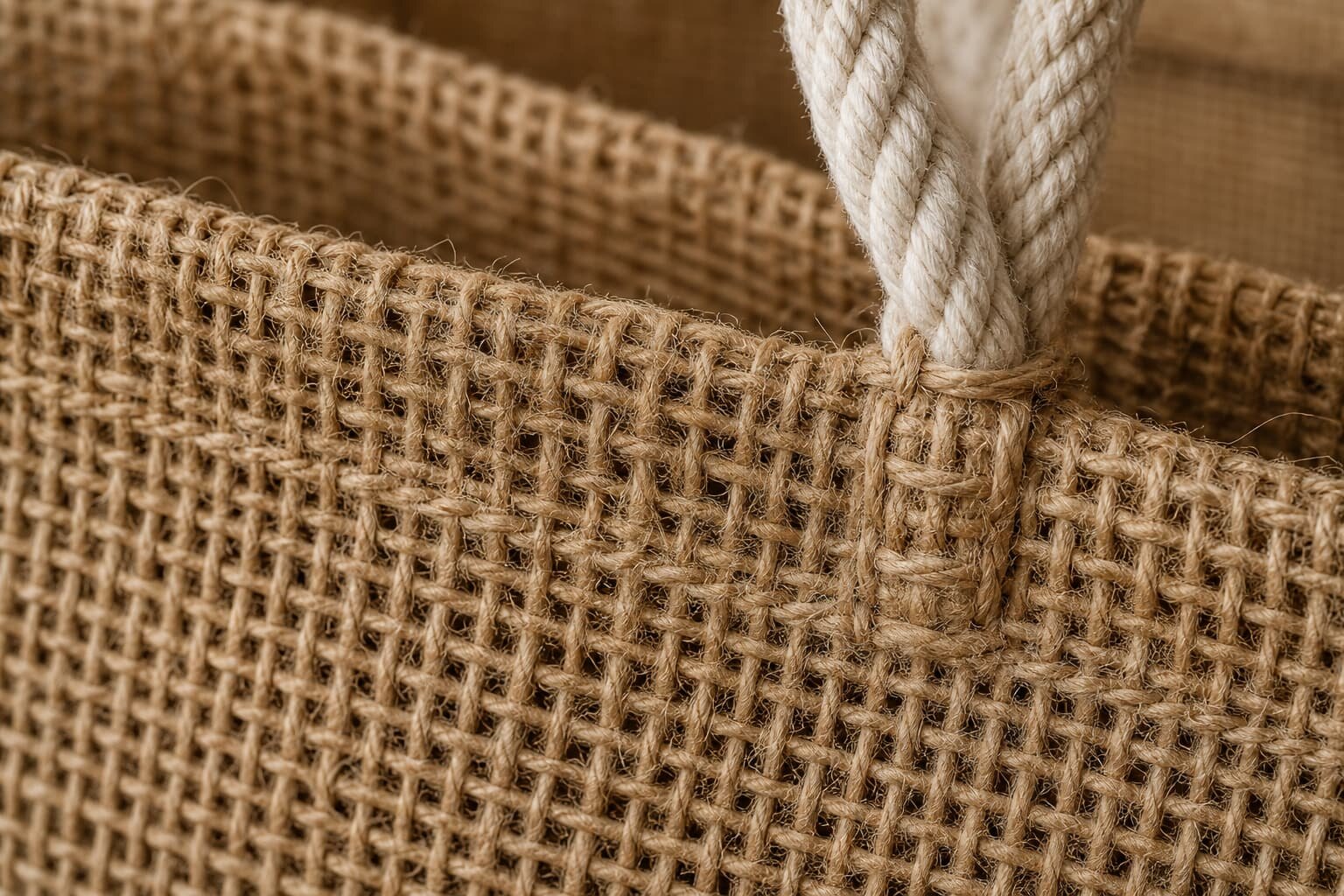
On jute burlap bags, the fabric and the stitch plan matter more than buyers sometimes expect. A coarse weave will fray more, carry ink differently, and behave differently at the seam than a smoother promotional textile. That means you need to confirm the full construction stack: outer fabric GSM, any inner lining or lamination, seam allowance, top hem, bottom seam, handle attachment, and reinforcement. If the bag is supposed to stand up in retail display, say so. If it only needs to carry light goods, do not pay for structure you will never use.
Ask the factory to show the approved sample with a tape measure and confirm the actual measurements, not just the design intent. Check panel width, body height, gusset square, handle symmetry, and the look of the corners after turning and pressing. You want to know whether the bag holds its shape, whether the bottom is secure, and whether the handles are anchored in a way that survives real use. A good line release file records not only the dimensions but also the construction details that make those dimensions repeatable in bulk.
- State whether the bag is unlined, lined, or lightly laminated.
- Lock handle material, width, stitch pattern, and reinforcement style.
- Record the approved sample measurements and construction photos in the file.
Approve branding on the real burlap surface
Printing on burlap is where many buyers get caught. The weave is open, the surface is uneven, and ink can sink or spread if the method is not matched to the fabric. That is why a PDF proof is not enough. Ask for a strike-off or pre-production print sample on the same fabric weight and base color that will be used in mass production. If the logo has thin strokes, small type, or tight registration, check it carefully. What looks crisp on a screen can blur once it hits the rough jute surface.
For many bags, a simple one- or two-color screen print is the most reliable choice. If the brand wants a more premium look, a sewn woven label, side label, or patch may be a better answer than forcing fine print onto a coarse weave. The file should capture the exact print placement, logo size, color count, and any acceptable variation in tone. It should also state the reference artwork version so the production team does not pull an outdated file from a shared folder.
- Approve print on the same fabric and base color that will ship.
- State the exact artwork file name or version in the release packet.
- Check logo size, placement, color count, and edge sharpness before signoff.
Test the sample like a real buyer, not a display piece
A useful sample check is practical, not decorative. Fill the bag with the item weight you actually intend to sell against, carry it, set it down, fold it, and inspect the stitch points afterward. For a wine bag, check bottle clearance and neck fit. For a retail tote, check whether the handles sit comfortably and whether the body keeps its shape under load. If the bag is supposed to be folded into a carton, see how it behaves after compression. Jute can look acceptable when hanging on a hook and fail after a simple real-world use test.
Your signoff file should define what is acceptable and what is not. Give the factory a clear stop list: broken stitches, skewed handles, print misplacement, uneven gusset depth, heavy fray on visible panels, or a smell beyond normal natural fiber odor. Also define the tolerance on size and placement before production starts. A buyer who only says the sample looks okay leaves too much room for subjective judgment when the line begins and the first-off pieces do not match the sealed sample exactly.
- Load-test the sample with the actual product weight or a realistic surrogate.
- Check symmetry, handle comfort, print placement, and fray after handling.
- Write down the acceptable tolerance before the factory starts cutting bulk material.
Read the quote as a production plan
A usable quote for a jute burlap bag is more than one line with a unit price. It should show the cost drivers so the buyer can compare offers on equal terms. Ask for the fabric basis, cutting and sewing labor, print setup, label or trim cost, packing cost, carton cost, and any separate sample or tooling charge. If one supplier quotes a very low number and another quotes higher, the difference is often hidden in one of those buckets. Without that breakdown, you are not comparing suppliers; you are comparing assumptions.
MOQ logic matters just as much as the price. A low MOQ can still be expensive if the factory is spreading print setup, cutting waste, and carton setup over too few pieces. Ask whether the MOQ is per design, per color, or per size, because those are not the same. For a simple unlined bag with one-color print, a normal lead time from final signoff may often sit in a 20-35 day range, but anything with strike-off rounds, lining, or custom packing can stretch that. The important point is that the clock should start after signoff, not before.
- Request a line-item quote so fabric, labor, print, and packing are visible.
- Ask whether MOQ is per design, per size, or per color.
- Confirm what changes would trigger a price change after the release file is signed.
Use the line release to control the factory floor
The line release file should reach the production line before the first cut, not after the first complaint. The line leader needs to see the approved sample, the size sheet, the artwork, and the packing instruction in one package. If the factory is relying on a verbal briefing, the risk goes up immediately. That is when you see small shortcuts like a lighter fabric substitute, a different handle width, or print placement based on memory instead of measurement. Production runs are built on repetition, so the first repeat matters most.
Good release control includes a first-off check and a clear escalation rule. The factory should know which defects require immediate stop and buyer approval, and which ones can be reworked in line. If the fabric shade drifts, the print registers off center, or the handle length changes, the line should not continue until the issue is recorded and approved. The signoff file should also say who is allowed to approve any deviation. Without that, approvals get made informally and nobody can later prove what was agreed.
- Release the line only with the signed packet physically or digitally on site.
- Require first-off approval before bulk sewing continues.
- Write the escalation rule for substitutions, deviations, and rework authority.
Lock packing, carton marks, and shipment counts
Packing is easy to ignore when the focus is on the bag itself, but it is one of the most common sources of buyer frustration. A clean jute bag can arrive crushed, dusty, or short-counted if the pack plan was never defined. Decide whether the bags are bulk packed, folded into inner packs, or individually polybagged. If you are selling retail-ready goods, specify the fold direction, the bundle count, any label position, and whether the bag should be ready for shelf display or just warehouse receipt. This is part of the product spec, not an afterthought.
Carton markings should be written into the release file with the same care as the bag dimensions. State the style code, size, color, quantity per carton, total cartons, and any buyer-required marks. If the bags are heavy or the pack density is high, confirm that the carton grade and dimensions are suitable for freight and warehouse handling. A quote that ignores carton efficiency may look cheap at the unit level and expensive once it hits chargeable weight or pallet space. Good packing control protects margin as much as it protects appearance.
- Define inner count, outer carton count, and folding method in writing.
- Match carton marks to the PO, style code, and size naming convention.
- Check carton strength and weight before final signoff if the bag is heavy.
Avoid the claims that keep showing up on jute bags
Most jute burlap bag claims come from the same few places: uncontrolled fabric variation, weak print approval, vague packing instructions, and a sample that was approved on appearance alone. Natural fiber variation is normal. The problem is when the buyer does not define the acceptable range and the factory fills in the blanks to suit its own process. If the fabric shade, weave density, or surface finish can vary, the release file needs to say how much variation is acceptable and which points are non-negotiable.
Another common trap is comparing one supplier's all-in quote to another supplier's bare-bones quote. The low number may hide a lighter GSM, a cheaper handle, fewer stitches, no strike-off, or simplified packing. That is why the line release file is so valuable: it forces the spec into one place before the purchase order goes out. It also gives procurement a clean paper trail when the sales team, warehouse, or quality team asks why the order cost more than expected. The answer should be in the file, not in a memory of an email thread.
- Do not approve from a catalog photo or a generic product page.
- Do not allow silent substitutions in fabric, handles, print, or packing.
- Keep version numbers on artwork, sample photos, and the release sheet.
Make the file reusable for reorders and variants
The best release file is not a one-time document. It becomes the control base for the next reorder, the next size run, or the next print variant. After the first production, add actual measurements, any approved adjustment, packing performance, and any note from the quality team. That way, the next buyer or planner does not have to reconstruct the order from emails or old photos. For importers and distributors buying the same jute bag season after season, that saved time also reduces spec drift and keeps margin from leaking through small surprises.
If you launch a second color, a larger size, or a different handle build, clone the file and change only the relevant fields. That creates a clean comparison between versions and makes it easier to compare supplier offers. The signoff file then works as a living sourcing record: what was ordered, what was approved, what was shipped, and what should be repeated. For a product category as visually simple as jute burlap bags, that record is one of the fastest ways to keep production disciplined.
- Archive the signed file with the approved sample photo set and carton reference.
- Use the same version control structure for every reorder or variant.
- Record any approved production adjustment so the next order starts from facts.
Specification comparison for buyers
| Spec decision | Recommended option | When it fits | Buyer risk to check |
|---|---|---|---|
| Fabric weight / GSM | 280-360 gsm natural jute for standard totes | Retail or promo bags that need a firm hand and visible texture | Too light looks floppy; too heavy raises sewing cost and can slow production |
| Print method | 1-2 color screen print on actual burlap strike-off | Bold logos, short text, simple graphics | Fine lines can fill in on the weave; approve on the real fabric, not a PDF |
| Handle build | Self-fabric or cotton webbing with reinforced stitching | Carry bags, wine bags, and items with real weight | Check handle drop, symmetry, and bar-tack strength before mass release |
| Structure | Unlined or lightly reinforced, with optional inner lamination | Basic merch bags, gift packs, and dust-sensitive goods | Lamination changes cost, handfeel, and lead time; confirm the exact stack-up |
| Packing | Bulk or folded pack with defined inner count and master carton spec | Export orders that need stable carton counts and clean warehouse receipt | Wrong fold direction, loose counts, or weak cartons create claims at arrival |
Buyer checklist before sampling
- Confirmed finished size, gusset, handle drop, and tolerance by dimension
- Locked fabric type and GSM, including whether the bag is woven jute, burlap, or laminated
- Approved logo artwork version, print method, print colors, and placement
- Reviewed a pre-production sample or strike-off on the same fabric and color
- Verified stitch details, handle reinforcement, top hem, and bottom construction
- Compared sample, quote, and PO to confirm the same spec is being priced and bought
- Defined MOQ by design, size, and color, not just one total number
- Confirmed packing method, inner count, carton marks, and master carton size
- Checked lead time from final signoff, not from the first inquiry
- Filed the signed release packet, photo set, and any approved deviations together
Factory quote questions to send
- What exact fabric type and GSM are you quoting, and what is the fabric width?
- Is the quote based on woven jute, burlap, laminated jute, or a blend?
- What print method is included, how many colors, and is strike-off cost separate?
- What handle material, width, length, and attachment method are included in the price?
- What stitching or reinforcement is standard, especially at stress points and seams?
- What is the MOQ by size, color, and design, and what drives that MOQ?
- What sample types are available before mass production, and what do they cost?
- What packing is included per inner pack and outer carton, and are carton marks included?
- What lead time starts after final signoff, and what factors extend it?
- What changes would trigger a price adjustment, and which items are fixed after release?
Quality-control points to confirm
- Approved artwork version matches the release file and every attached proof
- Fabric GSM, weave appearance, and shade match the approved sample or sealed reference
- Finished dimensions, gusset depth, and handle drop stay within the agreed tolerance
- Seam line, top hem, and bottom construction are consistent on first-off and bulk pieces
- Handle reinforcement and bar-tacks are present, neat, and positioned as approved
- Print placement, color density, and edge sharpness match the strike-off on actual burlap
- No excessive fray, oil marks, broken stitches, or loose fibers on visible panels
- Inner pack count, fold direction, and carton count match the packing instruction
- Carton marks, style code, size, and quantity match the PO and signoff file
- First-off photos, lot notes, and any approved deviation are recorded before full release