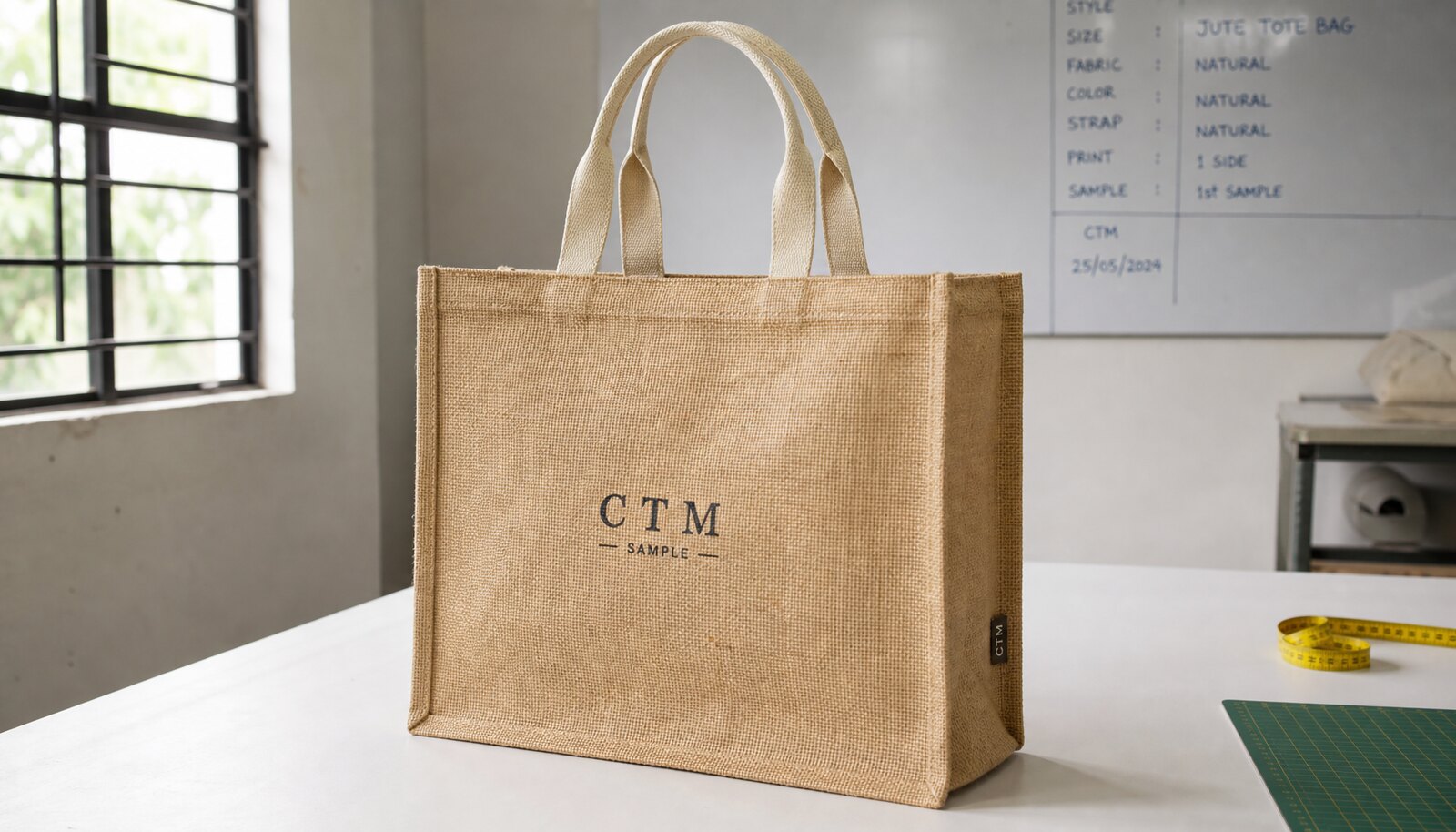
Start With the Use Case, Not the Logo
When buyers order jute bags with company logo, the first failure is usually commercial, not graphic. The logo is easy to discuss, so the spec gets written around artwork while the real buying decision is about use: what the bag must carry, how often it will be reused, and where it will be distributed. A trade-show handout bag, a retail bag, and a distributor sample bag can all look similar in a PDF and behave very differently in production.
Write the order around the job the bag must do. If the contents are light and short-life, a simpler structure with a modest fabric weight can be enough. If the bag sits on a shelf or goes home with the customer, the body, handle, and print method need to survive repeated handling. Put the distribution channel into the spec as well, because retail buyers often need shelf-ready packing, while B2B programs usually need bulk cartons and lower packing cost.
- State the primary load in kilograms or by contents, not just by style name.
- Define the sales channel: giveaway, wholesale, retail, or distributor replenishment.
- Specify whether the logo must remain visible when the bag is folded for packing.
- Note whether the bag must stand upright, hold a box shape, or remain soft and collapsible.
Choose Fabric Weight and Finish to Match the Payload
Jute is not a one-spec material. Factory quotes can differ by raw fabric weight, weave density, coating, lining, and how much finishing is added after sewing. For jute bags with company logo, the most useful planning range is usually 280-300 GSM for light promotional use, 320-360 GSM for a stronger reusable bag, and 380-400 GSM when the bag needs a more retail-grade feel. These are planning ranges, not automatic quality grades.
The finish matters as much as the weight. An unlaminated natural jute bag gives a softer, more organic look and is easier to price, but it will show fiber variation and fray more at the edges. A lined or laminated bag looks cleaner and is better for heavier contents, but it adds setup, material cost, and schedule risk. If the order is meant for books, bottled goods, or boxed gifts, ask the supplier to show a similar sewn structure before you approve the first sample.
- Use 280-300 GSM for light giveaways, short events, and lower-cost bulk distribution.
- Use 320-360 GSM when the bag will be reused and needs a better hand feel.
- Use 380-400 GSM when the product is retail-facing or expected to carry heavier items.
- Add lining or internal binding when the contents have sharp corners or repeated loading pressure.
Pick a Logo Method That Fits Rough Fiber
A jute surface is uneven, so artwork behaves differently than it does on canvas or paper. Small serif text, hairline strokes, gradients, and soft fades usually lose clarity. For most branded orders, a simple one- or two-color screen print is the most practical route because it gives the best balance of cost, speed, and legibility. If the design needs crisp small text, a woven label or sewn patch often produces a cleaner result than trying to force detail directly into the jute weave.
Premium branding can be done with an embossed patch, a sewn-on label, or a more controlled print area, but the artwork has to be simplified for the material. Keep the print area away from the seam line unless the factory has already proven that placement on a similar bag. If the logo wraps around the bag, or if there are multiple print positions, the risk is not just visual inconsistency; it also increases alignment errors and rework time.
- Use screen print for most bulk orders with one clear company mark.
- Use a woven label or sewn patch when the logo has small text or fine borders.
- Avoid gradients, photographic detail, and very thin reversed text on raw jute.
- Approve artwork on a real strike-off, not only on a digital mockup.
Compare Supplier Routes Before You Compare Price
The cheapest-looking quote often comes from the supplier who is hiding the most handoffs. A direct factory with in-house sewing and printing is usually the cleanest choice for repeat orders because the production flow is shorter and the same team owns the bag body, the logo placement, and the final packing. A trading company can still be useful when the order is small, the buyer wants one contact point, or the program includes multiple products, but the buyer should know exactly who is making and inspecting the bag.
For urgent replenishment, some buyers rely on local decorators or stock bag suppliers. That route can work if the size and material are standard and the logo is simple. It is a poor fit when the bag needs custom dimensions, a specific GSM, or a retail-ready finish. The rule is simple: if the supplier cannot show the actual sewing line, the print method, and a recent sample from the same material family, the quote is not yet good enough to compare.
- Direct factory: best for controlled specs, repeat programs, and cleaner accountability.
- Trading company: useful for smaller orders or mixed sourcing, but verify the real factory.
- Local decorator: good for speed only when the bag body already exists in stock.
- Ask for production photos, not just product photos, before you shortlist a supplier.
Read the Quote as a Production Document
A usable quote for jute bags with company logo should be broken down, not bundled into one vague number. At minimum, it should identify the bag body spec, handle material, print method, setup charge, sample fee, carton packing, and lead time. If the supplier gives only an all-in unit price, you cannot tell whether a cheaper quote comes from lower GSM, weaker stitching, fewer print colors, or a reduced packing standard.
Good quote data also helps procurement compare landed cost later. Ask for the exact fabric spec, finished size, handle length, number of colors, placement size, carton pack, carton dimensions, and whether the quote is EXW, FOB, or something else. That sounds administrative, but it prevents the most common mistake in branded bag sourcing: comparing one factory's low unit price with another factory's stronger material and then discovering the total cost gap only after approval.
- Lock the finished size, GSM, and handle construction before asking for best price.
- Separate unit price from setup, sample, packing, and export charges.
- Ask for carton dimensions and gross weight so freight can be estimated properly.
- Request quote validity in writing so the numbers do not change after artwork approval.
Understand MOQ Logic and Make Sampling Work for You
MOQ is not a random number; it comes from setup cost, cutting efficiency, color runs, and sewing line scheduling. A standard one-color bag with a simple body can often support a lower MOQ than a version with lining, multiple print positions, or special handles. As a planning range, smaller pilot orders can sometimes work at a few hundred pieces when stock fabric is available, while custom sizes and more complex builds usually move into the 1,000 to 2,000 piece range or higher. The factory is not being difficult when the MOQ moves; the economics of the process are moving.
Sampling should be treated as a control step, not a courtesy. A pre-production sample should confirm the final size, handle length, print placement, and packing direction. A strike-off or print sample should prove that the logo remains readable on real jute, not just on a white art board. If the factory sends a sample and the buyer ignores the seam line, color variation, or handle reinforcement, the bulk order usually repeats those same issues at scale.
- Approve a sample only after size, print, and handle notes are written together.
- Treat the strike-off as a material test, not a design approval only.
- If the logo is complex, ask for one corrected sample before bulk approval.
- Do not accept a verbal promise that the bulk order will be better than the sample.
Set QC Thresholds Before the Order Starts
Quality control for jute bags should be defined in measurable terms. A common target is a finished size tolerance of around 0.5 to 1.0 cm, but the exact range depends on the structure and whether the bag includes lining or gussets. Handle length, print position, and pocket placement should also be controlled against the signed sample. The bigger risk on jute is not that every piece is identical; it is that the buyer accepts uncontrolled variation because the material is natural and assumes that is normal.
Build inspection around the points that fail in use. Check stitching at the handle anchors, seam continuity along the side and bottom, and print clarity at the roughest part of the weave. A bag can look acceptable in one photo and still fail in warehouse handling if the reinforcement is weak or the stitching is uneven. If the contents are heavy, include a simple pull test or load check in the inspection plan and keep the result in the same file as the approved sample.
- Control size, gusset, and handle length against the signed sample.
- Inspect for skipped stitches, loose threads, open seams, and handle tearing points.
- Verify logo sharpness, color consistency, and print position on real fabric.
- Check odor, stains, and carton count before release.
Specify Packing for the Channel, Not Just for Shipping
Packing is where many branded jute orders become inconvenient for the buyer. Wholesale and distributor programs usually want bulk folded cartons, clear case counts, and simple carton marks. Retail programs often need individual polybags, barcodes, hang tags, or country-of-origin labels. If the buyer does not specify the packing route, the factory will choose the cheapest format that still ships safely, which is not always the format the channel needs.
Natural jute also reacts to moisture and odor differently from synthetic bags. Long ocean transit, humid warehouses, and over-sealed packing can create issues that have nothing to do with the sewing. If the bag is unlaminated, use packing that protects the product without trapping unnecessary moisture. Define the fold direction so the logo faces outward when the carton is opened, and make sure the carton label matches the exact size, color, and count of the approved order.
- For wholesale, use a clear carton pack with stable counts and simple markings.
- For retail, add individual packaging only when the channel truly needs it.
- If humidity is a concern, use carton liners or desiccants instead of over-wrapping.
- Confirm barcode, origin label, and carton mark placement before production starts.
Use Lead Time and Landed Cost to Make the Final Call
Lead time for jute bags with company logo is usually stage-based: artwork sign-off, sample approval, material preparation, cutting, sewing, printing, curing, packing, and final inspection. For a straightforward order, bulk production can often fit into a typical factory window of roughly 25 to 40 days after sample approval, but queue time, peak season, and rework can push that out. Adding lining, multiple print positions, or special packaging always increases schedule risk because each step creates another opportunity for delay.
Landed cost should decide the order, not unit price alone. Freight, customs, carton efficiency, testing, inland transport, and any rework from a weak sample can erase the savings from a cheaper factory quote. A bag that looks low-cost ex-works can become expensive if the cartons are oversized, the logo must be reprinted, or the packing format is wrong for your warehouse. The best buying decision is usually the supplier who gives the clearest spec discipline, not the lowest number on the first line.
- Freeze the spec before the final quote so the numbers are comparable.
- Allow one revision cycle for artwork and sample correction, not endless changes.
- Compare landed cost by carton efficiency, not by unit price only.
- Choose the supplier that can explain where time and money are spent at each step.
Specification comparison for buyers
| Spec decision | Recommended option | When it fits | Buyer risk to check |
|---|---|---|---|
| Sourcing route | Direct factory with in-house sewing and printing | Repeat orders, medium-to-large volumes, artwork changes that need fast control | Verify the factory owns the actual cutting, sewing, and printing steps instead of brokering them out |
| Sourcing route | Trading company with a stable factory base and local QC support | Smaller programs, mixed product baskets, buyers who need one contact point | Confirm who is responsible for stitching, print approval, and final inspection so margins and accountability are not hidden |
| Fabric weight | 280-300 GSM jute for light promotional use | Trade shows, events, handout bags, lower payloads | Test seam strength and handle pull if the bag will carry catalogues, bottles, or sample kits |
| Fabric weight | 350-400 GSM jute for retail or repeated use | Store sales, premium promotions, heavier contents | Check that the thicker body still folds cleanly and that print pressure does not create uneven coverage |
| Finish | Unlaminated natural jute with simple inner binding | Natural-look branding, lower cost, breathable packing | Accept some fiber variation, and define how much shade change and fray are acceptable |
| Logo method | 1- to 2-color screen print with fixed Pantone targets | Most company logos, large runs, clean artwork | Fine text and thin strokes can fill in on rough fiber, so approve a strike-off on real material |
| Logo method | Woven label or sewn patch for small text or premium branding | Retail bags that need crisp edges or a more finished look | Patch cost and sewing time rise, so lock placement and wash resistance before bulk production |
| Packing route | Bulk folded carton pack, no individual polybag unless retail requires it | Wholesale, distribution, warehouse replenishment | Retail programs may need barcode labels, hang tags, and country-of-origin marking |
| MOQ logic | Lower MOQ with one color and standard size; higher MOQ with lining, coating, or multiple print positions | Pilot orders, first launches, uncertain demand | Watch for hidden setup charges that make a low MOQ look cheaper than it really is |
Buyer checklist before sampling
- Finished size in cm, including gusset and handle length, with an acceptable tolerance range
- Jute fabric weight in GSM, plus whether the bag is laminated, lined, or unlined
- Handle material, width, attachment method, and whether stress points are reinforced
- Logo artwork file, number of print colors, and exact print position on the bag
- Whether the bag must stand upright, fold flat, or fit a retail shelf dimension
- Target payload, likely contents, and any sharp edges or heavy items the bag must carry
- MOQ by size, color, and print version rather than one generic number
- Sample approval path, including strike-off, pre-production sample, and final sign-off
- Packing requirement for wholesale or retail, including carton count and label format
- Destination market, incoterm, target ship date, and any compliance or labeling requirement
Factory quote questions to send
- Is your quoted price based on in-house sewing and printing, or is any part outsourced?
- What exact GSM or fabric specification will you use for the bag body and handles?
- What handle material, width, and reinforcement method are included in the quote?
- How many print colors are included, and what setup or screen charges apply?
- What is the MOQ per size, color, and artwork version?
- What sample types can you provide before mass production, and what is the sample fee?
- What carton pack, carton dimensions, and gross weight should we expect for export?
- What is the lead time after sample approval, and what parts of the schedule can move it?
- Which terms are included in the unit price, and which items are extra charges?
- Can you share photos of a recent similar production order and the final packed goods?
Quality-control points to confirm
- Finished size matches the approved spec within the agreed tolerance
- Fabric weight, finish, and hand feel match the signed sample
- Logo placement, color, and sharpness match the strike-off on real jute
- No skipped stitches, loose threads, open seams, or broken handle anchors
- Handle length is consistent, and reinforcement stitching is intact at stress points
- No oil marks, stains, off-smell, or visible contamination on the fabric
- Print does not crack, blur, or sink excessively into the fiber texture
- Carton count, bundle count, and carton labels match the packing list
- Fold direction and packing orientation are consistent across the order
- Random pull checks and load checks pass on sampled units before shipment