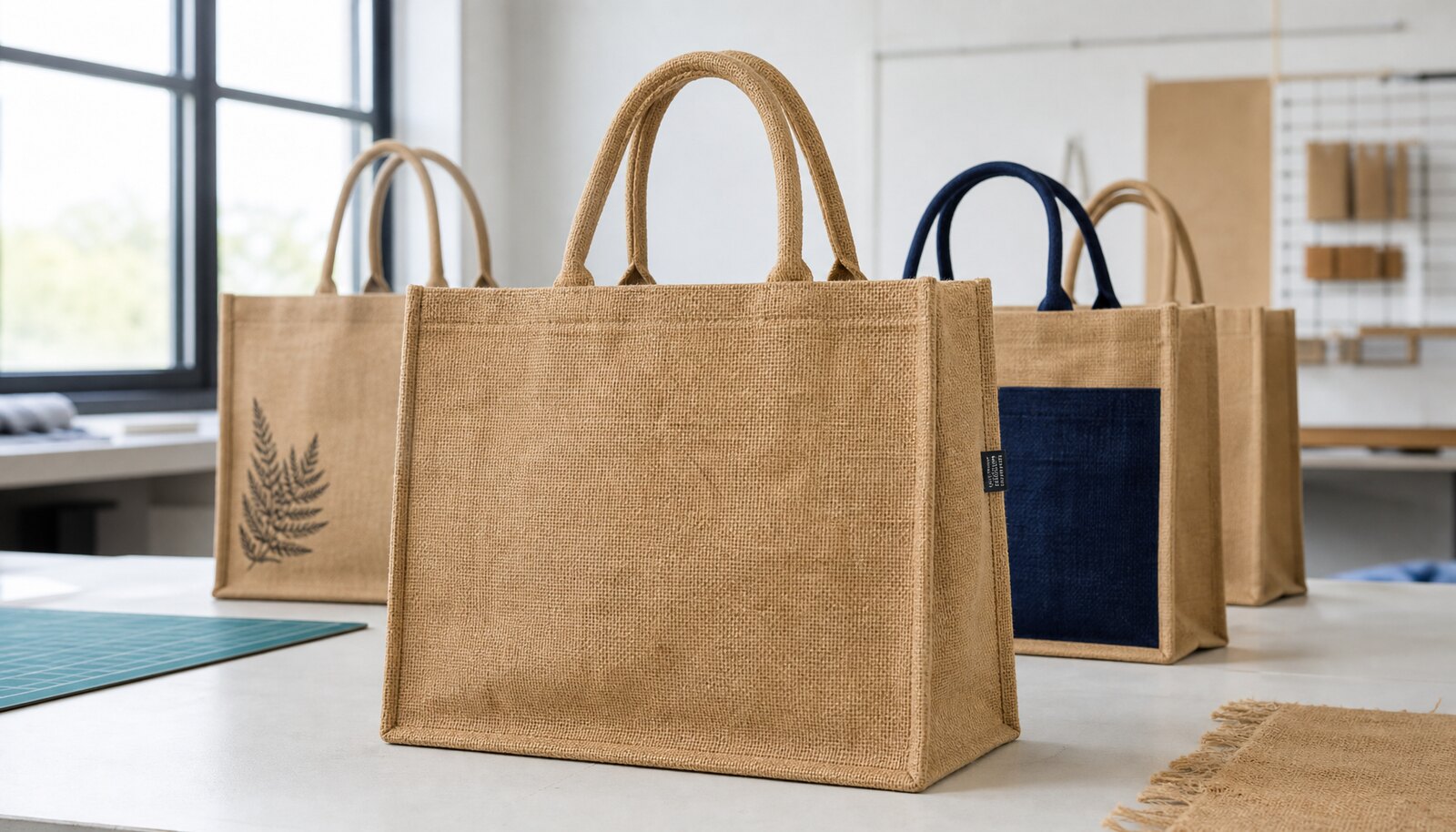
Start With the Buying Job, Not the Artwork
Jute bags customised are rarely a simple print purchase. The real buying job is to match construction, load-bearing strength, print method, and packing to the way the bag will actually be used. A retail shopper bag, a trade-show giveaway, and a gift bag for premium packaging do not need the same fabric weight or seam build, even if the logo looks identical on screen.
If the RFQ starts with artwork only, suppliers will fill in the blanks with their own assumptions and you will compare uneven quotes. Start by defining the bag's use case, target load, expected shelf life, and whether the bag must look clean and structured or can tolerate a more rustic finish. That one decision changes GSM, lining, handles, and even the best print method.
- Use case first: promo, retail, grocery, gift, or event merchandising.
- Set the intended load in practical terms, such as light handouts or everyday shopping.
- Decide whether the bag must stand upright, protect contents, or only carry and brand.
Choose the Right Jute Construction
For most customised jute programs, the main spec lever is fabric weight. Lightweight promotional bags often sit around 250 to 280 GSM and work for giveaways, brochures, or light retail items. Midweight bags around 300 to 340 GSM are a better default for shopping and brand retail because they hold shape better and feel less flimsy in the hand. Heavier builds in the 340 to 400 GSM range, or a lighter shell with lining or lamination, make sense when the bag must carry more weight or present a more premium structure.
Do not treat GSM as the only structure decision. Jute weave density, lining, gusset depth, handle width, and handle attachment all affect performance. A 300 GSM bag with narrow handles and weak stitching can fail sooner than a 280 GSM bag built with better reinforcement. If the buyer only writes 'jute bag, natural color, logo print,' the factory will choose a default construction that may not fit the end use.
- 250 to 280 GSM: lighter promotions and lower-cost campaigns.
- 300 to 340 GSM: the practical retail baseline for everyday carry.
- 340 GSM and above: heavier loads, premium feel, or more structure.
- Wider handles and stronger stitch reinforcement matter as much as fabric weight.
Pick the Branding Method by Volume and Finish
Most jute bag decoration comes down to screen print, woven label, sewn patch, or a combination. Screen print is usually the best value for one to two colors and works well when the logo has solid shapes and clear spacing. It is less forgiving with tiny type, thin lines, gradients, or multicolor images because the weave shows through and can soften the edges. If the brand needs a cleaner premium finish, a sewn label or side label can add identity without relying entirely on the print surface.
Choose the print method based on the artwork, not just on price. A one-color screen print on a natural jute surface is simple and durable. A fine logo with small text often needs a larger print area, simplified artwork, or an alternate label approach. If the buyer wants full-color artwork, ask the factory how they manage registration on textured jute and whether they recommend a print-proof adjustment before sample approval.
- Best value: one or two-color screen print with clear spacing.
- Best premium cue: woven side label, sewn patch, or a clean brand tab.
- Avoid tiny copy and thin lines unless the supplier proves the print can hold.
- Place the logo where the fabric is flat enough to reduce distortion.
Read Supplier Quotes Line by Line
A useful quote should separate the bag price from the costs that change it. Ask for the unit price, sample cost, screen or plate charges, packaging cost, and any extras tied to lining, lamination, labels, or handle upgrades. If those items are buried in a single number, you cannot compare suppliers fairly. Two factories can both quote a low unit price while one has hidden setup fees and the other has a weaker construction that costs more later in claims or rework.
The quote should also state the assumptions behind the price. That means finished size, GSM, number of print colors, print sides, handle length, carton count, and whether the bags are packed flat or folded. A quote that omits these details is not a final quote; it is a starting point. For import buyers, the real comparison is not the ex-factory number alone but the cost of getting the right bag to the right warehouse without surprises.
- Separate base bag cost from setup, sample, packing, and upgrade charges.
- Make sure the same size, GSM, print count, and packing count are used across all offers.
- Ask whether the price includes outer labels, inner bags, silica, or palletization.
- Check whether the supplier quoted the same construction as the sample they showed.
MOQ and Sampling Should Match the Risk
MOQ logic in jute is usually tied to fabric cutting efficiency, print setup, and how much labor the bag needs. A simple natural bag with one-color print can often run at a lower MOQ than a fully lined bag with multiple print locations or special handles. If your forecast is uncertain, do not force a large order just to get a lower unit price. It is usually cheaper to buy a smaller run of the correct bag than to clear a large run of the wrong one.
Use a sample ladder instead of skipping straight to production. The sequence should be development sample, corrected sample if needed, pre-production sample, and then a sealed golden sample. For jute, the sample is not only about appearance. It is the only practical checkpoint for weave feel, size, handle balance, and how the print sits on the surface. If a supplier refuses a pre-production sample on a custom program, that is a signal to slow down.
- Lower MOQ usually comes with simpler construction and fewer print colors.
- Development sample is for idea testing, not final approval.
- Pre-production sample should match the planned mass-production materials.
- Keep one sealed golden sample for receiving and dispute reference.
Set QC Thresholds That Reflect Real Use
Quality control for customised jute bags should focus on the failures the buyer will actually see. The usual problems are size drift, off-center print, crooked handles, weak seam reinforcement, frayed edges, and moisture issues after packing. A cosmetic tolerance that is too loose creates retail inconsistency, while a tolerance that is unrealistically tight creates dispute without improving the product. The right answer depends on whether the bag is for a shelf display, a distributor pack, or a low-cost campaign.
Build your acceptance criteria around the bag's job. For promotional bags, a slightly rustic surface may be acceptable, but the print must still be readable and the handles must stay secure. For retail or resale bags, the bag must be more consistent in shape, trim, and finish. State the acceptable size tolerance, print placement tolerance, seam quality, and carry test in the PO or spec sheet so the factory knows what will be inspected.
- Check finished dimensions against a written tolerance, not a visual estimate.
- Use the approved sample to judge print placement, color, and handle alignment.
- Define a carry test that matches the intended load of the bag.
- Reject damp, moldy, or strongly odorous cartons before they enter inventory.
Packing Can Make a Good Bag Arrive Wrong
Jute is a natural fiber, so packing matters more than many buyers expect. The wrong packaging can trap moisture, create odor, or flatten the bag into a shape that looks poor when the carton is opened. Bags should be dry before packing, and if the shipment will move by sea, the supplier should think about ventilation, carton strength, and the level of moisture protection needed for the route. Airtight packing is not automatically better if the product is still holding humidity.
Ask for the packing logic, not just the carton count. How many bags are bundled together, how many bundles fit in one carton, whether the bags are folded or flat, and what the gross weight per carton will be all matter to warehouse handling and freight cost. If the product goes to retail, carton marks, barcode labels, and count accuracy become just as important as the bag itself. One wrong inner count can turn into a store receiving issue even when the bag quality is fine.
- Confirm bundle count, inner pack count, and carton count before production.
- Keep bags fully dry before sealing cartons to reduce mildew risk.
- Ask for carton dimensions so you can estimate cube and freight cost.
- Use clear master carton marks if the bags will be cross-docked or split by store.
Plan Lead Time Around Real Bottlenecks
A realistic lead time for jute bags customised usually depends on artwork approval, material sourcing, print setup, sewing capacity, and packing. The longest delays often come from slow sample approval or from changes after the first proof. If the buyer keeps changing logo size, print placement, or handle spec after the sample stage, the schedule slips even when the factory is on time. Treat sample approval as a production gate, not a design meeting that can move indefinitely.
Seasonality matters as much as the factory calendar. Peak export windows, holiday promotions, and back-to-school or year-end retail programs can crowd the same lines that your order needs. Build buffer time for artwork approval, material lead time, and freight booking. For replenishment programs, place the first order early enough to create a second-order window so you are not forced into an expensive rush order if sales are stronger than expected.
- Typical lead time expands when a bag needs special handles, lining, or multi-color print.
- Delay risk rises when artwork is not final before sampling starts.
- Build a reorder window instead of waiting for stock to hit zero.
- Reserve more time for sea freight than for the factory's sewing line alone.
Compare Landed Cost, Not Just Factory Price
A cheap unit price can be the wrong buy if it hides higher freight, more defects, or a higher minimum order than you need. The buyer should compare landed cost across equivalent bags: bag price, setup charges, packing, inland handling, ocean or air freight, duty, and receiving cost. In jute programs, a slightly more expensive factory can still win if it gives more consistent GSM, better print yield, and fewer rejects on arrival. The quote that looks lowest on paper is not always the lowest cost to sell or distribute.
The sourcing route also changes the economics. A direct factory works best when you have a clear spec and repeat demand. A trading company may help when you need several bag styles in one shipment. A local decorator can solve urgent replenishment, but you may lose consistency with future factory reorders. The right route depends on volume, lead time, and how much variation your brand can tolerate across seasons.
- Direct factory: best for repeatable specs and stronger process control.
- Trading company: useful when you want one purchasing contact for multiple styles.
- Local decorator: useful for urgent, simple jobs with short domestic lead time.
- Dual-source: the best hedge when sales are growing and supply continuity matters.
Specification comparison for buyers
| Spec decision | Recommended option | When it fits | Buyer risk to check |
|---|---|---|---|
| Direct factory with in-house sewing and print | Use one supplier that controls fabric cutting, stitching, print, and packing in one line | Best for repeat programs, exact sizing, and fewer handoff errors | Confirm the factory is not brokering the print or sewing to a third party |
| Trading company with multiple factory sources | Use a trader only if they can name the real factory, share specs, and manage QC | Useful when you need several bag constructions from one procurement contact | Check whether sample quality and mass production come from the same plant |
| Stock jute blanks plus local decoration | Buy undecorated bags and add print or labels near your market | Works for urgent promotions and short domestic replenishment cycles | Make sure the blank GSM, handle strength, and weave quality match your final use |
| Small workshop or artisan supplier | Use for boutique retail, low volume, or hand-finished appearance | Fits premium positioning and small launch orders | Watch for size drift, slower scale-up, and inconsistent stitch density |
| Large exporter with structured QC | Choose a factory with documented process control and carton discipline | Good for chain stores, retail programs, and repeat seasonal orders | Minimums may be higher and design changes may cost more |
| Dual-source approved factory route | Approve two factories to the same BOM, artwork, and golden sample | Best for forecasted demand and supply continuity | Different machines can still create small color and shape variation |
| Nearshore print-and-pack route | Decorate imported blanks close to your warehouse or market | Useful when transit time is tight and the logo is simple | Imported blanks must stay consistent across replenishment rounds |
| Factory with lining or lamination capability | Use when the bag must hold shape, protect contents, or feel more retail ready | Good for heavier loads, cleaner interiors, and premium store programs | Check odor, seam bulk, and whether lamination changes the hand feel too much |
Buyer checklist before sampling
- Define the end use first: promotional carry, retail shopping, gift packaging, or event merchandising.
- Lock the finished size, gusset depth, handle length, and handle attachment method before requesting prices.
- State the target fabric weight in GSM and whether the bag needs lining, lamination, or board insert.
- Specify the print method, number of colors, logo placement, and acceptable color match standard.
- Ask for a pre-production sample and a signed golden sample before mass production starts.
- Confirm the unit price, tooling or setup charges, sample cost, and all packing assumptions in writing.
- Agree on carton pack count, carton dimensions, moisture protection, and master carton marks.
- Set your acceptable tolerance for dimensions, print placement, stitch quality, and carry performance.
- Ask who sources the jute fabric, thread, handles, and labels, and whether any part is subcontracted.
- Match lead time to the selling calendar, freight mode, and any retail receiving appointment window.
Factory quote questions to send
- What GSM, weave type, and finish are included in the quoted price?
- Does the price include lining, lamination, board insert, or only the outer jute shell?
- Which print method is quoted, how many colors are included, and what are the setup charges per color?
- What is the MOQ by size, print color count, and handle style?
- Can you quote sample cost separately for development sample, pre-production sample, and courier shipping?
- What are the standard size tolerances and print placement tolerances you work to?
- How are the bags packed per carton, and what is the carton size and gross weight?
- What is the production lead time after sample approval, and what can extend it?
- Do you produce the handles, labels, and packaging in-house or through outside vendors?
- What QC records, inspection photos, or pre-shipment checks can you share before shipment?
Quality-control points to confirm
- Finished size stays within the agreed tolerance, usually tighter for retail bags than for promotional bags.
- Handle attachment is symmetrical, secure, and reinforced at the stress points with no loose bartacks.
- Print placement matches the approved sample and does not distort across the weave beyond the agreed limit.
- Main seams, base seams, and gusset seams have no skipped stitches, puckering, or open holes.
- Natural jute smell is normal, but the shipment must not carry dampness, mildew, or chemical odor.
- Loose fibers, frayed edges, and broken threads stay within the agreed cosmetic limit for the grade.
- Carton pack count, carton marks, and inner bundle count match the packing list exactly.
- Carry strength is tested against the intended load, not a generic lab target that ignores real use.