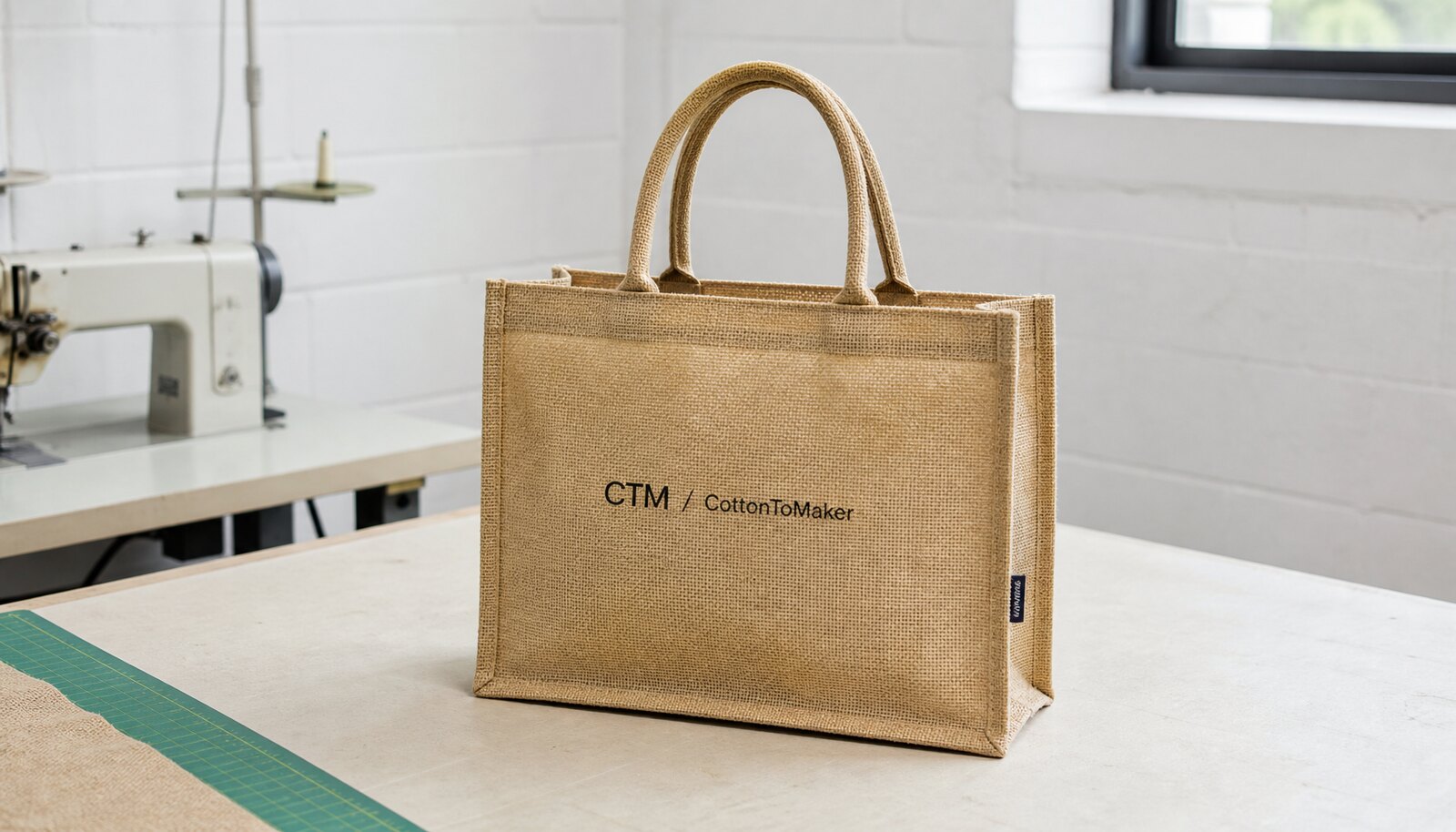
Why buying a jute bag with logo needs a tighter spec than it first appears
A jute bag with logo looks simple on a product page: a tote, a print, and a carton count. In procurement, that simplicity is exactly what causes cost drift and quality disputes. Jute is a natural fiber with visible weave variation, so the same artwork can look clean from one factory and weak from another even when both suppliers quote the same nominal size. If the spec is loose, you can end up with a technically delivered order that still misses the brand standard.
The buyer’s task is to turn a visual product into a controlled specification. That means deciding not only the size, but the fabric build, the handle reinforcement, the print process, and the packing format. Use case matters. A bag for retail resale needs cleaner seams and a more stable silhouette than a one-day event giveaway. A bag carrying boxed goods needs more reinforcement at the handle root than a bag used for flat literature.
Most quoting problems start with hidden assumptions. One supplier may price a laminated 350 GSM body with cotton webbing handles and screen print. Another may assume a lighter unlaminated body, self-fabric handles, and simpler packing. Those are not interchangeable offers. Before you request prices, define what “acceptable” means in functional and commercial terms so you can compare like with like.
For buyers, the most useful rule is this: write the spec as if it will be used on the factory floor. If the wording is precise enough for production, it will also be precise enough for sample approval, receiving inspection, and dispute resolution. If it is only precise enough for a sales conversation, it is not yet ready for a PO.
- Retail use needs cleaner finishing and tighter print alignment than event giveaways.
- Natural fiber variation is normal; brand inconsistency is not.
- A quote without a clear construction definition is not a comparable quote.
Start with the bag build: fabric, weight, lamination, and shape
The first decision is the bag build, because it drives cost, appearance, and performance. Suppliers often use broad words like “heavy jute” or “premium jute,” but those phrases do not help a factory make the same bag twice. In RFQ language, ask for a numeric fabric target and a build description. For many standard shopper bags, buyers land in a mid-weight range around 320-400 GSM or the equivalent ounce specification. That is not a rule; it is a common procurement band for bags that need a reasonable mix of body, durability, and print readability. Lower weights can work for light giveaways. Heavier builds are more appropriate when the bag must carry bottles, boxed products, or repeated use.
Lamination is the next major choice. Inner lamination can improve moisture resistance, reduce linting, and create a cleaner backing for print, but it also changes sewing behavior and can increase the chance of crease marks at fold points if the bag is packed tightly. Some buyers want the cleaner presentation. Others want the bag to remain fully natural for a sustainability story or a more rustic look. The real decision is not whether lamination is good or bad. It is whether the change in finish, odor, stiffness, and seam behavior fits your channel.
Shape matters more than many buyers expect. A flat tote may be enough for literature or lightweight collateral. A gusseted bag creates volume and improves stability for retail packaging. If the bag must stand upright for shelf display, warehouse picking, or premium presentation, ask for a base structure or insert board rather than assuming fabric weight alone will solve the problem. Without that decision, the bag can look fine flat on a table and still collapse when loaded.
The best RFQ wording is concise and production-ready: fabric type, weave or weight, laminated or not, gusset depth, base structure, and any stiffness requirement. That gives the supplier enough information to price correctly and gives procurement enough detail to inspect the result later.
- Write fabric as a numeric target, not as a marketing adjective.
- State lamination yes/no and why it is needed.
- Specify whether the bag must stand upright when loaded.
Choose the print method based on artwork, quantity, and acceptable risk
Printing on jute is where buyers often ask the material to do more than it can. The coarse weave affects ink coverage, edge sharpness, and how much detail survives. That is why the “best” print method is the one that fits the substrate and the order size, not the one that sounds most advanced. For many bulk programs, screen printing remains the practical default because it is durable, repeatable, and easier to control on coarse natural fabric than most buyers expect.
Screen printing works best when the artwork is simplified. Fine serif text, tiny legal marks, thin rules, and delicate gradients tend to close up or break apart on jute. If the logo depends on small detail, simplify the art for this substrate or move to a different decoration route. Heat transfer and digital transfer can hold more detail, but on rough fabric they may feel more layered, show edge lift, or create a finish that looks too glossy for a natural-fiber product. Embroidery, woven labels, and sewn patches look more premium, but each adds cost, labor, and potential delays in approval or production.
The right buyer question is not “Which method is best?” It is “Which method can hold my artwork on this surface at this quantity, with an acceptable defect rate?” That question forces the factory to discuss line thickness, color count, coverage, and adhesion. Ask for a print sample on actual jute, not on paper or a smoother substitute. Many decoration issues only become visible once the ink meets real weave.
If the logo is brand-sensitive, ask the supplier to state the print tolerance in writing. Define the approved color reference, the placement zone, the smallest readable text size, and what counts as an acceptable shift. The supplier should know in advance what happens if the first run differs from the approved sample. Without that, every carton becomes a negotiation.
- Use screen print for bold, repeatable logos with one or two colors.
- Use transfer only when the design detail matters more than texture authenticity.
- Approve print on actual jute, not on a substitute fabric.
Handle construction, reinforcement, and load are where the real failures happen
Handles are the most common mechanical failure point on a jute bag with logo, and they are also one of the easiest places for a supplier to cut cost without making the quote look cheaper. Two handles can look similar from the outside while having very different reinforcement underneath. Procurement should ask for the exact handle material, width, length, drop, and join construction. If the bag needs to carry meaningful weight or be reused many times, this is not a detail to leave to factory preference.
Common handle options include self-fabric jute handles, cotton webbing handles, and hybrid builds that use jute for the visible finish but add reinforcement where the handle joins the body. Cotton webbing is generally more comfortable in hand and more forgiving under load. Jute handles are visually cohesive with the body but can feel rougher and may fray if edge finishing is weak. The strongest-looking handle is not always the strongest handle, so ask for the actual stitch construction: bartacks, box stitch, double-row seam, or reinforcement patch. If the factory cannot explain the construction clearly, that is a warning sign.
Think about how the bag will be carried. A bag used for short event distribution may never see long-term stress. A retail or grocery-style bag often gets repeated loading, shifting contents, and pulling from a cart or car trunk. That creates dynamic stress at the handle root, not just static weight. A simple way to ground the conversation is to state the expected load in kilograms or pounds, then ask the supplier what reinforcement they recommend and what test they use to verify it. For many commercial programs, buyers ask for a load test at or above the intended service load, then watch for seam opening, distortion, or stitch breakage.
Do not accept a handle spec that only says “strong handle.” Strong by what measure? Strong enough for how many kilograms? Strong enough after lamination? Strong enough after repeated lifting? These are the questions that separate a quote from a usable production standard.
- Specify handle material, width, drop, and join reinforcement.
- Ask for a realistic load test, not only a visual sample.
- Treat the handle root as a high-risk QC point, not a cosmetic detail.
Use an RFQ structure that makes quotes comparable line by line
The biggest commercial mistake is asking for “a price for a jute bag with logo” and expecting meaningful comparison across suppliers. That request invites every supplier to interpret the product differently. One may quote a thinner body, another may assume looser packing, another may use a cheaper decoration route, and another may leave setup charges off the first number. The fix is straightforward: force the quote to mirror the same technical structure for every supplier.
A strong RFQ should separate the bag into line items. At minimum, it should specify finished size, gusset depth, fabric weight, lamination, handle material and length, logo method, number of print colors, packing method, and carton quantity. If there is a setup cost, keep it separate from the unit price. If there is an extra charge for art changes, label it. If the supplier uses standard carton sizes, ask for them. This can feel meticulous, but it is the only reliable way to compare factory A against factory B without guessing whether one of them is quoting a different product.
For repeat programs, ask the supplier to show the break point where price changes. A low-MOQ quote may look attractive until you realize the unit price drops only at a much higher order volume. That is useful if you are buying at scale, but it becomes a problem if you are doing a pilot order or a first trial. Also ask whether MOQ applies per artwork, per size, or across a mixed order. Those distinctions matter when the buyer wants to test two logo versions or two bag sizes in one shipment.
In practice, the best quote is not the lowest number. It is the quote that lets you award the order without hidden assumptions. If two suppliers are not quoting the same spec, they are not competing on the same job.
- Separate one-time setup charges from recurring unit price.
- Keep the RFQ specific enough that the supplier cannot quietly downgrade the build.
- Ask for MOQ by SKU, by artwork, and by packing configuration if variants are involved.
Compare sourcing routes honestly: direct factory, trading company, or hybrid
Sourcing route is a control decision. A direct factory is usually the best fit when the product is defined, repeatable, and expected to recur. If the same factory handles sewing, printing, inspection, and packing, there are fewer handoffs and fewer chances for the logo or carton specification to drift. That does not make the factory automatically better. It means the buyer has fewer invisible steps to audit. For a stable SKU with a known finish, that simplicity is valuable.
A trading company can still be useful. If the buyer needs a small trial, multiple product categories, or a combined shipment that includes other gift or packaging items, an intermediary may save time. But it adds another layer of interpretation, and interpretation is where specs get diluted. If you use a trader, be explicit about who actually makes the bag, who prints the logo, who inspects it, and who packs it. Avoid broad phrases like “our factory” unless you know which factory and whether it is the same site every time.
A hybrid arrangement is common in practice: the quote comes from a commercial intermediary, but the run happens in a nominated sewing or print facility. That can work if change control is tight. If the factory changes the fabric lot, moves the print work to another room, or substitutes a different handle tape, the intermediary must know before shipping. Ask directly: who owns raw material purchase, who owns sample approval, who signs off on in-line inspection, and who is responsible if the carton count is wrong? Those answers tell you whether the sourcing route is controlled or merely convenient.
One useful buyer rule: if the bag is standard, repeatable, and material-sensitive, direct factory sourcing is often easier to manage. If the order is small, mixed, or still in testing, an intermediary can be acceptable if they can show the actual maker and the actual inspection flow. Either way, the same written spec and acceptance standard still apply.
- Ask who actually sews, prints, inspects, and packs the order.
- Require the name of the production site or factory code if the quote comes through a middle layer.
- Use trading routes for flexibility, not as a substitute for a weak spec.
What a usable factory quote should contain, and what is missing when it doesn’t
A useful quote for a jute bag with logo should read like a production summary, not a sales slogan. At minimum, the supplier should state the fabric build, finished dimensions, handle construction, logo method, print color count, packing format, carton configuration, production lead time, and any one-time charges. If the supplier gives only a single price, the quote may be useful as a rough benchmark, but it is not yet ready for award.
Buyers should also ask for the exclusions. This is where hidden costs often live. Does the price include sample development? Screen setup? Carton printing or barcode labels? Pantone matching, or only a best-effort visual match? Is freight included, and if so, on what basis? A good supplier will not promise the impossible, but they should tell you what is and is not included. That makes the final landed cost more predictable.
The line-item view matters because it reveals where supplier behavior may change after award. If a quote is too low on material or setup, the factory may try to recover margin by switching to a lighter fabric, reducing reinforcement, or simplifying packing. None of those changes show up clearly in the unit price. The only reliable prevention is to require the quote to mirror the approved spec and to keep a signed version on file. That signed version becomes the reference when production questions arise later.
If a supplier refuses to itemize, ask why. Sometimes the product really is standard and the pricing is clean. More often, the lack of detail is hiding a downgrade or a future charge. For branded programs, that is too much risk to leave unresolved.
- Use the quote to expose assumptions, not hide them.
- Keep exclusions written so setup charges do not reappear later.
- Award only against a spec that both sides can trace back to sample approval.
Sample approval should test the bag as a product, not just the logo as artwork
A sample is not a miniature decoration proof. It is the decision point where material, print, sewing, and packing come together. For a jute bag with logo, buyers should request a pre-production sample made from the intended fabric, with the intended print method, handle construction, and packing style. If the sample uses a smoother substitute or a different ink process, it cannot serve as a reliable benchmark. Approving a sample because the logo looks fine, while the bulk run uses a different build, is one of the most common errors in this category.
During sample review, inspect the points that are expensive to correct later. Check logo position, print density, thread tension, seam straightness, top edge finish, handle placement, and whether the bag sits properly when filled. Then do a basic function test. Put in a realistic weight, lift it several times, and look for seam opening or handle distortion. If the bag is meant to be retail-ready, inspect how it folds, whether it wrinkles excessively, and whether the print survives handling without cracking or shedding.
Keep sample governance simple. One signed reference sample stays with procurement, one stays with quality control, and if possible one remains with the supplier as the locked master. If any later batch differs, you need a direct comparison point. Buyers sometimes skip this because the product feels simple, but simple products are exactly where memory becomes fuzzy after the first shipment. A locked sample reduces that problem.
If the supplier offers only photos for approval, be cautious. Photos help with initial review, but they do not show surface roughness, ink bite, odor, stiffness, or stitch feel. For this category, physical approval is worth the time. It protects both sides and reduces disputes over issues that were visible to the hand but not to the camera.
- Approve the real material and real print method, not a substitute.
- Use a practical load test before final sign-off.
- Keep one signed reference sample at procurement and one at QC.
Packing and carton specs affect damage rate, warehouse labor, and receiving errors
Packing is often treated as a side note, but it can change the real cost of a jute bag with logo as much as a small print adjustment. Bulk packing is the cheapest route and is often fine for internal distribution or large promotional campaigns where presentation is secondary. But if the bags are going to a retail store, e-commerce fulfillment center, or branded gift program, individual protection starts to matter. A bag that arrives with hard fold lines, dust marks, or crushed corners can fail even if the sewing and print are acceptable.
Ask the supplier to quote the packing method explicitly. Inner packs, polybags, moisture protection, carton insert sheets, desiccant if needed, and carton labeling should all be visible in the spec. In humid supply chains or longer sea transit, moisture protection is not a luxury. Jute can pick up odor and surface marks if the pack is poorly controlled. For retail programs, barcode or SKU labeling is also useful because it speeds receiving and reduces the chance of mixed inventory.
Carton design is not just a logistics detail. If cartons are too large, the bags shift, crease, and arrive looking tired. If cartons are too small, the stack compresses the fabric and leaves recovery marks. Ask for carton dimensions and target gross weight so the buyer can judge whether the case pack is practical for warehouse handling. If the supplier can provide pallet dimensions or palletization rules, that helps the receiving team plan storage and reduces damage during transit and unloading.
The main procurement point is this: packing is part of the product, not an administrative afterthought. Once you decide how the bags will be received, stored, and distributed, the packing spec becomes obvious. If you leave it open, the supplier will usually choose the cheapest acceptable method, which may not be right for your channel.
- Define whether bags are bulk packed, bagged individually, or retail-ready packed.
- Ask for carton dimensions, carton quantity, and gross weight targets.
- Use moisture control when shipping through humid lanes or long transit cycles.
Lead time is usually decided before production starts, not during it
Many buyers focus on the final lead-time number and miss the real schedule drivers. For a custom jute bag with logo, the clock usually starts slipping before the workshop begins sewing. The delays are often in artwork correction, sample revision, fabric sourcing, handle confirmation, or carton print approval. So when a supplier says 14 to 25 days, the more useful question is: 14 to 25 days from what exact event? Sample approval? Deposit received? Artwork locked? Raw material on hand?
For simple printed bags, a two- to four-week production window after sample approval is often realistic, but only when the spec is stable. Add lamination, specialty handles, complex packing, or multi-color print, and the schedule tightens. Buyers should build a buffer for seasonality, shipping cutoffs, and approval cycles. Retail programs often underestimate how long it takes to get sign-off across merchandising, marketing, procurement, and logistics. By the time everyone approves, the production window may be far shorter than it looked at the start.
A practical way to control lead time is to ask the supplier for a stage plan: art confirmation date, sample date, bulk material purchase date, production start date, in-line inspection date, packing date, and ready-to-ship date. That forces the supplier to show where the time is actually going. If they cannot give stage dates, they may not have a stable production plan. For buyers, that is a warning sign if the order is tied to a launch or fixed shipping window.
Lead time should be negotiated as part of the commercial package. Faster is not always better if it means the factory is bypassing sample control or substituting stock material. You want the date that can be achieved with the right construction, not the date that wins the quote and fails in production.
- Ask for lead time from a specific milestone, not a vague order date.
- Request a stage plan: artwork, sample, material purchase, production, packing, shipment.
- Build extra time for approval loops and seasonal shipping congestion.
Specification comparison for buyers
| Decision area | Option to specify in RFQ | Best use case | Commercial and QC watchout |
|---|---|---|---|
| Fabric build | Natural jute, laminated jute, or jute-cotton blend with stated GSM/oz and weave count | Natural look and low-cost promos, retail display bags, or more refined gift bags | Vague fabric wording is a common quote trap; ask for exact GSM, finish, and whether the bag is rigid enough to stand when loaded |
| Fabric weight | Light promo weight, medium retail weight, or heavy-duty retail weight with a numeric target such as 280-320 GSM, 320-400 GSM, or above 400 GSM | Choose by load, shelf presentation, and print clarity | If the supplier only says ‘thick’ or ‘heavy,’ you cannot compare quotes or verify consistency |
| Lamination | No lamination, full inner lamination, or partial lamination on body only | Use lamination for moisture resistance, cleaner print backing, and upright shape retention | Ask whether lamination affects sewing ease, recyclability claims, odor, or fold cracking at stress points |
| Handle material | Same-fabric jute handle, cotton webbing handle, or mixed handle with reinforcement patch | Use cotton webbing for hand comfort and heavier carry loads; use jute handles for a more natural look | Handle comfort does not equal strength; demand reinforcement details, bar-tack count, and stitch length |
| Handle reinforcement | Single seam, double seam, bartack at join, or patch reinforcement under handle root | Necessary for retail, grocery-style carry, or heavier contents | Weak handle roots are a common failure point; request a pull-test method and acceptance threshold |
| Closure and structure | Open top, zipper top, button loop, board base, or lining | Open top for promos; structured base for retail; closure for premium or transit-sensitive goods | Every extra structure adds labor and can change MOQ, lead time, and defect risk |
| Logo method | Screen print, heat transfer, digital transfer, embroidery, woven label, or sewn patch | Screen print for most one- to two-color orders; embroidery/patches for premium positioning | Rough jute can blur fine artwork; ask for minimum line thickness and color separation guidance |
| Color management | Pantone-matched print ink, supplier standard color, or approved visual match against master sample | Pantone control for brand-sensitive buyers | Natural fiber variability means exact visual repeatability needs a real sample approval process, not just a file upload |
| Packing format | Bulk pack, individual polybag, moisture-wrap, labeled carton pack, or retail-ready inner pack | Bulk for internal distribution; retail-ready for shelf or e-commerce fulfillment | Packing changes carton size, damage rate, and receiving labor; specify counts and labels in the RFQ |
Buyer checklist before sampling
- Define the finished size, gusset depth, handle drop, and whether the bag must stand upright when filled with the intended load.
- State the fabric build in numeric terms: GSM or ounce weight, lamination yes/no, and whether the jute should be natural, bleached, dyed, or blended.
- Provide vector artwork, a clear print position diagram, Pantone references, and the maximum number of print colors or passes.
- Specify the end use: retail resale, grocery-style carry, event giveaway, premium gifting, or internal distribution, because the use case changes the acceptable QC standard.
- Ask the supplier to quote the same spec on a line-item basis: material, sewing, print setup, packing, and any one-time charges.
- Request a pre-production sample made with the final material, final print method, final handle construction, and final packing method.
- Confirm carton quantity, carton dimensions, gross and net weight target, palletization if needed, and barcode or SKU label format.
- Set an acceptance rule for print misalignment, stitch defects, loose threads, stains, smell, and dimensional variation before approving mass production.
- Compare at least two sourcing routes using the same specification sheet so you can see whether price differences come from actual build differences or hidden assumptions.
Factory quote questions to send
- What exact jute build are you quoting: GSM or ounce weight, weave description, and whether the fabric is laminated, unlaminated, or blended?
- What is the handle material, handle width, handle drop, and what reinforcement is included at the join and top seam?
- Which logo method will you use, how many colors or passes are included, and what is the setup charge for screens, plates, or tooling?
- Can you confirm the minimum line thickness, smallest text size, and print placement tolerance that your process can hold on coarse jute?
- Is the quote based on the final approved sample spec, or is it only a provisional estimate that may change after sampling?
- What is the MOQ for this exact size, fabric, print method, and packing combination, and do setup charges change if we split artwork or sizes?
- Please separate one-time charges from recurring unit cost, including sample charge, screen charge, plate charge, embroidery digitizing, or packaging setup if applicable.
- Who is responsible for sewing, printing, inspection, and packing—your own line, a subcontractor, or a mixed workflow?
- Can you describe your change-control process if we revise artwork, fabric, handle length, or packing after sample approval?
- What packing method is quoted, how many pieces per inner pack and carton, and what carton dimensions and gross weight should we expect?
Quality-control points to confirm
- Check finished size after sewing and pressing, not just cut size. Record length, height, and gusset against a tolerance band that matches the use case; for many tote programs, a practical commercial tolerance is around ±5 mm to ±10 mm on key dimensions, tighter if the bag must fit a retail fixture or insert.
- Verify handle strength at the root, not only handle appearance. Use a load test on sample bags with real weight and observe for seam opening, bartack failure, yarn breakage, or distortion at the top edge.
- Inspect print against the approved sample under the same lighting used for receiving. Confirm legibility, placement, ink density, edge sharpness, and whether the artwork breaks into the weave or fills in on coarse fibers.
- Set an acceptable limit for print shift and registration. For simple one-color logos on jute, small variation may be acceptable, but it should be written in advance; do not rely on verbal ‘close enough’ approval.
- Check for loose threads, skipped stitches, needle holes, broken seams, frayed handle edges, puckering, and top-binding irregularities because these are the defects buyers usually see first in retail or warehouse receiving.
- Inspect for stains, oil marks, black specks, mold smell, moisture, and laminate cracking at stress folds. These are especially important on natural-fiber goods stored in humid lanes or packed for export.
- Confirm carton count, outer carton mark, SKU label, and pack consistency by random carton opening. One acceptable sample inside a carton is not enough if the rest of the batch is mixed or undercounted.
- Use a practical AQL-style approach for shipment release: predefine major and minor defect types, sample multiple cartons, and reject if handle failure, wrong print, wrong size, or heavy staining exceeds the agreed threshold.
- Ask for a pull test or load simulation on the first production run, then keep a retained sample from the approved batch. Retained samples help resolve disputes if a later batch drifts in size, print, or finishing.