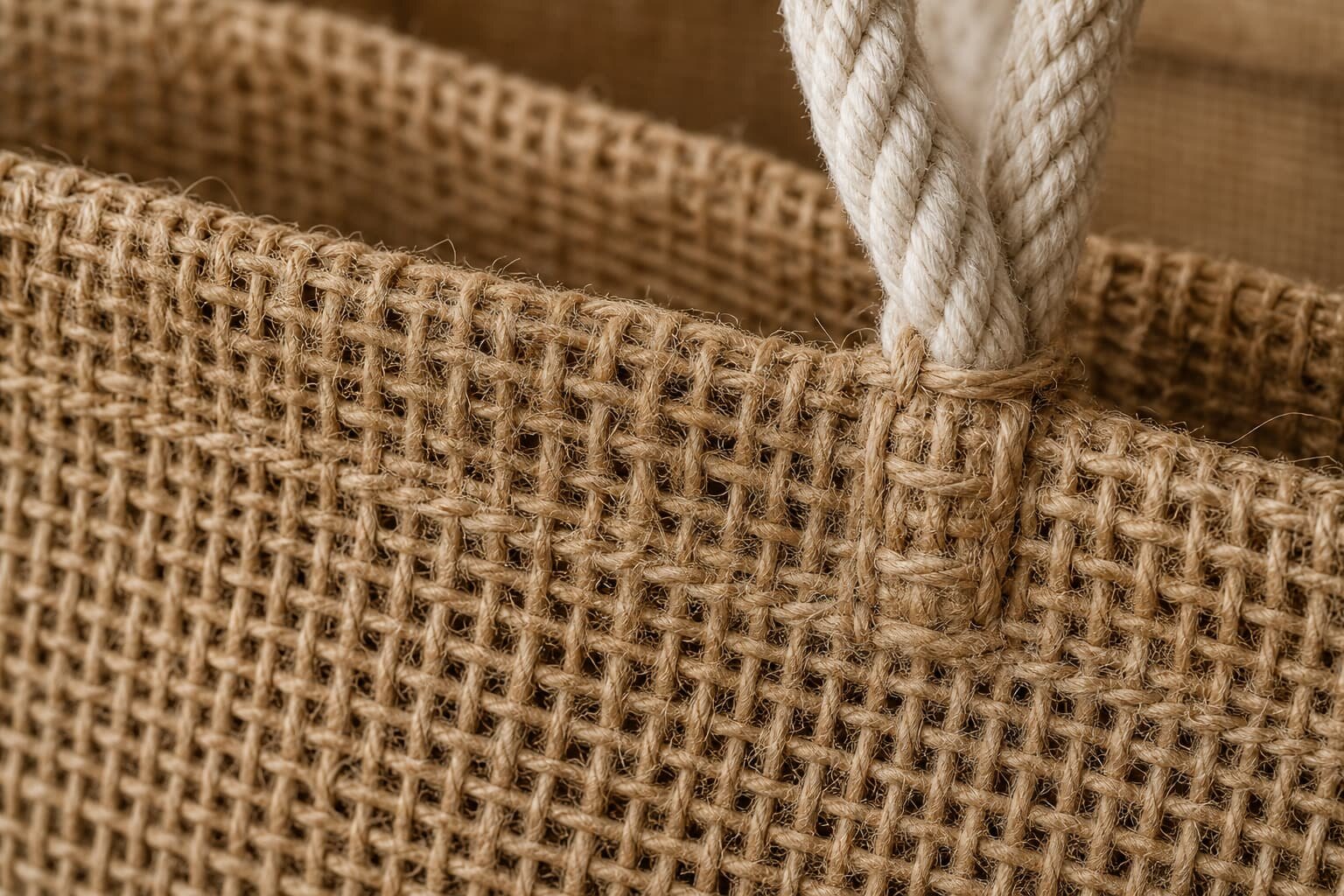
Why repeat jute bag orders still go wrong
A repeat order feels low risk because the buyer already has a supplier, a previous PO, and a product that shipped once. In practice, repeat jute bag orders often fail for quiet reasons: the old fabric stock is gone, the print screen was remade, the handle webbing supplier changed, the buyer revised a barcode, or the packing team used a different carton size to save space. None of these changes may appear clearly in a short email that says, please repeat last order.
For procurement teams, the main job is not to describe the bag from zero again. The job is to freeze what must stay unchanged, identify what has changed, and make the factory quote only against those controlled facts. A good jute bag repeat order checklist prevents two expensive problems: accepting a lower quote that is not like-for-like, and approving production based on memory instead of a signed sample.
- Do not use the previous invoice as the main specification document.
- Do not assume the same factory line, fabric mill, or packing team is still being used.
- Do not approve bulk production before confirming all artwork and packing versions.
- Do not compare quotes unless each supplier confirms the same physical construction.
Start with the last approved sample, not the last price
The strongest reference for a jute repeat order is the last approved physical sample plus a marked-up change list. A unit price from last year does not show fabric shade, weave density, lamination thickness, handle hand feel, stitch quality, or print absorption. If the buyer only sends the previous PO, the supplier may quote a similar bag rather than the same bag.
Keep one office sample sealed as the buyer master and ask the factory to keep one production reference from the previous run. Before quoting, compare both samples if possible. If the factory cannot locate the old reference, treat the order as a controlled repeat, not an automatic repeat. That does not mean starting the project again, but it does mean checking every critical line item before deposit.
- Photograph the previous sample from front, back, side gusset, bottom, inside, handles, label, and carton.
- Record finished size in millimeters, not only in inches or general descriptions.
- Note whether the previous sample was laminated, unlaminated, dyed, natural, washed, or stiffened.
- Attach the current artwork file name and revision date to the repeat order file.
- List every requested change in a separate change log so it is not hidden inside email threads.
Lock the jute fabric weight, hand feel, and structure
Jute bag performance starts with fabric. For many promotional tote bags, buyers commonly see fabric around 270-320 GSM. Heavier retail bags, structured shopping bags, or gift bags may use around 340-380 GSM or more depending on the construction. The number alone is not enough. Two jute fabrics with similar GSM can feel different because of yarn thickness, weave, lamination, finishing, and moisture content.
For repeat orders, tell the factory whether the target is visual match, strength match, price match, or all three. If the previous order used laminated jute, confirm whether the lamination is inside or between layers, and whether the buyer accepts any change in shine, stiffness, smell, or fold recovery. If the product carries sustainability claims, any change from unlaminated to laminated material must be reviewed by the brand team before purchase.
- Specify fabric GSM and acceptable tolerance if your program requires it.
- Confirm natural jute shade, dyed shade, or bleached shade against a swatch or sealed sample.
- Ask whether the quoted fabric is current stock, booked stock, or a substitute from another mill.
- Check if lamination changes the bag weight, carton cube, folding marks, or print adhesion.
- Request a fabric swatch first when the reorder quantity is large or color consistency is critical.
Control handles before approving the repeat order
Handle changes are one of the easiest ways for a repeat jute bag to become a different product. The quote may still say cotton handle or jute handle, but the width, thickness, weave, color, drop length, and reinforcement stitch can change. A small change in handle length affects user comfort and shelf appearance. A small change in reinforcement affects load performance.
For retail shopping bags, grocery bags, wine bags, and heavy promotional packs, ask the factory to confirm handle pull strength or at least repeat the same reinforcement pattern used in the approved order. If the previous product had bartacks, cross-stitches, rivets, or inside reinforcement patches, include these details in the repeat checklist. Do not let the factory simplify construction unless the buyer has approved a cost-down version.
- Measure handle width, total length, visible drop height, and insertion depth.
- Confirm handle material: cotton webbing, jute webbing, rope, padded cotton, or mixed material.
- Check handle color against the approved sample, especially for natural cotton and dyed webbing.
- Specify stitch pattern and thread color at the handle join.
- Ask for load test criteria when the bag will carry bottles, groceries, books, or gift sets.
Recheck print method, artwork, and logo tolerance
A repeat jute bag often carries the same logo, but the artwork file may not be the same. Marketing teams change taglines, legal text, QR codes, Pantone values, or logo spacing. If procurement sends an old file by mistake, the factory may produce exactly what was sent and still be technically right. Always attach the current file and mark it as final for repeat order production.
Screen printing is common for bold logos on jute, but the coarse surface limits fine line accuracy. Large ink coverage can look uneven, and small reverse text can fill in. Heat transfer, woven labels, sewn labels, embroidery, or leather patches may be better for certain designs, but changing the decoration method changes cost, MOQ, production time, and appearance. For a repeat order, the safest route is to keep the same method unless there is a clear reason to revise it.
- Confirm logo width, height, and placement from bag edges in millimeters.
- Use Pantone references for print targets, but approve against the real jute surface.
- Set practical tolerance for print position, especially on flexible gusseted bags.
- Check rubbing, cracking, ink smell, and coverage on the production seal sample.
- Keep old and new artwork files clearly named so the factory does not use the wrong version.
Use MOQ logic to avoid misleading repeat quotes
Repeat order MOQ is not only a factory preference. It is connected to fabric procurement, cutting efficiency, print setup, handle material, label production, carton usage, and labor planning. A factory may have been willing to produce a small first order to win the program, but a later reorder with more SKUs, lower quantity, or revised packing may carry a different cost structure.
Buyers should ask for MOQ by actual decision point: size, fabric color, print version, label version, and packing version. If you combine four logo versions and three carton label versions, the total order quantity may look strong but each production batch may be inefficient. This is where many quote comparisons become unfair. One supplier may include setup and handling costs honestly, while another hides them until after sample approval.
- Separate MOQ for plain bag body, printed design, private label, and retail packing.
- Ask what happens to unit price if the reorder quantity is 20-30 percent lower than last time.
- Confirm whether leftover fabric or handles from the previous order are available and usable.
- Check if mixed sizes or mixed prints can share the same fabric purchase.
- Request a price ladder only when each quantity level uses the same specification.
Approve the right sample for a repeat order
Not every repeat order needs a full development cycle, but most repeat orders need some form of confirmation sample. If nothing changed, a reference photo and sealed production sample may be enough for a trusted ongoing supplier. If fabric, artwork, logo size, label, packing, or factory line changed, request a repeat order pre-production sample before mass cutting or bulk printing.
The sample should answer production questions, not just look nice in a photo. Check whether the sample uses the real bulk fabric, real handle material, real print method, and real label. If the sample uses substitute material because bulk material is not ready, the approval should be limited. A sample made from convenient stock can hide the exact problems that appear during production.
- Label the sample as reference sample, pre-production sample, or production seal sample.
- Ask whether the sample was handmade or made on the same line planned for bulk production.
- Check dimensions after the bag is folded and reopened because jute can hold crease memory.
- Compare print color under normal daylight and indoor retail lighting if brand color matters.
- Keep one approved sample with procurement and one with the factory quality team.
Confirm packing before the carton is produced
Packing is often treated as an afterthought in repeat orders, but it affects freight cost, warehouse receiving, retail compliance, and damage rate. A jute bag can be folded flat, half folded, individually polybagged, bundled, or packed loose by a fixed count. Each method changes carton size, wrinkles, moisture exposure, labor cost, and scanning efficiency.
If the previous shipment moved through a distributor, retail DC, or ecommerce warehouse without issues, repeat the carton plan unless there is a reason to change. Confirm quantity per carton, carton dimensions, gross weight, net weight, carton strength, carton marks, barcode position, and pallet requirement. If the buyer has sustainability goals, confirm whether individual polybags are required or whether bundle packing is acceptable.
- Match carton marks to the latest PO, SKU, destination, and retail routing guide.
- Confirm whether each bag needs a hangtag, barcode sticker, care label, or country of origin label.
- Ask the factory to send one packed carton photo or video before final packing continues.
- Use desiccant or moisture control when shipping laminated or dense packed jute in humid seasons.
- Recalculate CBM if fold method, carton count, or bag stiffness has changed.
Build a realistic lead time from approval points
A repeat order is faster only when all inputs are ready. If fabric must be woven or dyed, if artwork needs revision, if labels need new compliance text, or if the buyer delays sample approval, the calendar can stretch like a new project. Ask the factory to quote lead time in stages instead of giving one simple number.
A practical schedule should show sample confirmation, material booking, cutting, printing, sewing, trimming, packing, inspection, and shipment handover. This makes risk visible. For example, if print approval is late, sewing cannot start on printed panels. If carton artwork is not approved, finished goods may wait unpacked. For seasonal retail programs, the repeat checklist should include buyer-side approval deadlines, not only factory production days.
- Ask when the factory must receive deposit, final artwork, and sample approval to keep the ship date.
- Confirm whether peak season, holidays, or fabric mill capacity affects the reorder.
- Reserve inspection time before the cargo ready date, not after cartons are already loaded.
- Ask for a production progress update after material arrival and after first bulk printing.
- Keep shipping mode assumptions separate from factory production lead time.
Compare repeat quotes by data, not by headline unit price
A repeat order is a good time to benchmark pricing, but the comparison must be controlled. A lower price may come from lighter GSM, thinner handle webbing, fewer stitches, smaller carton, omitted labels, cheaper print ink, or no allowance for inspection support. Ask each supplier to quote from the same spec sheet and to identify any deviation clearly.
Useful quote data includes bag size, fabric GSM, lamination, handle specification, print method and color count, label and packing details, MOQ, sample cost, setup cost, carton quantity, carton dimensions, CBM, estimated gross weight, lead time, payment terms, and validity date. If one supplier cannot provide these numbers, the buyer cannot judge whether the price is genuinely better.
- Request a deviation list even when the supplier says the bag is same as sample.
- Separate tooling, screen, sampling, and document fees from the unit price.
- Compare landed impact by carton cube and gross weight, not only factory unit cost.
- Check whether rejected goods replacement, rework time, and inspection cooperation are included.
- Keep a quote comparison file so future repeat orders do not restart from incomplete data.
Specification comparison for buyers
| Spec decision | Recommended option | When it fits | Buyer risk to check |
|---|---|---|---|
| Fabric weight for repeat jute tote | Usually repeat the approved GSM, commonly 270-320 GSM for promotional totes and 340-380 GSM for heavier retail bags | Fits when the previous order passed load testing and the same product positioning is required | Mill substitution can change hand feel, stiffness, and bag weight even if the quoted GSM looks similar |
| Inner construction | Keep the same laminated or unlaminated structure as the approved sample | Lamination helps shape retention and moisture resistance for retail or grocery use | Changing lamination affects print adhesion, odor, fold marks, recyclability claims, and carton cube |
| Handle type | Repeat the exact material, width, length, and reinforcement stitch pattern | Cotton webbing, jute webbing, or rope handles each suit different price and appearance targets | A supplier may quote the same handle description but use thinner webbing, shorter drop length, or fewer bartacks |
| Print method | Use the previous approved method unless artwork, color count, or coverage changed | Screen print is practical for bold logos; heat transfer or woven label may suit fine details | Large ink coverage on coarse jute can crack, bleed, or look uneven unless pre-production proof is approved |
| MOQ planning | Base MOQ on fabric availability, print setup, and carton efficiency, not only on last order quantity | Useful when reordering seasonal colors, branded retail packs, or mixed SKUs | Small repeat runs can carry hidden setup charges or color variation if fabric is bought from a different batch |
| Sample approval | Request a repeat order reference sample or production seal sample before mass cutting | Needed when artwork, label, packing, or factory line has changed | Skipping a new sample because it is a repeat order is a common cause of wrong logo size or old label version |
| Packing format | Repeat bag fold method, polybag rule, carton size, carton mark, and pallet instruction | Important for distributors, retail DCs, and ecommerce kitting operations | A changed fold can create permanent creases, increase freight cube, or make barcode scanning difficult |
| Quote comparison | Ask suppliers to quote against a frozen spec sheet with change notes from the last PO | Best for comparing current supplier against backup factories | A lower quote may exclude sampling, inner labels, export carton strength, inspection support, or updated artwork plate charges |
Buyer checklist before sampling
- Match the repeat order against the last approved physical sample, not only against the previous invoice or PO.
- Confirm jute GSM, lamination, fabric shade, bag size, gusset size, handle material, handle length, and stitch reinforcement in one updated spec sheet.
- Mark every change from the previous order, including small revisions such as label wording, barcode, carton mark, hangtag, or folding method.
- Ask the factory whether the same fabric batch, same print process, same handle supplier, and same packing method are available for the new run.
- Request a repeat order pre-production sample if artwork, color, fabric, handle, label, or packing has changed in any way.
- Confirm logo size in millimeters, Pantone target, print position tolerance, and acceptable print coverage on coarse jute.
- Recheck MOQ logic by SKU, color, size, print color count, and carton packing, especially if the reorder quantity is lower than the first order.
- Ask for updated lead time split by sample approval, material booking, cutting, printing, sewing, packing, inspection, and shipment handover.
- Verify export carton dimensions, gross weight, cube, inner packing, carton marks, pallet rules, and retail barcode placement before production.
- Keep one signed or sealed production sample and one packed carton reference for inspection comparison before shipment.
Factory quote questions to send
- Is the quoted jute fabric the same GSM, weave, color shade, and laminated or unlaminated structure as the last approved sample?
- If the original fabric is not available, what substitute fabric are you quoting, and can you send a swatch before sample making?
- Are the handle material, width, length, drop height, color, and reinforcement stitches exactly the same as the previous order?
- Does the quote include all print setup, screen charges, color matching, sampling, labels, hangtags, barcode stickers, and carton marking?
- What is the MOQ by size, color, logo version, and packing version, and what cost changes if the quantity is below the previous order?
- Will you provide a repeat order pre-production sample or production seal sample before bulk cutting and printing?
- What are the current lead times for fabric procurement, sample approval, mass production, packing, and export document preparation?
- What carton size, quantity per carton, gross weight, and CBM are quoted, and are they the same as the previous shipment?
- Can you keep one sealed sample and one fully packed carton for third-party inspection or buyer video inspection?
- Which parts of the specification are different from the previous PO, even if the unit price appears unchanged?
Quality-control points to confirm
- Measure finished bag width, height, gusset, handle length, and handle drop against approved tolerances before bulk packing.
- Check jute GSM or fabric weight by approved lab method or agreed supplier method when fabric substitution is suspected.
- Compare fabric shade, odor, lamination feel, stiffness, and surface cleanliness against the sealed sample.
- Inspect print position, logo size, ink color, ink coverage, edge sharpness, rubbing resistance, and registration for multi-color artwork.
- Pull-test handles and review bartack or cross-stitch reinforcement, especially for grocery, wine, and retail carry applications.
- Check seam allowance, skipped stitches, loose threads, corner shape, gusset alignment, and top hem consistency.
- Verify labels, hangtags, barcode stickers, warning text, country of origin marking, and retail carton data against current artwork files.
- Confirm folding method, inner bag count, polybag rule, moisture protection, desiccant requirement, carton strength, and carton marks.
- Perform packed carton drop or compression checks when bags are heavy, cartons are tall, or the shipment will be palletized.
- Compare production output to the sealed sample before final inspection, not only to the supplier's internal worksheet.