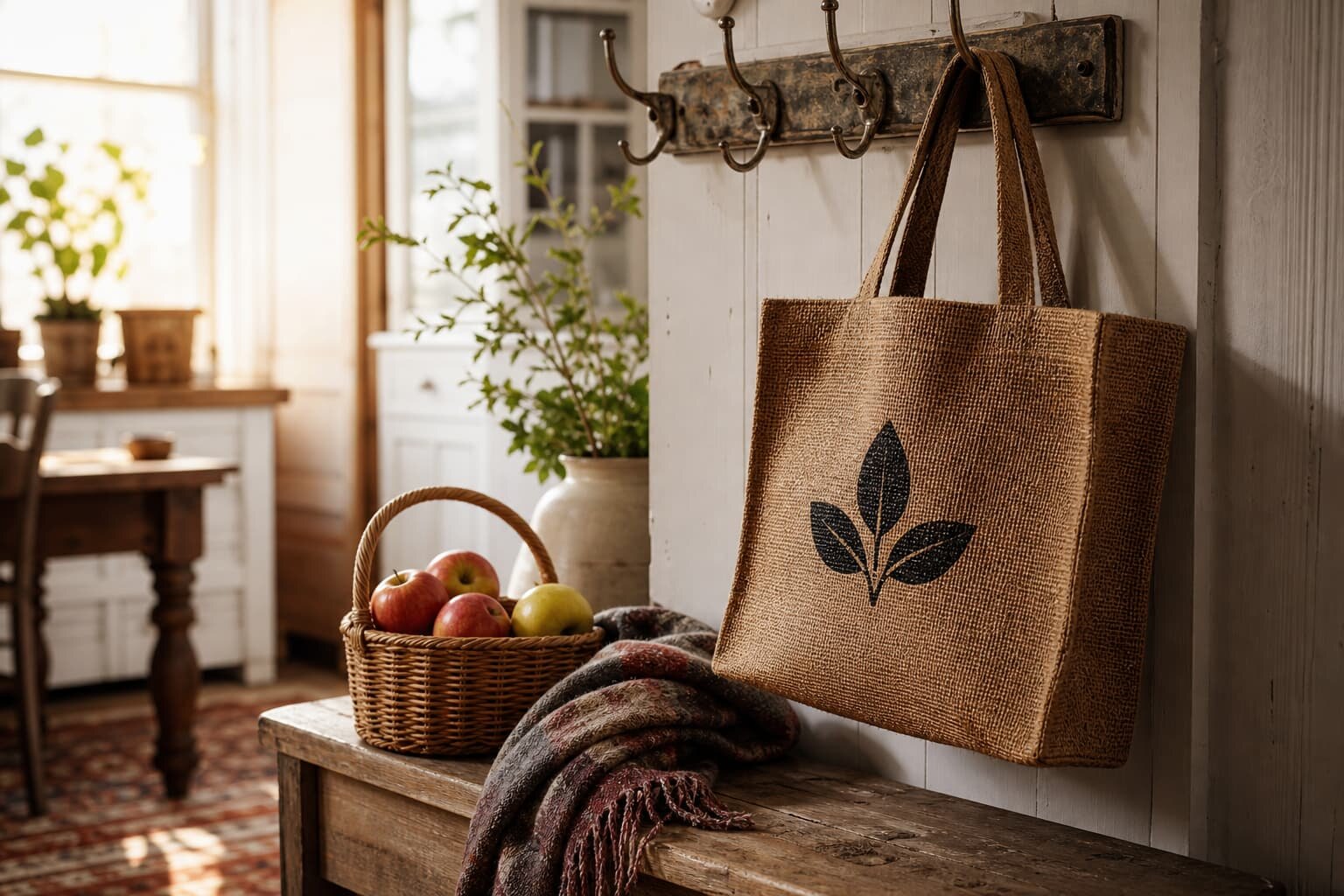
Why jute printing quotes vary so much
Most jute bag printing costs are driven by construction first and decoration second. A factory is not quoting a blank surface; it is quoting a woven natural material that changes with fabric weight, weave density, bag size, and seam structure. If one supplier builds the bag with a lighter cloth and another quotes a heavier, better-shaped bag, the print price can look similar while the real landed cost is very different.
The other reason quotes swing is that jute is less forgiving than coated fabrics or smooth cotton canvas. A clean logo on a tight weave may print well with one setup, while the same logo on a looser weave may need adjustment, extra ink, or a different method. Buyers who ask only for a unit price often miss the real cost drivers hidden inside the construction and print assumptions.
- Compare the full bag spec, not just the logo print line.
- Treat fabric weight, size, and structure as part of the print cost.
- Ask the supplier to state what is included, not what is assumed.
Start with the bag build, not the logo
Before you talk about print methods, lock down the base bag. For jute, the fabric weight or GSM range matters because it affects how the bag holds shape, how clearly the logo sits on the surface, and how much the supplier needs to control stitching and finishing. A very light bag may save material but can look soft, wrinkle more, and create a less consistent print area. A heavier bag can improve presentation, but it also adds cost and may push the factory into stronger sewing or wider seam allowances.
Size also changes the print economics. A small pouch-style bag uses less fabric but may offer less print area and tighter alignment tolerances. A larger retail tote can absorb a bigger logo panel, but it may also need longer handles, deeper gussets, or a stronger bottom panel. When you request quotes, give the factory the intended use: giveaway, retail, exhibition, grocery, or branded packaging. That context helps them recommend the right construction instead of simply pricing the cheapest cloth available.
- State the use case so the factory can recommend a realistic GSM.
- Ask if the quote includes reinforcement at the handle and bottom seams.
- Confirm whether the bag is meant to stand upright, fold flat, or carry heavier contents.
Choose the print method by artwork and volume
For most bulk jute programs, screen printing is still the workhorse method because it is cost-effective for simple logos and solid brand colors. It fits straightforward artwork, especially one-color or two-color marks with clear edges. The cost usually rises with each added color, each additional print side, and each special registration requirement. That means a buyer should not ask for a generic print quote; they should ask how many screens, setup steps, or curing passes are needed for the approved artwork.
If your artwork has small type, gradients, or many colors, the cheapest quote may not be the safest quote. A factory may agree to print it, but the result can look weak on coarse jute fibers. For buyer reviews, the question is not only whether the logo is technically printable. It is whether the print will remain legible after folding, shipping, and store handling. That is why proof approval should include actual print area, ink coverage, and whether the logo still reads cleanly from a normal shelf distance.
- Use screen print for simple branding and repeat orders.
- Treat extra colors, extra sides, and fine detail as cost multipliers.
- Ask for a print proof on the same jute base, not on smooth paper.
How to read a factory quote line by line
A good quote for a printed jute bag should separate the bag body, print work, setup charges, packing, and any special finishing. If the supplier sends only one unit price, ask them to break it out. That makes it easier to compare suppliers fairly and spot where one factory is hiding a lower bag price behind a higher print fee, or vice versa. For procurement teams, line-item clarity is usually more valuable than chasing the lowest headline number.
The most useful quote data includes the exact bag specification, fabric weight, dimensions, handle style, print area, number of colors, print sides, sample type, carton configuration, and lead time. If a supplier cannot provide that level of detail, the risk is not just pricing confusion. The real risk is production drift, where the factory builds to its own interpretation and your receiving team gets something that needs rework or repacking.
- Ask for separate line items for bag body, print, setup, packing, and cartons.
- Confirm whether sample charges are credited against bulk orders.
- Check whether freight, duty, or inland charges are excluded from the quote.
MOQ logic: what really pushes the minimum order
MOQ for jute bag printing is usually not driven by fabric alone. It is often set by print setup efficiency, cutting yield, stitching time, and packing labor. A supplier may accept a lower MOQ for a blank bag but require a higher MOQ once the same bag is printed in multiple colors or with a larger logo area. That is normal, because each extra decoration step adds setup and line handling work that the factory must recover through volume.
Buyers should ask for MOQ by configuration, not just by style. The MOQ may change if you move from one-color front print to two-sided print, or if you ask for individual polybags, hang tags, or barcode stickers. If you are testing the market, it is often better to reduce decoration complexity before shrinking the run too far. A simpler print spec usually lowers both risk and cost more effectively than forcing the factory into a tiny order with a complicated logo.
- Get MOQ by print color count, not only by bag style.
- Ask whether lower MOQ changes unit price or sample approval terms.
- Use simpler artwork if the first run is meant to test demand.
Sample checks that save money later
Jute sample approval should not stop at visual approval. The sample has to confirm the actual material feel, print clarity, and stitching behavior. Check whether the weave is tight enough for the logo, whether the ink sits cleanly on the fibers, and whether the handles feel balanced after the bag is filled. A printed sample that looks good flat can still fail when the bag is opened, folded, or carried.
For procurement teams, the best sample workflow is usually blank sample first, then printed sample, then pre-production sample if the order is large or the artwork is sensitive. That sequence catches problems earlier and keeps the factory from building bulk against a moving target. If the supplier is reluctant to send a sample or wants to skip proofing, that is usually a warning sign that the bulk quote may be too optimistic for the actual production process.
- Check print position, color match, and edge sharpness on the actual fabric.
- Inspect seam quality and handle reinforcement on the sample under load.
- Approve a reference sample before bulk production starts.
Packing details affect cost more than many buyers expect
Packing is one of the easiest places for a quote to look cheap and then become expensive later. Flat packing is often the standard for jute bags, but the exact folding method, piece count per carton, carton marks, and labeling rules can change the labor time and carton volume. If the buyer needs retail-ready packing, barcode labels, or country-of-origin marks, those needs should be stated upfront so the factory prices the right process.
For export shipments, carton dimensions matter because jute bags are bulky even when folded. A quote should state how many pieces go into each carton and whether the factory optimizes for carton strength or for container efficiency. If your receiving warehouse has strict scan-in rules, ask for barcode placement and outer carton labeling as part of the quote data. A low unit price is not useful if the cartons arrive in a format your warehouse cannot receive quickly.
- Confirm folding style and piece count per carton.
- Ask whether barcode labels, hang tags, or inserts are included.
- Check carton size against your warehouse and freight planning rules.
Lead time depends on more than the production line
Lead time for printed jute bags usually has at least three parts: sample time, bulk production time, and shipment time. Buyers often focus only on the bulk days and ignore the time needed to finalize artwork, approve the proof, and lock the packing spec. That is how a project misses a launch window even when the factory works on schedule. If the print method requires screen preparation or setup approval, include that time in the schedule from the beginning.
A realistic production plan also has to account for seasonal load. If the factory is running a full schedule, the same bag can move slower even if the quote price does not change. Ask the supplier to separate the earliest start date from the delivery date assumption, and ask what happens if the artwork changes after sample approval. Late artwork changes are one of the most common reasons a jute bag order slips.
- Separate sample lead time from bulk lead time.
- Ask what happens if art approval is delayed by a week.
- Include packing and carton preparation in the production timeline.
How to compare quotes without missing hidden cost
The cleanest way to compare jute bag quotes is to normalize them against the same spec sheet. If Supplier A quotes a heavier fabric, better stitching, and flat packing while Supplier B quotes lighter cloth, simpler sewing, and loose packing, the lower number is not a fair comparison. Procurement teams should compare material weight, print method, finishing, packing, and sample terms side by side before deciding which quote is genuinely better value.
A useful rule is to compare cost against risk, not just cost against cost. A slightly higher quote that includes clearer print proofing, more exact carton packing, and better handle reinforcement may save money in the first shipment and in the reorder. The cheapest option often becomes the expensive option when the buyer has to reject samples, rework the artwork, or split the order across multiple cartons because the packing was not planned properly.
- Compare all quotes against one written spec sheet.
- Treat packing and sample terms as part of the true unit cost.
- Favor the quote that reduces rework, not just the lowest number.
Common mistakes that inflate cost or create rework
The most common mistake is sending artwork before the bag spec is fixed. When the logo is approved first, buyers sometimes discover later that the print area is too large for the seam layout or too detailed for the jute weave. Another common issue is asking for a retail-looking finish on a basic promotional bag without stating that expectation. The factory then quotes a simpler build, and the buyer interprets the difference as a pricing problem instead of a spec problem.
Another avoidable error is comparing sample approval and bulk approval as if they were identical. A sample can be hand-finished and still look acceptable, while bulk production must run consistently at scale. That is why buyers should ask for acceptance criteria: print position tolerance, color tolerance, seam strength expectations, and packing format. Clear acceptance criteria reduce back-and-forth and make the factory accountable to a measurable standard.
- Do not approve artwork before the bag size and print area are fixed.
- Do not assume sample finish equals bulk finish.
- Write down acceptance criteria for print, seams, and packing.
Specification comparison for buyers
| Spec decision | Recommended option | When it fits | Buyer risk to check |
|---|---|---|---|
| Print method | Screen print for simple logos and solid colors | Most bulk programs with one to three colors and clear artwork | Check line thickness, registration tolerance, and whether the factory prices each extra color separately |
| Jute fabric weight | Medium-weight fabric around the middle of the supplier range | Retail-ready bags, promotions, and branded programs that need a cleaner surface | Lighter cloth can distort during printing; heavier cloth can raise unit cost and reduce flexibility |
| Bag structure | Standard stitched tote with reinforced handles and bound top edge | General retail, events, and everyday carry use | Ask whether reinforcement, lining, or gussets are included or priced as add-ons |
| Packing format | Flat packed with counted cartons and clear size labeling | Import shipments and warehouse receiving | Verify if folding, inner poly, barcode stickers, and carton marks are included in the quote |
Buyer checklist before sampling
- Confirm the exact bag size, gusset, handle length, and whether the quote includes binding, lining, or reinforcement.
- State the jute fabric weight or ask the factory to propose a weight range that matches the intended use.
- Send final artwork with the exact print area, color count, and logo placement marked on a dieline or sample photo.
- Ask for the print method, setup fee, plate fee, and whether each color or side is priced separately.
- Request a sample or pre-production proof and define what must be checked before bulk approval.
- Ask for the MOQ by bag style, print color, and carton configuration, not just a single total MOQ.
- Confirm packing details: folding method, inner packing, carton qty, master carton dimensions, and label requirements.
- Get the lead time separated into sample time, production time, and transit assumptions so the schedule is realistic.
Factory quote questions to send
- What jute fabric weight do you recommend for this size and use case, and is that weight already included in the unit price?
- Which print method are you quoting, and what changes in cost if we move from one color to two or three colors?
- Do you charge separately for artwork setup, screens, plates, or design cleanup?
- Are handle reinforcement, top binding, lining, gusset stitching, and internal seams included or treated as extras?
- What is the MOQ for this exact size and print spec, and does the MOQ change with more colors or a larger print area?
- Can you show the quote as line items for bag body, print, packing, carton marks, and sample charges?
- What sample type will you supply: blank sample, printed sample, or pre-production sample?
- What is your standard packing method, and how many pieces per carton do you recommend for export shipment?
- How long do you need after artwork approval before bulk production starts?
- What are the most common reasons this bag spec gets delayed or rejected in your factory?
Quality-control points to confirm
- Check jute weave consistency, loose fibers, odor, stains, and color tone before printing starts.
- Verify that the sample matches the agreed bag size, seam allowance, handle length, and gusset depth.
- Inspect print placement against the approved artwork and confirm registration on every color layer.
- Measure print coverage on rough jute surfaces to ensure the logo remains legible, not broken or over-inked.
- Check stitch strength at handles, side seams, and bottom seams on filled or weighted samples.
- Confirm fold direction, carton count, carton labeling, and any barcode or country-of-origin marking requirements.
- Review ink curing or drying quality so printed bags do not smudge, stick, or transfer during packing.
- Approves color tolerance against the master sample, especially for natural jute backgrounds that vary batch to batch.