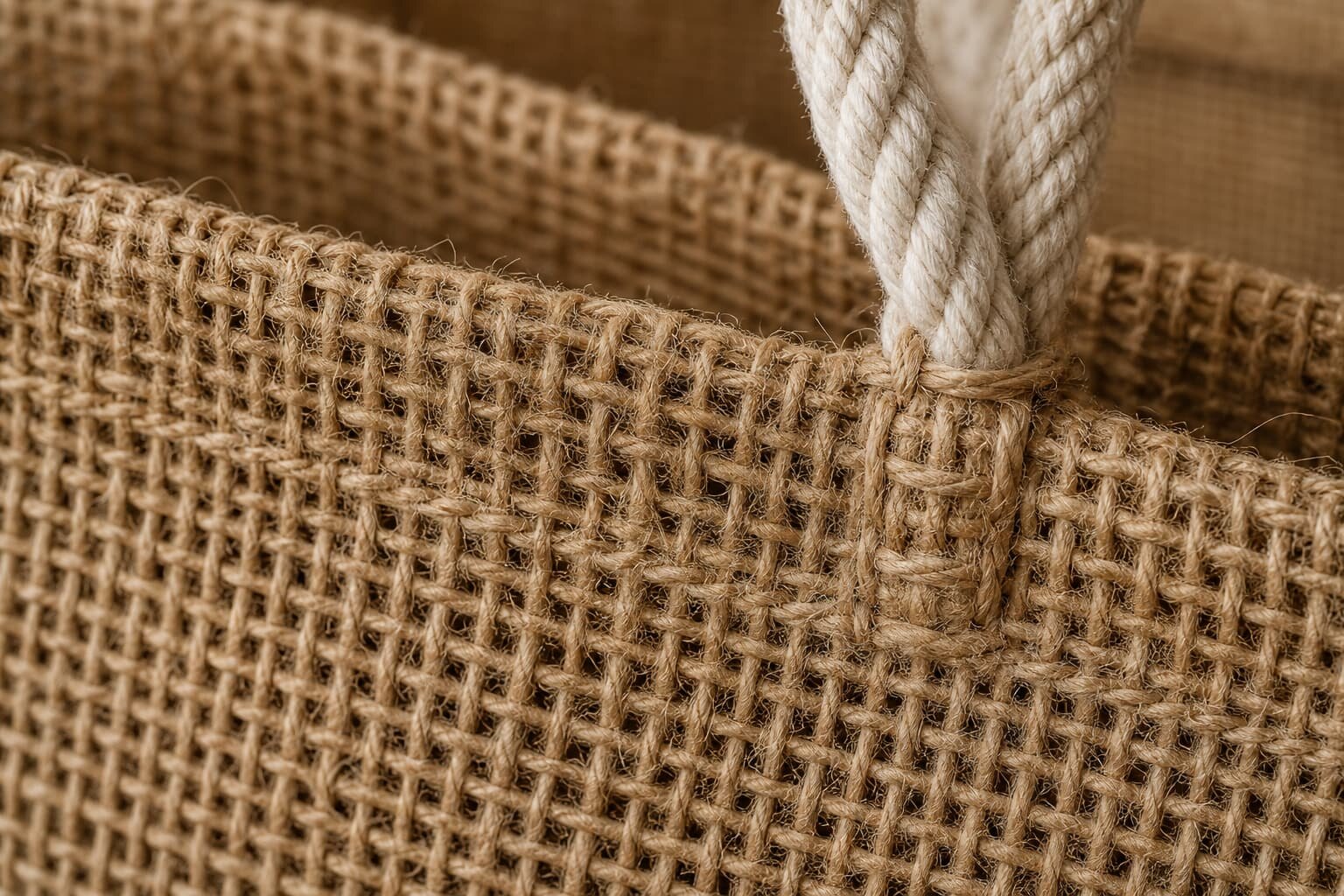
Why jute bag inspection needs a separate checklist
A jute bag pre shipment inspection checklist should not be copied from a cotton tote checklist. Jute is a coarse natural fiber with more variation in color, weave, thickness, hairiness, and smell. A bag can pass a quick visual check and still create buyer complaints after arrival because the handles stretch, the print bleeds into the weave, or cartons arrive with moisture odor.
For import buyers, the main buying problem is simple: you need to know whether the finished goods match the approved sample and purchase order before the balance payment and shipping release. The checklist should convert a subjective product into measurable points: GSM, finished size tolerance, stitching strength, logo position, carton quantity, and packing condition. If the factory quote does not define these points, the inspection becomes an argument instead of a decision.
- Use a jute-specific inspection checklist for totes, wine bags, gift bags, drawstring jute pouches, and laminated shopping bags.
- Do not rely only on product photos; require measurements, defect classification, and packed carton checks.
- Agree on the inspection standard before production starts, not when the goods are already packed.
- Keep one approved sample sealed for comparison during final inspection.
Start inspection from the approved sample and quote file
The most useful inspection document is not a long generic form. It is a clean quote file that connects the commercial offer to the physical product. The inspector should have the same version of the specification sheet used by purchasing, merchandising, and factory production. If the quotation only says natural jute bag with logo, the inspector has no firm basis to reject low GSM fabric, cheaper handles, or smaller cartons.
Before shipment, compare the actual goods with the approved pre-production sample, signed artwork proof, packing approval, and purchase order. A factory may make a correct sales sample but switch to a different fabric roll in bulk because of availability or MOQ. This is why the inspection should start with material identity and construction, not only finished appearance.
- Keep approved sample photos plus one physical sealed sample when possible.
- Attach final artwork with logo size, print color reference, print position, and tolerance.
- List fabric GSM range, weave type, lamination requirement, handle material, thread color, and reinforcement method.
- Include carton packing specification, carton label, barcode format, and any polybag or plastic-free requirement.
- Record quote assumptions such as MOQ by color, print setup, sample lead time, bulk lead time, and included packing method.
Check jute fabric weight, weave, color, and lamination
Fabric weight is one of the easiest areas for quote differences to hide. Many suppliers quote a jute bag by style and size, but the real cost depends heavily on fabric construction, GSM, weave tightness, and lamination. A bag made from lighter loose-weave jute may look acceptable in a compressed carton photo, but it can lose shape on a retail shelf and show the contents through the panel.
For standard jute shopping and gift bags, buyers often see fabrics in the approximate 260-320 GSM range, but the right specification depends on bag size, gusset, load expectation, lamination, and price target. Instead of asking only for GSM, request a fabric swatch and state an acceptable range. Natural jute also varies in shade from pale beige to golden brown, so color approval should be by range, not a single perfect tone.
- Measure or verify GSM against the approved swatch, especially when the quote is unusually low.
- Check whether the weave is tight enough for the print method and the intended retail positioning.
- Inspect for large slubs, broken yarns, holes, oil marks, mildew, black stains, and excessive fiber shedding.
- If laminated, check for even bonding, no bubbles, no peeling at seam lines, and no strong plastic or solvent odor.
- Confirm the lamination side: inner lamination is common for structure, while outer lamination changes print behavior and surface feel.
Measure finished size and sewing tolerances correctly
Jute bags are cut, folded, stitched, and sometimes pressed, so finished dimensions will not behave like rigid packaging. A realistic tolerance must be agreed before production. For many jute totes, a practical tolerance may be around plus or minus 5 mm to 10 mm depending on size and construction, while handle drop may need tighter control if the bag must fit over the shoulder or hang on a retail fixture.
Do not measure only one perfect sample from the top carton. Take bags from different cartons and different positions inside cartons. Flatten the bag naturally before measuring, but do not stretch the fabric to force it into tolerance. Measure width, height, gusset, bottom width, handle length, handle drop, and logo placement. For wine bags or bottle bags, internal usable size matters more than external size because a tight neck or narrow base can make the bag unusable.
- Measure at least several pieces across multiple cartons according to the agreed sampling plan.
- Record width, height, side gusset, bottom gusset, handle drop, and print position separately.
- Check whether gussets are symmetrical and whether side seams twist after the bag is opened.
- For bottle or retail packaging bags, test with the actual product or a same-size dummy insert.
- Reject measurement methods that stretch the jute fabric or ignore sewing distortion.
Inspect stitching, handles, reinforcement, and load points
Handle failure is one of the most expensive jute bag complaints because it usually appears after the product has been distributed. The buyer sees a finished bag, but the real risk is hidden in seam allowance, stitch density, thread quality, and whether the handle end is properly captured inside the seam. For reusable shopping bags, box stitching or cross stitching at handle points is usually safer than a simple straight stitch, especially with heavier loads.
During pre shipment inspection, check both appearance and function. Pull the handle firmly by hand and inspect whether stitches open, fabric tears, or handle webbing frays. If the order has a declared load requirement, the buyer should define a simple load test method in the purchase order. Without a defined method, the factory and buyer may disagree about what strong enough means.
- Check stitch density, skipped stitches, loose thread, broken thread, and uneven seam lines.
- Confirm handle material: jute webbing, cotton webbing, rope, padded handle, or custom tape.
- Inspect handle drop consistency from left to right and bag to bag.
- Check handle end finishing so fraying is not hidden inside the seam.
- Review bottom corners and side seams because these points carry load when the bag is filled.
- If load testing is required, define sample quantity, load weight, hanging time, and pass/fail criteria before production.
Control logo printing on rough jute surfaces
Jute is not a smooth canvas. Open weave, hairiness, and uneven yarn thickness affect print coverage and edge sharpness. Screen printing is often the practical choice for solid one-color or two-color logos, while heat transfer may be considered for detailed artwork on suitable surfaces. Embroidery can look premium on some bags but may distort loose weave if not backed properly. The inspection standard should reflect the method chosen, not an unrealistic paper-like artwork proof.
The buyer should approve strike-off samples before bulk printing. A digital artwork file is not enough because ink absorption and color appearance change on natural jute. During final inspection, compare logo size, position, color, registration, curing, and rubbing resistance. Also check whether the printed panel creases at the fold line during packing. A beautiful logo at the factory table can crack or transfer if packed too early before the ink is cured.
- Use Pantone as a target reference, but approve the actual print on jute because natural fabric changes the visual result.
- Check logo placement from top edge, side seam, and bottom fold with a ruler.
- Rub the print lightly with a dry white cloth and, if specified, a damp cloth to check transfer risk.
- Inspect print edges for bleeding, pinholes, poor coverage, and misregistration between colors.
- Confirm whether the quoted price includes screen setup, color count, strike-off sample, and artwork revision.
Use defect categories that match commercial risk
A useful jute bag checklist separates defects by how they affect saleability and function. Not every natural jute slub should be treated as a major defect, but mildew, wrong logo color, weak handles, incorrect size, missing labels, or mixed packing can create real chargebacks. The buyer should define critical, major, and minor defects in plain language before final random inspection.
AQL can be used, but it should be connected to the product risk. For example, a small loose fiber may be minor, a crooked logo visible from the front may be major, and a mold odor or broken handle may be critical. If the order is for a retail chain, distributor, or branded campaign, visual consistency usually matters more than for a low-cost event giveaway. The acceptance criteria should match the selling channel.
- Critical defects: mold, unsafe sharp objects, severe odor, wrong product, broken handle, wrong logo, or contamination.
- Major defects: size out of tolerance, poor print, open seam, wrong packing quantity, visible stains, or lamination peeling.
- Minor defects: small jute slubs, light hairiness, tiny loose thread, or slight shade variation within approved range.
- Define whether sorting, repair, remake, discount, or re-inspection is required when defects exceed the limit.
- Ask the factory to keep defect samples after inspection so the corrective action is based on the same evidence.
Verify packing, cartons, moisture control, and shipping marks
Jute bags are sensitive to moisture and odor during storage and sea freight. A good product can become a claim if cartons are packed wet, stored on a damp floor, or sealed too tightly after printing. The pre shipment inspection must open packed cartons, not only review loose finished goods. Check carton strength, quantity per carton, inner packing, shipping marks, barcode labels, and whether the bags are over-compressed.
Packing choices also affect landed cost and retail handling. Flat packing usually saves volume, but too much compression can create hard creases on laminated jute panels. Individual polybags improve cleanliness but may conflict with plastic-reduction policies. If the buyer wants plastic-free packing, this must be in the RFQ because the factory may otherwise quote with standard inner bags or carton liners.
- Confirm units per carton, carton dimensions, gross weight, net weight, and carton ply match the packing specification.
- Open cartons from different pallet positions to check quantity, assortment, color mix, and size mix.
- Check carton labels, shipping marks, item number, PO number, destination, barcode, and country-of-origin marking if required.
- Use desiccants or moisture-control packing only when specified and suitable for the shipping route.
- Reject cartons with dampness, odor, crushing, bursting, wrong labels, or mixed SKUs that will create warehouse receiving problems.
Connect inspection timing with MOQ and lead time
Many quality problems start before inspection because the MOQ logic and lead time were not understood. Jute fabric may be purchased by roll, lamination may require batch processing, and printing setup may be based on logo color and design count. A low MOQ order with many sizes, colors, and print designs can push the factory into inefficient cutting and rushed packing. That is when errors in assortment, logo placement, and carton labeling increase.
Schedule inspection based on actual production completion, not only the planned ship date. A final random inspection is meaningful when most goods are packed and the remaining goods are finished. If inspection happens too early, it misses packing defects. If it happens after container loading is booked with no buffer, the buyer has little leverage to demand sorting or rework. Build inspection time into the lead time from the RFQ stage.
- Ask MOQ by bag size, fabric color, print design, handle type, and packing method.
- Confirm whether the lead time starts after deposit, artwork approval, sample approval, or fabric arrival.
- Keep buffer days for print curing, packing, final inspection, corrective action, and re-inspection if needed.
- Avoid approving mass production from a sample made with substitute fabric unless the substitution is clearly recorded.
- For mixed-SKU orders, require a packing matrix before production finishes.
What buyers should require before shipment release
Shipment release should be based on evidence, not trust alone. For a jute bag order, the factory should provide finished goods photos, packing photos, carton markings, measurement records, and confirmation that the goods are ready for inspection. If a third-party inspector is used, provide the inspector with the latest approved sample and written tolerances. If the buyer performs remote inspection, request structured photos and videos, not random beauty shots.
Before paying the balance, review whether the inspection result matches the purchase order and quote. If defects are found, decide the corrective action by commercial impact. Some defects can be trimmed or cleaned. Wrong logo color, weak handles, serious odor, or incorrect size may require remake or sorting. Do not let the container closing date become the quality standard.
- Require final inspection report with sample size, defect counts, measurements, carton checks, and photos.
- Ask for corrective action photos after sorting or repair, especially for print, seam, and packing defects.
- Confirm revised carton quantity if defective pieces are removed or replaced.
- Hold shipment release until packing list, commercial invoice data, carton marks, and inspection conclusion are aligned.
- Keep all inspection evidence with the order file for future reorder comparison.
Specification comparison for buyers
| Spec decision | Recommended option | When it fits | Buyer risk to check |
|---|---|---|---|
| Main fabric weight | 13 x 14 or 14 x 15 jute, often around 260-320 GSM depending on weave | Standard grocery totes, retail gift bags, wine bags, and brand giveaway bags | Loose weave can look transparent, shed more fiber, and deform after loading even if the quoted GSM looks acceptable |
| Lamination | Inside PE or PP lamination 12-18 microns for cleaner shape and moisture resistance | Retail bags needing structure, printed panels, or food-adjacent packaging where a cleaner inner surface matters | Lamination bubbles, peeling near seams, odor, and cracked fold lines after packing compression |
| Handle type | Cotton webbing or jute webbing with reinforced box stitch or cross stitch | Reusable shopping bags and heavier retail loads | Weak handle anchoring, inconsistent handle drop, fraying ends hidden inside the seam |
| Printing method | Screen print for solid logos; heat transfer only for detailed multi-color artwork on suitable laminated panels | Brand logos, event bags, and distributor programs with repeated artwork | Ink bleeding on open weave, poor registration, wrong Pantone target, or cracking after folding |
| Bottom construction | Gusseted bottom with proper seam allowance and optional insert for higher load | Retail shopping bags, grocery bags, and display packaging | Uneven gusset width, twisted side seams, and weak bottom corners that fail during carton drop or store handling |
| Packing method | Flat pack in export carton with moisture control and clear carton marking | Most sea freight and distributor stock orders | Over-compression, mildew risk, mixed sizes in carton, missing polybag requirement, or carton bursting under stacking |
Buyer checklist before sampling
- Confirm the inspection is scheduled when at least 80 percent of goods are packed and the balance is finished, not while sewing or printing is still in progress.
- Use the approved pre-production sample, artwork proof, packing sample, and signed specification sheet as the only inspection standard.
- Check fabric type, weave density, GSM range, lamination, color tone, odor, and visible jute defects before measuring finished bags.
- Measure bag width, height, gusset, handle length, handle drop, seam allowance, and carton dimensions against the tolerance agreed in the purchase order.
- Inspect logo placement, print size, Pantone match, ink coverage, registration, curing, rubbing resistance, and whether the print cracks at fold lines.
- Pull-test handles and review stitching density, backstitching, loose threads, skipped stitches, raw edges, and bottom corner reinforcement.
- Open packed cartons to confirm unit packing, carton quantity, assortment ratio, barcode label, shipping mark, desiccant use, and carton strength.
- Record defect photos by carton number and defect type so the factory can sort, repair, replace, or repack before balance payment and shipment release.
- Compare the inspected goods with quote data including fabric GSM, handle material, print method, packing method, MOQ assumptions, and lead time commitment.
- Do not approve shipment only from a finished goods photo; require measured results, defect counts, and clear acceptance criteria.
Factory quote questions to send
- What jute fabric construction and approximate GSM are included in the quoted price, and can you submit a cut swatch for approval before bulk fabric purchase?
- Is the bag laminated or unlaminated, and what lamination material and thickness are used if the bag needs better shape or moisture resistance?
- What size tolerance do you apply to finished jute bags after sewing and pressing, especially for width, height, gusset, and handle drop?
- Which print method is included in the quote, how many colors are priced, and what is the maximum print area on the selected bag size?
- Can you confirm the stitching method for handles, seam allowance, bottom corners, and whether reinforcement is included or quoted separately?
- What is your MOQ for this jute bag style by fabric color, print design, bag size, and packing method, not only by total order quantity?
- What pre-production sample will you provide, how many days does it take, and will it use correct bulk fabric, handle, lamination, and print method?
- What packing specification is included: units per carton, inner polybag or no polybag, carton ply, carton dimensions, gross weight, and shipping marks?
- At what production stage can a buyer or third-party inspector perform final random inspection, and who pays for re-inspection if defects exceed the agreed AQL?
- What lead time is based on fabric availability, printing workload, sample approval date, and carton packing completion rather than only order deposit date?
Quality-control points to confirm
- Fabric GSM and weave density match the approved sample and purchase order.
- Jute surface is reasonably clean for the grade, without large holes, oil marks, mildew, excessive hairiness, or strong chemical odor.
- Finished size, gusset, handle length, and handle drop are within agreed tolerance after sewing and packing.
- Logo print is positioned correctly, cured properly, and does not rub off, bleed heavily, crack, or show unacceptable registration shift.
- Handle stitching is secure with backstitching, correct thread color, no skipped stitches, and no loose handle ends.
- Bottom seam and side seam are straight, reinforced where specified, and not twisted or puckered.
- Lamination, if used, is bonded evenly without bubbling, peeling, delamination at stitch lines, or brittle cracking.
- Cartons contain the correct quantity, assortment, barcode label, shipping mark, and moisture protection method.
- Packed goods are dry, odor-controlled, and not compressed so tightly that permanent crease damage or deformation occurs.
- Inspection report links each defect to quantity, severity, photo evidence, and corrective action before shipment approval.