Jute Bag OEM Product Development Capability for United States Buyers
Byline: Vincent Xi, Editorial Author, CottonToMaker. Author profile: https://cottontotemaker.com/authors/vincent-xi/
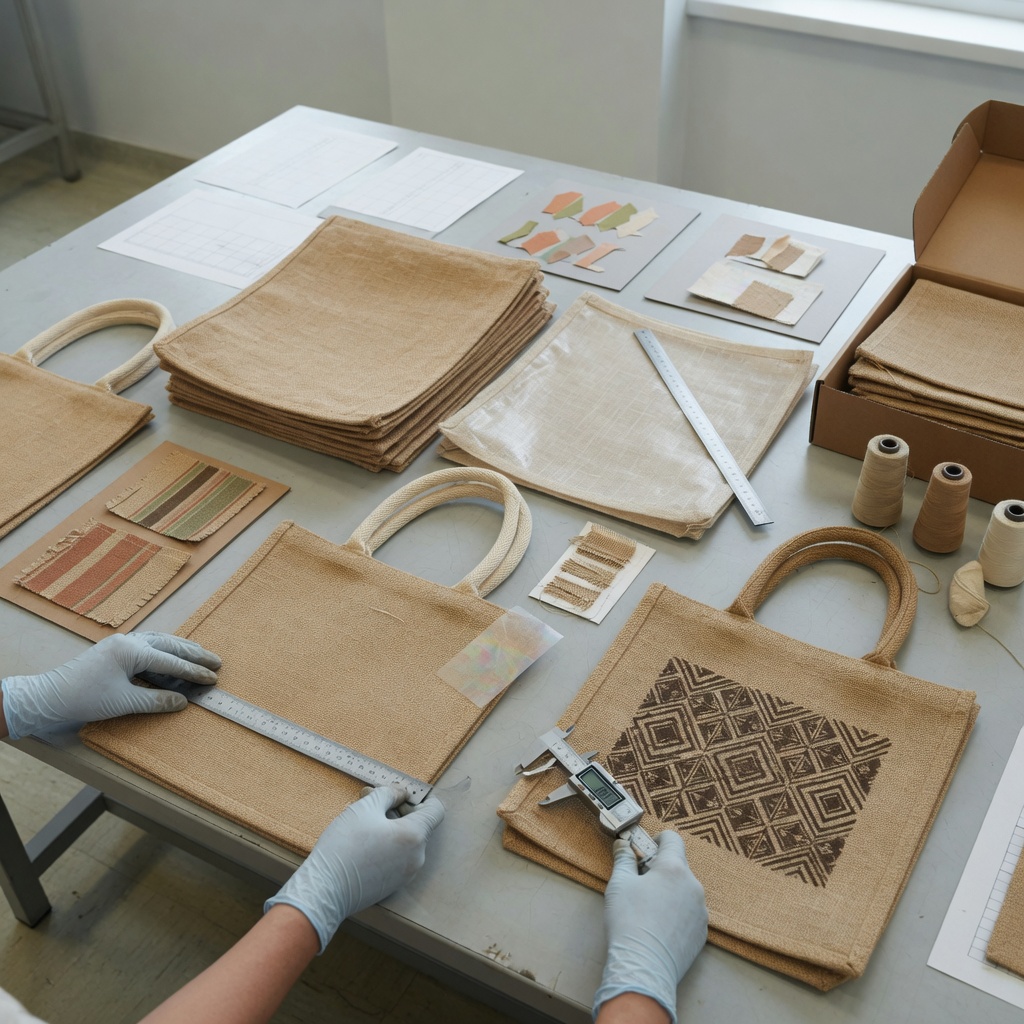
United States B2B buyers should judge jute bag OEM product development capability by the manufacturing packet they can freeze with the purchase order, not by sewing-head count. A sketch is not authority to cut bulk fabric. Hold the production deposit until the quoting plant returns a sized pattern, graded jute callout, print sequence, handle construction, signed sample, and a revision-controlled bill of materials (BOM). If that plant cannot also archive origin labels, carton marks, packed-carton data, and a named inspection method, the file is not ready for United States receiving.
Decision rule. Approve development only when the factory returns files a United States importer can label, inspect, and receive. Process claims below are comparison templates from named third-party pages, not CottonToMaker offers. FYBagCustom’s jute-fabric manufacturing guide describes a client tech pack or brief (dimensions, handles, artwork, features), then graded-jute sourcing, panel cutting, silk-screen printing before sewing, optional polypropylene (PP) lamination, reinforced assembly, and full-process quality control (jute fabric B2B manufacturing guide). Jundong Factory’s product-development page describes sketches through in-house pattern engineering, Pantone matching, working prototypes, BOM confirmation, and AQL-style QC (custom bag product development workflow). Require the quoting plant to restate calendar units, starting quantities, and inspection levels in its own RFQ response. None of the day-counts or piece-counts below is a CottonToMaker commercial offer, a United States landed-cost quote, or a certification.
Minimum packet to freeze before deposit
- Dimensioned drawing: width × height × gusset, handle drop, tolerances, units.
- Material callout: jute grade, weight with unit, color, lining, laminate yes/no.
- Print engineering: method, color count, size in millimeters, panel-print-before-sew yes/no, strike-off on production fabric.
- Signed sample with photos and a measured spec.
- Revision-controlled BOM (fabric, thread, handle, laminate, labels, carton).
- Named QC method: inspection level, defect classes, third-party inspection right.
- United States private-label and receiving marks: origin, language, PO/SKU, carton diagram.
- Packed logistics: bags per inner, inners per master, carton cm, gross kg, air-sample vs ocean-bulk split.
Specify the United States program before OEM manufacturing starts
Lock commercial and compliance context before pattern work. A promotional tote, a grocery-style shopper, and a jute gift bag used as retail packaging do not share the same label, test, and receiving rules. Write those differences into the RFQ so sampling does not outrun import and DC controls.
Capture the following in the RFQ:
- Destination type: US door, deconsolidation warehouse, or retailer DC, including whether California distribution is in scope for the buyer’s chemical-review process.
- Incoterms rule and named place (for example FOB origin port versus DAP US DC). That allocation covers freight, insurance, importer security filing, and duty—not a marketing door-to-door phrase.
- End use. If the bag is sold as a textile product, confirm Federal Trade Commission fiber-labeling duties with counsel. Country-of-origin marking for imported articles is a separate US Customs requirement.
- Whether the bag is intended for children. Children’s products trigger additional CPSC/CPSIA obligations; do not assume an adult promotional tote covers that use.
- Artwork rights and print sequence, including whether printing happens on flat panels before sewing—the sequence described in the FYBagCustom custom-jute manufacturing guide (FYBagCustom process).
- Packed logistics data a US 3PL needs: bags per inner pack, inners per master, carton dimensions in centimeters, gross carton weight in kilograms, and pallet pattern if the DC is pallet-in.
These are product-development RFQ controls. They prevent a sample that cannot clear, label, or receive in the United States.
Product development capability checkpoints for OEM jute bag manufacturing
Product development capability in this category is the plant’s ability to turn an incomplete brief into a repeatable manufacturing packet. Score factories on files you can archive with the purchase order, not on unsourced tenure claims.
- Brief intake. The manufacturer restates width × height × gusset, handle drop, closure, and print locations, with units and tolerances. A sketch should come back as a measured drawing, not a lifestyle rendering.
- Material callout. Graded jute, fabric weight (gsm or oz/yd²), color, lining, and laminate. FYBagCustom’s OEM jute guidance includes fabric weights, closures, dyeing, and accessories among customization items (FYBagCustom).
- Pattern engineering. In-house patterns, not trader relay. Jundong’s product-development page lists sketches, material and hardware sourcing, and in-house pattern engineering as OEM/ODM steps (Jundong).
- Print engineering. Method, color count, print size in millimeters, and panel-print-before-sew versus post-sew. Treat post-sew print on a gusseted tote as a placement risk: require a panel-print proof and a photo of the printed flat panel before bulk, because a formed gusset can move the logo relative to the flat artwork.
- Prototype loop. Physical sample or working prototype with a stated clock start (artwork lock, fabric-in-house, or deposit). Published third-party day-count examples sit in the sampling section below; use them only to ask the quoting plant for its own clock.
- BOM freeze. Fabric, thread, handle, eyelet, laminate, carton, and label identifiers. Bulk should not start on same-as-sample language.
- QC method. Process checks plus a bulk sampling plan. AQL-style QC appears on the Jundong product-development path; require inspection level, defect classes, and the right to nominate a third-party inspector. AQL-style is not a named inspection level and is not a certificate.
- Private-label packet. Origin mark, hangtag or sewn label, polybag, and English master-carton marks with PO and destination. Szoneier’s retail-packaging OEM commentary treats private-label detail and repeat production as a reason to prefer a development-experienced factory over a trader (Szoneier).
- Information control. Written NDA if artwork is unreleased. Jundong’s OEM bag-development page lists NDA protection among supports (Jundong). An NDA is a contract, not a certification.
Go / hold / no-go
- Go: measured drawing, production-fabric strike-off, revision-controlled BOM, named inspection plan, United States label and carton mockups, and a sample clock with a start event.
- Hold: files incomplete, or the sample uses a library remnant rather than a bulk-lot swatch of the quoted jute.
- No-go: trader relay with no pattern ownership; gusseted artwork with no panel-print proof; or a request to cut bulk before a signed sample, spec, and BOM revision number.
Score the files, not claimed tenure. Do not transfer another company’s R&D-year or factory-age marketing statements into this RFQ.
Material, lamination, print, and handle trade-offs
Jute bag manufacturing quality is mostly decided before the sewing line. Freeze each trade-off so the sample is not a one-off. The physical effects below are specification and quote controls to verify on the signed sample—not CottonToMaker lab results.
Fabric weight and grade. Heavier cloth can increase stiffness and material cost and can fight the gusset fold. Lighter cloth can cut cost and cube but can show print strike-through and handle pull-out sooner; confirm both on the production-fabric sample. Do not write “premium jute.” Write a weight with units and a visual standard (natural color band, slub, oil-odor limit for a US stockroom). Example specification to verify in the supplier quote—not a lab result and not an equivalence: state one primary unit, for example 300 gsm or 10 oz/yd², each with a buyer-stated tolerance. Convert units in the quote; do not treat gsm and oz/yd² as interchangeable labels.
Lamination. Optional PP lamination is on the FYBagCustom custom-jute process map (FYBagCustom). Specify it because it can change moisture resistance, print smoothness, recyclability claims, odor, and the buyer’s California Proposition 65 file when films and inks are in scope. Specify one-side, two-side, or unlaminated per SKU.
Print. Silk-screen on flat panels before sewing is the sequence described for OEM jute production on that same FYBagCustom guide. Extra colors add setup cost and registration risk on a coarse weave; price both in the development quote and require a strike-off on production fabric. State whether PMS match is visual or instrumental.
Handles and reinforcements. Webbing, twisted jute rope, or cotton tape change load path and minutes at the needle. Specify handle drop in millimeters, attachment length, and bartack or box-X at the root. Do not invent a kilogram load rating unless a current test report is attached to the RFQ.
Each choice should appear on the sample approval form as accept, revise, or reject, with a photo of the approved standard.
Sampling, MOQ, and bulk manufacturing lead time after approval
Published third-party pages give numerical process examples. They are comparison anchors, not this site’s price list, and the excerpts used here do not include a dated as-of stamp. Confirm working versus calendar days and when the clock starts.
Concrete published examples (verify in the live quote):
- Physical samples: 3–5 days. Unit: days. Scope: physical samples as described for OEM/ODM jute bag production from a client tech pack on the FYBagCustom jute fabric manufacturing guide. As-of: undated public page in the source excerpt used for this editorial. Verify whether the window includes printing and assumes fabric already in house (source).
- Working prototypes: 5–7 days. Unit: days. Scope: custom bags including jute covers, as described on Jundong Factory’s product-development page (sketches, pattern engineering, Pantone matching). As-of: undated public page in the source excerpt used for this editorial (source).
- Bulk starting quantity 100–300 pieces and 15–30 days production after approval. Units: pieces and days. Scope: bulk runs after sample approval and BOM confirmation on the same Jundong product-development page, which also lists AQL-style QC, branded packaging, and logistics support. As-of: undated public page in the source excerpt used for this editorial. Treat 100–300 pcs as that publisher’s stated band, not a universal MOQ (source).
Price these trade-offs explicitly:
- A short sample window that assumes stock natural jute will miss dyed, laminated, or special-handle programs. Put fabric-in-house on the calendar.
- Low starting quantities reduce inventory risk for a United States test launch but usually raise cut-make-trim per piece and can block custom-dyed lots.
- Air for approval samples protects a US launch date; ocean for bulk protects unit landed cost. Split the modes in the RFQ.
- Revision rounds restart the published 5–7 day example if logo placement fails on a gusset. Cap complimentary revisions in the development quote.
- If fabric, laminate, or handle lot changes after the prototype, require a pre-production sample before bulk cut.
Do not release bulk fabric until the buyer returns a signed sample with photos, a measured spec, and a BOM revision number.
How United States buyers should compare OEM factories
Compare development evidence with trader relay. Every row below is a specify, compare, or verify action for the quoting plant—not a transfer of another factory’s published band into the purchase order.
| Checkpoint | Specify in the RFQ | Evidence of capability | Trade-off |
|---|---|---|---|
| Pattern ownership | Who draws and stores the production pattern | Dimensioned PDF of the buyer’s size | Relayed patterns hide sewing allowance and slow revisions |
| Material control | Jute grade, weight with unit, laminate, thread | Bulk-lot swatch, not a library remnant | Stock lots are faster; custom dye adds days and MOQ |
| Print sequence | Panel print before sewing if artwork meets a gusset | Process photo of printed panels plus fabric strike-off | Post-sew print can be cheaper on simple logos and weaker on placement |
| Prototype clock | Start event, working vs calendar days, revision count | Written sample lead time for this SKU’s materials | Published 3–5 or 5–7 day windows may exclude special materials |
| Starting quantity | MOQ by color and by print, not a blended number | Pcs per colorway after approval vs the 100–300 pcs published example | Lower pcs raise unit cost; higher pcs raise US inventory risk |
| QC method | Inspection level, AQL or equivalent, defect classes | QC SOP excerpt and blank inspection form | Tighter AQL raises reject cost; looser AQL shifts risk to the US DC |
| Private label | English labels, origin mark, carton marks | Label mockup in the sample and carton diagram | Extra labels add cost and prevent receiving failures |
| Export pack | Bags per carton, carton cm and kg, odor control | Packed-carton photo with dimensions | Overpack wastes US cube; underpack crushes bags |
The same comparison themes—development ability, material knowledge, sample quality, logo accuracy, sewing control, MOQ flexibility, and communication—appear in Szoneier’s retail-packaging OEM guidance (Szoneier).
United States labeling, landed cost, and delivery controls
Keep the manufacturing packet aligned with import and receiving, or an approved sample can still fail the first US inbound. These are buyer-side controls, not a CottonToMaker customs ruling.
Labeling and marks. Specify country-of-origin text, fiber content if the importer’s counsel determines textile labeling applies, and any retailer ticket. Do not print a recycling claim on PP-laminated jute unless legal has approved the claim. Carton marks should include the product description jute bag, PO, SKU, quantity, carton number, destination, and gross weight.
Landed-cost build (worksheet to complete in the quote, not a price). Unit FOB, packing, inland to port, ocean or air, insurance, US duty as classified by the importer’s broker, merchandise processing fee, harbor maintenance fee if ocean, ISF and bond if applicable, trucking to DC, and 3PL inbound. Jute bags can fall under different Harmonized Tariff Schedule numbers depending on construction (sacks versus shopping-style totes). Do not guess a duty rate in the development file. Require a supplier HTS suggestion and let the United States importer of record confirm it. A supplier HTS suggestion is not a binding ruling.
Delivery. Sample path: air courier and a duplicate approval sample retained at the factory. Bulk path: on-board date and a delay clause tied to fabric-in-house. If a US retailer appointment is fixed, put that date in the RFQ so development does not consume production time.
Chemical and odor. Natural jute can carry batch odor; laminated and printed bags add films and inks. If the program ships to California, run the buyer’s Proposition 65 review on the BOM and request ink and film identity—not an eco adjective. This page is not a certification, test report, or customs ruling.
RFQ checklist for jute bag OEM product development
Each item helps specify, compare, verify, approve, or order manufacturing.
- End use and destination. United States destination type and whether California distribution is in scope.
- Incoterms and importer of record. Named rule and place; who files ISF and pays duty.
- Dimensioned drawing. Width × height × gusset, handle drop, tolerances, units. Require a measured drawing if the input is only a sketch.
- Fabric specification. Grade, weight with unit (gsm or oz/yd²), color, laminate polymer if used.
- Handle and reinforcement. Material, width, drop, stitch pattern, and any retailer pull-test method.
- Print packet. Vector art, method, color count, size in mm, placement, panel-print-before-sew yes/no, artwork-lock date.
- Label packet. Origin mark, fiber content if required, SKU/barcode, language.
- Sample plan. Proto count, strike-off fabric, working vs calendar days, clock-start event, included revisions. Ask the factory to explain any gap versus the published 3–5 day physical-sample and 5–7 day prototype examples above.
- Bulk quantity. Pieces per color and per print after approval; compare with the published 100–300 pcs starting example and record the factory’s number.
- Production calendar. Fabric-in-house, cut, finish; use the published 15–30 day production example only as a discussion range.
- BOM and change control. Revision-controlled BOM; no bulk cut on verbal changes.
- QC. Inspection level, defect list (open seam, handle-root failure, print miss, odor, oil stain, measurement), inspection location, third-party inspection right.
- Packing. Bags per carton, carton cm, gross kg, English marks for US receiving.
- Landed-cost worksheet. Blank fields for freight, broker-confirmed duty, and US inland—no implied rate.
- Approval gate. Signed sample photos, spec, BOM, carton marks, and a pre-production sample if materials changed after the proto.
- NDA and pattern reuse. Who may reuse the pattern.
- Failure path. Recut, repair, or reject if bulk misses the named inspection plan, and who pays air replacement to the United States.
Evidence basis, method, and limits
Author note. Editorial specification article by Vincent Xi, Editorial Author at CottonToMaker (https://cottontotemaker.com/authors/vincent-xi/). The byline does not claim factory employment years, laboratory tests, customer names, awards, or first-person sampling diaries.
Source contexts. (1) FYBagCustom’s B2B jute-fabric manufacturing guide: tech pack, graded jute, cut, silk-screen before sewing, optional PP lamination, reinforcements, full-process QC, and a 3–5 day physical-sample statement. (2) Jundong Factory’s product-development page: sketch-to-BOM workflow, 5–7 day working prototypes, 100–300 pcs bulk starting examples, 15–30 day production, AQL-style QC, NDA mention, and logistics support. (3) Szoneier’s jute gift-bag manufacturing page: buyer evaluation set and the factory-versus-trader distinction on private-label work.
Method. Process steps and numerical examples were taken only where they appear on those public B2B pages, then recast as RFQ controls for United States buyers. Units were preserved (days, pieces). Where a page did not state working versus calendar days or an as-of date, that gap is disclosed. US labeling and customs items are framed as buyer-side verification tasks, not rulings. This article does not state search-volume, CPC, difficulty, or ranking metrics.
Limits / what to verify. Day-counts and piece-counts are third-party published examples without a dated capacity letter in the excerpts; they can change and may exclude peak season, custom dye, or hardware lead time. Hosting this editorial does not transfer another company’s MOQ, sample window, or years-of-R&D claim into a CottonToMaker offer. Duty, HTS, textile labeling, CPSIA, state bag rules, and Proposition 65 depend on the SKU and must be confirmed by the United States importer of record, licensed broker, and counsel. AQL-style is not a substitute for a named inspection level on the purchase order. No ISO, social-audit, or organic certificate is implied; request current documents if a program requires them. Natural jute varies by batch—approve a bulk-lot swatch, not only the prototype.
Discuss Your Requirements
Review our manufacturing capabilities, then share your specifications for a supplier-fit review.