Jute Bag OEM Packing Requirements for Canadian Buyer RFQs
By Vincent Xi | Editorial Author
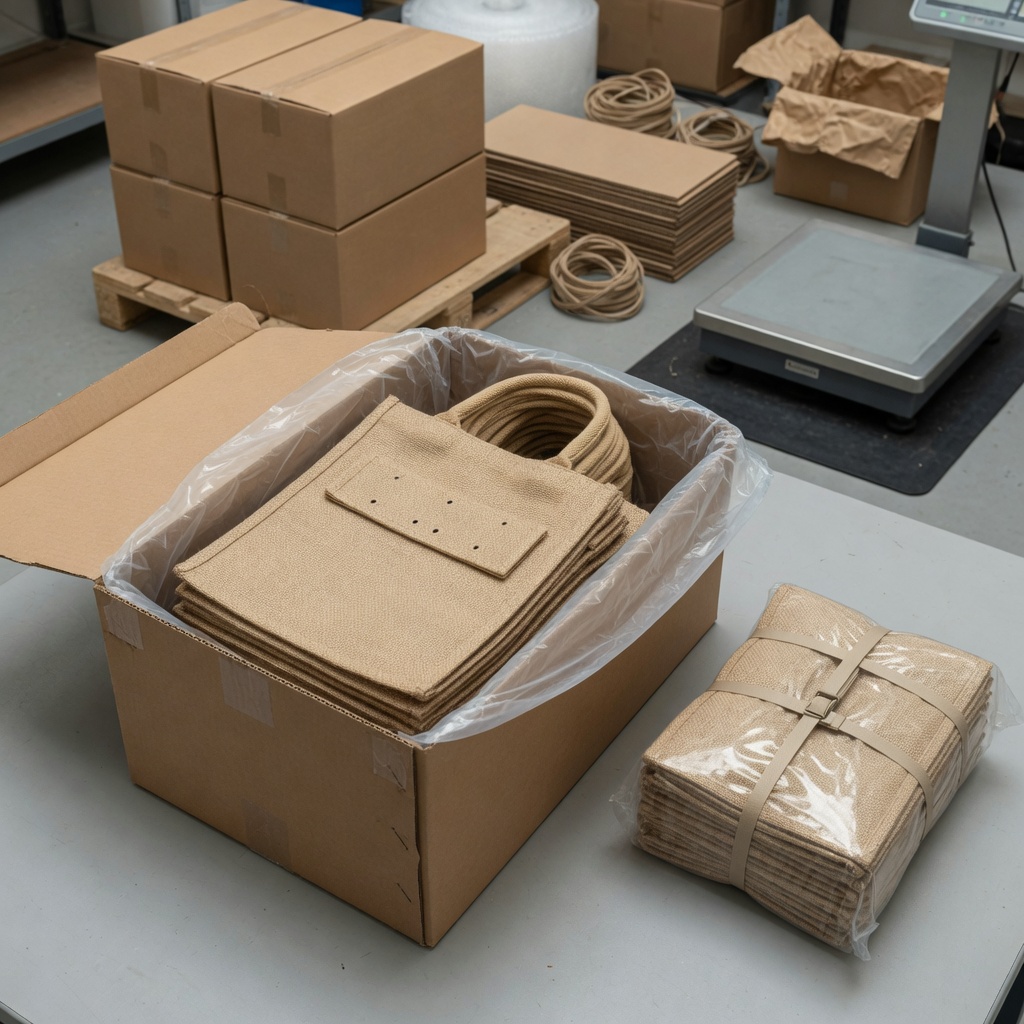
For Canadian B2B buyers, jute bag OEM packing requirements belong in a controlled, SKU-specific schedule issued with the RFQ and purchase order. The schedule should define the packing hierarchy, bag count, fold method, compression permission, moisture protection, outer-pack construction, packed dimensions and weights, loading method, marks, labels, costs, documents, and approval evidence.
Require the supplier to return a proposed value for every field and identify all deviations and assumptions. Product approval does not establish packing approval: evaluate a representative pack made with the approved SKU and proposed production materials before bulk packing begins.
The cited jute bag manufacturing-process source identifies bundles, cartons, compressed bales, and ironbound bales as possible finished-bag formats. It also discusses instructions covering bag counts, labels, bale marks, compression limits, and pallets. It does not establish a universal pack count, carton size, weight limit, compression setting, or Canada-specific format. Those values must be resolved in the supplier quote and pack trial.
Jute Bag OEM Packing Requirements for Canada
Use the same field structure in the buyer specification, supplier response, deviation log, and approval record. Ask the supplier to mark each field Comply, Deviation, or Not applicable, then provide the proposed value, measurement basis, and evidence reference.
| RFQ decision field | Buyer specification | Required supplier response | Approval control |
|---|---|---|---|
| SKU and revision | Finished dimensions, gusset, fabric construction, handles, closure, decoration, ordered quantity, and SKU-separation rule | Product revision covered by the proposal and any construction assumptions affecting packing | Trial evidence must use the approved SKU |
| Packing hierarchy | Permitted inner pack, bundle, carton, bale, pallet, or floor-loaded sequence | Material and purpose of each proposed layer | Every finished bag must map to an identifiable outer unit |
| Count control | Bags per inner and outer unit, partial-pack treatment, and buyer-defined tolerance | Proposed count by layer and calculated total by SKU | Ordered, packed, and documented quantities must reconcile |
| Fold and orientation | Fold drawing; handle, closure, gusset, and decorated-face position; permitted inserts | Images or a representative physical sample in packed and unpacked condition | A written description alone does not approve the fold |
| Compression | Whether compression is permitted, how its limit will be expressed, and the required unpacked condition | Compression method, recovery interval with unit, packed dimensions, and observed unpacked condition | Unspecified compression remains an open deviation |
| Moisture control | Proposed barrier or liner material, placement, closure, prohibited materials, and observable acceptance criteria | Material description, closure detail, and sample-pack evidence | A general moisture-resistance claim is not a complete specification |
| Outer protection | Carton or bale construction, wrap, sealing, strapping, edge protection, and handling restrictions | Proposed construction and inspection evidence | Approval applies only to the construction used in the trial |
| Dimensions and weights | Reporting units, length x width x height orientation, measurement points, and tolerances | External dimensions in cm, volume in m^3, net weight in kg, gross weight in kg, and measurement basis for each outer-unit type | Freight planning should use production-representative measurements |
| Loading method | Palletized or floor-loaded basis, stack constraints, receiving restrictions, and permitted handling method | Pallet dimensions, loaded height, gross weight, outer-unit count, or floor-loading plan | The proposal must fit the buyer's receiving constraints |
| Marks and labels | Buyer-controlled artwork, PO and SKU references, placement, revision, and approval authority | Marking proof and placement proof for each packing layer | Unapproved product or compliance wording must not be added |
| Packing costs | Required base format, quote currency, charge basis, and separately priced alternatives | Itemized materials, labor, pallets, restraint, labels, samples, and repacking charges | Compare complete packing proposals, not only bag unit prices |
| Evidence and documents | Required samples, images, records, draft deadlines, final deadlines, and release authority | Evidence index, draft documents, deviations, and responsible contact | Release remains blocked until evidence and quantities reconcile |
Practical Jute Bag RFQ Checklist for Canada Packing Requirements
Use this checklist when preparing the RFQ, evaluating the supplier response, approving the representative pack, and releasing the shipment. Attach the completed checklist and referenced evidence to the applicable SKU and purchase-order revision.
Buyer inputs before RFQ issue
- [ ] Identify the finished jute bag SKU, product revision, ordered quantity, construction, gusset, handles, closure, decoration, and SKU-separation rule.
- [ ] State the permitted packing hierarchy, including any allowed inner pack, bundle, carton, bale, pallet, or floor-loaded arrangement.
- [ ] Attach the required fold drawing and define the orientation of handles, closures, gussets, and decorated faces.
- [ ] Mark compression as permitted or prohibited and define the required condition after unpacking when compression is proposed.
- [ ] Define the required moisture-control proposal, barrier placement, closure method, prohibited materials, and observable acceptance criteria.
- [ ] Specify the required outer protection, sealing, strapping, edge protection, and handling restrictions.
- [ ] Define how outer dimensions, volume, net weight, and gross weight must be measured and reported.
- [ ] State palletized or floor-loaded receiving constraints and any permitted handling methods.
- [ ] Supply buyer-controlled marking and label artwork, placement instructions, revision status, and approval authority.
- [ ] List the packing cost components, evidence, document drafts, and approvals required with the quote.
Supplier return with the quote
- [ ] Mark every RFQ field Comply, Deviation, or Not applicable and explain each assumption or exception.
- [ ] Confirm the product revision and identify any construction feature that changes the proposed packing method.
- [ ] Return the proposed count at each packing layer and show how packed quantities reconcile to the order by SKU.
- [ ] Describe each packing material, fold step, barrier placement, outer closure, restraint method, and loading arrangement.
- [ ] Provide proposed external dimensions, volume, net weight, gross weight, reporting units, and measurement basis for each outer-unit type.
- [ ] Itemize packing materials, labor, labels, pallets, restraint, representative samples, alternate formats, and repacking charges.
- [ ] Submit a marking proof, document index, proposed trial evidence, and a written deviation log.
Buyer checks before packing approval and shipment release
- [ ] Confirm that the representative trial uses the approved SKU and the proposed production packing materials.
- [ ] Compare the packed and unpacked condition with the agreed fold, compression, moisture-control, and protection criteria.
- [ ] Verify measured dimensions and weights against the supplier response and shipment planning inputs.
- [ ] Resolve every deviation in writing and record the approved packing revision.
- [ ] Reconcile the purchase order, physical outer-unit count, production packing record, marks, and final packing list before release.
A checked item records that the specified response or evidence was reviewed; it does not by itself establish Canadian legal compliance, customs acceptance, test performance, or certification.
Choose the Packing Format for the Approved SKU
The manufacturing-process source supports treating bundles, cartons, compressed bales, and ironbound bales as options rather than interchangeable defaults. Select the format only after reviewing the approved bag's construction, decoration, fold, protection, handling, and condition after unpacking.
| Source-supported format | Quote and trial details to resolve |
|---|---|
| Bundle | Wrap or tie material, bag count, moisture-control proposal, handling method, dimensions, weight, and identification |
| Carton | Board construction, liner, closure, external dimensions, net and gross weight, stack condition, and marks |
| Compressed bale | Compression method, recovery interval, unpacking criteria, dimensions, weight, wrap, closure, and marks |
| Ironbound bale | Banding construction, contact protection, handling method, unpacking method, and acceptance by the buyer's logistics parties |
| Palletized loading | Pallet construction, loading pattern, outer-unit count, restraint method, loaded dimensions, and gross weight |
| Floor loading | Outer-unit orientation, stacking constraints, handling method, load plan, and receiving compatibility |
The pack trial should use the approved dimensions, fabric construction, handles, closures, gussets, inserts, and decoration. Record the fold orientation, barrier placement, outer closure, packed measurements, and condition after unpacking. The supplied evidence does not support transferring a generic count, size, weight, or compression setting from one SKU to another.
The cited export-logistics source discusses moisture-resistant packaging, export cartons, palletization, accurate labels, container-space use, and moisture damage as export-planning considerations. These observations support RFQ fields for barrier material, closure, packed dimensions, gross weight, loading arrangement, label proof, and unpacking checks. They are not order-specific specifications or performance guarantees.
Canada Packing Requirements for Labels, Costs, and Documents
Label ownership and compliance scope
Separate finished-product artwork from logistics information. Identify what belongs on the jute bag, attached tag, inner pack, outer pack, pallet, and packing list. The buyer should control the approved wording, artwork revision, placement, and approval authority.
The supplied sources are not Canadian statutes or regulatory guidance. They do not establish whether bilingual wording or another Canadian labeling rule applies to a particular bag, private-label element, or transport package. Obtain shipment-specific advice, then provide the exact approved text to the supplier before printing or packing.
Artwork approval confirms the approved copy, revision, and placement. It is not evidence of Canadian legal compliance, customs acceptance, product certification, or facility certification.
Packing inputs for landed-cost comparison
The cited OEM and import-planning source discusses packaging costs and document gaps in an import-planning context. Use that context to request separately stated inputs for the shipment-specific landed-cost model:
- Inner wrap, liner, or other moisture-control material.
- Bundle, carton, compressed-bale, or other outer-pack material.
- Pallet, restraint, strapping, sealing, and edge protection.
- Private-label application and shipping marks.
- Packing labor and representative sample-pack charges.
- Repacking and alternate-format charges.
- Outer-unit count, dimensions, net weight, and gross weight by SKU.
- Palletized or floor-loaded shipment basis.
The cited evidence supplies no transaction-specific freight rate, duty, tax, brokerage charge, classification, or Canadian clearance cost. Obtain those inputs for the actual goods, route, terms, and dated quote.
Packing-linked documents
The export-logistics source lists a commercial invoice, packing list, bill of lading or airway bill, and certificate of origin in its export-document discussion. The manufacturing-process source also refers to packing lists and fumigation documents when required. The OEM and import-planning source discusses document availability in its own commercial context.
Treat these references as planning prompts, not proof that every document is mandatory or sufficient for a Canadian shipment. The buyer's shipment-specific matrix should identify the requested document, issuer, required data, draft deadline, final deadline, and approving party.
Before release, reconcile the packing list with the purchase order and physical packing record for SKU, description, quantity per outer unit, outer-unit type, total outer-unit count, dimensions, net weight, gross weight, marks, and shipment totals.
Example Packing Calculation to Verify in the Supplier Quote
All figures below are explicitly unsourced example assumptions for a hypothetical Canada-bound SKU as of the supplier's dated quote. They are calculation inputs, not benchmarks, supplier capabilities, or industry norms. Each value must be confirmed or replaced in the quote and representative pack trial.
| Illustrative input | Example calculation | Supplier verification required |
|---|---|---|
| Example assumption: 1,200 finished jute bags for the hypothetical SKU as of the supplier's dated quote, packed at 40 finished bags per carton for that SKU and quote date | Example result: 1,200 finished bags divided by 40 finished bags per carton equals 30 cartons for the hypothetical order | Confirm production pack count, partial-carton treatment, and total carton count |
| Example assumption: External carton dimensions of 60 cm length x 40 cm width x 35 cm height for the hypothetical SKU as of the supplier's dated quote | Example result: 0.60 m x 0.40 m x 0.35 m equals 0.084 m^3 per carton; 0.084 m^3 per carton x 30 cartons equals 2.52 m^3 for the hypothetical shipment | Measure production-representative cartons, confirm dimension orientation, and recalculate shipment volume |
| Example assumption: Gross weight of 18 kg per carton for the hypothetical SKU as of the supplier's dated quote | Example result: 18 kg per carton x 30 cartons equals 540 kg gross weight for the hypothetical shipment | Confirm measured carton weights, total shipment gross weight, and weighing basis |
A lower outer-unit count does not by itself establish an acceptable pack or a lower landed cost. Compare dimensions, measured weights, itemized packing charges, loading method, handling constraints, and unpacked condition for each proposed format.
Packing Approval and QC Evidence
| Approval gate | Evidence required before approval |
|---|---|
| RFQ response | Completed field schedule, itemized costs, declared assumptions, and written deviations |
| Representative pack trial | Approved SKU, proposed production materials, packing sequence, measurement record, unpacking observations, marking proof, and deviation disposition |
| Production packing | Approved packing revision, SKU counts, material confirmation, outer-unit identification, packed measurements, and production deviations |
| Shipment release | Reconciled purchase order, production record, physical outer-unit count, marking proof, and final packing list |
For the representative trial, record the finished-bag revision, bags per packing layer, fold orientation, barrier placement, outer-pack construction, external dimensions, net and gross weights, and measurement basis. When compression is proposed, define a recovery observation interval with a unit and document the condition after unpacking.
Observable checks can include creasing, distortion, contamination, visible dampness, color transfer, print damage, and damage to handles or closures. Convert each relevant check into an agreed acceptance criterion instead of relying on general descriptions such as export packing or good condition.
No named packaging standard is established by the supplied evidence. If the buyer adds a standard, identify the applicable document, revision, method, sample-selection rule, and pass criteria in the RFQ. A supplier's internal procedure is not automatically a requirement of that standard. Do not represent testing as certification, and do not claim certification without a current document covering the relevant product, facility or process, and scope.
Evidence Method and Limitations
Method: The supplied pages were reviewed by source context. Factual observations were retained only where the cited page supports them. The RFQ fields, checklist, and approval gates are buyer controls derived from those observations; they are not presented as laws, standards, supplier practices, or test results. The quantitative example uses explicitly labeled assumptions and direct arithmetic rather than source-derived benchmarks.
| Source context | Supported use | Not established |
|---|---|---|
| Jute bag manufacturing process | Possible packing formats and instruction topics involving counts, labels, bale marks, compression, pallets, and packing records | Universal counts, dimensions, weights, compression settings, Canadian rules, or supplier capability |
| Export logistics | Moisture protection, cartons, palletization, labels, container-space planning, moisture risk, and export-document context | Canada-specific legal requirements, current costs, route outcomes, or guaranteed transit performance |
| OEM and import planning | Packaging-cost visibility, private-label coordination, and document-gap planning | Independent proof of mandatory documents, Canadian compliance, or another supplier's service capability |
| Vincent Xi author profile | Author name, role, and profile URL | Factory visits, tests, audits, procurement experience, certifications, or customer outcomes |
Limitations and verification: The cited pages are informational or commercial contexts, not Canadian statutes, customs determinations, independent packaging tests, or shipment quotations. No actual jute bag SKU, supplier quote, tested pack, route, warehouse condition, import classification, or Canadian legal analysis was supplied. Verify all pack counts, materials, dimensions, weights, costs, compression conditions, moisture controls, labels, loading rules, and documents for the specific purchase order. Do not infer company practice, regulatory compliance, customs acceptance, test performance, or certification from this article.
Author basis: The CottonToMaker author profile identifies Vincent Xi as an Editorial Author. It supplies no basis for first-hand factory, testing, audit, procurement, or customer-outcome claims, and none are made here.
Discuss Your Requirements
Review our manufacturing capabilities, then share your specifications for a supplier-fit review.