Jute Bag OEM Shipping Lead Time for United States Orders
By Vincent Xi, Editorial Author
Experience basis: The approved CottonToMaker author profile identifies Vincent Xi as an Editorial Author. No first-hand factory visit, product test, freight booking, or customer outcome is claimed.
For a United States business purchase order, approve jute bag OEM shipping lead time only when a dated quotation converts the supplier’s range into accountable milestone dates. Those milestones should cover specification and label freeze, sample approval, material readiness, bulk manufacturing, inspection and rework, packing, cargo readiness, freight handoff, quoted transport stages, any buyer-defined customs or broker checkpoint, and receipt at the named U.S. dock.
Hold the purchase order if the quotation omits the schedule start event, endpoint, working-versus-calendar-day basis, buyer approval time, capacity-reservation condition, responsibility boundary, destination, or validity date. A production range is not evidence of dock delivery unless the dated quotation expressly includes the later logistics stages.
Scope: This article addresses logistics controls for OEM jute bag manufacturing orders destined for the United States. The cited figures are undated, page-specific supplier statements. They are useful for framing RFQ questions, but they are not market averages or guaranteed U.S. delivery dates.
United States jute bag OEM shipping lead time: purchase-order gates
These are buyer-defined approval controls, not claims about a supplier’s current capacity.
| Gate | Approve when the dated response states | Hold when |
|---|---|---|
| Schedule clock | Exact start event, endpoint, working-or-calendar-day basis, excluded buyer time, and committed milestone dates | The response provides only a broad production or shipping range |
| Product release | SKU quantities, finished dimensions, tolerances, materials, handles, seams, decoration, accessories, packing, and substitution rules are version-controlled | The schedule is based on an incomplete or changeable specification |
| Sample and material status | Sample preparation, dispatch, buyer review, revisions, approval, material reservation, and bulk-release dates are separated | Sampling, approval, material readiness, and manufacturing are combined into one estimate |
| Quality release | Inspection stage, acceptance criteria, rework ownership, release authority, and revised-date procedure are defined | Cargo may be handed over without documented quality release |
| Logistics boundary | Cargo-ready date, named handoff place, responsible party, booking status, planned route, transport scope, and named U.S. destination are stated | Factory completion is presented as United States delivery |
| Labels and documents | Buyer-approved files, revision identifiers, proof status, freeze date, document list, and change authority are recorded | The supplier is asked to interpret an undefined instruction such as U.S.-compliant |
| Landed-cost basis | Included and excluded charges, currency, quotation validity, cargo assumptions, destination, and responsibility boundary are aligned | Headline unit prices use different freight or delivery scopes |
> Buyer-defined schedule structure: elapsed delivery schedule = sample and approval stages + material and bulk manufacturing stages + inspection or rework + packing and cargo readiness + freight handoff + quoted transport stages + buyer-defined customs or broker checkpoint where applicable + final delivery + buyer-set contingency.
This structure is an RFQ decomposition, not a source-derived duration. Each stage needs an owner, planned date, committed date, closing evidence, and written change-control rule.
What the cited shipping lead-time claims establish
The supplied excerpts do not consistently define quantity, construction, day basis, clock-start event, endpoint, route, or destination. Each figure must therefore remain attached to its source wording and stated scope.
| Claim as supplied | What it does not establish | RFQ control |
|---|---|---|
| 28–35 days. Unit: days. Date context: no publication date is shown in the supplied excerpt. Scope/source: the production lead time described as FOB by Avecobaggie. | Quantity, SKU, working-or-calendar-day basis, start event, exact endpoint, named handoff place, and U.S. destination are not shown. | Ask whether the endpoint is cargo readiness, handoff, departure, or another event. Obtain dates for every remaining United States delivery stage. |
| 1 week for sampling, 3 weeks for production, and 1 week for air logistics. Unit: weeks. Date context: no publication date is shown in the supplied excerpt. Scope/source: the named stages in the Avecobaggie breakdown. | Quantity, specification, route, week basis, sample transit, buyer review time, and dock-delivery endpoint are not shown. | Request separate committed dates. Do not add the stages together and present the result as a U.S. delivery promise. |
| 15 days with a 10% additional fee. Units: days and percentage. Date context: no publication date is shown in the supplied excerpt. Scope/source: the rush service and additional fee described by Avecobaggie. | Eligible quantity, construction, day basis, material status, reserved capacity, inspection scope, freight scope, and fee calculation basis are not shown. | Require the rush quotation to identify compressed, unchanged, and excluded stages, together with the additional-fee basis. |
| 7–10 days for sampling and 20–35 days for bulk production. Unit: days. Date context: no publication date is shown in the supplied excerpt. Scope/source: the sample and bulk stages stated by Bene Bags. | Day basis, quantity, construction, decoration, sample transit, buyer review time, inspection, and freight scope are not shown. | Keep sample preparation, sample transit, buyer approval, material release, and bulk manufacturing as separate clocks. |
| 10–30 days for typical bulk production depending on quantity and complexity. Unit: days. Date context: no publication date is shown in the supplied excerpt. Scope/source: the bulk-production statement from Bene Bags. | Qualifying quantities, complexity variables, day basis, start event, inspection stage, and shipping endpoint are not defined. | Bind the current quotation to the exact SKU matrix, quantity, construction, decoration, and clock definition. |
Do not average, add, or convert these figures into a United States planning benchmark. Their stages and endpoints are not sufficiently aligned. A rush-production claim also does not establish transport capacity or a receiving-dock date unless those stages are expressly included.
The supplied Porkanpack checklist supports asking separately about sample development and bulk-production timing. It also identifies unclear sampling policies, material shortages, and revision rounds as delay risks.
Freeze measurable specifications before manufacturing starts
The supplied Bene Bags excerpt links bulk-production timing to quantity and complexity, while the Porkanpack checklist identifies material availability and revisions as schedule risks (Bene Bags; Porkanpack). Convert those variables into controlled RFQ fields.
| RFQ field | Required entry | Shipping lead-time control |
|---|---|---|
| Order matrix | Quantity by SKU, permitted overrun or underrun, split-release rule, and partial-delivery status | Bind the quotation and production slot to the approved matrix revision |
| Jute construction | Material description, color reference, agreed material measurement, backing, lining, coating, or lamination where applicable | Require written availability confirmation and prohibit unapproved substitutions |
| Finished dimensions | Width, height, gusset, measurement condition, unit, and numerical tolerance supplied or approved by the buyer | State whether measurements apply before packing or after unpacking and conditioning |
| Handles and seams | Handle material, width, drop, placement, reinforcement, seam finish, unit, and acceptance method | Link bulk release to the controlled sample or specification record |
| Decoration | Artwork revision, print method, color references, coverage, placement, registration tolerance, and proof status | Prevent bulk decoration before controlled proof approval |
| Labels and accessories | File revision, dimensions, placement, attachment method, closures, pockets, hardware, and inserts | Freeze files and separately sourced components before bulk release |
| Packing and cargo data | Fold method, protection, units per carton, carton dimensions, gross weight, pallet instructions, and carton-marking revision | Require verified packing data before approving the freight response |
| Quality release | Defect definitions, acceptance criteria, inspection stage, reference sample, rework procedure, and release authority | Prevent cargo handoff until the agreed release record is complete |
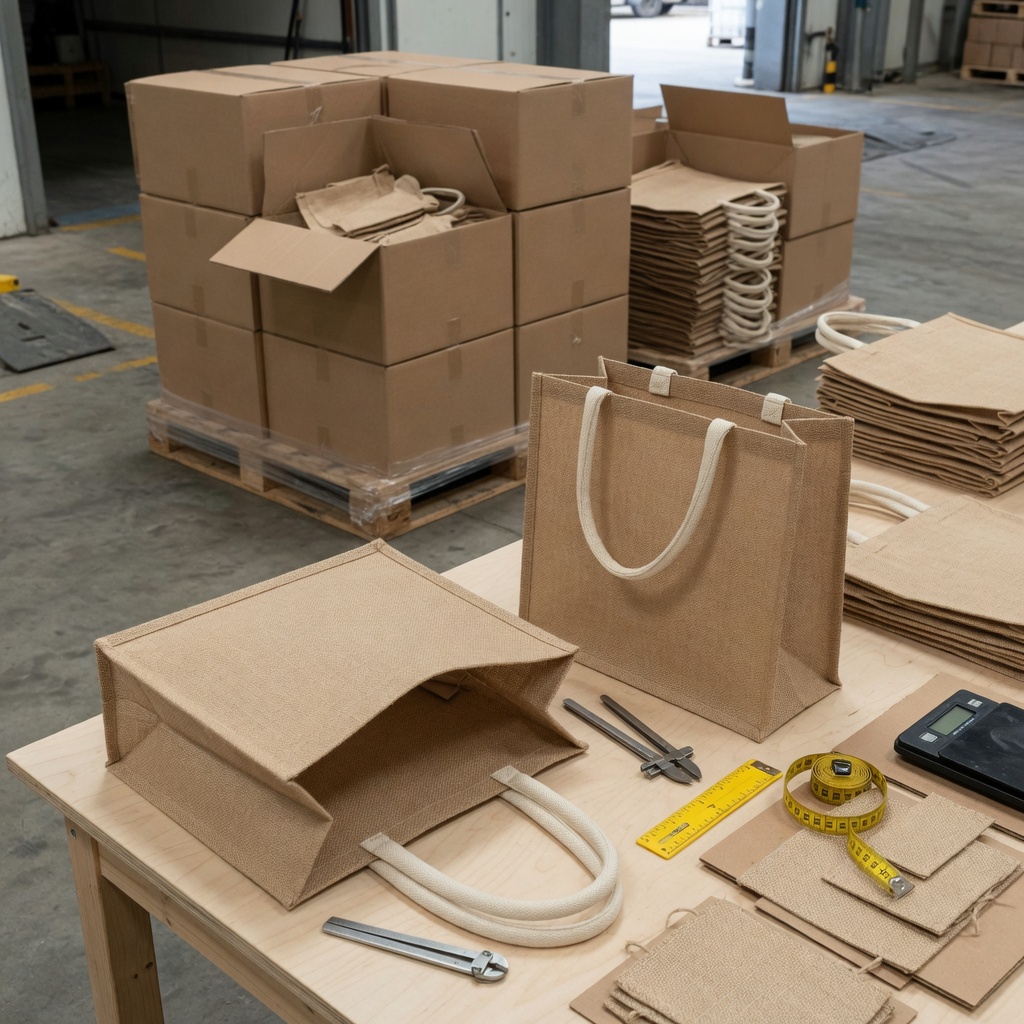
Illustrative current-RFQ assumption to verify in the dated supplier quotation: a tote body measuring 38 cm wide × 42 cm high × 15 cm gusset, with a natural woven jute body, cotton-webbing handles, reinforced X-box stitching, and a blank front panel. Units: centimetres. Scope: an editorial example for the current RFQ under review. These dimensions and materials are not a standard size, supplier capability claim, or CottonToMaker product specification.
Require a written schedule-and-cost impact response for every post-approval change. The response should address material booking, sample status, bulk work, labels, packing data, inspection, cargo readiness, and the freight plan.
Build shipping lead time backward from the United States dock date
Begin with the required delivery event at the named U.S. warehouse, fulfillment facility, or commercial receiving dock. Ask each responsible party to complete a reverse schedule rather than substituting factory completion for final delivery.
| Milestone | Required response | Closing evidence |
|---|---|---|
| Final receiving-dock delivery | Named address, required date, appointment rules, receiving hours, vehicle restrictions, and unloading responsibility | Buyer-approved receipt or other agreed delivery evidence |
| Buyer-defined customs or broker checkpoint | Responsible party, document set, review timing, assumptions, and escalation contact where applicable | Confirmation from the buyer, broker, or qualified adviser for the final SKU and shipment plan |
| Arrival and inland handoff | Planned location, date, responsible party, onward-delivery scope, and exception-notice process | Current logistics schedule or quotation |
| Origin departure | Planned departure, booking status, cutoff assumptions, and notification responsibility | Booking evidence when available |
| Cargo handoff | Named handoff place, planned date, cargo condition, packing-data status, and responsible party | Forwarder receipt or equivalent agreed evidence |
| Inspection release | Inspection date, result, unresolved defects, rework plan, and release authority | Approved inspection record |
| Bulk completion and packing | Committed completion date, packing method, carton data, and cargo-ready date | Production status record and buyer-approved packing information |
| Specification and approval freeze | Controlled specification, sample, artwork, label, and packing revisions, with approval owner and date | Versioned approval record |
The quotation must state whether its endpoint is cargo ready, handed over, departed, arrived, or delivered to the named dock. If the supplier does not control a later stage, obtain a current schedule and cost response from the responsible logistics party before approving the overall shipping lead time.
United States labeling and document freeze controls
The cited supplier pages do not provide a legal determination of label or document requirements for a particular United States SKU, construction, or sales channel. Treat labeling as a buyer-controlled schedule input:
- Have the buyer’s compliance team, importer, customs adviser, or qualified counsel determine the required content for the final product and intended channel.
- Supply buyer-approved artwork, label files, placement instructions, attachment methods, carton marks, and controlled revision identifiers.
- Require a proof or sample showing label placement and attachment before the agreed freeze date.
- State who may approve a file change and how a rejection or revision affects material booking, manufacturing, packing, inspection, and cargo readiness.
- Give the supplier the buyer’s or broker’s document checklist and require written confirmation of which documents will be supplied, by whom, and at which milestone.
- Do not accept an undefined statement such as
U.S.-compliantin place of approved files and documented review.
This article does not determine legal label content, tariff classification, duty treatment, tax treatment, or document sufficiency. Verify those matters for the final product and shipment through qualified buyer advisers.
Align landed cost with shipping lead time
The supplied Bene Bags excerpt lists sea, air, and express courier as shipping options (Bene Bags). That statement does not establish a current route, rate, capacity commitment, or United States delivery date. Request a dated response for each commercially feasible option using the same cargo and destination assumptions.
| Comparison field | RFQ requirement |
|---|---|
| Product basis | Use the same SKU specifications, quantities, sample status, decoration, inspection scope, and acceptance basis |
| Packing data | Use verified packed quantity, carton dimensions, gross weight, pallet data, and cargo-ready location |
| Responsibility boundary | Name where the supplier’s cost and responsibility end and who controls every remaining stage |
| Transport response | State mode, planned route, booking status, handoffs, milestone dates, quotation validity, assumptions, and exclusions |
| Origin and main transport charges | Itemize applicable origin charges, main transport, insurance scope, currency, and validity |
| Customs-related cost | Obtain buyer or adviser validation of classification, duty and tax treatment, broker scope, and document requirements |
| Destination and domestic delivery | Itemize applicable destination charges and delivery to the named U.S. address, including appointment scope |
| Exception exposure | State responsibility and notification rules for rebooking, document correction, inspection failure, storage, or delayed pickup |
Use a buyer-defined worksheet rather than comparing headline unit prices:
> Landed-cost comparison total = product and development charges + inspection + applicable origin charges + transport + insurance + buyer-validated customs-related charges + applicable destination charges + domestic delivery + identified exception allowances.
Compare cost per accepted bag only after each option uses the same SKU quantity, packing data, U.S. destination, responsibility boundary, currency treatment, and quotation-validity basis. If a quotation uses a trade label such as FOB, record the named place and map every included and excluded cost layer. This article does not interpret the trade term.
Copy-ready RFQ controls for jute bag OEM shipping lead time
> Please quote only against the attached SKU matrix, specification revision, approved sample status, artwork and label revisions, packing requirements, inspection criteria, and named United States delivery location. State the quotation date, validity, schedule start event, schedule endpoint, working-or-calendar-day basis, buyer-controlled approval time, capacity-reservation condition, and exclusions. Return separate planned and committed dates for sample work, sample dispatch, buyer review, revisions, material release, bulk start, bulk completion, inspection, rework, packing, cargo readiness, handoff, departure, arrival, and receiving-dock delivery wherever each stage is in scope.
Product and approval controls
- [ ] Attach the controlled SKU matrix, quantities, dimensions, tolerances, material construction, handles, seams, reinforcement, decoration, accessories, packing requirements, and substitution rules.
- [ ] Attach controlled artwork, label files, placement instructions, carton marks, and revision identifiers.
- [ ] Identify the sample or specification record governing bulk acceptance.
- [ ] Require written material and component availability confirmation against the quoted schedule.
Schedule and delivery controls
- [ ] Name the exact start and end events and state the day basis.
- [ ] Separate supplier work, buyer approval time, inspection or rework, cargo handoff, transport, and final delivery.
- [ ] Assign a responsible party, committed date, and closing evidence to every milestone.
- [ ] Require written schedule-and-cost approval for changes to quantity, specification, artwork, labels, packing, inspection, route, or delivery location.
- [ ] Require any rush response to identify compressed, unchanged, and excluded stages.
- [ ] Give the named U.S. receiving address, required dock date, appointment rules, and receiving constraints.
Commercial release controls
- [ ] State currency, payment triggers, applicable development charges, rush-fee terms, cancellation terms, and quotation validity.
- [ ] Separate product, origin, transport, insurance, customs-related, destination, and domestic-delivery charge lines.
- [ ] Keep purchase-order approval conditional on a dated supplier response, controlled specification and label files, inspection plan, verified packing data, current logistics response, and buyer or adviser customs review.
Methodology, source context, and limitations
Methodology. Numerical statements were retained from the supplied excerpts and grouped by their source-described stage: sampling, bulk manufacturing, rush service, or logistics. Original units and stated scopes were preserved. The ranges were not averaged, combined, converted into a market benchmark, or treated as current United States delivery performance. Identified scope gaps were converted into RFQ controls. The prescriptive tables are editorial buyer controls, not supplier-capability claims, legal requirements, or guaranteed outcomes.
Source context. Avecobaggie and Bene Bags are supplier-controlled pages containing their own stated timing or shipping information. Porkanpack is a supplier-controlled checklist addressing bulk and OEM-order questions and stated delay risks. The CottonToMaker author profile supports Vincent Xi’s role as Editorial Author only. These sources are not independent capacity audits, carrier records, inspection reports, customs determinations, legal opinions, or current delivery guarantees.
Limitations and what to verify. The supplied excerpts do not show publication dates and do not fully define quantities, construction, decoration, material availability, working-versus-calendar-day treatment, buyer approval time, current capacity, inspection status, route, destination, booking status, or customs scope. Before issuing a purchase order, verify every schedule and cost figure through a dated supplier quotation, controlled specification, approved sample, written material confirmation, production calendar, inspection plan, verified packing data, current logistics quotation or booking evidence, buyer-approved labeling files, and qualified United States customs or compliance review.
Discuss Your Requirements
Review our manufacturing capabilities, then share your specifications for a supplier-fit review.