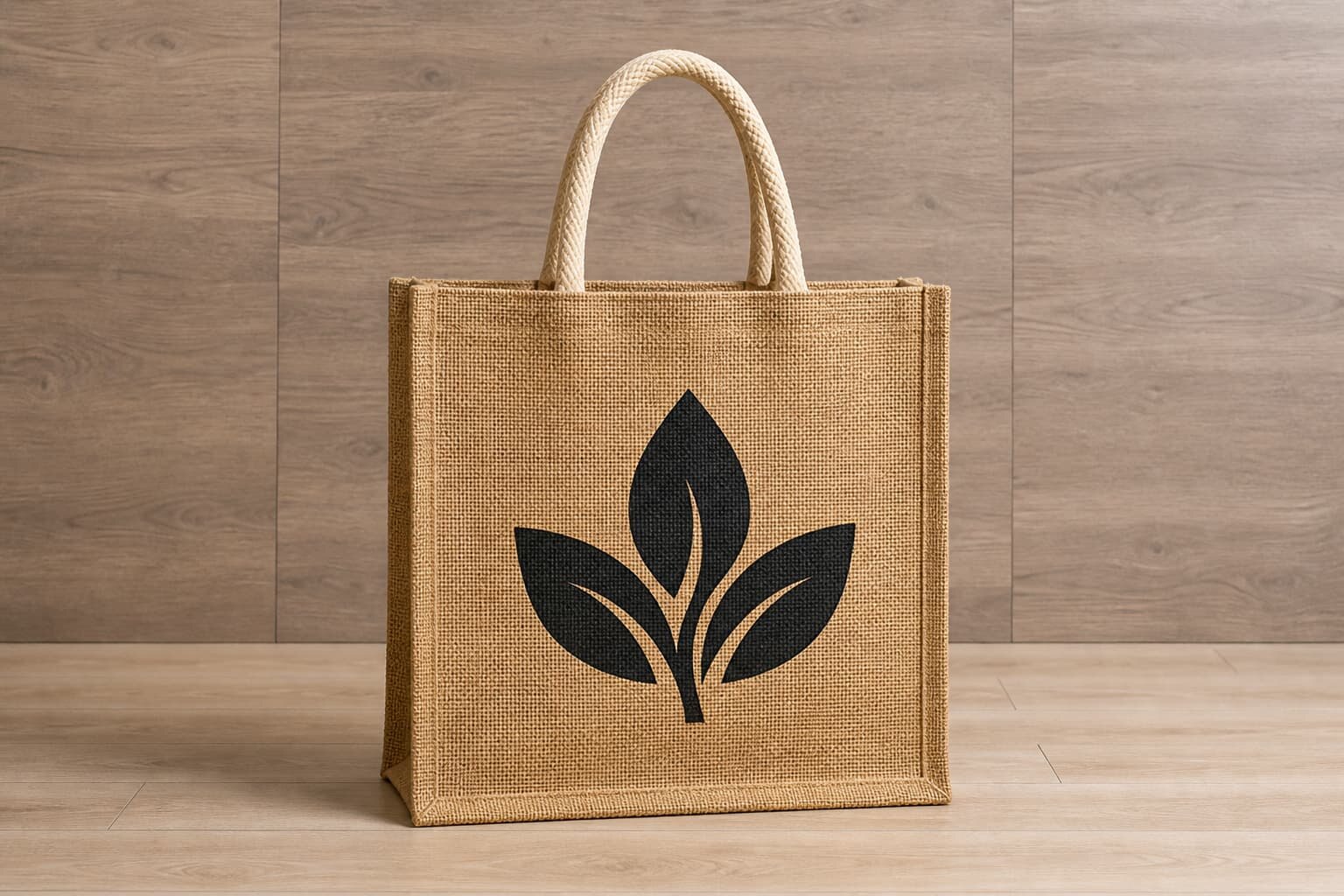
Why the logo proof matters more on jute than on cotton
A jute bag custom logo print proof is not just a design approval. It is a production risk check. Jute has thick yarns, slubs, color variation, and an uneven surface. A logo that looks sharp on a PDF or cotton tote can look broken, darker, lighter, or slightly wavy on jute. If the buyer approves only a digital layout, the first real proof may be the bulk shipment, which is too late for a clean correction.
For procurement teams, the proof should answer four commercial questions before the purchase order moves to mass production: can the supplier reproduce the artwork, can the chosen jute quality support the print, can the placement be held in production, and can the packing protect the printed surface during export? Treat the proof as a control document, not a marketing preview.
- Use the proof to confirm actual print behavior on the selected jute fabric.
- Separate natural jute texture variation from avoidable printing defects.
- Record the approved artwork file, logo size, color reference, and placement tolerance.
- Do not approve bulk production from a screen photo unless the order is low risk and repeat proven.
Start with the bag specification before artwork approval
Logo approval cannot be isolated from the bag specification. A 220 GSM loose-weave jute shopping bag and a 320 GSM laminated jute retail tote will not print the same. Lamination gives a more stable print surface but may change ink adhesion and curing requirements. Unlaminated jute gives a natural feel but absorbs ink unevenly. If the supplier prepares a logo proof on a substitute base, the approval has limited value.
Before reviewing logo position, lock the core bag construction: size, gusset, panel shape, handle type, lining, lamination, binding, seam allowance, and expected carrying weight. A small change in gusset or handle attachment can move the visual center of the front panel. This is why many logo placement disputes are really bag construction disputes.
- Common promotional jute bag range: about 220-260 GSM for light campaigns and giveaways.
- Common retail jute tote range: about 260-320 GSM for better body and more stable printing.
- Heavy-duty or premium styles may use higher GSM, cotton canvas panels, padded handles, or inner lamination.
- Ask whether GSM is measured before lamination, after lamination, or as the full composite material.
Choose the print method based on artwork, not habit
Screen printing is usually the practical first option for jute bags with simple custom logos. It works well for solid marks, large text, one to three colors, and distributor branding. The screen mesh, ink viscosity, squeegee pressure, and curing time need adjustment because the fabric surface is rough. A supplier that prints cotton totes every day may still need a different setup for jute.
Other branding methods can be better for specific requirements. Heat transfer may help with multicolor artwork but can look too smooth or patch-like on natural jute. Embroidery is durable but can pull the weave and is not ideal for very small text. Woven labels, cotton labels, PU patches, and leather patches can give a cleaner brand presentation when the logo is too detailed for direct printing.
- Use screen print for solid logos, simple store names, event marks, and large repeat orders.
- Consider a sewn label if the logo has small text, color gradients, or very tight line details.
- Use embroidery carefully on reinforced areas, not on loose panels that may pucker.
- Avoid approving metallic or very glossy finishes without a packing and rub test.
Prepare artwork files that the factory can actually use
A clean proof starts with usable artwork. Send vector files such as AI, EPS, or production-ready PDF with fonts outlined. Include the exact logo width and height in millimeters, not only a proportional image. If the order includes several logo versions, give each file a clear name and connect it to the SKU, bag color, carton mark, and packing plan.
Low-resolution files create avoidable quotation and sampling delays. The factory may redraw the logo, but then someone must approve the redrawn version before printing. Procurement should not let this correction happen informally through chat screenshots. A small letter spacing change or missing registered mark can become a brand compliance issue in retail channels.
- Send vector artwork with outlined fonts and embedded or linked color references.
- List Pantone colors, but accept that jute base color changes the visual result.
- Provide minimum readable text height if the logo includes website, QR-like details, or taglines.
- Use revision control such as CTM-JUTE-LOGO-V03 rather than final-final file names.
Define color approval realistically for natural jute
Pantone references are useful, but they are not a guarantee that ink on jute will look identical to coated paper. Natural jute ranges from pale beige to golden brown, and each batch can shift. White ink may need heavier deposit to look visible. Black usually hides texture better, while light yellow, pale green, and thin red lines can lose clarity on the yarn surface.
For brand buyers, the safest method is to approve a physical print proof under consistent lighting and keep it as the production standard. If the order is a repeat program, ask the factory to keep a sealed reference sample and record ink mixing data. If several factories are quoting the same order, ask each supplier to state how they control jute shade and logo color, not just whether they can match Pantone.
- Approve an acceptable shade range for natural jute, especially for repeat orders.
- Use a drawdown or printed swatch only as a pre-check; the final decision should be on the actual bag material.
- For white logos, ask whether one pass or two passes are required for coverage.
- Avoid very fine reversed-out text in light ink unless the proof confirms readability.
Check placement with measurements, not visual opinions
Most logo approval arguments happen because the buyer says the logo looks too high or off-center, while the supplier says it followed the sample. Avoid this by defining placement numerically. Use distance from top edge, bottom edge, side seam, handle stitch box, or gusset fold. For a tote bag, the visual center of the front panel may differ from the flat fabric center after the side gusset is formed.
Ask the factory to mark the placement on the technical sheet and measure the pre-production sample. For jute wine bags, drawstring pouches, and box-bottom bags, the logo may distort when the product is filled. If the bag will be used with a bottle, gift box, or retail insert, approve the proof with the bag shaped as it will be used, not only lying flat.
- State logo size as printed width x height in millimeters.
- Define centerline or edge distance from fixed construction points.
- Set realistic tolerance, for example plus or minus several millimeters depending on bag size and print timing.
- Photograph the approved sample with ruler references for internal buying records.
Understand MOQ logic before requesting many logo versions
Custom jute bag MOQ is not only about cutting fabric. Logo printing creates setup time, screen making, ink mixing, test loss, and version control. One bag style with ten small distributor logos may be more complex than one large order with a single logo. If the buyer asks for many logo versions but expects one simple bulk price, the supplier may hide setup loss in the unit price or increase the MOQ later.
A practical sourcing approach is to group versions by same bag body, same fabric, same print method, and same logo size. If only the text changes, ask whether one screen can be adapted or whether each version needs a separate screen. For multi-country distributors, confirm inner packing and carton segregation early, because logo version mix-ups are expensive to sort after production.
- Separate bag body MOQ from logo version MOQ in the quote.
- Ask for screen charge or setup charge per logo version if applicable.
- Confirm whether sample cost is per artwork, per color, or per bag style.
- Use SKU-level packing lists when multiple logos ship in one container or one consolidated order.
Review the physical proof like an inspector
When the pre-production sample arrives, do not only check whether the logo looks attractive. Review it as a production standard. Measure the bag, weigh or verify fabric quality, inspect seams, check handle strength, and then inspect the printed logo. A print proof on a badly sewn sample should not be approved as the final standard unless the construction issues are separately corrected and recorded.
For logo quality, look at edge sharpness, color density, pinholes, ink bleeding, broken lines, registration between colors, skew, odor, drying, and ink transfer. Jute texture will create some natural irregularity, but the supplier should still avoid careless screen movement, dirty marks, heavy ink lumps, or obvious misalignment. If you reject a proof, describe the defect with measurements and photos, not just comments like make it better.
- Check the proof at normal viewing distance and close inspection distance.
- Rub the print with a clean dry cloth after curing to check loose pigment or smearing.
- Fold and handle the bag as a user would, especially around printed gusset areas.
- Compare all logo colors against the approved reference in the same light source.
Control lead time around proof approval
Logo proofing affects lead time because the factory cannot safely start bulk printing until approval is clear. A common delay is not printing itself but missing artwork, unclear Pantone references, buyer comments across several email threads, or late changes to logo size after screens are prepared. Procurement should build a simple approval calendar into the RFQ instead of assuming sample time is separate from production time.
For a new jute bag custom logo order, ask the supplier to split timing into artwork checking, material preparation, sample making, buyer review, bulk material booking, printing, sewing, packing, inspection, and export documentation. This makes the quote easier to compare. One supplier may quote a shorter production time because they have greige jute and handles in stock; another may need to weave, laminate, dye, or source special webbing.
- Ask for sample lead time after receipt of correct artwork, not after first inquiry.
- Confirm whether bulk fabric is reserved before proof approval or only after deposit and approval.
- Avoid changing logo size after screen making unless you accept extra time and cost.
- Set a decision deadline for buyer approval so shipment planning does not drift.
Pack printed jute bags to prevent damage in transit
A good print proof can still fail commercially if packing is wrong. Fresh ink, large dark logo areas, laminated surfaces, and tightly compressed cartons can create offset marks, sticking, creases, or pressure shine. Jute bags are often packed flat to save volume, but flat packing must not press handles, buckles, drawstrings, or rough seams into the logo area.
Ask the factory how long printed panels cure before stacking and whether interleaving paper is needed for large or sensitive prints. For retail buyers, specify individual polybags, kraft sleeves, hangtags, barcode labels, or carton assortment rules before the final quote. Packing affects labor, carton size, chargeable weight, inspection access, and warehouse handling, so it belongs in the logo proof discussion.
- Check whether the approved sample includes the final folding method.
- Ask for carton drop and compression awareness if logo faces are tightly packed.
- Use interleaving only when needed; it adds cost and waste but can prevent offset.
- Confirm carton marks connect to logo version, SKU, color, and quantity.
Specification comparison for buyers
| Spec decision | Recommended option | When it fits | Buyer risk to check |
|---|---|---|---|
| Jute fabric weight | 260-320 GSM laminated or unlaminated jute | Retail gift bags, promotional totes, wine bags, and medium-load shopping bags | Low GSM may distort during sewing and make logo edges look uneven on rough yarns |
| Logo print method | Screen print with adjusted ink deposit | Most one to three color logos, solid marks, retailer names, event graphics | Fine lines can fill in; ask for print proof on actual jute, not paper or cotton |
| Logo color approval | Pantone reference plus physical print tolerance | Brand-controlled orders where logo shade must stay close across repeats | Jute base color changes perceived color, especially white, beige, yellow, and light green |
| Artwork format | Vector AI, PDF, or EPS with outlined fonts | Clean logos, text, icons, and line graphics | Low resolution PNG/JPG causes jagged edges and unclear proof responsibility |
| Proof stage | Pre-production sample using confirmed fabric and handle material | New logo, new supplier, retail packaging, or strict brand approval | Digital proof alone cannot confirm ink absorption, texture breaks, or print placement |
| Logo position tolerance | Center point and edge distance marked on technical sheet | Front panel logos, side gusset marks, bottle bag logos, and private label panels | Bag panels shrink and shift after sewing; placement tolerance must be agreed before production |
| MOQ planning | Group same fabric and same print method where possible | Multiple store names or distributor logos under one master order | Too many small logo versions increase screen charges, setup loss, and packing errors |
| Packing method | Flat pack with interleaving for fresh print when needed | Large logo areas, dark ink, laminated jute, or export cartons with tight loading | Ink offset, creasing, and handle marks can appear if bags are packed before curing |
Buyer checklist before sampling
- Confirm bag type, dimensions, gusset, handle material, jute GSM, lamination, lining, and load requirement before discussing the logo proof.
- Send vector artwork with Pantone references, actual print size, logo placement diagram, and any minimum clear space rules.
- Ask the factory to print the proof on the same jute quality planned for bulk production, not on substitute fabric.
- Check whether the logo uses fine text, small gaps, gradients, distressed effects, or light colors that may not reproduce cleanly on jute.
- Approve color by physical sample or agreed tolerance, because natural jute shade affects the final visual result.
- Measure logo width, height, distance from top edge, distance from side seam, and alignment to bag center during sample review.
- Rub the printed area after curing and check for cracking, smudging, ink dust, or weak adhesion on laminated and unlaminated surfaces.
- Confirm whether the print is made before or after sewing, because this affects placement accuracy, seam coverage, and setup cost.
- Request packaging approval if the logo has a large ink area, dark ink, metallic ink, or a finish that may transfer during carton loading.
- Keep the signed sample, proof photo, artwork file name, Pantone number, and production spec together as the approval standard.
Factory quote questions to send
- Which jute GSM and yarn quality are included in your quote, and is the sample made from the same batch or equivalent bulk material?
- Is the logo quoted as screen print, heat transfer, embroidery, woven label, leather patch, or another method, and why do you recommend it for this artwork?
- How many colors are counted in the logo, and are there separate screen charges, setup fees, or minimum print run charges?
- Can you produce a physical logo proof on actual jute before bulk production, and what is the sample lead time?
- What file format do you need for production, and will your team redraw low-resolution artwork if needed?
- What Pantone tolerance or visual approval method do you use for printing on natural jute?
- Will the print be applied before sewing or after sewing, and what placement tolerance can you hold in bulk production?
- How will you prevent ink transfer, creasing, and handle marks during packing and export carton compression?
- What is the production lead time after proof approval, and what artwork or material issues could extend it?
- What inspection standard will you use for logo defects, including misregistration, stains, broken print, skewed placement, and color variation?
Quality-control points to confirm
- Artwork file matches the approved version name and revision number.
- Bulk fabric GSM, lamination, color tone, and weave match the approved sample within agreed tolerance.
- Logo size and placement are measured against the technical sheet, not judged by eye only.
- Ink coverage is even enough for jute texture and does not leave unacceptable pinholes or heavy build-up.
- Logo color is compared under consistent lighting against approved sample or Pantone target.
- Print edges, small text, and registration are checked on the first-off production pieces before mass printing continues.
- Printed panels are cured or dried before stacking, sewing, or packing.
- Packed bags show no ink transfer, sticking, odor issue, or carton pressure damage after normal handling.
- Random inspection includes cartons from different production times, not only the top cartons prepared for review.
- Defect classification is agreed for critical logo errors, major visible defects, and minor natural jute variation.