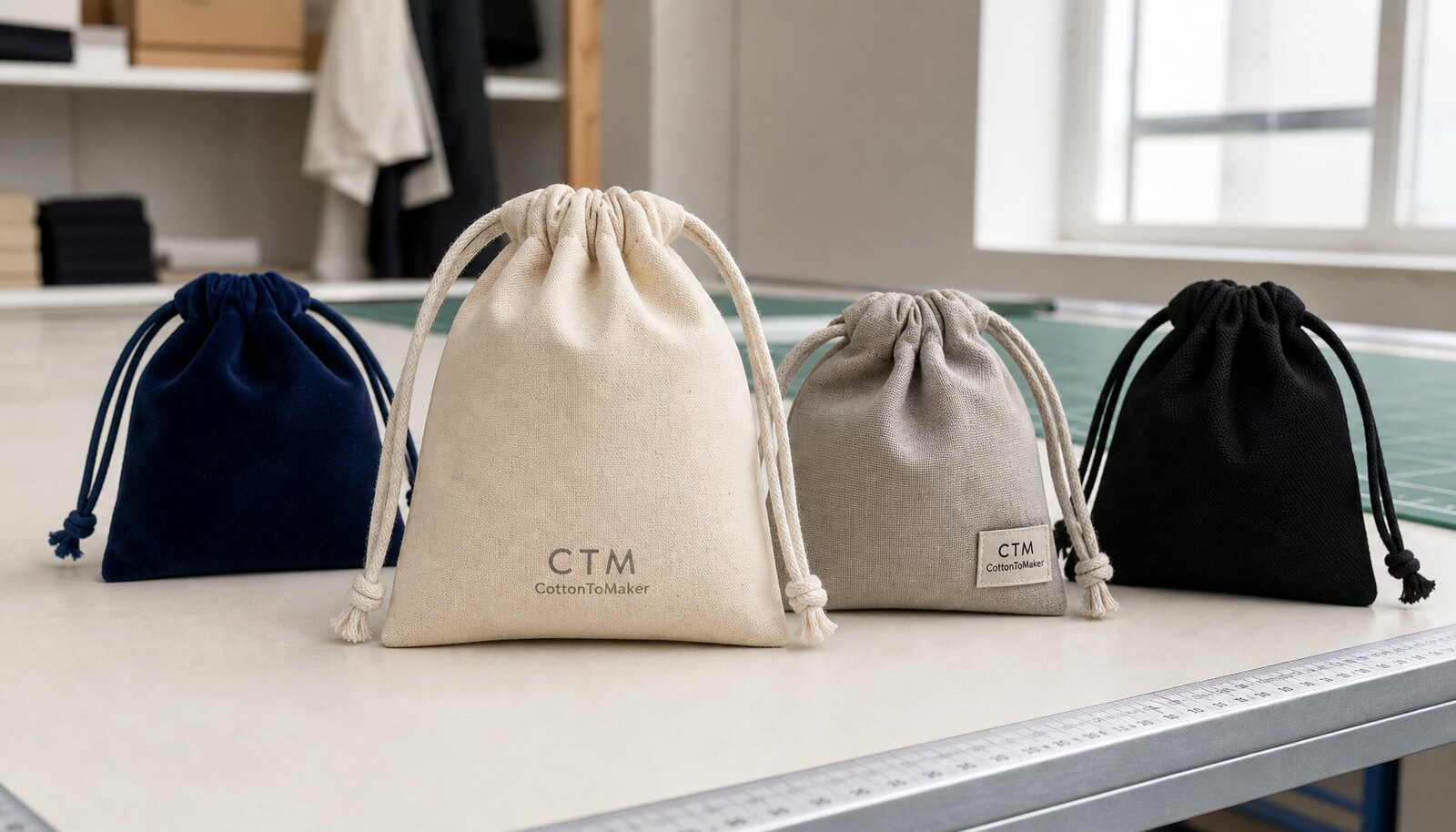
Why Jewelry Pouches Fail in Ecommerce
Jewelry drawstring pouches look like a low-risk accessory, but ecommerce makes them sensitive to small spec errors. The pouch has to do three jobs at once: protect delicate items, present well in product photos, and arrive looking clean after long transit through warehouses, parcel networks, and customer returns. If the fabric feels thin, the closure snags, or the logo print looks weak, the pouch stops helping the product and starts hurting the brand.
The biggest sourcing mistake is treating the pouch as a generic packaging line item. Buyers often focus only on the outside size and logo, then discover the inner volume is too tight for multi-piece sets, the drawstring opens unevenly, or the fabric picks up dust in transit. For ecommerce, the right spec is the one that survives repeated touch, sortation, and unboxing while still matching the jewelry tier you sell.
- For rings or stud sets, the pouch can be smaller and softer; for necklaces and multi-item sets, the opening and depth matter more than the flat face size.
- If the pouch appears in the listing image, the finish quality must be consistent enough to support close-up photography.
- Returns often start with presentation defects, not functional failure, so appearance tolerance matters more than many buyers expect.
Start With the Product, Not the Pouch
A useful RFQ starts by describing what the pouch must hold. A small velvet pouch for one ring has a very different structure from a cotton pouch carrying a bracelet set, cleaning cloth, and insert card. Measure the product stack with the actual carton or jewelry tray inside it, because a pouch that fits the jewelry alone may become useless once the retail presentation is added.
Use finished dimensions, not cut size assumptions. State the target flat width, length, and opening allowance, then define how much extra volume the buyer needs at the mouth after the cord is tightened. For ecommerce, it is usually better to allow a little depth and a more generous opening than to chase a tight aesthetic that makes packing harder.
- Write the spec as finished size plus usable opening, for example a pouch that can accept a flat jewelry card or small box insert.
- If the pouch is meant to hold multiple items, define the maximum combined thickness the pouch must close around.
- For subscription or gift sets, verify that the pouch still works after the jewelry is inserted with tissue, tag, or polish cloth.
Fabric and GSM Drive the Real Handfeel
For jewelry drawstring pouches, fabric choice is the main quality signal. Cotton and muslin are the common entry option because they are easy to source, easy to print, and usually cost-controlled. A practical range for light ecommerce use is often around 100 to 140 GSM, while a more substantial feel may sit higher depending on weave and finish. Very light fabric can look weak under lighting, and too heavy a cloth can make a small pouch feel stiff or oversized.
Velvet, microfiber, and suede-like materials move the pouch into a different buyer expectation. These fabrics can improve perceived value, especially for giftable or premium jewelry, but they also need better color control and more careful lint management. If the color is dark and the pile is long, the supplier should show how the fabric behaves after brushing, folding, and packing. A pouch that looks rich in sample photos but sheds lint onto the jewelry will create more problems than it solves.
- Cotton or muslin: best for breathable, simple, natural-brand presentation and lower-risk printing.
- Velvet or microfiber: better for premium presentation but more sensitive to shade, pile direction, and dust.
- If the jewelry can scratch easily, ask whether the inside face needs a smoother finish or a partial lining.
Closure Design and Branding Method Matter More Than Buyers Expect
The drawstring channel is not a minor detail. If the channel is too narrow or the cord is too thick, the pouch will bunch unevenly and slow down packing. If the cord is too thin, it may look cheap and feel unreliable. Buyers should ask the factory to show the exact cord diameter, tip finish, and locking behavior under repeated opening and closing, because this is where daily ecommerce handling exposes weaknesses first.
Decoration choice should match the fabric and order size. Screen print and heat transfer can work well on cotton when the artwork is simple and the line weight is strong enough, while woven labels or sewn labels give a more durable brand mark for frequent handling. Embossing and debossing are more relevant on synthetic or suede-like surfaces, but they need clear approval on the actual pouch surface, not just a sample patch. Small logos and fine text often fail when they are scaled down for a pouch face, so the artwork should be reviewed at real size before production.
- Print method should be chosen by fabric and logo detail, not only by unit cost.
- Tiny text, thin rules, and complex gradients are weak choices for small pouch branding.
- A sewn label can outperform print when the pouch will be handled often or resold through multiple channels.
Compare Supplier Routes Before You Compare Unit Price
For jewelry drawstring pouches, the cheapest quote is often the least useful if it does not match your commercial route. A direct factory can usually control the pouch spec better, but it may require higher MOQs or longer sample cycles. A trading company may make the buying process easier when you need mixed items, but it can obscure the real material source and make defect resolution slower. Stock suppliers can win on speed, yet they limit custom sizing and brand consistency.
The right comparison is about how the supplier fits your launch plan. If you are testing a new jewelry line, stock pouches with a logo add-on may be enough. If the pouch is a core part of the brand experience, the factory route gives better control over fabric weight, closure feel, and carton packing. Use the table below to compare routes on the criteria that affect ecommerce execution, not on generic sales language.
Supplier Route Comparison for Ecommerce Pouches
When you compare sourcing routes, focus on what the supplier can prove in sample stage and what they can repeat in bulk. A quote that looks lower on paper can become expensive if the factory cannot hold color consistency, if the print alignment drifts, or if the packing method creates warehouse rework. Buyers should ask for at least one finished sample from the same fabric and decoration method proposed for the order.
The most useful quote data is the kind that removes ambiguity: finished size, fabric GSM, cord type, print method, carton count, inner packing, and lead time after sample approval. If two suppliers quote the same nominal pouch size but one uses a softer 120 GSM cotton and the other uses a thinner 90 GSM cloth, the unit prices are not directly comparable. A clean RFQ makes those differences visible before the negotiation starts.
What to Put in the RFQ So Quotes Are Comparable
A good RFQ should force every supplier to quote the same commercial object. Include finished dimensions, target fabric, GSM or fabric weight, inside finish, cord type, decoration method, logo size, packing method, carton configuration, and shipping term. If you need multiple colors or pouch sizes, break them into separate line items so the supplier cannot hide differences inside one blended quote.
For ecommerce, packing terms often change the true cost more than the pouch itself. A pouch that is loose-packed may be cheaper at source but slower to count and scan in your warehouse. A pouch packed in a single polybag with the SKU printed on the label may improve fulfillment speed and reduce errors. That matters when the pouch is sold as a standalone accessory or included in mixed jewelry sets.
- State whether artwork is one-color print, multi-color print, woven label, or sewn label.
- Include whether you want a sample seal, barcode sticker, care card, or master carton label.
- Ask the supplier to quote separately for tooling, screen setup, and any custom tags.
Sample Approval Is the Cheapest Quality Control You Will Buy
The sample stage should answer more than whether the pouch looks good. A good approval sample proves the fabric feel, print registration, cord movement, seam strength, and finished size at the same time. Buyers should inspect a sample by opening and closing it several times, loading it with the actual jewelry item or a representative weight, and checking whether the mouth holds shape after the cord is drawn tight.
Do not approve only from photos if the pouch will carry your logo in the listing image. Request images of the actual sample laid flat, opened, and stuffed. If the pouch has a label or print on a seam area, verify that the logo remains readable after the pouch is gathered. Fine artwork can distort badly when the fabric tension changes, so the approved sample should reflect the exact production method rather than a close substitute.
- Check seam straightness, loose threads, and whether the drawstring exits evenly from both sides.
- Confirm the approved sample is marked and retained as the production reference.
- If the supplier changes fabric lot or cord supplier, require a fresh pre-production sample or at least updated photos.
QC Thresholds That Actually Catch Real Problems
Most pouch defects are visible without lab equipment, which makes warehouse-ready QC straightforward if the acceptance standard is written clearly. Focus on measurable visual and functional defects: holes, stains, broken stitches, loose cords, uneven hems, print misplacement, and color mismatch. For small pouches, a minor flaw that would be acceptable on a larger bag becomes obvious immediately, especially in close-up ecommerce photography.
A practical quality standard should separate critical defects from cosmetic variation. A pouch that cannot close, sheds lint onto jewelry, or has a torn channel is a reject. Slight shade variation within a defined range may be acceptable if the full batch stays visually consistent. Put the threshold in writing before bulk production starts, because small accessories often suffer from vague acceptance language that creates disputes later.
- Reject any pouch with a broken cord channel, hole, stain, or loose seam that affects function.
- Set a visual tolerance for logo placement so print drift does not become a batch dispute.
- Inspect random samples from each carton, not only the top layer of the shipment.
Packing, Cartons, and Fulfillment Reality
Packing is where many jewelry pouch orders become operationally expensive. If the supplier bulk-packs mixed colors without clear segregation, your warehouse team will spend time counting, sorting, and relabeling. If the pouches are placed loose in cartons, they may arrive creased or dusty. If the inner polybag is too tight, the fabric can hold fold marks that show on listing photos. The best packing method depends on whether the pouch is sold alone, included with jewelry, or shipped as part of a gift set.
Ask for a packing structure that matches your fulfillment flow. For direct-to-consumer ecommerce, individual polybags with SKU labels often make receiving and picking easier. For larger wholesale orders, carton-level sorting by color and size may be enough. The supplier should also confirm carton dimensions and gross weight, because these affect freight cost and storage efficiency. The wrong carton size can make the landed cost worse even when the ex-factory unit price looks strong.
- Use separate pack instructions for DTC, wholesale, and kit-insertion programs.
- Require carton markings that show SKU, quantity, color, and pack count clearly.
- Avoid packing methods that leave permanent fold lines on premium velvet or brushed fabrics.
Specification comparison for buyers
| Spec decision | Recommended option | When it fits | Buyer risk to check |
|---|---|---|---|
| Direct factory sourcing | Best for custom size, custom fabric, and repeat programs | You need control over GSM, logo placement, lining, and packing | Longer development if the supplier does not already run small pouch patterns |
| Trading company sourcing | Useful when you need mixed SKUs or low internal sourcing capacity | You want one contact to coordinate pouch, insert card, and outer carton | Margin stacking can hide the actual factory spec and weaken QC visibility |
| Stock pouch with logo add-on | Fastest route for early-stage ecommerce launches | You need a quick test of market response before committing to tooling or new patterns | Stock fabric, cord color, and pouch size may not match the brand image exactly |
| Fully custom cut-and-sew | Best for brand owners with stable demand and clear packaging standards | You need a specific shape, logo treatment, or premium hand-feel | Higher MOQ and more sample rounds if construction details are not locked |
| Cotton or muslin fabric | Simple, breathable, cost-controlled option for lightweight jewelry sets | You want a clean natural look with flexible decoration methods | Too-light fabric can show through, wrinkle badly, or feel weak after repeated use |
| Velvet or microfiber fabric | Better for giftable presentation and higher perceived value | You sell premium jewelry, kits, or seasonal gift sets | Loose pile, color rub, and lint transfer can cause complaints if the mill quality is weak |
| Printed branding | Best when the pouch is part of the ecommerce unboxing experience | Your logo needs to be visible in photos and on arrival | Ink cracking, off-center print, and small text fill-in are common on soft fabrics |
| Woven label or sewn label | Best for a cleaner, more durable brand mark | You want a low-failure decoration that survives handling and transit | Label size and stitch placement can distort a small pouch face if not approved on sample |
| Bulk packed by size/color | Best for warehouse picking and multipack ecommerce fulfillment | You sell several SKU variants and need easy carton identification | Mixed counts or weak carton labels create packing errors at the fulfillment center |
Buyer checklist before sampling
- Confirm finished pouch size, usable opening, and whether the jewelry piece must fit flat or in a box insert.
- Lock fabric type and GSM, including face fabric, lining, and any reinforcement at the drawstring channel.
- Approve the branding method on the exact pouch size, not only on a larger sample panel.
- Define acceptable shade range for pouch color, cord color, and print color across the full order.
- Specify how each pouch should be packed: loose, nested, polybagged, paired, or boxed.
- Set carton count, carton dimensions, and outer label format before production starts.
- Request pre-production sample photos from the actual batch fabric and cord, not library samples.
- Write down the AQL or visual defect threshold for stains, holes, broken cords, and print misalignment.
- Confirm the factory’s production lead time and whether sample approval pauses the clock.
- Align the quote on incoterm, accessory inclusions, and whether packing labor is part of the unit price.
Factory quote questions to send
- What is the finished pouch size, fabric GSM, and lining spec you are quoting for each SKU?
- Does the quote include cord, cord ends, labels, printing, and individual packing, or are any of these extra?
- What is the MOQ by size and by color if we use the same fabric but different logo art?
- What print or decoration method do you recommend for our logo, and what are the durability limits on that method?
- Can you share pre-production sample photos from current material, including close-ups of stitching and drawstring channel construction?
- What is the expected lead time after sample approval, and how does it change if we place multiple colorways?
- How do you pack the pouches for export, and what carton count do you recommend for ecommerce fulfillment?
- Which defects do you sort out during inline inspection, and what is your replacement or rework policy for rejected goods?
Quality-control points to confirm
- Finished size tolerance should stay within the approved range so the pouch still closes properly around the product.
- Drawstring pull test should confirm smooth movement, no snags, and no cord slippage at the channel opening.
- Stitch density and seam lock should hold the side seams, bottom seam, and channel seam without skipped stitches.
- Print placement should remain centered and legible, with no bleeding, cracking, or severe shade shift across the batch.
- Fabric should be checked for holes, oil stains, thick slubs, loose weave, and visible contamination before packing.
- Cord ends, knots, or tips should be secure so they do not fray during ecommerce handling.
- Polybag or carton packing should keep the pouches clean, dry, and size-sorted for warehouse intake.
- Outer cartons should carry the right SKU, color, quantity, and carton count so mix-ups are visible before dispatch.