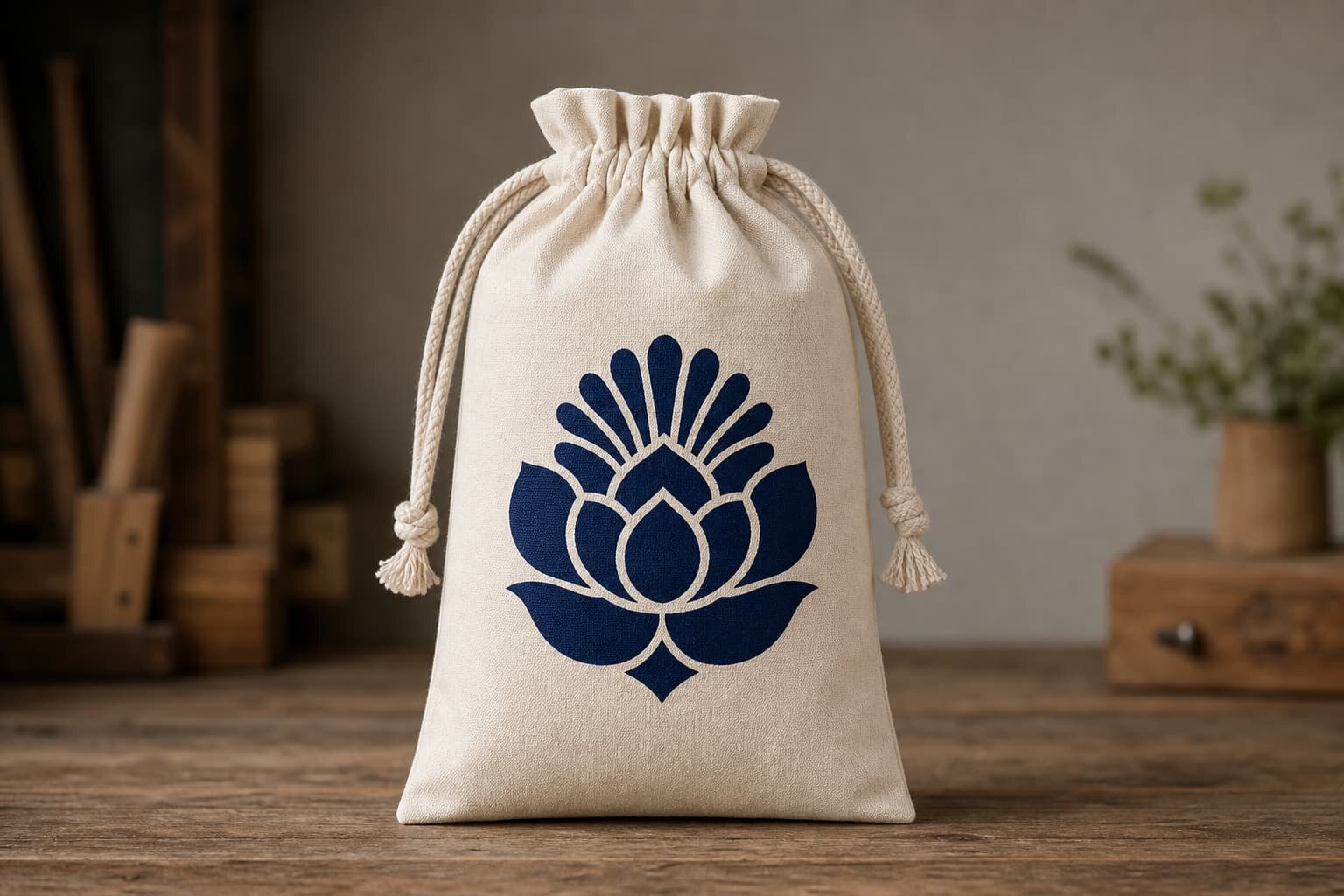
Start With the Quote Scope, Not the Unit Price
A jewelry drawstring pouch quote is only useful when it describes the same product across suppliers. A line that says only 'cotton pouch' is not a specification; it is a loose category. Procurement teams need the quote to tie together size, fabric, closure, decoration, and packing so that every supplier is pricing the same build. If those details are missing, one factory may quote a plain stock pouch while another prices a lined branded version, and the numbers become impossible to compare.
For jewelry packaging, the quote should also show what the pouch is expected to do. Is it a retail presentation pouch, a scratch-protection sleeve, or an e-commerce insert that sits inside a box? Each use case changes the fabric, seam finish, and decoration tolerance. Ask the factory to state assumptions in writing. If they are assuming stock color, no lining, and one-color print, you want that visible before you compare the number.
- Body size and opening width
- Fabric composition and GSM
- Drawstring type and tip finish
- Logo method and placement
- Packing format and carton spec
Define the Jewelry Use Case Before Sizing the Pouch
A pouch for earrings is not the same as a pouch for a necklace set or a bracelet gift box. Small items can sit in a thinner pouch, but premium sets usually need more structure so the pouch feels intentional when opened. If the pouch is only meant to be a dust cover, you can save cost with lighter fabric and simpler sewing. If it has to support retail shelf appeal, the fabric weight, label type, and cord quality matter as much as the print.
Write the use case into the RFQ instead of letting the factory guess. Say whether the pouch holds one item, a set, or an accessory bundle; whether it will be reused by the end customer; and whether it must protect against scratching, dust, or rubbing against a hard box. That one note helps factories recommend the right construction instead of defaulting to their cheapest format.
- Single piece, set pouch, or gift add-on
- Flat pouch or gusseted pouch
- Presentation first or protection first
Choose Fabric and Build to Match the Jewelry
On jewelry pouches, the fabric decision is not only a style question; it is the biggest cost and quality driver. Light organza around 35-50 gsm gives a delicate look, but it offers little surface protection and can fray if the seam and drawstring channel are weak. Cotton or muslin in the 120-180 gsm range is usually easier to quote, easy to brand, and more forgiving in sewing. Velvet and microfiber suede are the premium end of the range; for pile fabrics, ask for base fabric weight and pile density because GSM alone does not tell the full story.
Construction can move the quote almost as much as fabric. A single-layer pouch with overlocked seams is fast to make, but it may look cheap and can irritate fine jewelry if the inside edges are rough. A turned seam or lined pouch costs more, yet it hides raw edges, holds shape better, and reduces lint transfer. If the jewelry is delicate or plated, the safe route is usually a softer interior, a smooth seam, and a cord channel that does not expose hard stitch ends.
- Ask for fabric width and consumption per piece
- Ask if material is stock-dyed or custom dyed
- Ask if seams are overlocked, turned, or bound
Pick the Decoration Method That Will Survive Use
Decoration method changes both the quote and the reject rate. Screen print is usually the simplest choice for cotton or other smoother fabrics when you want one or two spot colors and a clean front logo. A woven side label works well when the brand mark needs to stay readable after repeated handling. Embroidery or stitched patches can look premium, but they add thread volume and can pucker lighter fabrics. Heat transfer is useful for short runs or detailed graphics, but it should be tested on the exact fabric because texture, pile, and rubbing change how long it lasts.
Ask for art size, placement, color count, and the exact method the factory plans to use. A logo that looks sharp on paper can disappear on velvet or bleed on open-weave cotton. That is why a print proof on actual fabric matters more than a PDF on a screen. If the pouch is meant to sit inside a jewelry box, a small woven label or a neat one-color print often gives better long-term branding than a large graphic that costs more and ages badly.
- Screen print: best for simple spot-color branding on smoother fabrics
- Woven label: better for permanent branding and repeated handling
- Embroidery or stitched patch: premium look, but test for puckering
- Heat transfer: useful for short runs, but verify abrasion resistance
- Print proof on actual fabric, not just on paper or screen
Know How MOQ Changes by Fabric, Color, and Artwork
MOQ is rarely about the pouch count alone. Factories usually price around fabric roll usage, color change, print setup, and sewing line changeover. That means one pouch style can carry different MOQs depending on whether the order uses stock fabric, custom-dyed fabric, multiple logo colors, or special labels. If a quote looks cheap but the MOQ is high, the factory may be spreading setup cost across a larger run. If the MOQ is low, you should check whether the price includes more assumptions or more compromises.
The smartest way to reduce MOQ without damaging the product is to standardize the parts that cost the most to change. Keep one body fabric, one closure type, and one sewing pattern where possible, then vary the logo or side label only. Ask the factory to show one-time setup charges separately from recurring unit cost. That lets procurement see whether the order is truly cheaper or simply shifted into hidden fees.
- Ask if MOQ applies per style, per color, or per artwork
- Ask whether custom dye changes the MOQ differently from print only
- Ask for separate setup fees for screens, labels, and packaging
- Ask if reruns keep the same tooling or require fresh setup
Make Samples Prove the Real Production Spec
The sample stage should prove more than color. A useful sample checks size, handfeel, seam balance, drawstring movement, logo legibility, and whether the pouch protects jewelry surfaces from rubbing. Ask for a pre-production sample made from production material, not a showroom sample that uses a different fabric or a faster decoration method. If the sample is not close to the final build, the production quote is not really comparable.
A good sample set usually includes a blank construction sample, a decorated sample, and the final pre-production sample with the real cord, label, and packing method. If the quote includes special stitching, metal tips, a woven side label, or an inner lining, the sample should show all of those items together. That is the easiest way to catch a mismatch before the order moves into bulk cutting.
- Check the body size and opening after sewing, not only on the pattern sheet
- Check the drawstring pull strength and whether the channel twists
- Check the logo or label on the exact fabric texture
- Check that the sample includes the same cord, tips, and packing as the quote
Do Not Ignore Packing, Cartons, and Barcode Data
Many quote mistakes live in packing. Small jewelry pouches can be bulk packed, packed in individual polybags, placed in inner boxes, or assembled into retail-ready cartons, and each option changes labor, material, and freight cube. Buyers often focus on the pouch itself and forget that folding style, tissue, sticker labels, and how many pieces fit in a master carton can shift the landed cost more than they expect.
Ask the factory to quote packing the same way your warehouse receives it. If you need one barcode per inner pack, say so. If the pouch must arrive folded a certain way to avoid wrinkles, include that instruction. A compact pouch with clean packing can be cheaper in freight even if the factory unit price is slightly higher, so carton dimensions and pack count should be treated as part of the product, not as an afterthought.
- Inner pack format and count per polybag or box
- Master carton dimensions, gross weight target, and carton count
- Barcode, SKU label, or size sticker requirements
- Any tissue, insert card, silica gel, or retail hangtag needs
Break Lead Time Into Steps You Can Actually Manage
Lead time is not a single number. It is a chain of steps: sample approval, material sourcing, print setup, cutting, sewing, inspection, and packing. If a factory gives only one date, you still do not know where the risk sits. Jewelry pouch orders with custom dye, woven labels, or special cords usually need more upstream control than blank stock pouches, because each added detail can become a separate waiting point.
Ask the factory which steps are on the critical path and which can run in parallel. The right answer should tell you when fabric is booked, when artwork is approved, when the first article is checked, and when final inspection happens. If the factory cannot explain where delay is most likely to occur, they probably have not planned the order deeply enough for a procurement team to trust the date.
- Ask what starts the lead-time clock: PO, deposit, artwork approval, or sample sign-off
- Ask whether material booking happens before or after sample approval
- Ask which steps can overlap and which steps cannot
- Ask what happens if you change print or packing after approval
Compare Factory Quotes on the Same Sheet
The cleanest way to compare quotes is to build one sheet with matching columns for fabric, GSM, lining, cord, decoration, label, packing, sample fee, setup fee, MOQ, lead time, and tolerance. One quote may look cheaper because it omits the lining, quotes a thinner cord, or assumes a simpler packing method. When the data is normalized, the real gap between suppliers usually becomes obvious very quickly.
When quotes differ, ask what is assumed rather than included. The strongest supplier quote is the one that lists its assumptions in writing, because it lets procurement decide where to save and where not to save. You may choose to trim packaging, switch to stock fabric, or reduce print colors, but you should make those tradeoffs on purpose. Never let a quote decide them quietly for you.
- Compare unit price only after fabric, print, and packing are aligned
- Check whether sample cost and tooling are included or separate
- Watch for hidden upgrades such as a better cord, lining, or label
- Require clear tolerances for size, print placement, and sewing appearance
Send a Sharper RFQ and Force Better Answers
A sharper RFQ gets a sharper quote. Send one spec sheet with the pouch size, target jewelry use case, fabric direction, decoration method, quantity by SKU or color, packing requirement, and a reference image or sample photo. If possible, include an approved sample or at least a clear note on what must stay the same and what can change. That keeps every supplier quoting against the same target instead of filling in the blanks with their own habits.
It also helps to ask for two options on the same sheet: one that matches the exact spec, and one that keeps the look but trims cost. That gives procurement a true choice. For jewelry drawstring pouches, the usual cost levers are fabric weight, decoration method, lining, cord finish, and packing format. If the supplier cannot offer a meaningful alternate spec, they probably have not studied the product closely enough.
- Send a dimensioned drawing or measured sample
- Attach the artwork file and note the logo size and placement
- State the quantity split by size, color, or artwork version
- Ask for a standard quote and a lower-cost alternate quote
- Require all exclusions and assumptions to be listed in the reply
Specification comparison for buyers
| Spec decision | Recommended option | When it fits | Buyer risk to check |
|---|---|---|---|
| Main fabric | Cotton or muslin at about 120-180 gsm | Everyday retail inserts, branded giveaways, and orders that need a clean natural look | Ask whether the fabric is tightly woven enough to avoid lint, and check shrinkage after pressing or washing |
| Premium fabric | Velvet or microfiber suede with a soft interior finish | Gift sets, higher-value jewelry, and packaging that must feel more premium in hand | Ask for base fabric weight and pile density, because GSM alone does not fully describe pile fabrics |
| Sheer option | Organza around 35-50 gsm | Lightweight pieces, layered gift presentation, and low-cost promotional packaging | Check seam fray, transparency, and whether the pouch still protects delicate plating or stones |
| Closure system | Self-fabric channel with cotton cord and reinforced exits | Orders that need simple sewing and reliable day-to-day opening and closing | Check for cord slippage, uneven pull length, and stress at the channel ends |
| Decoration method | Woven side label or one-color screen print | Branding that must stay readable after handling and repeated use | Check print edge sharpness, label irritation, and whether the decoration method matches the fabric texture |
| Packing format | Bulk inner pack with clear size label and consistent carton count | Higher-volume distribution and orders that will be repacked downstream | Check mixed-size risk, pack count accuracy, and whether carton dimensions match your freight plan |
Buyer checklist before sampling
- Confirm the pouch use case: retail presentation, dust protection, e-commerce insert, or gift add-on.
- Lock the body size, opening width, and drawstring length before asking for pricing.
- State the fabric composition, fabric weight or GSM, and whether the fabric is stock or custom dyed.
- Choose the decoration method, logo size, print colors, and exact placement.
- Specify lining, seam style, cord material, cord tip finish, and any label or patch requirement.
- Define the packing method, inner pack count, carton dimensions, and barcode or sticker needs.
- Request a pre-production sample made from the actual production materials and print method.
- Ask the factory to separate unit price, setup cost, sample cost, packing cost, and any exclusions.
Factory quote questions to send
- What exactly is included in the quoted unit price, and what is excluded?
- Is the MOQ per style, per size, per color, or per artwork version?
- What fabric composition, fabric weight, and fabric width are you quoting?
- Which decoration method will you use, how many colors are included, and where will the logo sit?
- Are lining, reinforced seams, cord tips, labels, and any special stitching included in the quote?
- What sample types do you offer, and are sample fees credited back on production orders?
- Can you break the lead time into material booking, sample approval, cutting, sewing, inspection, and packing?
- What are the accepted tolerances for size, print placement, and stitch appearance on this style?
- What is the quoted carton spec, pack count, and gross weight target for shipping?
- Can you quote one alternate version that lowers cost without changing the brand look too much?
Quality-control points to confirm
- Finished dimensions match the approved spec and stay within the agreed tolerance.
- Drawstrings run smoothly, sit evenly, and exit the channel without twisting or snagging.
- Logo placement, print sharpness, or woven label position matches the approved sample.
- Fabric surface is clean, with no holes, stains, shade jumps, or visible weaving defects.
- Seams are even, ends are secured, and there are no skipped stitches or weak stress points.
- The pouch opens and closes cleanly without exposing raw edges or rough interior seams.
- Packing count, inner pack labels, and outer carton marks match the approved packing sheet.
- Cartons are strong, closed correctly, and sized to avoid crushed corners or excess freight cube.