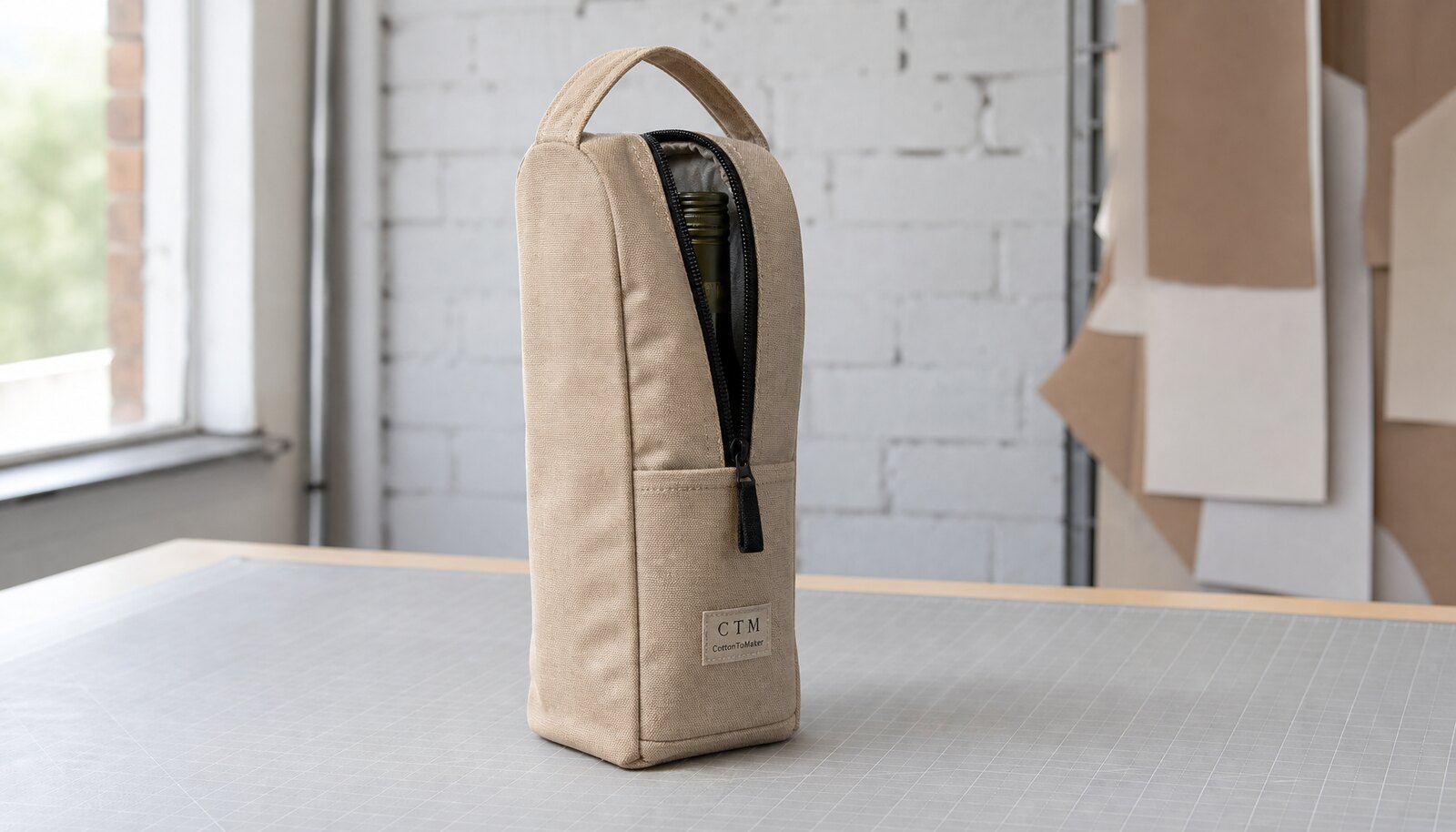
Why the spec matters before you discuss price
When buyers source insulated wine bags personalized, the real purchase is not a logo on a pouch. It is a soft-goods build that has to carry a bottle safely, hold a clean retail appearance, and pack efficiently without driving freight or return costs. If the spec is vague, every supplier will fill the gaps differently, and the lowest quote usually hides the most substitutions.
A procurement-ready brief should define the bottle, the use case, the construction, and the commercial envelope before anyone starts talking about artwork. A wine bag for seasonal gifting can tolerate a simpler structure than a retail SKU that sits on a shelf for months. A short-hold carry bag does not need the same wall thickness as a cooler tote, but it still needs enough structure to stay upright and present the brand properly.
The mistake to avoid is quoting by image. A product photo tells you almost nothing about fabric weight, foam thickness, zipper grade, or how much labor the assembly needs. Those four items often move price more than the logo itself, and they determine whether a replenishment order behaves like the sample you approved.
- Define the use case before you ask for a unit price.
- Treat the bag as a construction product, not just a print surface.
- Keep one approved spec sheet that ties the quote, sample, and QC record together.
Start with bottle fit, not artwork
The first technical question is simple: what bottle are you fitting? A standard 750 ml bottle is not the same as a Burgundy bottle, a sparkling bottle, or a larger format spirit bottle. The body diameter, shoulder shape, and neck height change the internal clearance you need, and the closure has to accommodate that geometry without pinching the top panel.
For buyer control, give the factory the bottle height, maximum diameter, and neck style in millimeters. If the bag must fit a bottle with a capsule, gift box sleeve, or insert card, say that up front. A bag that fits the bare bottle on a sample bench can fail once you add packaging or a thicker glass profile.
Finish dimensions should include tolerances. For smaller single-bottle bags, a target tolerance band of plus or minus 5 mm is a practical starting point. For larger or less rigid formats, plus or minus 8 mm may be more realistic. What matters is that you decide the tolerance before the first sample, because that becomes the basis for acceptance or rejection in bulk.
- List bottle height, diameter, shoulder shape, and neck clearance in the RFQ.
- State whether the bag must fit a capsule, sleeve, or gift insert.
- Set a dimensional tolerance before sampling, not after bulk production starts.
Material choices that actually move cost and performance
For insulated wine bags personalized, the outer layer usually comes down to stock polyester, canvas, or a specialty-look laminate. Polyester in the 300D to 600D range is the most common commercial choice because it prints well, folds neatly, and keeps sewing complexity under control. Canvas in the 10oz to 12oz range gives a more tactile, premium look, but it generally increases labor and can make the bag bulkier in carton pack.
The insulation stack matters more than many buyers expect. Ask for a written layer breakdown instead of the word "insulated." A practical structure often uses outer fabric, 3 mm to 5 mm EPE foam, and a PEVA, nonwoven, or foil lining. If the factory proposes thicker foam, ask for the total wall thickness and confirm that the bag still closes cleanly. Extra padding can improve feel, but it can also distort the panel, increase sewing difficulty, and push unit cost up without improving buyer value.
If you want a premium look, do not assume a heavier material is automatically better. A smart spec is the one that matches use case and packing method. For example, a promotional gift bag can be lighter and still look sharp, while a retail bag that hangs on a display needs cleaner seam behavior and a face panel that stays flat enough for branding.
- Use 300D-600D polyester when you want balanced cost and print stability.
- Use 10oz-12oz canvas when tactile value matters more than foldability.
- Require the supplier to disclose foam thickness in millimeters and the full layer stack.
- Ask whether the lining is PEVA, nonwoven, or foil-backed, because that changes feel and cleanliness.
Choose the closure and handle spec like a freight buyer would
Closures and handles are where low-priced quotes usually cut corners. A zipper that feels fine in a sample can still fail if the tape is too light, the slider is weak, or the top-stop reinforcement is poor. For most bulk programs, a nylon coil zipper in size #5 is a sensible base, while larger or premium formats may justify #8. The point is not to overbuy hardware; it is to define the closure so the supplier cannot swap to a visibly weaker component later.
Handle design should match the load and the hand-carry experience. A 25 mm to 38 mm webbing handle is common because it spreads the load and is easy to reinforce. Self-fabric handles can work on lighter promotional bags, but they need folded reinforcement and visible bar-tacks at the anchors. On the sewing side, ask the factory to state its structural stitch standard. A buyer target of 7 to 9 stitches per inch on load seams, plus multiple bar-tacks at stress points, is a practical way to make the spec testable.
Do not leave strength requirements in descriptive language. Ask for the exact method the factory uses for stitch density, reinforcement width, and handle anchor construction. If the supplier cannot describe those items clearly, the same vagueness will show up when the order reaches inspection.
- Specify zipper size and type, not just "zipper closure."
- Use webbing handles for heavier use or repeated carry.
- Set stitch density and bar-tack expectations in the RFQ.
- Ask for the handle anchor reinforcement width in millimeters.
Branding methods should be judged for durability, not only appearance
The best logo method depends on fabric, color count, and how the bag will be handled after packing. Screen print is usually the most economical route for a simple one- or two-color brand mark on polyester or canvas. It is easy to repeat on larger runs and it gives procurement a clean setup structure. If the artwork contains fine text, gradients, or multiple colors on a textured surface, a woven label, sewn patch, or heat transfer may produce a more stable result.
Buyers should also think about how the logo will age. A heat transfer can look sharp at first, but if the bag is folded tightly or repeatedly handled, some transfers will crack or lift sooner than expected. Direct print on dark fabric may need an underbase to preserve color brightness. Woven labels and sewn patches generally hold detail better than a complex direct print, but they change the visual style and the assembly sequence.
The right question is not "which method is cheapest". It is "which method gives the lowest risk at the required presentation level?" A premium retail bag and a trade-show giveaway do not need the same branding method, even if they carry the same logo file.
- Screen print is best for simple, repeated bulk artwork.
- Heat transfer can help with detail, but test for crack resistance after folding.
- Woven labels or patches are useful when the logo needs to stay crisp on textured fabric.
- Ask whether dark fabric needs an underbase and whether that is priced in.
How to compare two factory quotes on equal terms
Most quote comparisons fail because buyers compare prices that are not built on the same spec. One supplier may include 3 mm foam, a #5 zipper, one-color screen print, and polybag packing. Another may quote a thicker wall, a better slider, a more complex logo method, and a lower MOQ. Those quotes are not competing on the same product, even if the line item says the same thing.
Normalize the quote first. Break each offer into the same line items: outer fabric, foam thickness, lining, zipper size, handle type, print method, packaging, sample fee, carton spec, and any setup or color surcharge. Then compare the total landed cost, not only the factory unit price. The carton size and gross weight can matter more than a small unit-price difference once freight is added.
A simple scorecard helps procurement avoid arguing over incomplete numbers. You can weight construction compliance, branding quality, packaging efficiency, lead time, and commercial terms separately. That makes it easier to see whether one supplier is genuinely better or only cheaper because it omitted a component.
- Force every quote into the same line-item format before comparing price.
- Separate base unit cost from setup, sample, packaging, and freight-sensitive carton volume.
- Use a weighted scorecard for construction, branding, packing, lead time, and commercial terms.
- Reject any quote that says "similar as sample" without naming the actual material stack.
MOQ, colorways, and where hidden costs usually appear
MOQ for insulated wine bags personalized usually depends on three things: material availability, print method, and how many colorways or artwork versions you need. If the factory can use stock fabric and a simple one-color logo, the minimum can be more manageable. Once you ask for custom dyeing, multiple print positions, or a premium label, the line has to be set up more carefully and MOQ tends to rise.
The hidden cost is often not the bag itself. It is the way setup charges accumulate when the order changes. A second logo position, a different zipper color, a new woven patch, or a retail insert can each add cost. If you ask for several design variations in one order, confirm whether the factory can mix colors in the same production run or only in the final pack-out. Those are different cost structures, and they should not be treated as interchangeable.
For seasonal orders, ask the supplier to break the price by break point. You want to know what happens at 500, 1,000, 3,000, and 5,000 pieces, and whether the price changes are driven by material, labor, or carton efficiency. That information gives procurement a real negotiation tool instead of a single all-or-nothing quote.
- Confirm MOQ per color, per artwork version, and per packaging style.
- Ask whether mixed colors can share the same production run.
- Request price breaks at multiple volume points so you can see the actual curve.
- Watch for extra charges on second print positions, label changes, and custom color trims.
Sample approval should test construction, not just appearance
A photo sample is not enough for this product. The pre-production sample should use the final fabric, final zipper, final handle, and final branding method, because those details affect everything from hand feel to seam behavior. If you approve a blank or partially substituted sample, you lose the only practical reference for production control.
When the sample arrives, test it like a buyer and like a line inspector. Insert the intended bottle, close the zipper, and check whether the top panel stays flat and the bag remains balanced in the hand. Look at the logo from normal viewing distance and check whether the placement feels centered on the panel. If the bag is meant for gift use, also judge shelf impact: straight seams, clean corners, no visible foam, and no wrinkling around the brand mark.
Put the approval in writing and keep one sealed reference sample. That reference should travel with the PO, the tech pack, and the inspection record. If the factory ever switches materials on a reorder, the reference sample is what lets procurement prove the difference quickly.
- Approve only a sample built with final materials and final artwork.
- Test bottle fit, zipper action, handle balance, and panel flatness on the actual sample.
- Keep one sealed approval sample for future production comparison.
- Mark any dimensional or visual tolerance on the sample card before sign-off.
Quality control points that catch defects before shipment
A good QC plan starts before final inspection. Inspected soft goods can still fail if the buyer never defined what to measure. For insulated wine bags personalized, check the finished size, bottle clearance, seam line consistency, zipper operation, and handle anchor strength. If the bag has visible print, verify that the logo sits within the approved frame and that the color does not drift from the sample under the same lighting condition.
Stitch control deserves more attention than it usually gets. Ask for even stitch density on structural seams and strong reinforcement at the stress points where handles meet the body. Make the supplier state the acceptable range for skipped stitches, loose threads, and bar-tack placement. This is where factory language often becomes vague, so the buyer needs to force numbers or at least explicit pass/fail descriptions.
Also inspect the finish, not only the structure. Odor, adhesive residue, dirty lining, exposed foam, and poorly trimmed thread ends are common reasons a gift item looks inexpensive even when the base construction is acceptable. Check the first cartons and the last cartons, because production drift tends to show up at the edges of a run.
- Measure size, gusset, bottle clearance, and handle drop on random units.
- Cycle the zipper at least 10 times on sample units before release.
- Inspect for exposed foam, loose threads, residue, and panel wrinkling.
- Check the first and last cartons so you can catch run-to-run drift.
Packing, carton limits, and freight-ready decisions
Packing has a direct effect on both quality and logistics. These are soft goods, so excessive compression can flatten the insulation, crease printed panels, and distort the zipper top. Too little compression wastes carton space and increases freight cost. The right pack plan depends on whether the bag is going direct to retail, distributor, or warehouse receiving.
For export bulk packing, a common structure is one bag folded per polybag and then packed into an outer carton at a fixed count. The exact carton count should be chosen around handling and weight, not habit. A carton that is too heavy slows warehouse work and increases damage risk. A practical buyer target is often to keep gross carton weight around 12 to 15 kg unless the receiving warehouse has a different handling standard.
Ask for carton dimensions and gross weight with the quote, not after the order is placed. That lets procurement calculate CBM, compare freight impact, and see whether a slightly cheaper factory price will be erased by a larger carton footprint. If you need retail inserts, barcode stickers, or hangtags, lock those details early because they change both labor and carton utilization.
- Request carton dimensions, gross weight, and units per carton in the quotation.
- Set a maximum compression standard if the bag has foam or a printed face panel.
- Decide whether each unit needs a polybag, insert card, barcode label, or hangtag.
- Check that the packing plan matches warehouse handling limits, not just factory convenience.
Specification comparison for buyers
| Spec decision | Recommended option | When it fits | Buyer risk to check |
|---|---|---|---|
| Outer fabric | 300D-600D polyester or 10oz-12oz canvas | Retail, gift, promo, and repeat handling where you need a stable print surface and predictable sewing behavior | Very light fabric can wrinkle and distort logo placement; heavy canvas raises unit cost and can reduce foldability |
| Insulation structure | 3-5 mm EPE foam with PEVA, nonwoven, or foil lining | Short-hold chilling, gifting, and e-commerce fulfillment where the bag needs basic thermal help without becoming bulky | If the factory only says "insulated," ask for total wall thickness and layer breakdown; thin foam can collapse near seams |
| Closure style | #5 nylon zipper with reinforced tape or a flap with secure closure | Retail packs, distributor programs, and gift sets where bottle retention matters during hand carry and display | Low-grade zippers can snag, split, or wave after repeated use; require zipper brand, size, and cycle-test details |
| Handle construction | 25-38 mm webbing handles or self-fabric handles with folded reinforcement and bar-tacks | When the bag will carry a full bottle plus tag, insert card, or small gift item | Weak handle stitching causes early returns; ask for stitch count, bar-tack count, and pull-test criteria |
| Print method | Screen print for one- or two-color logos; heat transfer or woven label for small or multi-color artwork | Simple brand marks, seasonal promos, or premium logo placement on dark fabric | Fine gradients can blur on textured fabric; heat transfers may crack if the bag bends or is packed tightly |
| MOQ route | Factory direct with stock fabric at 1,000-3,000 pcs per color/spec; lower-volume stock programs if available | Brands testing one seasonal SKU or a small set of designs on one base construction | Small runs often trigger setup charges and color variation; confirm surcharge by artwork position, color count, and packaging style |
| Packing method | Folded bag in polybag, bulk carton, or retail-ready insert pack if shelf display matters | Retail and distributor programs that need barcode, SKU, or shelf control | Over-compressed cartons can crease printed panels and deform foam; define carton count and maximum compression |
| Sample route | Pre-production sample built from final fabric, final zipper, final print, and final packing method | Any order with a brand logo, Pantone target, or fixed launch date | Photo approval misses hand feel, zipper action, and seam alignment; require a physical sample for repeat orders |
| Sourcing route | Direct factory for custom construction; trader only if you need mixed product categories or bundled sourcing | Buyers who need construction control, repeatability, and clear QC ownership | Trader quotes can hide subcontracted steps and weaker traceability; verify who cuts, prints, sews, and packs |
Buyer checklist before sampling
- State the exact bottle type first: standard 750 ml, Burgundy, sparkling, or a larger spirit bottle, and include height, diameter, and neck shape in the RFQ.
- Decide whether the bag is for short-hold cooling, gift packaging, retail display, or distributor carry before you request prices.
- Lock the outer fabric, insulation thickness, lining type, zipper size, and handle material before you compare suppliers.
- Specify the print method, logo size, artwork file format, Pantone references, and whether a woven label, patch, or direct print is acceptable.
- Ask for the finished size tolerance, with a buyer target such as plus or minus 5 mm for small bags and plus or minus 8 mm for larger formats.
- Set the structural acceptance points in writing: seam finish, zipper smoothness, handle reinforcement, odor, and logo placement.
- Request a pre-production sample using the final fabric, final closure, and final artwork, not a blank substitute.
- Confirm packing format, units per carton, carton dimensions, gross weight, and whether retail inserts or barcode stickers are required.
- Ask for landed-cost inputs, including unit weight, carton volume, any setup fees, and any surcharge for additional colors or print positions.
- Record lead time by milestone: sample, sample approval, bulk production, cartonization, and ship date.
Factory quote questions to send
- What exact outer fabric are you quoting, and what is the denier or ounce weight, coating, and color method if it is not stock color?
- What is the insulation stack, including foam thickness in millimeters, lining type, and total wall thickness?
- What zipper size and zipper type are included in the price, and is the slider a standard or upgraded grade?
- Which print method is included, how many colors are covered, and what is the setup charge per additional color or second logo position?
- What are the MOQ per color, per artwork version, and per packaging style, and can mixed colors be produced in the same run?
- Can you make a pre-production sample using final materials, final logo placement, final zipper, and final carton pack before bulk approval?
- What are the finished dimensions, tolerance bands, and internal clearance for the bottle, including allowance for a capsule or gift insert?
- What is the stitch spec on load points, including stitch density, bar-tack count, and reinforcement at handle anchors?
- What is the carton pack, carton size, gross weight, and estimated CBM at our target quantity?
- What quality checks do you run for seam integrity, zipper cycling, handle pull strength, print adhesion, and odor after unpacking?
Quality-control points to confirm
- Measure the finished bag against the approved spec sheet, including height, width, gusset, bottle clearance, and handle drop.
- Check the wall build at seams and corners to confirm the foam or insulation layer does not gap, fold, or pull away from the lining.
- Cycle the zipper at least 10 full open-close movements on random units and reject any snagging, wave, split, or top-stop failure.
- Verify logo placement against the approved artwork frame and compare color under daylight or a controlled neutral light source.
- Inspect structural seams at the handle anchors, base corners, and zipper ends for loose thread, skipped stitches, or weak bar-tacks.
- Confirm stitch consistency on load seams; set a buyer target for dense, even stitching on stress points rather than accepting vague factory language.
- Check odor, residue, and print cure on the first cartons and the last cartons so you do not approve a good sample and receive a different bulk result.
- Verify carton count, inner polybag size, and compression level so finished bags are not flattened, dented, or creased in transit.
- Review edge trim, thread trimming, label alignment, and any exposed foam or lining at visible seams.
- If you use a retail pack, check barcode placement, hangtag orientation, and shelf-facing consistency before release.