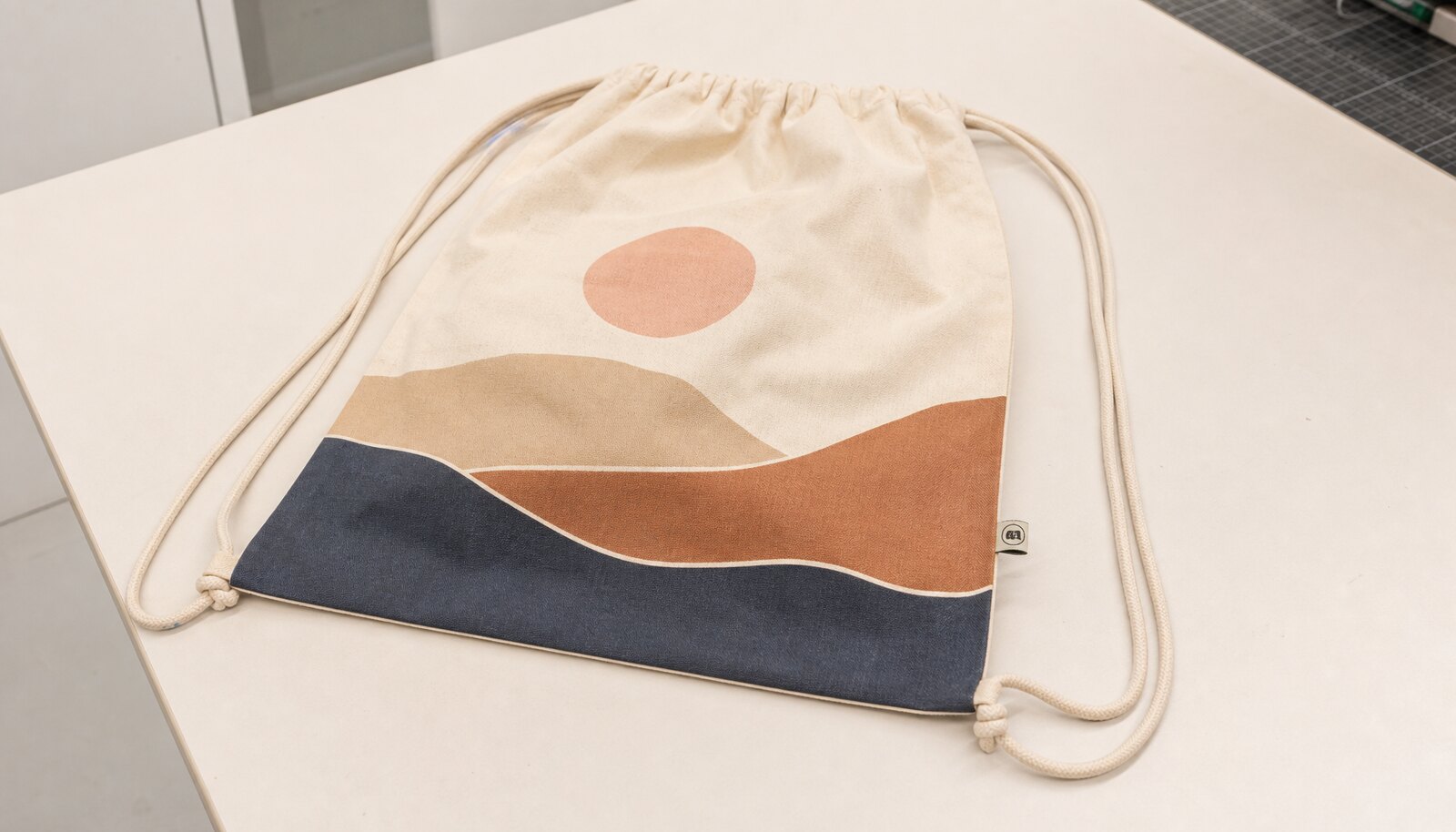
What buyers are actually sourcing, and why it fails when treated like a simple promo item
Imprinted drawstring backpacks are usually bought as a working branded item: a bag that carries a logo, survives normal handling, and arrives in quantity without creating avoidable exceptions. That sounds simple, but the sourcing risk comes from how the product is built. Buyers are not just buying print space. They are buying a sewn body, a cord system, reinforcement at stress points, and packing that preserves the bag during transit. If any one of those parts is under-specified, the quote may still look competitive while the order fails in use.
The common mistake is to treat the purchase like a decoration job instead of a manufactured item. That mindset leads to vague RFQs, weak sample approvals, and late surprises on setup fees or packing. A procurement buyer needs a more operational view: what fabric is being used, where the print sits, how the corners are reinforced, what tests prove the bag will hold up, and what happens to landed cost when packing density changes. Those details decide whether the supplier is genuinely comparable or only cheap on the first page of the quote.
For commercial buyers, the real sourcing question is simple. Can this supplier reproduce the same bag, same logo, and same pack format at the same cost on the repeat order? If the answer is unclear, the quote is not ready for purchase order release.
- Best fit: promotions, schools, sports events, campus campaigns, club merchandise, and lightweight retail carry bags.
- Main failure modes: seam failure, weak print adhesion, fabric substitution, inconsistent color, and packing that increases freight or damage.
Define the bag build before you ask for price
Price becomes meaningful only after the build is fixed. For imprinted drawstring backpacks, the supplier should quote the body fabric, the cord, the top hem construction, the eyelet or grommet type, and any reinforcement at the drawstring channel or lower corners. If the request only says 'custom drawstring bag with logo,' the factory will fill in the blanks with its preferred default construction, and the buyer may not discover the substitution until sample approval or inspection.
Fabric is usually the first cost lever. 210D polyester is common for low-cost promotions because it sews quickly and keeps the quote down. It is suitable for giveaways and event handouts, but it can feel thin if the load is sharp, heavy, or likely to be reused often. Moving to 300D polyester improves body and presentation without jumping into a premium retail structure. 420D polyester gives a sturdier feel and usually improves perceived quality, though it can add freight volume and cost. On cotton bags, buyers commonly work in a range such as 120–140 gsm for a lighter promotional feel and 140–180 gsm when they want more structure and better opacity under print.
Construction details matter just as much as cloth choice. Ask whether the top hem is single- or double-stitched, whether the corners are bar-tacked, and whether the eyelets are metal or reinforced fabric openings. If the factory uses metal parts, ask about rust control and edge finishing. If the cords are synthetic, ask how the ends are sealed so they do not fray in the carton or during distribution. These are not luxury details; they are the difference between a bag that is merely cheap and one that is unacceptable on arrival.
- Do not accept a quote that says 'custom fabric' without denier, GSM, weave, or coating details.
- Ask for a drawing or dimension sheet that marks body size, cord length, and reinforcement points.
- If the bag will carry heavier contents, prioritize reinforcement before decoration complexity.
Choose the print method based on art, quantity, and durability
The print method should follow the artwork and fabric, not habit. Screen print remains the best-known option for simple branding on medium to large runs because it can be efficient and visually strong when the artwork uses one to three solid colors. DTF or heat transfer is often a better fit for short runs, variable names, fine type, gradients, or multi-color logos. Sublimation can work well on light polyester when the buyer wants full coverage or high-detail graphics, but it is not a universal answer for cotton, dark fabrics, or textured surfaces.
A clean sample can still hide a weak production process. That is why buyers should ask how the print is cured, how the factory checks adhesion, and whether the design crosses seams or sits on a flat face. A logo centered on a smooth panel is easier to hold than one placed over a drawstring channel or near a stitched edge. If the design is sensitive to distortion, the quote should say so upfront, because moving the artwork slightly during production can change the look more than the supplier expects.
The most useful print discussion is practical. Ask whether the quoted price includes one or multiple colors, whether a new screen or plate is needed for each version, and how the factory handles small text. If the logo has thin lines or tiny words, ask for a production-size proof, not just a digital mockup. For procurement, the real question is not 'Can they print it?' but 'Can they print it the same way every time without a quality dispute?'
- Screen print: best for simple logos, repeat runs, and lower decoration cost at scale.
- DTF / heat transfer: best for short runs, multi-color art, names, or more complex graphics.
- Sublimation: best for light polyester only, especially when full-coverage graphics are required.
- Ask for a real-size proof if the artwork contains thin text, line work, or fine registration needs.
Rank the main build options by durability, hand feel, and use case
A useful buying decision is not simply 'which fabric is cheapest.' It is which build best matches the way the bag will be handled. The options below are ranked in a practical procurement sense, not as universal truths. A lighter bag can be perfectly acceptable for a one-day event, while a heavier bag may be unnecessary and expensive for mass handouts. The goal is to match strength, feel, and freight efficiency to the channel.
For high-volume giveaways, 210D polyester is usually the simplest option. It is light, compact, and easy to quote, which helps when the program is price-sensitive and the bag will not carry heavy content. For campaign bags that should feel more substantial without moving into a premium category, 300D polyester is often the sweet spot. 420D polyester is the most durable of the common polyester options here, but the extra body can increase carton size and freight. Cotton sits in a different lane: it gives a softer hand feel and a more natural presentation, but it needs closer attention to shrinkage, fabric stability, and print behavior.
The ranking below is a sourcing shortcut, not a sales pitch. If the bag will be distributed once and discarded, overbuilding adds cost without value. If the bag is meant to be reused, the lowest-cost cloth can become the most expensive choice when returns, complaints, or replacements are counted. That is why the best spec depends on the expected number of uses, the average load, and whether the print must stay sharp after folding or abrasion.
Build MOQ logic around versions, not just total pieces
MOQ is often presented as one number, but for this product it is usually several constraints stacked together. A supplier may have a low total piece MOQ, yet require a minimum per color, per artwork, or per fabric shade. That means two quotes with the same headline minimum can behave very differently in the real order. One may allow a flexible mix; the other may force the buyer to buy extra units just to satisfy decoration setup.
The better way to manage MOQ is to separate the commercial variables. Ask for the minimum quantity by bag color, by print version, by fabric type, and by repeat order. If the buyer plans to run multiple logo versions, the factory should quote each one separately so setup cost and utilization are visible. A quote that blends versions into one number is difficult to audit later. It can also make a reorder look cheaper than it really is if the first run absorbed one-time setup costs that will reappear on the second design.
Direct factory sourcing is usually strongest when the buyer needs control over those variables. A trading company or local decorator can be faster for small runs, but the buyer should expect less transparency on the original fabric source and less control over repeatability. For a buyer managing several programs, the most efficient strategy is often to keep the base bag the same and vary only the logo or text. Every extra variable—fabric color, cord color, label style, or packaging type—adds risk, setup time, or both.
- Ask whether MOQ is based on pieces, cartons, or decorated panels.
- Separate MOQ by artwork version if you plan multilingual or multi-department campaigns.
- If the supplier will not state reorder MOQ, treat the offer as incomplete.
- Standardizing the body while varying only decoration usually gives the cleanest procurement control.
Read the quote like a landed-cost sheet, not a brochure price
A supplier quote for imprinted drawstring backpacks is only useful if it can be compared line by line. The base unit price is just one part of the commercial picture. Setup charges, screen fees, plate fees, sample fees, color-change fees, packing charges, carton dimensions, and the shipping term can change the true landed cost more than a small difference in fabric price. A low headline price can become the highest total cost if the supplier hides important items in vague wording or leaves them out altogether.
The quote should include enough detail to compare factories fairly: exact fabric specification, print method, decoration area, sample cost, lead time after sample approval, carton count, unit packing method, gross weight, and trade term. If you are comparing two sources, use the same RFQ language for both. Same art, same size, same fabric, same packing, same delivery term. Without that discipline, the cheaper quote may simply be quoting a thinner bag, a smaller print, or a less protective carton pack.
There is also a freight angle that buyers overlook. A bag that folds efficiently may ship far more cheaply than one that requires loose packing or oversized cartons. That is why carton dimensions and pack count belong in the quote, not as an afterthought. If a factory refuses to quote packaging clearly, it is often because the unit price looks better than the actual ship-ready cost. For procurement, that is a warning sign rather than a convenience.
- Request separate lines for sample, setup, bulk production, packing, and delivery term.
- Normalize all offers to the same spec before comparing unit price.
- Check carton size and gross weight early because freight can change materially with packing density.
- Ask whether the quote includes labels, inner packs, and carton marking, not only the sewn bag.
Use a sample approval process that locks the commercial spec
The sample is the last low-cost checkpoint before production. For imprinted drawstring backpacks, a useful sample review goes beyond the logo. Measure the bag, confirm the fabric hand feel, inspect the cord channel, verify the print position, and look at the corners and eyelets under normal handling. If the supplier only sends a photo, the buyer still does not know how the bag behaves when folded, packed, or pulled by the cord. A physical sample is the safest basis for approval.
A disciplined approval process uses one signed golden sample and one written spec sheet. The sample should reflect the exact fabric, print method, cord type, reinforcements, and packing style that will be used in the bulk run. Once that sample is approved, any change in size, color, print placement, or carton packing should be treated as a revision. That matters because many production disputes begin with a small 'factory adjustment' that was never formally approved. If the buyer has a strong approval file, the supplier has less room to argue after shipment.
For repeat programs, archive the sample with a revision date, the approved artwork file, and the signed packing standard. That makes reorder decisions much easier. It also helps when multiple departments touch the order—marketing, merchandising, quality, and logistics—because everyone can work from the same physical reference instead of relying on memory or old email threads.
- Approve the actual sample, not only the digital proof.
- Record the approved dimensions, print size, color references, and packing format on one sign-off sheet.
- Keep one golden sample with procurement and one with QC or the warehouse.
- Treat late revisions as a new approval cycle unless the factory proves they are truly minor.
Set QC criteria that catch real defects, not just cosmetic noise
Good QC on this product needs measurable targets. The big risks are seam failure, weak print adhesion, size drift, missing or damaged cords, and packing damage. If the inspection sheet is too general, the factory will pass units that look acceptable from a distance but fail once the customer fills the bag. Buyers should define the failure points before production so the line knows what will be measured and what will be rejected.
Practical acceptance criteria work better than vague language. Use the approved sample to define size tolerance and print position tolerance. For many buyers, a simple tolerance such as ±5 mm on smaller dimensions and a slightly wider range on larger panels is easier for the factory to hold than an undefined 'close enough.' Define what counts as a major print defect—such as misalignment, incomplete fill, or visible cracking—and what counts as a minor issue like a loose thread that can be trimmed. If the bag has eyelets, check for sharp edges, rust marks, or poor setting. If it uses synthetic cord, check whether the ends are sealed so they do not unravel during packing or transit.
Ask the factory what test methods they use and whether they can show a record from the production line. Even a simple pull check on the top hem and cord channel is better than no evidence. The goal is not to turn a small promo bag into an engineered product; the goal is to make sure the inspection criteria match the buyer’s actual risk. A bag that looks fine but fails the first use is more expensive than a slightly higher unit price on a better-controlled order.
- Set tolerances before production, not after the first inspection failure.
- Use a rub check on the print to catch weak curing or transfer adhesion.
- Reject torn seams, sharp eyelets, broken cords, major print misalignment, and visible stains.
- Ask the supplier to sort nonconforming units before carton packing so defects do not travel downstream.
Inspect the first article, the mid-run, and the packed cartons
A strong inspection plan is staged. The first article tells you whether the setup is correct. The mid-run check shows whether the line is staying consistent. The packed-carton review confirms the product that will actually ship. For imprinted drawstring backpacks, that matters because a bag can look correct in one sample and then drift once the line starts moving or a new operator joins the process.
At first article, check fabric, print position, dimensions, cord length, reinforcements, and seam quality against the approved sample. During the run, pull units from multiple boxes or bundles to check consistency in print density, stitching, and finishing. At carton stage, confirm unit count, label accuracy, and that the packing method has not crushed the logo or kinked the cord. If production is large enough to span more than one batch, identify each batch so color or print drift can be traced quickly.
For higher-confidence procurement, ask the supplier to use an AQL-based inspection approach or a documented equivalent. Even if the buyer does not specify a full standard by name, the inspection should still define sampling size, critical defects, major defects, and minor defects. As a practical rule, critical defects should be zero-tolerance, major defects should be limited to the agreed acceptance level, and minor defects should be controlled through rework or trimming before release. That framework is more useful than a generic 'checked before shipment' promise.
- Inspect first article, mid-run, and packed cartons; do not rely on a single final check.
- Use sampling from different cartons, not only the top layer.
- Keep batch identification when the order spans multiple production days.
- Use a documented acceptance standard with zero tolerance for critical defects.
Plan packing and shipment around the destination channel
Packing should follow the channel, not the factory’s default habit. A campaign bag going to a trade show may be packed differently from a retail bag going to a distributor warehouse. Bulk packing is usually more efficient for promotions because it reduces packaging cost and keeps freight density high. Individually polybagged units may be better for retail, kitting, or e-commerce because they preserve presentation and simplify handling. The wrong choice can add cost or damage without improving the product.
The quote should specify unit fold method, whether the bag is compressed or loosely packed, how many units go into a master carton, and how those units are labeled. For retail resale, confirm barcode placement, polybag warnings if required by the destination market, and whether the cartons are labeled by color, size, or artwork version. For bulk distribution, confirm that carton counts match the internal distribution plan so receiving teams do not spend time recounting every box. If the bag is printed on a flat panel, packing pressure matters because excessive compression can leave permanent creases or stress the print edge.
A practical procurement tip: ask for carton dimensions before approving the order, not after. A slightly larger carton may not change the unit price much, but it can materially affect freight. On the other hand, over-compressing the bag to save carton volume can create wrinkles, crushed corners, or a print surface that looks poor on opening. The best packing choice is the one that balances appearance, protection, and shipping efficiency for the actual destination.
- Specify whether units are flat-folded, loosely folded, or individually bagged.
- Confirm carton count, label location, and barcode format before production starts.
- Check whether packaging or carton compression could damage the print during transit.
- Match packing to the channel: promo, retail, kitting, or e-commerce.
Specification comparison for buyers
| Decision variable | Option to specify | Best fit | Quote check / procurement risk |
|---|---|---|---|
| Supplier route | Direct cut-and-sew factory with in-house print | Best when you need controlled build quality, custom dimensions, and one accountable factory for sewing plus decoration | Ask whether the factory owns the print line or outsources it; hidden outsourcing often adds lead time and weakens QC control |
| Supplier route | Print-specialist bag factory | Useful when logo quality is the priority and the bag construction is standard | Confirm who controls seam reinforcement, cord stitching, and final packing; print strength does not guarantee bag durability |
| Supplier route | Blank importer plus local decorator | Useful for urgent campaigns, small runs, or domestic fulfillment | Check whether blank stock is stable for repeat orders; the quote can look low until blank availability, local setup, and rework are added |
| Fabric | 210D polyester | Best for giveaways, mailers, schools, and high-volume event handouts | Ask for denier, coating, and fabric weight evidence; thin substitutions are common when the spec is vague |
| Fabric | 300D polyester | Better for repeat use, retail promotions, and buyers who want more body and less show-through | Confirm whether the supplier is quoting true 300D construction or a lighter cloth with a heavier finish |
| Fabric | 420D polyester | Better for premium presentation or heavier carry use | Check carton volume because thicker fabric can raise freight cost even if the unit price looks acceptable |
| Fabric | Cotton 120–140 gsm | Works for a softer hand feel and lower-cost branded retail or event bags | Ask for shrinkage control, colorfastness, and whether the supplier preshrinks or only cuts on greige cloth |
| Fabric | Cotton 140–180 gsm | Better when the bag should feel sturdier and accept more body under print | Verify opacity, seam performance, and whether print registration is affected by fabric texture |
| Print method | Screen print | Best for one to three solid colors on medium and large runs | Request screen count, setup fee per color, and minimum quantity per artwork; weak quotes often omit one of these |
Buyer checklist before sampling
- State the full bag specification: body fabric, denier or GSM, coating, dimensions, cord type, eyelet type, seam reinforcement, and whether the bag is single-layer or lined.
- Define the artwork exactly: print method, print size in mm or inches, color count, Pantone references if applicable, and acceptable placement tolerance relative to seams and top edge.
- Ask for a physical pre-production sample or golden sample before bulk cut and print approval; save one signed sample for procurement and one for QC.
- Request a line-item quote with bag body cost, print setup, sample fee, packaging, carton charges, inspection cost if any, and delivery term (EXW/FOB/DDP).
- Compare MOQ by bag color, artwork version, and fabric choice, not only by total pieces.
- Ask for measurable tolerances: bag size, print registration, cord length, and carton count per master carton.
- Request the supplier’s QC checklist, inspection stage, and defect thresholds before placing the order.
- Confirm test methods or references for seam strength, rub resistance, print adhesion, and odor / contamination checks.
- Verify carton dimensions, gross weight, unit packing method, barcode placement, and whether retail warnings are needed for polybags.
- Check whether the supplier owns the sewing line and print line, or whether either step is subcontracted.
Factory quote questions to send
- What exact fabric are you quoting for the body and cords: denier or GSM, weave type, coating, and any lining or backing?
- What print method is included, how many colors are covered, what is the decoration area in mm, and what setup fee applies per artwork version?
- What is the MOQ by artwork, by fabric color, and by repeat order? Please separate blank MOQ from decorated MOQ if they differ.
- Can you provide a dimensioned sample, or a physical pre-production sample, before mass production starts?
- What tolerances do you accept for overall size, print placement, cord length, and carton count?
- What seam reinforcement is used at the corners and drawstring channel? Are there bar-tacks, double stitching, or reinforced eyelets?
- What test method do you use for print adhesion, rub resistance, seam pull, and metal parts corrosion or edge safety, if applicable?
- What carton pack count, unit polybag format, label placement, and master carton dimensions are included in the price?
- Is the price EXW, FOB, or delivered? Which charges are excluded, including sample courier, export docs, remote area freight, and duties?
- If we reorder the same artwork, do setup charges, screen fees, or sample fees drop, and how long do you keep the production record on file?
Quality-control points to confirm
- Measure bag width, height, and any gusset against the approved spec using the same measuring method on sample and bulk units; agree a practical tolerance before production, such as ±5 mm for smaller dimensions or ±10 mm for larger panels, if the factory can consistently hold it.
- Check fabric weight or denier against the ordered material. If possible, ask for fabric mill documentation or an incoming material record; do not accept only a verbal statement that the cloth is 'same quality'.
- Inspect print placement, registration, and edge sharpness under normal indoor light, and check from the typical viewing distance a buyer or end user would use, not just under bright factory lamps.
- Use a simple rub check on the printed area with both dry handling and a controlled abrasion method agreed with the supplier. Ask what standard they reference, such as a dry rub or crocking-style check, and how many rubs are used before the print is considered unstable.
- Pull-test the top hem, cord channel, and eyelet area to confirm the seam does not open, fray, or distort. If the buyer expects heavier use, ask the factory to record a seam-strength target or demonstrate the pull method on a reference sample.
- Confirm cord length, cord diameter, knot style, and whether cord ends are heat-sealed, capped, or folded. Loose or unsealed synthetic ends are a common source of early fraying and customer complaints.
- Inspect the first and last carton of every lot for odor, stains, loose threads, crushed prints, and sewing damage caused by compression. If the order is large, inspect cartons from the top, middle, and bottom of the pallet stack.
- Verify carton count, unit count, barcode accuracy, and carton marking against the purchase order. A good sewing run can still become a receiving problem if packing counts are off by even a small amount.
- Set a defect threshold before inspection begins. Example: no critical defects such as torn seams, broken cords, sharp eyelets, or major print misalignment; limit major visual or functional defects to the agreed AQL level; and require trimming or rework for minor loose threads only if they do not affect appearance.
- Compare bulk units against the signed golden sample for color, print density, hand feel, and packing format. If the factory splits production across batches, require batch identification so any drift can be isolated quickly.