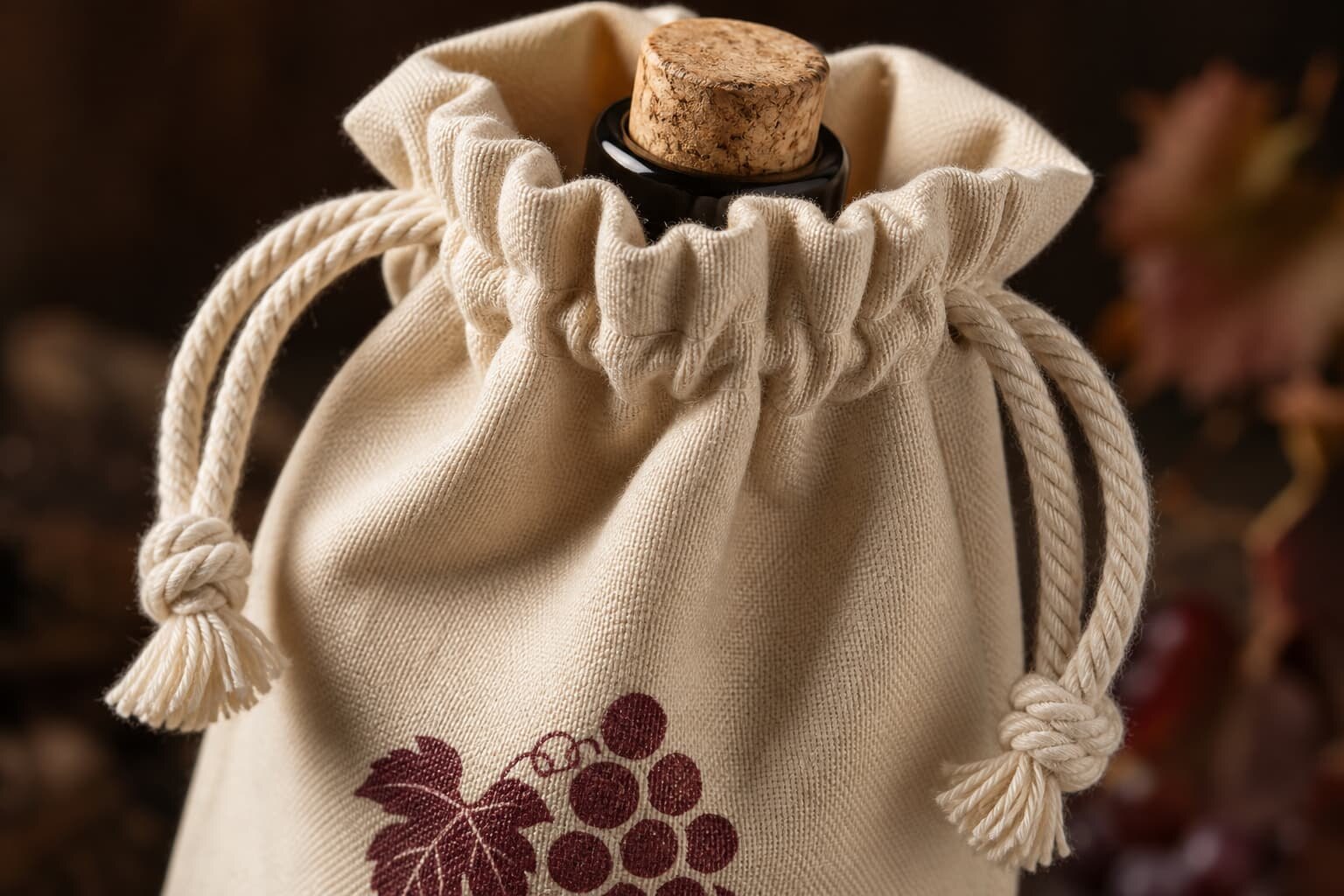
Why Similar Samples Get Different Quotes
A custom drawstring wine bag supplier can send two quotes that look almost identical on paper and still be pricing two very different products. One factory may be quoting 220 GSM cotton twill with reinforced side seams and a printed front logo. Another may be using lighter cloth, fewer stitches, no seam reinforcement, and a simpler packing method. If the RFQ only says "drawstring wine bag," the supplier fills in the missing details with its own default spec, and that is where most quote confusion starts.
The fix is not to ask for more quotes. It is to make every supplier quote the same bag in the same way. Lock the bottle type, finished size, fabric weight, decoration method, cord style, and packing before you compare numbers. Once those items are stable, quote gaps become useful signals instead of noise. A higher quote may reflect real value, while a low quote may simply mean the supplier omitted a line item you will pay for later.
- Quote differences usually come from fabric GSM, stitching method, and decoration setup, not just labor.
- A low quote is only meaningful when the spec, packing, and print details match exactly.
- Ask each factory to repeat the same assumptions in writing before you compare pricing.
Start With The Bottle, Not The Bag
The first mistake buyers make is specifying the bag before they define the bottle. A standard 750 ml Bordeaux bottle, a wider Burgundy bottle, and a tall sparkling bottle all need different clearance. If the bag is too tight, the bottle scrapes the seam, the drawstring pulls unevenly, and the finished product feels cheap even if the fabric is good. If the bag is too loose, the bottle slides around and the silhouette looks sloppy on shelf or in gift packaging.
For a useful RFQ, ask the supplier to quote against actual bottle dimensions: body diameter, shoulder shape, cap height, and whether the bottle has a foil capsule or decorative neck finish. If the bag is meant for a wine gift set, measure any insert, tag, or accessory that must fit inside as well. The supplier should tell you the finished internal width and height after sewing, not just a flat cut size that sounds impressive on a spec sheet.
- Measure the widest bottle point, not only the neck or base.
- Confirm whether the bag is for still wine, sparkling wine, or a mixed bottle program.
- Ask for finished internal clearance after seam loss and drawstring tunnel allowance.
Choose Fabric Weight And Build For The Channel
Fabric weight sets the hand feel, durability, and carton efficiency of a custom drawstring wine bag. For most retail and gifting programs, 220-240 GSM cotton twill is a practical starting point because it has enough body to hold shape without becoming too stiff. If the bag is part of a premium presentation set, 280-340 GSM canvas gives a firmer look and better opacity. For a rustic seasonal look, jute or a jute-cotton blend works, but the surface texture can make small logo details less crisp.
Construction matters almost as much as the material. A single-layer bag is cheaper and folds flat, but it may show bottle edges and print shadows on dark bottles. A lined bag improves structure and hides the bottle better, but it raises material consumption and labor. Ask whether the seams are overlocked, double-stitched, or bound, and whether the cord tunnel is reinforced. Those details affect both the quote and the chance of a bulk defect. If the fabric is prone to shrinkage, ask whether the factory has pre-washed it or adjusted the pattern to compensate.
- Use 220-240 GSM cotton twill for standard reusable wine bags.
- Use 280-340 GSM canvas when the bag needs more structure and a premium feel.
- Use jute only when the design can tolerate texture and a less precise print surface.
- Check seam type, tunnel reinforcement, and shrinkage control before approving bulk.
Match Branding Method To The Fabric And Artwork
The decoration method should follow the bag fabric, not the other way around. Screen printing is usually the cleanest choice for simple logos, one or two colors, and larger volume runs. It sits well on cotton and canvas, but very fine text, gradients, and tiny linework can become weak once ink hits a textured weave. Heat transfer can reproduce more complex artwork, but buyers should be careful if the bag will be handled often, because some transfers feel less durable over time than direct print.
Embroidery and woven labels are often better for brands that want a more tactile finish. Embroidery looks strong on thicker canvas, but it is not the best choice for very small logos or detailed typography. A woven side label or sewn patch is durable and easy to brand without covering the full front panel. For every method, ask the supplier to confirm artwork size in centimeters, Pantone references, placement from seam or top edge, and whether the print is one-side or two-side. That is the quote data you need to compare factories apples to apples.
- Use screen print for clear, repeatable logos and large runs.
- Use embroidery only when the artwork is bold enough to survive stitch detail.
- Use woven labels when you want durable brand ID with low visual clutter.
- Lock print size, position, and color count before requesting a final price.
Understand MOQ Logic Before You Chase A Low Unit Price
MOQ is not just a factory preference; it is usually tied to fabric sourcing, print setup, and packing efficiency. A supplier using stock natural cotton can often offer a lower MOQ than one that must custom dye fabric, source a special cord, or create a woven label just for your order. The same is true for decoration: a blank bag, a one-color screen print, and a fully branded bag with a side label may all have different minimums because the setup time is not the same.
When buyers only ask for the lowest unit price, they often get a quote that looks attractive but hides the real cost of small-run production. A better approach is to ask for three scenarios: blank bags, printed bags, and labeled bags. That makes it easier to see where the cost moves. If you expect repeat orders, also ask whether the factory can keep the same fabric shade and cord spec on reorder. A cheap first order is not useful if the second order changes look or fit.
- Separate MOQ by fabric color, print colors, and label type.
- Ask whether the factory is quoting stock materials or custom-sourced materials.
- Compare blank, printed, and labeled versions of the same bag.
- Check reorder consistency, not only first-order pricing.
Read The Quote Like A Factory Engineer
A useful quote should show exactly what is inside the unit price. At minimum, look for fabric type and GSM, bag size, cord material, stitching method, decoration method, sample cost, packing details, and carton configuration. If any of those items are missing, the factory may be assuming a standard version that does not match your spec. That is how buyers end up paying extra for print setup, label sewing, or stronger packaging after the purchase order is already issued.
The best comparison method is to ask every supplier to quote the same line items at the same order quantity. For example, ask for pricing at a blank version, a one-color printed version, and a printed plus woven-label version. Then request the carton size and gross weight with each version, because freight can change the landed cost more than the unit price suggests. If one quote is lower but has no mention of packing, print setup, or overrun tolerance, treat it as incomplete rather than competitive.
- Verify what is included in the unit price and what is charged separately.
- Request the same quantity break points from every supplier.
- Ask for carton size and gross weight so freight comparisons are realistic.
- Treat missing quote data as a risk, not a bargain.
Use Samples To Catch Problems Before Bulk
Samples are not only for sign-off; they are the cheapest way to stop a bad bulk run. Start with a development sample that checks the overall look, then move to a pre-production sample that reflects the final fabric, print, cord, and label. Once the sample arrives, test it with the actual bottle, not an empty bag. Check how easily the bottle slides in, whether the drawstring closes evenly, and whether the top opening stays neat when the bag is lifted.
Also test the small defects that cause big production losses. Rub the print lightly to see whether ink transfers. Pull the cord several times to check if the tunnel stays intact. Measure the finished bag against the spec and note any mismatch in writing. If the bag is lined, inspect the lining alignment and seam finish. Keep one approved sample sealed and signed so the factory has a reference point during bulk inspection. That one step prevents a surprising number of arguments later.
- Approve a development sample first, then a pre-production sample.
- Test with the actual bottle and any insert or accessory.
- Check print rub, cord movement, and seam strength before bulk release.
- Keep one signed approval sample as the production reference.
Plan Packing And Cartons Before You Confirm The Order
Packing is part of the product cost, not an afterthought. Most drawstring wine bags are shipped flat-folded, but the exact fold method, inner pack count, and carton size can change cube efficiency and carton strength. A thick canvas bag may need fewer pieces per carton than a lighter cotton version. If the bag is pre-shaped or packed with tissue, the landed freight cost can increase quickly even when the unit price looks steady.
Ask the factory to state the piece count per inner bag, the number of inner bags per carton, the carton dimensions, and the gross weight. If your distribution team uses barcode labels, carton marks, or master pack control, confirm those details before bulk. Also check whether the print or label can rub during transit if bags are packed too tightly. Flat pack is usually the most efficient option, but only if the fold is consistent and the decoration is protected from pressure marks.
- Request carton size, gross weight, and piece count with every quote.
- Compare flat pack versus shaped pack when freight cost matters.
- Check whether decoration can rub or crease inside the carton.
- Confirm carton marks and label placement if your warehouse needs them.
Lock Acceptance Criteria Before You Award The Order
The final order should only move forward when the acceptance criteria are clear. Define the allowed size tolerance, fabric shade range, print placement tolerance, stitch quality standard, and carton count accuracy. If you buy for retail, include appearance items such as straight seams, clean thread trimming, and even cord ends. If you buy for gifting or promotion, also define what counts as acceptable wrinkling, because some fabrics fold better than others and the wrong assumption can make a good bag look rejected on arrival.
You do not need a complicated quality system to avoid bulk problems. You need a written spec that a factory can actually follow. Use a simple approval workflow: confirm dimensions, confirm material, confirm decoration, confirm packing, then freeze the sample. If the supplier cannot repeat those points in the quote, the quote is not ready for procurement. The strongest buyers are not the ones who push for the lowest price first; they are the ones who remove ambiguity before production starts.
- Set size, color, print, and stitch tolerances in writing.
- Approve the sample only after all production details are frozen.
- Treat carton count and packing appearance as part of the quality spec.
- Award the order only when the quote matches the approved sample and packing plan.
Specification comparison for buyers
| Spec decision | Recommended option | When it fits | Buyer risk to check |
|---|---|---|---|
| Body fabric weight | 220-240 GSM cotton twill | Standard single-bottle retail and gifting | Too light can sag, show the bottle outline, and wrinkle badly |
| Premium body fabric | 280-340 GSM canvas | Higher perceived value and rigid presentation packs | Heavier cartons, higher cost, and less flexible folding |
| Rustic look | Jute or jute-cotton blend around 250-300 GSM equivalent | Seasonal gifting and natural-style branding | Fiber shedding, rough hand feel, and weaker print detail |
| Brand decoration | 1-color or 2-color screen print | Large runs with simple logos and clear artwork | Fine lines, gradients, and small text can fill in or misregister |
| Secondary branding | Woven side label or sewn patch | Durable brand ID without a large front print | Label size, stitch placement, and edge finish must be approved |
| Packing method | Flat pack with carton count locked | Export orders where cube efficiency matters | Loose folding can crease print, distort cords, or change carton loads |
Buyer checklist before sampling
- Confirm the bottle type, bottle diameter, cap height, and whether the bag is for one bottle or a gift set.
- Freeze the finished bag size, fabric GSM, closure style, and seam construction before asking for pricing.
- Choose the decoration method based on artwork detail, order quantity, and durability needs.
- Ask for a pre-production sample or strike-off before bulk approval.
- Request carton size, gross weight, and piece count so freight comparisons stay realistic.
- Check whether the quote includes cord, label, print setup, and packing materials.
- Set acceptable size tolerances, color variation limits, and print placement limits in writing.
- Verify the supplier's MOQ by fabric, color, print method, and packing configuration.
- Keep one signed approval sample for reference during bulk inspection.
Factory quote questions to send
- What is the exact fabric composition and GSM of the quoted bag?
- Is the quoted size finished size or cut size, and what tolerances do you allow after sewing?
- How many print colors, print positions, and setup fees are included in the quote?
- Does the unit price include cord, label, packing, and carton marks?
- What is the MOQ by color, artwork, and decoration method?
- Can you quote the same bag as blank, printed, and labeled so I can compare the cost impact?
- What are the sample fees, sampling lead time, and revision limits?
- What are the standard carton size, gross weight, and pack quantity per carton?
- What inspection checks do you perform before shipment, and what defect rate do you allow?
- If I reorder, can you match the same fabric shade, print placement, and packaging spec?
Quality-control points to confirm
- Measure finished size against the approved spec and check the usable inner space, not only the outside dimensions.
- Verify fabric weight, weave density, and color shade against the approved sample or lab dip.
- Inspect seam strength at the side seams, bottom seam, and cord tunnel for loose stitches or skipped stitches.
- Check print registration, curing quality, and ink rub resistance after handling.
- Pull the drawstring several times to confirm smooth movement and secure cord exits.
- Confirm label placement, label stitch quality, and edge trimming on woven labels or patches.
- Open random cartons to verify piece count, folding method, and packing cleanliness.
- Review odor, moisture, and dust levels before approving export packing.