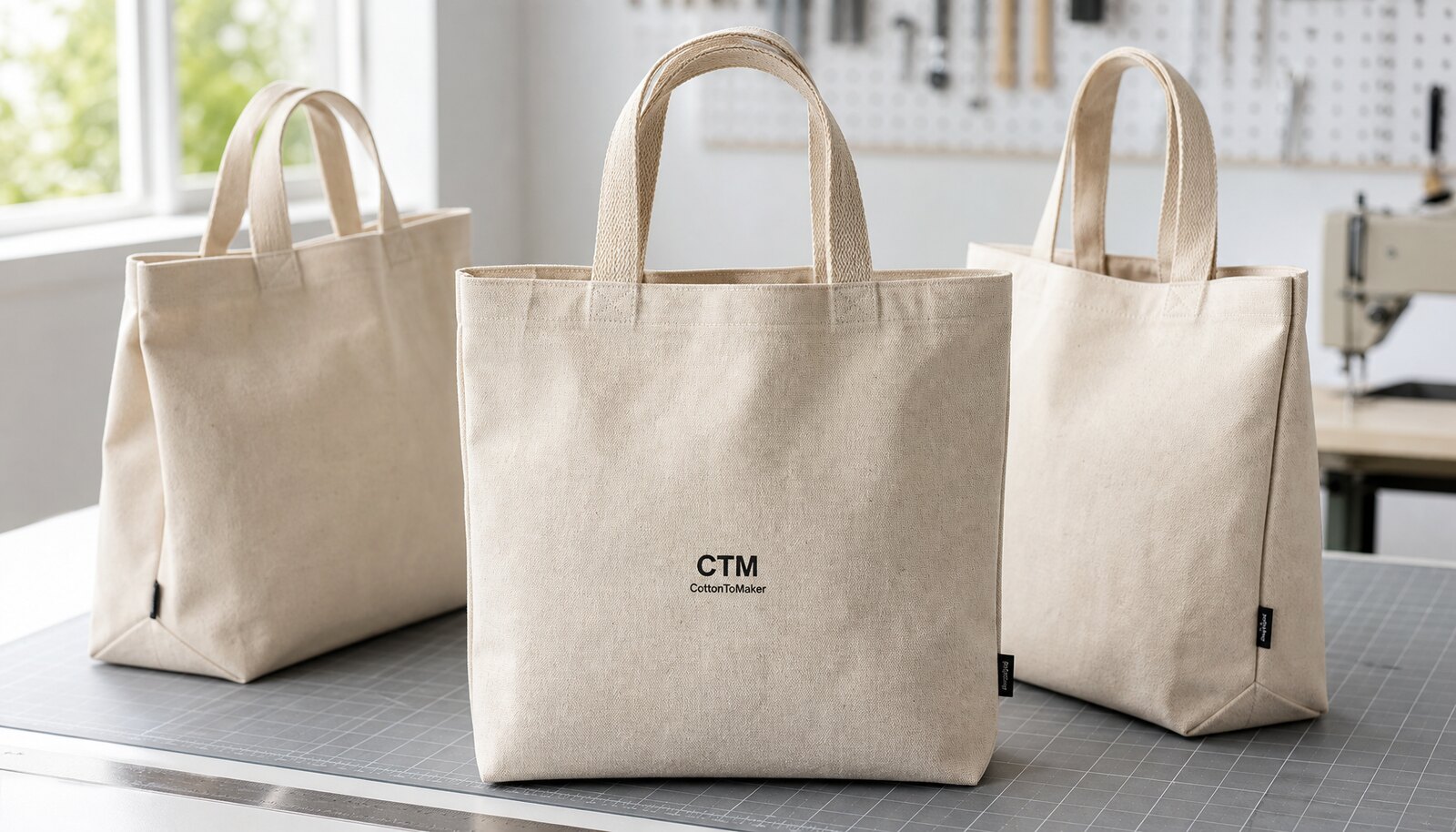
Why the First Quote Is Often Misleading
Promotional canvas bags look simple, but the first quote often hides the real cost drivers. One supplier may price a light 8 oz tote with loose bulk packing and a one-color screen. Another may quote a 10 oz or 12 oz build with reinforced handles, tighter finishing, and more labor in folding and packing. If a buyer compares only the unit price, the lower number can be the weaker commercial result because the bag arrives with less structure, poorer print durability, or more freight cube than expected.
For procurement teams, the bag should be treated as a small production program, not a generic print item. The quote only becomes meaningful after the finished size, fabric weight, handle construction, decoration method, packing format, and shipping assumption are fixed. Otherwise the supplier can move cost between line items and still appear competitive while the actual product drifts away from the intended spec. That is why the first task is not negotiation. It is normalization.
A useful rule is simple: if two quotes cannot be compared line by line, they are not yet procurement quotes. They are sales estimates. The job of the buyer is to convert them into a common structure before price is judged. That means rejecting vague language like standard quality, regular packing, or normal delivery, and replacing it with the exact build the business actually needs.
- Compare finished spec, not just bag category.
- Separate unit cost from setup, packing, and freight.
- Use one reference sample or one reference spec sheet across every supplier.
Lock the Fabric and Construction Before You Price Artwork
Fabric weight should drive the rest of the order. For promotional canvas bags, 8 oz or about 280 gsm is the lightest practical build and can work for short giveaways, but it will feel thin if the bag is reused often or asked to carry heavier contents. A 10 oz or about 340 gsm tote is the most defensible default for many buyers because it balances cost, hand feel, and perceived value. A 12 oz or about 400 gsm build makes sense when the bag needs stronger shape retention, heavier carry performance, or a more retail-ready presentation.
Construction matters as much as cloth weight. A flat tote is cheaper to sew and easier to pack, while a gusseted bottom or side gusset improves stability and gives the bag a more substantial look. Handle length, handle width, and reinforcement are common failure points because the body can be fine while the carry point fails first. Buyers should ask for the exact handle tape spec, where the handles are attached, whether the top edge is turned or bound, and whether the quoted size includes seam allowance or only the nominal body dimensions.
It is also worth deciding whether the program needs a soft giveaway item or a structured utility bag. The same promotional canvas bags can sit in either category, but the sourcing strategy changes. If the bag will be stuffed into an event pack, flat bulk packing and a lighter build may be enough. If it will hold samples, books, or bottles, the order should be written around seam reinforcement, a stronger handle attachment, and a finish that can survive repeated handling.
- Choose fabric weight based on actual use, not only on the event name.
- Ask whether the quoted weight is raw cloth or finished fabric after shrinkage and finishing.
- Match handle reinforcement to the expected load, especially for brochure packs, samples, or bottle inserts.
Use a Clean Comparison Matrix for Supplier Routes
The cheapest quote is not always the best route. A direct factory with in-house sewing and printing usually gives the best control over cloth, seam quality, print consistency, and packing. That route is often the strongest choice for repeat programs, custom sizes, or any order where the buyer needs a stable long-term spec. A trading company can be useful when the program includes multiple SKUs or the buyer wants one commercial contact, but the buyer still needs the actual factory name, the true production site, and a clear answer on who owns final inspection.
A decorator using imported blanks is the fastest route for short campaigns or simple logos. The tradeoff is that the blank bag and the decoration process may not have been designed together. That creates risk around fabric weight, dye lot, shrinkage, and print adhesion. For procurement buyers, the key question is not which route feels easier. It is which route gives the most control over the exact bag that will arrive at the dock.
The comparison table should therefore separate supplier route from product spec. When those two things are mixed in one table, the buyer cannot tell whether a price gap comes from a different commercial route or a different bag build. Keep route, use case, pricing pattern, risk, and verification points in one matrix, then compare fabric weight and construction in the spec sheet that sits beside it.
- Direct factory: best for spec control, repeat orders, and cleaner QC ownership.
- Trading company: useful for coordination, but verify the actual maker and the inspection trail.
- Blank-bag decorator: faster for small campaigns, but check compatibility between the blank and the print method.
Choose the Decoration Method Before You Compare Quotes
Decoration method changes both cost structure and defect risk. Screen printing is usually the cleanest option for simple spot-color logos and steady volumes because setup is predictable and repeatable. Transfer printing is better for artwork with gradients, thin lines, or more colors than a screen setup can handle efficiently. Embroidery can work on promotional canvas bags, but it is best for small premium marks rather than large graphic coverage because it changes both the hand feel and the cost per unit.
Buyers should not compare decoration methods only by unit price. A cheap transfer on rough canvas can crack or peel if the adhesive, pressure, or cure is weak. A low-cost screen print can look acceptable in a sample and then drift in bulk if the factory does not control platen alignment, mesh tension, or curing temperature. The decision should be based on artwork, end use, and expected handling after packing and shipping.
The practical test is simple: ask whether the artwork will survive the life of the bag. A large logo that will be folded, stacked, shipped, and reused needs a decoration route with strong adhesion and tolerable wear. Small text and tight brand colors need a process that can hold registration and stay legible on the weave of the canvas. If the supplier cannot explain the process in plain terms, the buyer probably does not yet have a defendable quote.
- Simple logos and medium or larger runs usually favor screen printing.
- Complex artwork and short runs may justify transfer printing.
- Ask for a photographed production sample, not just a digital mockup.
Build an RFQ That Removes Ambiguity
A usable RFQ for promotional canvas bags should force every supplier to quote the same build. Include the finished size, gusset depth, fabric weight, handle spec, decoration method, print area, packing format, carton target, inspection standard, and shipping assumption. Without that structure, one supplier can look cheaper because setup fees are hidden while another looks expensive because it is more transparent. The goal is not to create paperwork for its own sake. The goal is to eliminate the assumptions that usually produce cost surprises.
A strong RFQ also includes control language. One useful clause is: no material, decoration, packing, or subcontracting change without written buyer approval. Another is: the pre-production sample must use the same cloth, same handle tape, same print process, and same finishing route as bulk production. These lines matter because they stop the common pattern where the sample is handmade from a different material and the bulk run is later defended as equivalent.
Keep the pricing grid simple enough to compare, but not so simple that it loses meaning. Separate one-time setup from repeat production cost. Ask the supplier to show screen or plate costs, sample charges, inner pack charges, carton charges, and any premium for tight lead time. Then compare all suppliers on the same shipping assumption so the landed cost is real, not rhetorical.
- Use one RFQ template for every supplier and every route.
- Separate one-time setup from repeat production cost.
- Compare the same shipping assumption before selecting the winner.
What Sample Approval Should Actually Prove
A sample is only useful if it matches the production route. For promotional canvas bags, the pre-production sample should use the final cloth, final handles, final decoration method, and final seam construction. If the supplier sends a loose print proof or a handmade prototype from a different material, the buyer is approving appearance, not production reality. That is where disputes start, because the sample looked right but did not represent the actual line.
The sample review should focus on details that are easy to miss in a photo. Check the edge finishing, handle symmetry, print placement, thread cleanup, and how the bag folds after packing. If the bag is for retail or higher-visibility giveaways, inspect how the logo sits against the weave of the canvas. Fine type, thin strokes, and small marks can lose sharpness on coarse fabric, so the sample should be evaluated under normal daylight, not just on a screen.
Keep the approval record tight. It should include the date, artwork version, finished size, fabric weight, print method, packing format, and any agreed exceptions. If the buyer wants a future reorder to match the first run, the physical sample and the PDF spec sheet must be tied to the purchase order. That becomes the control point when the factory later asks for a substitution or says the fabric changed slightly.
- Approve the final material, not a substitute fabric.
- Check print placement, thread finish, and handle symmetry in hand.
- Keep one signed physical sample as the production reference.
Set QC Thresholds the Factory Can Measure
Quality control on canvas bags should focus on defects that affect appearance, carry strength, or retail presentation. Buyers get better results when the purchase order defines what counts as critical, major, and minor before mass production starts. Critical defects should always be zero tolerance because they make the bag unusable or non-compliant for the destination market. Major defects are failures that change function or presentation in a way the buyer would reject. Minor defects are cosmetic issues that may be acceptable within a controlled AQL if they do not affect the brand standard.
A practical control plan should also define the inspection method. ISO 2859-1 General Inspection Level II is a common starting point, with AQL 2.5 for major defects and AQL 4.0 for minor defects, but the buyer should tighten or relax that standard based on the program. The important part is consistency: the factory, the third-party inspector, and the buyer should all use the same defect definitions. For example, a skipped stitch of a few millimeters on a hidden seam may be minor, while an open seam at a handle attachment can be major or critical depending on the load requirement.
The most useful QC sheet is specific enough that two inspectors would make the same decision. Define the finished size tolerance, print placement tolerance, handle length tolerance, stitch quality, and acceptable appearance. For multicolor artwork, require a stated registration limit. For load-bearing seams, require no broken thread, no skipped stitch segment longer than the agreed limit, and no visible seam opening when the bag is filled and lifted. This is the difference between inspection that sounds good and inspection that actually blocks bad lots.
- Define critical, major, and minor defects in the PO or QC sheet.
- Use ISO 2859-1 General Inspection Level II as a practical default unless the program needs tighter control.
- Require measurements for size, placement, stitch quality, and carton count instead of subjective language like "good quality".
Use Acceptance Criteria That Match Real Use
QC needs sharper thresholds than a generic pass or fail. For size, many buyers use a working tolerance of plus or minus 1 cm on body dimensions and plus or minus 0.5 to 1 cm on handle length, adjusted for the bag size and market requirement. For print placement, require the artwork to sit within the agreed distance from the center line or top edge and add a tighter limit for premium retail presentation. For multicolor art, specify the maximum registration gap and require a pre-production strike-off when the design includes small text or fine lines.
Stitch quality should be checked as a measurable construction detail, not as a general impression. Require load-bearing seams to be consistent across the lot, with no open seam, no broken thread at the handle join, and no skipped stitch segment beyond the agreed limit. If the bag uses bar-tacks, ask the factory to state how many are applied and where they sit. If the bag uses a box stitch, require symmetry on both handles and no missed corners. These checks are simple, but they stop the most common failure points.
Load testing should reflect the intended use case. If the bag is a lightweight giveaway, the test can be a simple carry check with the expected contents and a close visual review of the seams. If the bag will carry books, samples, or bottles, require a static load test at 1.5x the intended working load and a short carry test with no seam opening, no handle tear, and no excessive elongation. The goal is not to make the factory guess. It is to force the buyer and supplier to agree on what acceptable performance means.
- Set size, print, and handle tolerances in writing before bulk production.
- Require a stated registration limit for multicolor artwork and a strike-off for fine detail.
- Tie load testing to the real payload, not to a vague factory standard.
Treat Packing and Freight as Part of the Product
Packing choices matter because canvas is soft, compressible, and easy to deform. Flat bulk packing is usually the most efficient choice for giveaways and insert items because it reduces labor and keeps carton cube under control. Individual polybags make sense only when the buyer needs retail presentation, barcode handling, or a cleaner shelf-ready finish. If the bag is going into stores, the packing specification should be treated as part of the product definition, not as a shipping afterthought.
Freight impact is often larger than buyers expect. Extra polybags increase labor, carton weight, and disposal volume. Oversized cartons may look acceptable at the factory and still create avoidable freight cost because they waste cube. Buyers should request carton dimensions, gross weight, inner pack count, and folding method before approving the quote. If the supplier says standard packing, ask them to define standard in writing. On promotional canvas bags, the difference between a neat flat pack and a loosely stuffed carton can materially change landed cost and the condition of the goods on arrival.
A good landed-cost comparison separates product cost from logistics cost. If one supplier uses cleaner folding and more efficient carton loading, the product may travel cheaper even if the base unit price is slightly higher. That is why buyers should request carton marks, master carton dimensions, and any palletization details before awarding the order. It is easier to compare suppliers when the freight math is visible.
- Use flat bulk packing for most promotional programs.
- Upgrade to retail packing only when presentation value justifies the extra cost.
- Compare carton dimensions and gross weight across suppliers before selecting the order route.
Check Compliance and Documentation for the Destination Market
Promotional canvas bags are simple products, but they still need a compliance plan when they are sold into regulated markets or into retailers with their own requirements. The buyer should ask for the test regime that applies to the destination, whether that is a retailer restricted substances list, regional chemical rules, or a destination-specific packaging requirement. Do not assume that a canvas bag is automatically low risk just because it has no electronics or moving parts.
The most useful request is not a broad claim of compliance. It is evidence tied to the actual materials and decoration method. If the print ink, transfer film, dye, or label adhesive changes, the compliance position may change too. For a buyer comparing factories and traders, this is a trust issue. Ask what test reports exist for the current material route, which lab issued them, what components were tested, and whether the report covers the exact bag spec being quoted. If the supplier cannot tie the report back to the build, the document is less useful than it looks.
Documentation matters for future reorders as much as for the first run. Keep the approved artwork file, care label text, country-of-origin language, carton marking format, and any test report that applies to the finished bag. If the product is sold through retail, ask who will apply barcode labels, what the placement tolerance is, and whether the pack format meets the buyer's receiving requirements. Missing paperwork can slow a release even when the physical bags are fine.
- Match compliance requests to the destination market and the final product route.
- Ask for test evidence tied to the actual cloth, ink, label, and print method.
- Treat a changed ink or label as a new compliance question, not a minor revision.
Specification comparison for buyers
| Supplier route | Best fit | Pricing pattern | Procurement watchouts | What to verify |
|---|---|---|---|---|
| Direct factory with in-house sewing and printing | Repeat programs, custom dimensions, and orders that need stable spec control | Usually strongest on repeat cost once the build is fixed; setup is visible if quoted properly | Lower ambiguity, but only if the factory owns the actual sewing, printing, and packing | Confirm fabric source, handle spec, decoration method, lead time, and who signs the final QC record |
| Trading company or sourcing agent | Multi-SKU programs, bundled purchasing, or buyers who want one commercial contact | Often higher unit price, but may simplify coordination and consolidate services | Risk of unclear factory identity and hidden subcontracting | Ask for the real factory name, production photos, inspection responsibility, and change-control process |
| Decorator using imported blanks | Urgent campaigns, simple logos, and short-run promotional needs | Fast to start, but total landed cost can rise if blanks, decoration, and packing are not aligned | Blank quality and decoration process may not be designed together | Verify blank fabric weight, print adhesion, shrinkage, and lot-to-lot size consistency |
| Material | 8-12 oz cotton canvas, 120-220 gsm cotton, recycled cotton, or blended fabric selected by use case and target price | Before price comparison | Different cloth weights, backing, or certification claims make quotes hard to compare | |
| Construction | bag size, gusset, handle drop, seam allowance, stitch density, reinforcement patch, and loading expectation | Before sampling | Weak stress points create returns and failed inspections | |
| Decoration | screen print, heat transfer, embroidery, woven label, or hangtag matched to fabric texture and brand durability needs | Before artwork approval | The wrong method can crack, bleed, pucker, or fail on the chosen fabric | |
| MOQ | Base MOQ plus change drivers | During quote review | Custom colors, trims, and packing can change minimums | |
| Sample | Physical sample with close-up photos | Before bulk cutting | Photo-only approval can miss hand feel and seam issues |
Buyer checklist before sampling
- Lock the finished size, gusset depth, handle length, handle width, and closure style before asking for price.
- Define the use case up front: giveaway, retail shelf, event merch, sample carry, or insert pack.
- Send vector artwork and state the number of print colors, print area, placement, and whether Pantone matching is required.
- Ask for the quoted fabric weight in finished terms, not only the nominal cloth specification.
- Request a pre-production sample made from the final cloth, final handles, final print method, and final packing format.
- Ask the supplier to split one-time setup, recurring unit cost, packing, and freight assumptions into separate lines.
- Require carton count, carton dimensions, gross weight, and inner pack count so freight can be compared on the same basis.
- State the inspection basis you want to use, such as ISO 2859-1 General Inspection Level II with agreed AQL thresholds.
- Ask whether sewing, printing, finishing, or carton packing is subcontracted, and who owns the final QC record.
- Request photos of the inside seams, handle reinforcement, and printed face before approving bulk production.
Factory quote questions to send
- What is the exact finished size, gusset depth, fabric construction, and finished fabric weight you are quoting?
- Is the body flat or gusseted, and what is the finished handle length, handle width, and reinforcement method?
- Which decoration process is included, and what is the setup cost per color, screen, plate, transfer, or embroidery file?
- Will the pre-production sample use the same cloth, same handle tape, and same print process as bulk production?
- What is the MOQ by size, by color, and by artwork version?
- What part of the quote is one-time setup cost, and what part is repeat production cost?
- What packing format is included, and how many units go into an inner pack and master carton?
- What inspection standard do you use, and do you accept buyer-specific AQL levels and defect definitions?
- Can you confirm whether any step is outsourced, including printing, sewing, finishing, or carton packing?
- What lead time applies after sample approval, and what issues typically extend it?
Quality-control points to confirm
- Set the inspection basis before production: ISO 2859-1 General Inspection Level II, with AQL 2.5 for major defects and AQL 4.0 for minor defects as a practical starting point; critical defects should be zero tolerance.
- Define critical defects clearly: wrong bag size beyond tolerance, missing handles, open seams, wrong logo side, holes, severe contamination, or a print that is unusable for the buyer's intended market.
- Set finished size tolerances on the PO and require the factory to measure from the approved sample, not a loose market norm; a common working target is plus or minus 1 cm on body dimensions and plus or minus 0.5 to 1 cm on handle length, depending on the bag style.
- Record print placement tolerance on the artwork sheet; for centered logos, require placement within the agreed distance from center line and keep tight registration limits for multicolor work, especially on coarse canvas where small text can blur.
- Define acceptable stitch quality with measurable criteria: no skipped stitches on load-bearing seams, no open seam, no broken thread at handle joins, and no visible seam gaps that expose the inside when the bag is loaded.
- Count reinforcement details rather than describing them vaguely: specify the number and position of bar-tacks or box stitches on each handle attachment, and require both handles to match the approved sample in placement and symmetry.
- Use a load test that reflects the actual use case: for light giveaway bags, confirm the bag can carry the intended contents without seam opening; for heavier retail or book use, require a static load test at 1.5x intended working load and a simple carry test with no handle tear, top seam failure, or excessive elongation.
- Inspect for common visual defects that matter in real use: oil stains, heavy wrinkles on the print face, loose thread tails beyond the agreed limit, needle holes at stress points, color spots, or shade mismatch against the approved sample.
- Check dimensional consistency after packing: bag bodies should open correctly, gussets should not twist, handles should not be crossed, and folded units should sit flat in the carton without distortion.
- Verify print quality against the artwork file and the approved sample, not against a generic internal standard; for simple logos, look for sharp edges, even ink coverage, and no cracking after a basic bend test.