What a Quote Really Covers
A jute burlap bag quote is only useful when every supplier is pricing the same bag, not the same general idea. On this product, a small change in GSM, lining, handle tape, print area, or packing can move the cost more than buyers expect. If the quote does not spell out those choices, the number on page one is not a buying number.
Treat the first quote round as a spec validation exercise. Ask each factory to restate the bag size, fabric weight, decoration, packing, and commercial term in writing before you compare price. That step removes most false low quotes and helps procurement spot where one supplier assumed a simpler build than another.
- Compare the same finished size, not cut size.
- Make suppliers quote the same print area and color count.
- Confirm whether the price includes samples, cartons, and inner packing.
- Make the incoterm and currency identical across quotes.
Fix the Fabric Spec First
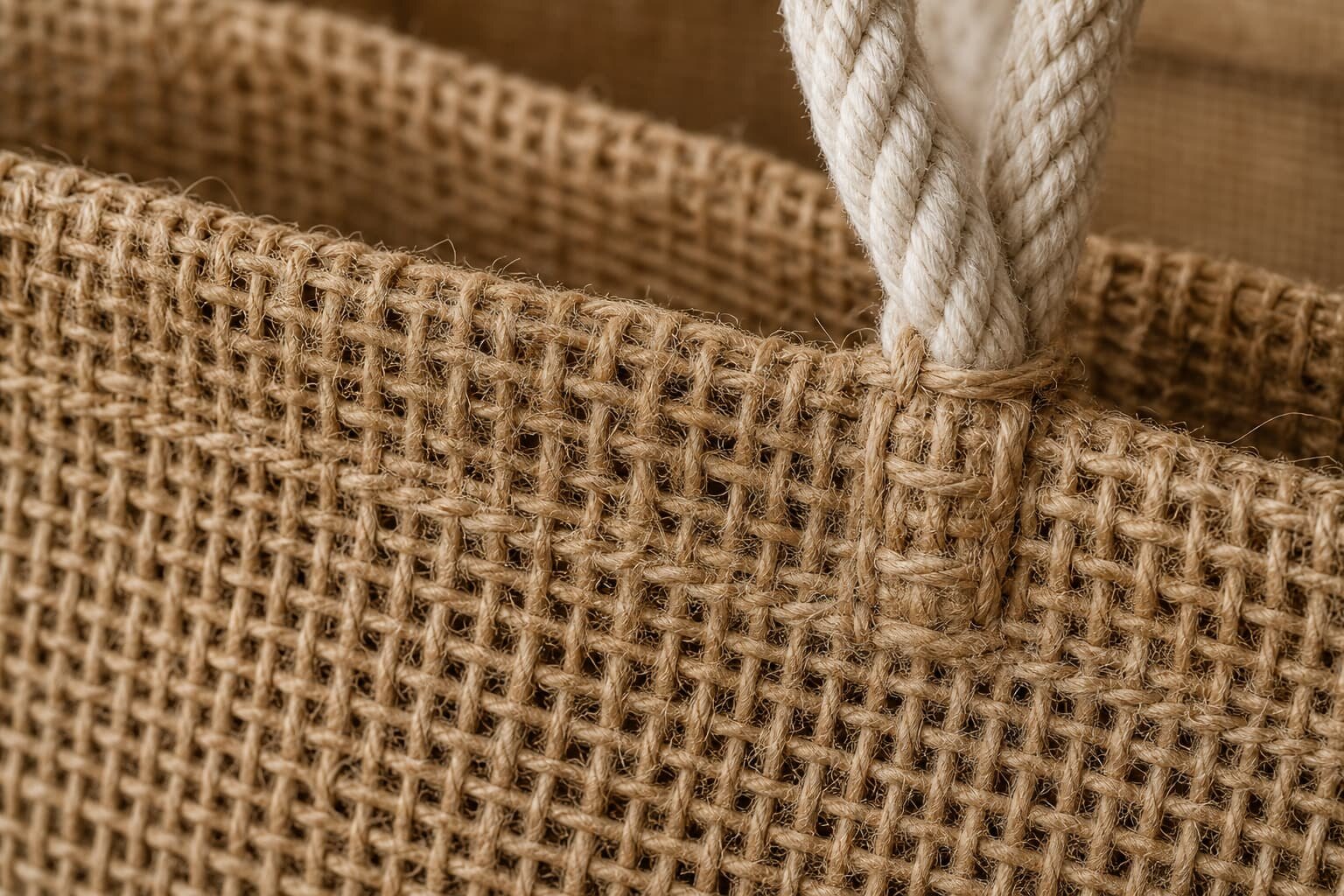
Jute and burlap are often used loosely in sales language, but the fabric choice matters. A looser rustic weave may look natural, yet it can shed more, distort during stitching, and accept print less cleanly. A denser jute burlap blend or heavier weave gives more structure and a cleaner retail look, especially if the bag must stand on a shelf.
For quote review, lock the fabric in GSM and finish, then ask for a physical swatch or photo of the exact weave. For simple promotional bags, 280-320 GSM is a common low-risk zone. For higher-value retail bags, 330-400 GSM usually gives better body. If the quote does not specify lining, lamination, or backing, assume the factory may choose the cheapest version.
- Ask if the fabric is single-layer, lined, or laminated.
- Confirm whether natural color variation is normal or controlled.
- Check edge fray on a cut sample, not just the face of the fabric.
- State the acceptable size tolerance before production starts.
Compare Print and Decoration Costs
Burlap is not a forgiving print surface. Fine text, thin lines, and large solid fills can look uneven unless the factory uses the right ink, screen count, and curing process. For most buyers, one- or two-color screen print is the safest cost and quality balance. It is usually the most transparent line item to compare across suppliers.
If the branding needs a more premium finish, a sewn woven label, canvas patch, or side label may be better than forcing detailed artwork onto rough burlap. The quote should state the decoration method, the number of colors, the print size in centimeters, and whether print is on one side or both sides. If a factory says it can do any design without extra cost, ask what that means for screens, setup, and registration.
- Request a strike-off or true sample, not only a digital proof.
- Ask whether white ink, metallic ink, or full coverage adds setup cost.
- Verify if print alignment tolerance is measured from center seam or edge.
- Make sure artwork revisions after proof approval are billed clearly.
Treat MOQ and Sampling as Commercial Terms
MOQ is one of the most misunderstood parts of a quote. A low MOQ can still be expensive if the factory spreads setup, screen, and material waste across a tiny run. A high MOQ can look cheaper per piece but leave you with excess inventory or awkward size splits. Buyers should compare total order value, not only unit price.
Sampling needs the same discipline. Separate pre-production sample, logo sample, and shipping sample if the factory uses those stages. The sample you approve should match final fabric, final trim, final print, and final packing. If the factory plans to substitute a strap tape, lining, or label during bulk production, that should be disclosed before you approve the quote.
- Ask for MOQ by color, print version, and size.
- Confirm whether the MOQ changes if you add a lining or closure.
- Ask for sample charge, sample lead time, and refund logic.
- Get written overrun or underrun tolerance, not a verbal promise.
Read the Price Breakdown Line by Line
The best quote shows where the money goes. You should see raw fabric, cutting, stitching, decoration, packing, and carton charge as separate logic, even if the final offer is a lump sum. When the supplier cannot explain the cost split, it is hard to judge whether the quote is strong or simply under-scoped.
This is where trade terms matter. EXW, FOB, and DDP are not interchangeable numbers. Ask what port is used, what currency the quote is in, whether export cartons are included, and whether labor for labels, barcodes, or polybags is built into the unit price. A quote that leaves out one of these lines may look cheap and still be the wrong total.
- Ask for separate setup charges and recurring unit charges.
- Confirm whether the quote includes cartons, inner bags, and desiccants.
- Check if artwork changes or extra logo colors create new line items.
- Make sure payment terms and validity period are stated on the same page.
Do Not Let Packing Hide the Real Cost
Packing is often where a neat quote becomes a messy order. Jute bags are bulky, so the way they are folded, stacked, bagged, and cartoned changes freight cost and warehouse handling. If you sell retail, each bag may need an individual polybag, insert card, barcode sticker, or tissue wrap. If you sell wholesale, bulk packed cartons may be enough.
Ask for the inner pack count, master carton count, carton dimensions, and gross weight. Then review whether the packing method matches the sales channel. A bag meant for shelf display should not arrive crushed or folded in a way that leaves a permanent crease. A bag meant for container loading should not waste cube with oversize retail packaging unless the margin supports it.
- Confirm if each bag is individually polybagged or bulk stacked.
- Ask for carton marks, carton number sequence, and label placement.
- Check whether handles are tucked, folded, or left exposed.
- Verify if moisture protection is needed for sea freight or humid storage.
Tie Lead Time to Approval Gates
A believable lead time has checkpoints. Ask the factory to separate sample approval, bulk material purchase, cutting, stitching, decoration, packing, and final inspection. If everything is rolled into one date, you cannot tell whether the supplier is fast or just skipping the planning detail that causes delays later.
The timing also changes when you update the bag. A logo change can require new screens; a size change can alter the cutting layout; a packing change can force new carton counts and label revisions. The quote should say what happens if artwork or spec changes after approval and whether the revised schedule is automatic or needs a new production slot.
- Ask when the lead time starts: deposit date, sample approval, or material receipt.
- Confirm whether rush orders change the MOQ or unit price.
- Request a milestone date for pre-production sample approval.
- Make the factory state who approves final artwork and carton marks.
Set Acceptance Criteria Before the PO
Production disputes usually come from vague expectations. If the buyer says the bag should be good quality and the factory says the bag passed inspection, both sides may still disagree on seam density, print sharpness, or acceptable loose threads. Use the quote stage to define what passing means in measurable terms.
For burlap bags, acceptance criteria should cover size tolerance, seam integrity, print registration, color consistency, and visible surface defects. If the bag is retail-facing, the front panel should have tighter cosmetic standards than the hidden seams. If the bag is for promotion or event use, the standard can be more functional, but it should still be written so the factory knows what to control.
- State the maximum allowed size variation in finished dimensions.
- Define seam quality, stitch density, and allowed loose thread count.
- Ask for print rub testing if the design uses dark or high-contrast ink.
- Specify odor, mold, stain, and moisture limits for packed goods.
Use a Revision Sheet Instead of a Loose Email
When a quote needs correction, do not negotiate through scattered messages. Send one revision sheet with the final size, GSM, print method, packing format, incoterm, and target MOQ. A clean revision saves time and reduces the chance that sales, sampling, and production work from different versions of the same bag.
The revised quote should clearly show what changed from the first version. That is important because many hidden cost increases happen after an innocent edit, such as adding a lining, switching from one-color to two-color print, or asking for retail packing instead of bulk packing. If the supplier cannot identify the delta, the quote is not ready for approval.
- Ask the factory to mark each revised line item with the reason for the change.
- Remove optional features before comparing final prices.
- Recheck carton size and net weight after any packing revision.
- Keep one final approved spec sheet attached to the PO.
Red Flags That Should Stop the Order
Some quotes should be challenged immediately. If the factory will not state GSM, does not explain the print method, avoids carton data, or says the sample is only for reference, the risk is too high for a clean order. A vague quote is usually not a sign of flexibility; it is a sign that the factory has not really costed the job.
Another red flag is when the supplier agrees to every request without noting cost or lead-time impact. Burlap bags are simple, but they are not zero-risk. Material variability, rough edges, and packing bulk all matter. A good supplier will tell you where the build is stable and where it needs control. That honesty is more valuable than a low number with no backup.
- Reject quotes that skip fabric weight, trim details, or trade term.
- Treat unusual low prices as incomplete until line items are explained.
- Do not approve a sample if it uses different fabric or print than the bulk plan.
- Pause the order if carton data, artwork approval, or packing method is still open.
Specification comparison for buyers
| Spec decision | Recommended option | When it fits | Buyer risk to check |
|---|---|---|---|
| Fabric weight / GSM | 280-320 GSM for promo bags; 330-400 GSM for retail or structured bags | Use when you need one clear spec across suppliers | Thin burlap can fray, print poorly, and lose shape; ask for a swatch and size tolerance |
| Lining or backing | Single layer for low-cost use; cotton lining or lamination for cleaner shape | Use when the bag must look sharper or hold better | Quote must state lining material, attachment method, and whether it is sewn in or bonded |
| Print method | 1-2 color screen print, or sewn woven label for premium branding | Use when artwork must stay visible on a rough surface | Check print area, color count, and whether one side or both sides are included |
| Handle type | Cotton webbing or rope for comfort; self-fabric handles for lower cost | Use when carrying comfort or retail look matters | Confirm handle length, reinforcement, and stitch count at the attachment points |
| MOQ and overrun allowance | State MOQ by size and color, with a tight overrun cap | Use when inventory risk must stay predictable | Open-ended overrun can raise invoice value and create excess stock |
| Packing format | Bulk carton pack for wholesale; individual polybag and barcode for retail | Use when channel requirements differ | Verify carton count, carton marks, and whether labels are applied before packing |
Buyer checklist before sampling
- Lock the finished bag size, gusset depth, and seam tolerance before requesting quotes.
- Specify the exact jute burlap GSM and ask for a matching swatch or photo reference.
- Choose the decoration method, print size, color count, and print location in advance.
- Confirm whether the quote includes lining, lamination, or a stiff insert, if needed.
- State the required MOQ, any overrun or underrun limit, and the approved size or color split.
- Ask for sample charge, sample lead time, and what version will be used for bulk approval.
- Confirm packing details: inner pack count, carton size, gross weight, labels, and barcode needs.
- Make the incoterm, currency, port, and quote validity period identical across suppliers.
- Define cosmetic and functional acceptance criteria for seams, print, odor, stains, and size variation.
Factory quote questions to send
- What exact fabric GSM, weave style, and finish are included in the quote?
- Is the price based on one side print or both sides, and how many colors are included?
- Does the quote include lining, lamination, insert boards, or other structure items?
- What is the MOQ by size and color, and what overrun or underrun tolerance do you allow?
- Are sample charges, screen charges, and setup charges separate from the bulk price?
- What packing method is quoted: bulk carton, individual polybag, or retail-ready packing?
- What are the carton dimensions, carton count, and gross weight per master carton?
- What is the lead time after sample approval and deposit, and what steps are on the critical path?
- Which incoterm, currency, and shipping port are used in the quote?
- What inspection standard do you use for seam strength, print rub, size tolerance, and visible defects?
Quality-control points to confirm
- Confirm fabric GSM against the approved swatch or reference sample.
- Check weave consistency, edge fray, and any loose fibers on cut panels.
- Measure finished size, gusset depth, and handle length against the approved spec.
- Inspect seam density, backtack quality, and reinforcement at handle attachment points.
- Review print registration, color density, and alignment to the center line or edge reference.
- Test print rub resistance and make sure ink does not crack, flake, or bleed excessively.
- Verify lining, lamination, labels, and closures match the approved bulk sample.
- Check carton count, carton marks, barcode labels, and packing accuracy before shipment.
- Inspect odor, moisture, stains, mold risk, and dust level after packing.