Start with the in-hands date
The safest planning date is not the day procurement wants to release the PO. It is the day the bags must be ready to use. For corporate gifting, that could be the morning a conference opens, the first week of an onboarding program, a distributor meeting, a sales kickoff, a university event, or a client delivery window. Those dates rarely move. Factory sewing time is only one part of the calendar, so a practical canvas messenger bags lead time planning guide for corporate gifting has to include approvals, material booking, production, inspection, freight, customs where applicable, and internal receiving.
When a supplier says production takes 25 or 35 days, ask what starts the clock. Production after deposit is not the same as production after approved artwork, approved pre-production sample, fabric arrival, and final trim release. Custom messenger bags can lose a week to logo proofing, sample transit, zipper sourcing, packing label approval, carton routing, or a warehouse appointment before bulk goods even leave the factory.
Begin with two buyer-side dates. First, identify when cartons must arrive at the warehouse, office, fulfillment center, or event city. Second, reserve time after arrival for counting, spot checks, relabeling, kitting, regional forwarding, or handover to the event team. If the bag is part of a welcome kit with notebooks, bottles, badges, or printed inserts, kitting time belongs in the same timeline as production.
- Work backward from the actual handover date, then add receiving, counting, kitting, relabeling, and internal transfer time.
- Ask suppliers to quote lead time after sample approval and material release, not only after PO or deposit.
- Build separate dates for artwork proof, sample review, bulk start, inline check, final inspection, dispatch, transit, and warehouse receipt.
- Keep a written buffer for customs review, courier delays, port congestion, warehouse appointment delays, and buyer approval lag.
- If the deadline is fixed, decide early whether a split shipment is acceptable for priority quantities.
Turn the use case into a real spec
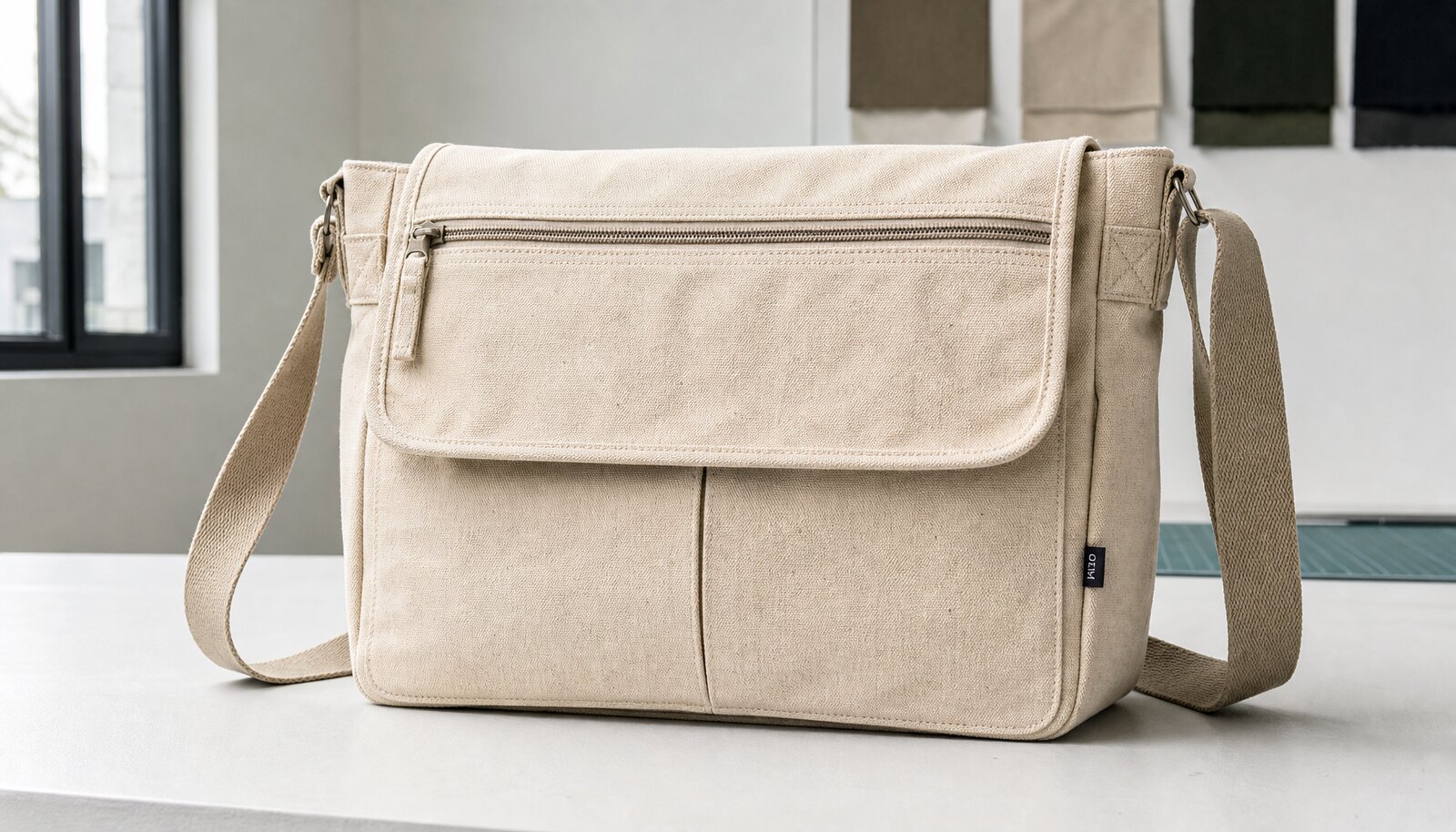
Canvas messenger bags are easy to buy from photos and hard to control from photos alone. Procurement should first define what the recipient will carry and how often the bag should be used. A trade show giveaway that holds a brochure and pen can be simpler than an employee gift expected to carry a tablet, notebook, charger, and water bottle. A sales kit may need a stable gusset and zipper top. A client gift may need a cleaner lining, reinforced base, and quieter branding.
Fabric weight should be chosen for the job, not treated as a vague premium label. 12oz canvas is common for lighter promotional bags where speed and cost matter. 14oz canvas, roughly 470gsm depending on mill conversion and finish, works well for many B2B gifting programs because it gives more structure while still printing cleanly. 16oz canvas or added interfacing can make the bag feel sturdier, but it may slow sewing, require stronger needles, add seam bulk, increase carton volume, and raise freight cost.
Capacity needs numbers. State finished width, height, gusset depth, flap depth, strap width, adjustable strap range, pocket dimensions, and closure type. If the bag must fit a tablet, A4 documents, product sample box, or standard welcome-kit insert, include those dimensions in the brief. That one detail prevents suppliers from quoting a visually similar bag that is smaller, lighter, or less useful.
- Use 12oz canvas for light event use, simple open-top bodies, and cost-sensitive campaigns.
- Use 14oz canvas for general corporate gifting when the bag should feel reusable and hold its shape.
- Use 16oz canvas, lining, padding, or reinforced base panels only when the intended contents justify the added cost and lead time.
- Specify intended contents so the factory can judge strap anchors, bottom seams, gusset depth, and closure strength.
- Freeze closure type, lining, pocket layout, strap hardware, trim finish, and logo placement before final quotation.
Make the RFQ comparable
A strong RFQ leaves fewer gaps for suppliers to fill with their own assumptions. For canvas messenger bags, include finished dimensions, body fabric in oz and gsm, canvas finish, body color, lining, closure, pocket layout, strap width, hardware finish, decoration method, logo size, logo position, quantity by version, packing format, destination, incoterm preference, and required in-hands date. If something is undecided, label it as undecided instead of letting each supplier choose a different default.
Ask for the price structure, not only a unit price. Separate the sample cost, artwork or digitizing charge, screen setup, patch tooling if applicable, unit bag cost, decoration charge, trim upcharges, individual packing, carton labeling, inspection, freight, and rush fees. One supplier may include individual polybags and carton labels. Another may assume bulk packing. One quote may be FOB port, another EXW factory, and another delivered duty unpaid. Until the scope matches, the prices are not truly comparable.
The RFQ should also define the timing assumptions behind the quote. A schedule counted from approved pre-production sample and fabric arrival is clearer than a broad promise after deposit. This matters because internal approvals often take several days. Marketing may review logo scale, procurement may approve cost, compliance may check labeling, and the warehouse may confirm carton routing. The supplier should tell you the last approval date needed to protect delivery.
- Attach vector artwork when available and state Pantone, thread, or brand color references.
- Break order quantity by body color, logo version, recipient group, destination, and packing version.
- Ask for separate line items for body, decoration, trims, labels, sample, packing, cartons, inspection, and freight.
- Require quote assumptions for incoterm, destination, carton quantity, fabric weight, decoration method, and packing format.
- Request the last buyer approval date required to maintain the quoted in-hands date.
Know who controls each step
The supplier route affects both timing and accountability. A direct factory with cutting, sewing, decoration, and packing under one management team can usually give clearer updates on custom or repeat orders. The advantage is not just price. It is knowing when fabric is booked, when cutting starts, whether first printed panels are approved, and how many sewing lines are assigned.
A trading company can still be the right partner when the gift program spans several product categories or the buyer wants one commercial coordinator. The key is transparency. Procurement should know which factory cuts and sews the bag, which vendor prints or embroiders the logo, who buys trims, and who performs inspection. If those roles are vague, quality disputes take longer to solve and schedule updates become less reliable.
Blank stock with local decoration can reduce risk when time is short and inventory is already available. It works best for standard bodies and simple one-color logos. It is weaker for custom dimensions, heavy canvas, special zipper colors, lining, private labels, multiple pockets, or premium construction. Before committing, inspect the blank stock, especially if the supplier is combining inventory from different batches.
- Use a direct factory when the spec is custom, repeat orders are likely, and production visibility matters.
- Use a trading company when the gift program spans multiple product categories and the buyer needs one commercial coordinator.
- Use blank stock with local decoration only after checking stock quantity, shade consistency, stitching quality, and decoration surface.
- Ask where cutting, sewing, printing, embroidery, patch making, washing, packing, and inspection will physically happen.
- Compare suppliers only after sample type, incoterm, packing scope, and freight responsibility are aligned.
Control artwork before it controls the schedule
Artwork is a common source of quiet delay. Corporate logos often arrive as low-resolution files, outdated marks, or artwork designed for screens rather than fabric. Canvas texture changes ink edges, opacity, stitch density, and patch adhesion. Thin lines can fill in during screen printing. Small lettering may lose clarity in embroidery. Gradients and shadows may need conversion or a different decoration method. These choices should be settled before the pre-production sample.
Screen printing is usually efficient for one or two solid logo colors and often makes sense for event-driven programs. Embroidery adds texture, but it requires digitizing, stitch testing, and density control so the canvas does not pucker. Woven patches, faux leather patches, rubber patches, and metal badges can lift perceived value, but each one adds sampling, material purchasing, attachment, and inspection. Treat every logo position and color version as its own approval path.
Placement instructions should be measurable. Instead of saying logo on flap, define logo width, height, centerline, distance from flap edge, distance from pocket seam, and acceptable rotation. For many soft goods, placement tolerance may be around +/- 5 mm to +/- 10 mm depending on logo size, panel shape, and sewing method. Agree the number in writing. Color control should rely on Pantone references, thread references, approved strike-offs, or approved first-output photos.
- Provide AI, EPS, PDF, or other vector artwork and identify the approved brand version.
- Define logo dimensions in centimeters or inches, not as a percentage of a product photo.
- Measure placement from fixed references such as flap edge, side seam, pocket seam, or centerline.
- Approve a print strike-off, embroidery stitch-out, patch sample, or first-output photo when brand color and placement are critical.
- List acceptable tolerances for logo position, color variation, registration, print opacity, and rotation before bulk decoration.
Use samples as the rulebook
The approved sample should become the production standard. For a corporate gifting order, it should confirm fabric weight, fabric finish, body dimensions, flap shape, gusset depth, strap comfort, closure function, seam construction, logo method, logo placement, inside finishing, packing fold, and overall presentation. A showroom sample or past-order reference is useful for direction, but it is not final approval if bulk production will use different fabric, trims, decoration, or packing.
Name each sample stage in the schedule. A reference sample shows general style. A mockup sample checks rough size or construction. A strike-off proves print, embroidery, or patch quality on the intended material. A pre-production sample should use final fabric, final trims, final logo method, and final construction. For fixed-event corporate gifting, this is the sample that matters most because it aligns the buyer's expectations with the factory's instructions before bulk material is cut.
Review samples quickly, but do it in an organized way. Measure the bag, load it with intended contents, test the zipper or closure, adjust the strap, inspect reinforcement, check logo visibility when the bag is filled, and look at the packed appearance. Gather comments from procurement, marketing, brand, and operations into one revision list. Scattered feedback can cost more time than the sample itself.
- Label the approved sample with date, version number, fabric spec, trim spec, logo method, and approval status.
- Take controlled photos of front, back, sides, inside, bottom, strap anchors, closure, decoration close-up, and packed unit.
- Confirm whether sample approval releases material purchase, decoration setup, cutting, or full sewing.
- Keep one approved sample with the factory and one with the buyer for higher-value or repeat orders.
- If revisions change dimensions, decoration, trims, or packing, ask the supplier to restate cost and lead time before bulk starts.
Lock materials and construction early
Canvas is only one component of the bag. Zippers, zipper pulls, webbing, D-rings, sliders, buckles, lining, thread, binding tape, snaps, hook-and-loop, woven labels, patches, hangtags, insert cards, cartons, and barcode labels can all affect the schedule. A factory may have natural canvas ready but still be waiting for a color-matched zipper tape or antique brass slider. Ask for material status on every visible and functional component before relying on the delivery date.
Construction complexity changes the production flow. A flat open-top messenger bag is relatively straightforward. A lined zipper-top bag with inner pockets, adjustable strap hardware, reinforced base, binding, and patch branding requires more operations and more inspection points. Those upgrades may be right for premium gifting, but late changes can trigger pattern revisions, new cutting markers, extra samples, and updated sewing instructions.
Material tolerances should be practical and written down. Fabric weight can vary by mill and finishing process, so define an acceptable range instead of naming only an ounce weight. Dyed canvas can vary between lots, and natural canvas may show slubs, seed specks, or slight shade differences. Those traits may be acceptable for a natural product, but the buyer and supplier should agree what is acceptable and what counts as a defect before production starts.
- Confirm availability and purchasing lead time for canvas, lining, zipper, webbing, hardware, labels, patches, cartons, and packing materials.
- State whether natural slubs, seed specks, and minor shade variation are acceptable for the chosen canvas finish.
- Specify reinforcement at strap anchors, handles, flap corners, pocket openings, bottom corners, and stress seams.
- Define inside seam finish: bound, overlocked, folded, lined, or intentionally raw-edge by design.
- Approve substitute trims only when color, finish, function, strength, and brand presentation remain acceptable.
Set QC rules before the first batch
Quality control works best when the rules are agreed before production starts. For canvas messenger bags, visible risks include crooked logos, print bleeding, shade variation, uneven stitching, loose threads, fabric marks, distorted pockets, and poor packing creases. Functional risks are more serious: open seams, detached straps, broken zippers, sharp hardware, failed snaps, or closures that do not hold. Classify defects as critical, major, and minor so final inspection is not a subjective argument.
AQL-style inspection can be useful when the order size justifies sampling inspection, but the defect list still matters. Critical defects include safety issues, severe contamination, wrong logo, unusable closure, or detached strap. Major defects include logo placement outside tolerance, open seams, skipped stitches at stress points, broken hardware, wrong fabric weight, obvious stains, incorrect packing label, or incorrect quantity. Minor defects might include a small loose thread, slight internal cosmetic issue, or shade variation within the approved range.
Measurement tolerances need to respect sewn construction. Finished dimensions may need more flexibility than rigid products because fabric relaxes, seams consume fabric, and manual sewing creates natural variation. Main dimensions may be managed around +/- 1 cm for many messenger bag styles, while logo placement may need tighter control for brand presentation. Also define how to measure: laid flat, empty, closed, seam to seam, and including or excluding gusset bulge.
- Agree critical, major, and minor defect definitions before bulk production begins.
- Set tolerances for width, height, gusset, flap depth, pocket size, strap length, and logo position.
- Inspect first decorated panels or first sewn units before the whole order repeats the same error.
- Check zipper action, snap hold, strap adjustment, hardware attachment, load-bearing seams, and lining interference.
- Require inspection photos or a report showing measured results and defect examples, not only pass or fail language.
Plan packing and receiving together
Packing affects both presentation and lead time. A canvas messenger bag may be bulk packed, individually polybagged, paper wrapped, packed with an insert card, barcode labeled, or placed in a gift box. Each option changes labor, material purchasing, carton dimensions, freight cost, and warehouse handling. If packing is decided at the end, finished bags can sit while the team waits for insert cards, labels, cartons, or routing instructions.
For many corporate programs, flat bulk packing with clear carton labels is efficient. It controls packaging cost and can reduce carton volume. Still, fold method matters. Heavy canvas can hold creases, and printed areas can be damaged if pressed against metal hardware, zipper pulls, or sharp folds. If the bag will be handed directly to executives, employees, or clients, approve a packed sample photo or packing trial before final packing begins.
Warehouse instructions should be collected early. Some buyers require carton labels with PO number, SKU, item name, quantity, carton number, barcode, destination, gross weight, net weight, and country of origin. Some fulfillment centers limit carton weight or require pallet labels and advance shipment notices. Event teams may need cartons separated by department, region, recipient group, or delivery date. These details belong in the factory pack plan before cartons are sealed.
- Choose bulk pack, individual polybag, recycled paper wrap, insert card, barcode label, or gift box based on delivery channel and presentation needs.
- Approve fold direction and packed-unit appearance when creasing, logo pressure marks, or pocket distortion would be unacceptable.
- Confirm units per carton, carton dimensions, gross weight, net weight, carton strength, sealing method, and shipping marks.
- Separate cartons by logo version, colorway, destination, department, or event group when downstream distribution requires it.
- Share routing guides, barcode rules, pallet requirements, ASN needs, and receiving appointment instructions before final packing.
Include freight in the buying decision
The lowest factory unit price is not always the lowest program cost. A landed-cost comparison should include product cost, sample cost, decoration setup, trim upcharges, packing materials, cartons, inspection, freight, duties where applicable, customs brokerage, local delivery, and rush handling. Canvas messenger bags are soft goods, but they can still create meaningful freight volume, especially with padded panels, structured bases, gift boxes, or low units per carton.
Choose freight around the event date and budget. Sea freight is usually the best fit when planning starts early and the buyer can accept a longer transit window. Air freight can protect a fixed event date, but it may change the economics of a bulky bag order. Courier is useful for samples and very small emergency shipments; it should not become the default for a large corporate gifting program unless budget owners have approved the cost. A split shipment can also work: send event-critical quantities by air and the balance by sea, or dispatch priority destination cartons first.
Documentation and receiving take time too. Commercial invoice, packing list, product description, carton data, consignee details, origin wording, and routing instructions should be checked before dispatch. If the goods go to a corporate warehouse or third-party fulfillment center, confirm appointment requirements, carton labels, ASN format, pallet rules, and delivery windows. Bags that arrive at the wrong dock, without labels, or without appointment approval may miss the moment they were ordered for.
- Compare quotes using the same incoterm, destination, packing format, delivery responsibility, and carton assumptions.
- Request estimated carton count, carton dimensions, gross weight, net weight, and total CBM before production finishes.
- Use air freight for samples, urgent launch quantities, or schedule recovery when budget owners accept the cost.
- Prepare commercial documents, consignee details, HS code review, origin information, and warehouse routing rules before dispatch.
- For fixed events, consider priority cartons, split shipment, earlier dispatch, or local buffer stock near the event city.
Specification comparison for buyers
| Planning decision | Practical B2B target | When it fits | Quote or QC risk to confirm |
|---|---|---|---|
| Planning anchor | Work backward from the required in-hands date, not the PO date | Event gifting, onboarding kits, dealer meetings, trade shows, sales kickoffs, and regional rollouts | Supplier lead time may exclude artwork approval, sample transit, customs clearance, receiving appointments, and kitting time |
| Baseline production route | Lead time stated after final sample approval and material release | Most custom canvas messenger bag orders | A quote based only on days after deposit can hide open artwork, trim sourcing, and packing approvals |
| Body fabric | 12oz, 14oz, or 16oz canvas stated with approximate gsm | 12oz for light event use; 14oz around 470gsm for general gifting; 16oz for extra structure | Actual gsm tolerance, finish, shrinkage, dye lot, and panel shade variation need acceptance criteria |
| Dimensions | Finished width, height, gusset, flap depth, pocket size, and strap length range | Bags meant to hold notebooks, tablets, literature, onboarding items, or sample kits | Photos do not prove capacity; require measurement tolerances and a loaded-fit review |
| Decoration method | Screen print for simple solid logos; embroidery, woven patch, or badge when texture justifies extra time | Corporate marks, campaign logos, employee gifts, dealer incentives, and premium kits | Fine lines, dense stitching, patch backing, color matching, and placement tolerances can drive rework |
| Construction upgrades | Lining, zipper top, inner pocket, base reinforcement, and adjustable strap approved before sampling | Reusable gifts, commuter-style bags, higher-value programs, and repeat annual orders | Every added trim creates purchasing, sewing, and functional inspection steps |
| MOQ structure | MOQ broken down by body color, logo version, trim set, packing style, and destination | Orders with departments, regions, co-brands, recipient tiers, or multiple delivery points | A total MOQ can look workable while version-level MOQ or setup charges make the plan impractical |
| Sample control | Pre-production sample using final fabric, trims, logo method, and packing direction | Deadline-sensitive programs and repeatable brand standards | Reference samples and mockups are useful, but should not release bulk production unless limitations are documented |
| Inspection plan | Inline check plus final inspection for high-risk or fixed-date programs | Custom bags with print, lining, zippers, patches, labels, or multiple versions | Final-only inspection may catch defects too late for rework before dispatch |
Buyer checklist before sampling
- Confirm final in-hands date, warehouse receiving deadline, event date, latest acceptable dispatch date, and internal kitting or distribution time.
- Freeze finished width, height, gusset, flap depth, pocket layout, strap width, strap length range, closure type, lining, reinforcement points, and intended load before PO release.
- State body canvas in oz and approximate gsm, plus finish requirements such as natural, dyed, washed, coated, brushed, or pre-shrunk.
- Define acceptable measurement tolerances, such as +/- 1 cm for main dimensions on small to medium bags and tighter tolerances for logo placement where brand presentation matters.
- Approve artwork in the actual decoration method with logo size, placement reference points, Pantone or thread references, and acceptable color and registration variation.
- Require the quote to separate sample cost, mold or setup charges, body cost, decoration, trims, packing, carton labeling, inspection, freight, and rush charges.
- Clarify MOQ by body color, logo version, decoration location, trim color, zipper type, lining option, packing format, and delivery split.
- Confirm availability and purchasing lead time for canvas, zipper, webbing, lining, thread, labels, hardware, patches, hangtags, insert cards, cartons, and barcode labels.
- Approve a pre-production sample or controlled sample photos showing front, back, side, inside, bottom, strap anchors, closure function, decoration, and packed unit.
- Ask for a milestone schedule covering artwork proof, strike-off if needed, sample making, sample review, material purchase, cutting, decoration, sewing, trimming, packing, inspection, document preparation, and transit.
Factory quote questions to send
- Can you break lead time into artwork proofing, strike-off or digitizing, sample making, sample transit, sample approval, material purchasing, cutting, decoration, sewing, trimming, packing, inspection, document preparation, and outbound shipping?
- Is the quoted production time counted from PO, deposit, artwork approval, sample approval, fabric arrival, or final material release?
- Which operations are in-house, and which are outsourced to dye houses, print shops, embroidery vendors, patch makers, washing facilities, carton suppliers, inspection teams, or packing subcontractors?
- What is the exact canvas specification in oz and gsm, and what tolerance do you apply for fabric weight, width, shrinkage, and color variation?
- Is the canvas natural, dyed, washed, coated, brushed, laminated, pre-shrunk, or finished after cutting, and will all panels be cut from the same fabric lot?
- What finished-size tolerance do you recommend for width, height, gusset, flap depth, pocket dimensions, and strap length on this construction?
- How many print colors, print placements, embroidery positions, woven labels, patches, hangtags, or insert cards are included in the quoted unit price?
- Will you provide a digital proof, print strike-off, embroidery stitch sample, patch sample, or first-output photo before full production?
- What is the MOQ and setup cost per body color, logo version, trim color, zipper type, lining option, patch type, and packing format?
- Are zipper, zipper puller, webbing, lining, thread, buckles, sliders, snaps, hook-and-loop, woven labels, and cartons in stock, or do they need separate purchasing time?
Quality-control points to confirm
- Canvas weight, weave, color, finish, and handfeel match the approved sample within the agreed tolerance, with no obvious panel-to-panel shade difference on the same bag.
- Fabric is free from prominent oil marks, water marks, heavy stains, broken yarns, holes, needle damage, cutting damage, mildew odor, or dirt on visible exterior areas.
- Finished width, height, gusset, flap depth, pocket size, strap width, strap length, and logo placement are measured against the approved spec and tolerance sheet.
- Logo size, placement, color, edge sharpness, opacity, registration, and rotation match the approved proof, with no obvious bleeding, cracking, ghosting, ink transfer, or skewing.
- Embroidery, woven labels, patches, and badges are straight, centered where specified, securely attached, and free from puckering, loose thread loops, backing exposure, glue marks, or scorched edges.
- Stitching is even and secure, with no skipped stitches, broken threads, open seams, uneven seam allowance, loose thread bundles, or missing backtacks at stress points.
- Strap anchors, handles, D-rings, buckles, sliders, flap corners, pocket openings, and bottom corners use the approved reinforcement construction and show no tearing when lightly load checked.
- Zippers, sliders, snaps, magnets, buckles, and hook-and-loop closures function smoothly and do not snag on canvas thickness, lining, loose threads, or seam allowances.
- The bag sits balanced when lightly loaded, and the flap, gusset, pocket, base, side seams, and lining align with the approved sample without twisting or severe distortion.
- Interior seams, binding, lining, inside pocket, and raw-edge treatment follow the approved construction and are clean enough for corporate gifting presentation.