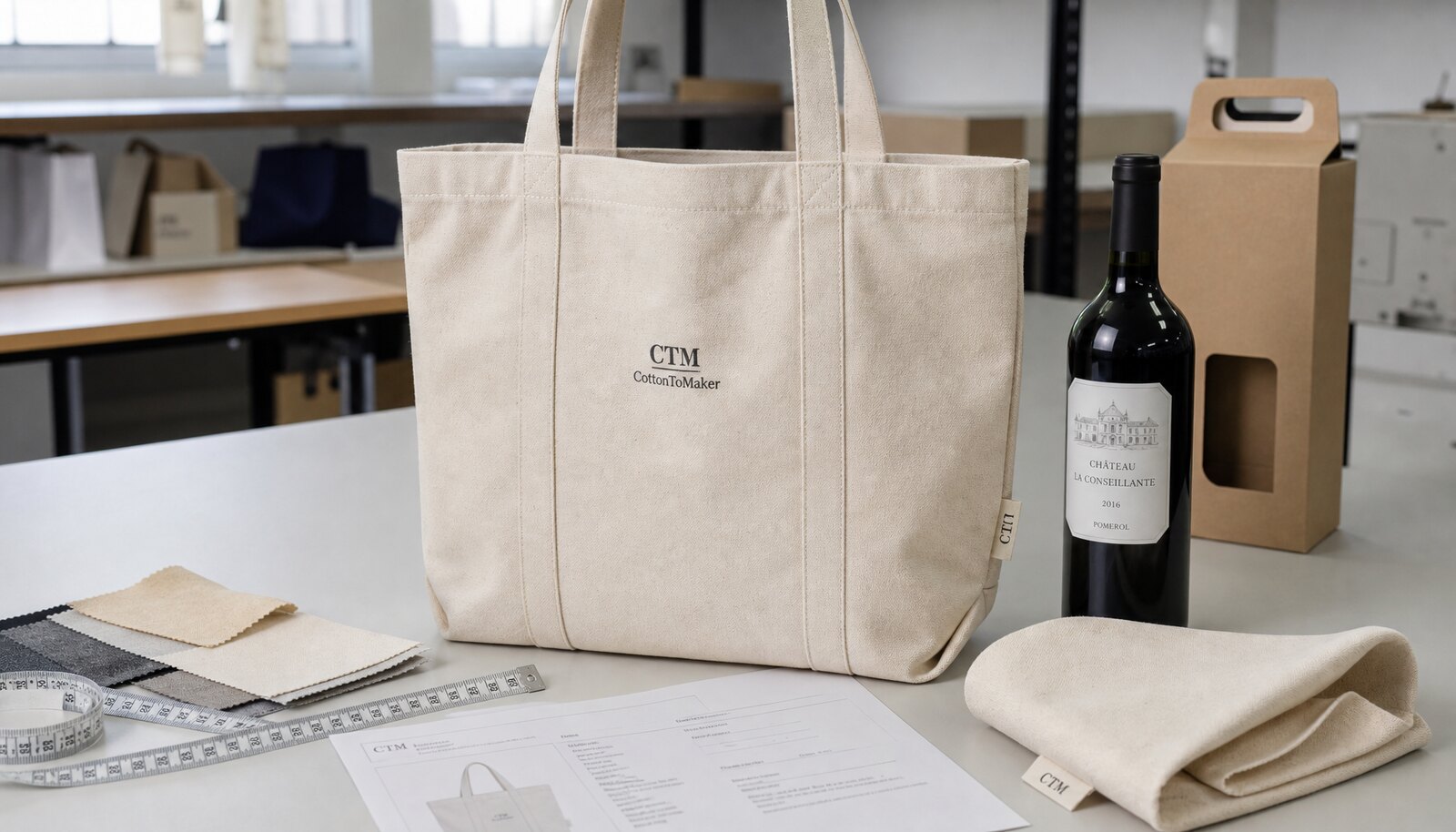
Start with the winery use case, not the tote shape
A recycled canvas tote for a winery is not just a branded carrier. It has to hold a bottle securely, look acceptable at retail, survive repeated handling in tasting rooms, and still feel aligned with the price point of the wine inside it. That is a different job from a generic promo bag, so the sourcing spec has to start with the bottle and the customer journey, not with a recycled canvas weight copied from another category.
The key question is whether the tote is meant for immediate gift presentation, recurring retail resale, member shipments, or a short-run event giveaway. Those four scenarios can justify very different construction choices. A bag for a bottle-and-glass gift set needs better structure and base control. A tasting-room resale item needs cleaner presentation and more repeatable print. A giveaway can be simpler, but even then it should not collapse around glass or arrive with weak seams.
- Single bottle carry: prioritize bottle height clearance, handle strength, and a stable base.
- Two-bottle or gift set use: prioritize gusset depth, divider structure, and upright balance.
- Retail resale: prioritize print quality, stitch neatness, and fold consistency on shelf.
- Club or membership packs: prioritize repeatable specs, reorder predictability, and low shade variation.
Lock the bag architecture before you ask for price
Procurement teams often ask for quotes before they have the bag architecture defined. That invites apples-to-oranges pricing. A quote should reflect the actual construction: body dimensions, gusset depth, handle length, reinforcement method, lining or no lining, and whether the tote needs a divider or closure. If any of those items are still open, the price is only a placeholder.
For winery programs, the base and handle geometry matter as much as the fabric itself. A narrow base may save fabric but can tip over with a bottle. Handles that are too short make the bag awkward once a customer adds a bottle gift box or a second item. Ask the supplier to show a dimensioned drawing or paper pattern so you can review the carry behavior before approving a sample.
- Ask for a dimensioned cut sheet with finished size, handle drop, and gusset depth.
- Confirm the bottle orientation: vertical, diagonal, or side-by-side.
- State whether the bag must stand on its own or can be stored flat only.
- Specify whether the closure is open-top, snap, drawstring, or zip, because each one changes labor and fit.
Compare supplier routes on cost, control, and repeatability
The same tote can cost very different amounts depending on who is making it. A direct factory often wins on ex-factory price once the order is large enough to absorb setup, but the buyer needs more discipline on approvals, scheduling, and QC. A trader or sourcing agent can be easier to manage when the team is small or the order mixes multiple winery SKUs, but the margin stack can hide real cost. A domestic converter may be the fastest route for a launch, even if the unit price is higher, because freight risk and communication overhead are lower.
Use the supplier route comparison as a control tool, not a price ranking. The lowest unit price is not automatically the best landed cost if the supplier cannot show a stable recycled fabric source, if the carton pack is inefficient, or if the factory subcontracts without telling you. For winery buyers, the better supplier is the one that can hold the same bag spec across reorders and give you the evidence to prove it.
- Direct factory: best for repeat programs and controlled QC, provided the paperwork and sample trail are clean.
- Trading company or agent: best when you need coordination across factories, but verify the actual maker and QC owner.
- Domestic converter: best for speed and lower shipping complexity, but usually not the cheapest at volume.
- Hybrid route: workable for custom art or local finishing, but split responsibility needs to be written down.
Recycled fabric claims need documentation, not just a sustainability sentence
If the bag will be marketed as recycled content, do not rely on a product page claim alone. Ask which document supports the claim and whether the document applies to the exact lot you are buying. Depending on the market and how the claim will be used, that may mean GRS, RCS, a mill declaration, a transaction certificate, or another chain-of-custody record. Your legal or compliance team should decide how formal the evidence needs to be, but the supplier has to be able to produce it.
Also ask what varies from lot to lot. Recycled canvas can show shade shift, surface flecks, and texture changes that are normal but still relevant for a retail brand. If the winery wants a clean, premium look, set an acceptance band against the approved master sample. If the look is intentionally rustic, define the limit anyway so the factory does not treat every variation as acceptable.
- Request the document type for recycled-content proof before sampling starts.
- Ask whether the fabric is lot-traceable back to the mill or only traceable at the factory level.
- If you sell in regulated markets, confirm any chemical or labeling requirements with your compliance team.
- Approve the acceptable shade band against a master sample, not against a web photo.
Choose print and decoration methods that survive retail handling
For winery logos, simple screen print is usually the best balance of cost and durability when the artwork uses one to three solid colors and the line work is not too fine. It holds up well on recycled canvas and gives a clean retail appearance when the ink density and curing are controlled. If the art is more detailed, ask for a proof on the same fabric rather than assuming a flat digital mockup will translate cleanly.
Heat transfer and digital decoration can work for short-run seasonal artwork or multicolor designs, but canvas texture can expose the weakness of a thin transfer. Embroidery can look premium on thick panels, yet it adds cost and can pull lighter canvas out of shape. Woven labels, side labels, or a small patch are useful when the winery wants quieter branding and less ink coverage. The right choice depends on whether the bag is a premium sell-through item, a club pack accessory, or a promotional give-away.
- Use screen print for simple logos and higher volume.
- Use transfer or digital methods only after testing adhesion and edge wear on the actual canvas.
- Use embroidery only if the panel is thick enough to hold the stitch without puckering.
- Set the minimum line thickness and color count in the RFQ so the factory quotes the right process.
Normalize quotes to landed cost, not just the ex-factory number
A good tote quote should be evaluated on the total landed cost per sellable unit, not just the factory price. That means you need to include sample charges, print setup, packing materials, carton volume, origin and destination handling, freight, and any duty or tariff exposure your broker expects for the chosen origin and classification. If one supplier quotes EXW and another quotes FOB, convert them to the same basis before comparing.
Illustrative example: if a quote is $1.20 FOB for 5,000 bags, that is $6,000 before freight and duty. If carton optimization reduces volume by 15 percent, the freight savings can be larger than a few cents on unit price, especially on LCL or air shipments. If your customs broker later confirms that the duty is calculated on customs value including packing, then a lower bag price does not always create a proportionate landed-cost win. Ask for a landed-cost model, even if it is only an estimate, before you award the order.
The same logic applies to carton packing. A bag packed too loosely may look cheaper on paper, but the higher dimensional weight and extra warehouse handling can erase the savings. If the bag is going to distributors or a fulfillment center, carton efficiency should be part of the commercial decision, not a warehouse afterthought.
- Compare quotes on the same Incoterms and the same carton specification.
- Ask the supplier to separate one-time setup costs from recurring unit costs.
- Request a freight estimate based on carton dimensions, not just bag count.
- Have your customs broker confirm tariff classification and any origin-related exposure before you lock the supplier.
Use MOQ and reorder rules that match your selling pattern
MOQ should reflect how the winery actually buys, not how the factory prefers to sell. A tasting-room tote that will be reprinted every season can justify a higher MOQ if the artwork stays stable and the stock turns quickly. A club gift bag with variable art, seasonal wine labels, or regional release dates needs more flexibility. If the supplier sets one MOQ for all colors and all artwork, you may end up paying for inventory that outlasts the campaign.
A stronger sourcing setup is tiered by complexity. For example, one-color art on one fabric color should have a different price break than a multi-color design with multiple versions. Ask whether reorders can come in below the first-order MOQ once the tooling and setup are already in place. That small question often decides whether the program becomes a reusable stock item or a one-time purchase that has to be redesigned every year.
- Ask for MOQ by design, color, and print method, not just one headline number.
- Confirm whether price breaks reset on each reorder or only on the first run.
- If you need multiple winery SKUs, ask whether the supplier can combine them under one fabric run.
- Check whether overrun units are billable and whether underruns are acceptable with a credit or a remake.
Approve a sample against a real bottle and a real pack-out
A sample should function like a prototype, not a display prop. Put the actual bottle or gift set into it. Check how the base sits, whether the bottle neck clears the top edge, and whether the bag stays upright when carried or placed on a counter. A tote can look right in a photo and still fail the moment a customer picks it up with glass inside.
The sample review should also cover print placement, seam alignment, fold behavior, and how the recycled fabric looks under normal retail lighting. Keep one approved master sample labeled with the version number, date, and artwork file name. If the supplier changes fabric lot, print method, or handle reinforcement later, you will need that baseline to decide whether the change is acceptable or not.
- Test with the actual bottle height and weight, not a generic dummy shape.
- Check the bag in daylight and under indoor retail lighting.
- Confirm that the sample fold matches the carton pack plan.
- Mark the golden sample and keep it tied to the order version.
Set measurable QC thresholds before production starts
Inspection language like neat sewing or good finish is too vague for a production order. Quality control needs measurable points that the factory and your receiving team can both use. For recycled canvas totes for wineries, the critical points are usually the handle root, side seam, base corners, print registration, finished dimensions, carton count, and lot consistency. If those are under control, most other issues are cosmetic rather than functional.
Do not wait until final inspection to discover a seam weakness. Ask for inline checks or at least documented process checkpoints before packing begins. For printed bags, ask for a defined rub or crocking check on the artwork. For sewn bags, ask for a seam and handle reinforcement check against a known load target. For packed cartons, ask for a count and fold review so the warehouse does not inherit a problem that should have been caught in the factory.
- Set a written size tolerance for body dimensions and handle placement.
- Reject any skipped stitching, seam opening, or handle pullout at the load-bearing points.
- Use a dry and wet rub check on the print area and define the pass mark in the PO.
- Inspect carton count, fold quality, label placement, and any odor or contamination before release.
Plan packing, shipping, and receiving as part of the order
Canvas totes are bulky, so packing and freight can change the economics of the order more than the unit price does. A slightly cheaper bag that packs poorly can cost more by the time it reaches your warehouse. Ask for carton dimensions, gross weight, palletization details if applicable, and whether each bag is folded with tissue, a polybag, or nothing at all. The answer changes freight, warehouse labor, and the look of the first retail opening.
For winery buyers, flat-packed cartons are usually the cleanest option, but the exact pack count has to balance protection against volume. If the bags are being shipped to a distributor or fulfillment center, confirm whether they need barcodes, country-of-origin marks, care labels, or outer carton markings. If the supplier cannot describe the shipping pack clearly, the order is not ready for PO release. The same is true if the receiving team cannot tell how many sellable units should be in each carton without opening it.
- Confirm inner pack style, master carton count, and carton dimensions before approval.
- Ask whether the order ships retail-ready or as warehouse stock for downstream finishing.
- Make sure the country-of-origin mark and any required labels match the destination market.
- Use the same pack-out plan for reorders unless you deliberately want a new freight model.
Specification comparison for buyers
| Supplier option | Typical cost behavior | Best-fit order scenario | What to verify before award |
|---|---|---|---|
| Direct cut-and-sew factory | Usually lowest ex-factory cost once the spec is locked, but setup and export details are on you | Recurring winery programs, custom sizing, and orders that need repeatability across seasons | Confirm no subcontracting without approval, request fabric source disclosure, and require a pre-production sample plus carton spec |
| Trading company or sourcing agent | Higher unit price because margin is layered in, but quoting and communication are simpler | Smaller programs, mixed-SKU buys, or teams without in-house sourcing bandwidth | Ask who actually makes the bag, who owns QC, how changes are billed, and whether the invoice chain matches the factory of record |
| Domestic decorator or converter | Higher unit cost, usually lower freight risk and faster turnaround | Launches, urgent event packs, local resale programs, or orders below a factory-friendly scale | Verify blank-bag origin, print durability after flexing, carton pack count, and whether the lead time is truly in-house |
| Hybrid model: overseas blank bag + local print/finish | Can be efficient for version control, but split responsibility can add rework cost | Seasonal winery artwork, variable club tiers, or programs where local decoration matters | Define who owns color matching, who pays for rework, and whether local finishing changes the landed cost enough to justify the split |
| Material | cotton canvas, jute, felt, nonwoven, or laminated paper sized to bottle diameter, weight, and condensation risk | Before price comparison | Different cloth weights, backing, or certification claims make quotes hard to compare |
| Construction | bottle fit, bottom reinforcement, handle or cord strength, divider option, seam allowance, and upright stability | Before sampling | Weak stress points create returns and failed inspections |
| Decoration | screen print, hot stamp, woven label, embroidery, or paper label positioned for curved bottle presentation | Before artwork approval | The wrong method can crack, bleed, pucker, or fail on the chosen fabric |
| MOQ | Base MOQ plus change drivers | During quote review | Custom colors, trims, and packing can change minimums |
Buyer checklist before sampling
- Start with the use case: single bottle, two-bottle, club gift set, or retail resale, then size the tote around the actual bottle dimensions and the carry experience you want.
- Ask for a dimensioned spec sheet, not just a product photo. You need finished size, handle drop, gusset depth, base width, print area, and fold size.
- Lock recycled-content documentation early if you plan to market the bag as recycled. Request the document type up front, whether that means GRS, RCS, mill declaration, or transaction certificate.
- State the print method, number of colors, and Pantone references before you ask for a price so the supplier does not quote the wrong setup.
- Compare quotes on the same basis: material weight, stitch construction, reinforcement, print method, packing count, sample fees, overrun allowance, and Incoterms.
- Ask for a physical swatch or production sample. Recycled canvas can vary enough in shade and hand feel that a text-only spec is not sufficient.
- Define the carton target before approval. Bulky canvas often costs more in freight than buyers expect, so carton size and pack count belong in the RFQ.
- Require a pre-production sample or golden sample sign-off before bulk cutting starts, and keep the approved sample labeled by version and date.
- Build a reorder rule into the contract: whether price breaks reset by color, by artwork, or by total annual volume.
- Ask the supplier to confirm what is excluded from the quote, especially inland pickup, export paperwork, destination handling, and any duty-related assumptions.
Factory quote questions to send
- What recycled canvas weight, weave construction, and recycled-content evidence are you quoting, and can you send a swatch or spec sheet before we award the order?
- Is the MOQ based on one design, one color, one print method, or a combined order across multiple winery SKUs?
- Which print method do you recommend for the artwork, and what are the setup charges, screen counts, minimum line thickness limits, or color limits?
- Can you quote the same bag with and without lining, base reinforcement, divider panels, or closures so we can compare landed cost options?
- What finished size tolerance do you commit to on width, height, gusset, and handle placement, and how do you measure it?
- What stitch density or seam construction are you using at the handle root and side seams, and can you show a photo of the reinforcement detail?
- What carton pack count, carton dimensions, and gross weight do you recommend for export, and how many bags fit before the tote starts to crease?
- What sample stages do you offer, how long does each one take, and is the pre-production sample credited against bulk?
- What overrun or underrun tolerance do you allow, and are extra units billable at the contract price or a different rate?
- Which Incoterms are you quoting, and what is excluded from the price such as inland freight, customs docs, or destination charges?
Quality-control points to confirm
- Finished dimensions should stay within a written tolerance against the approved sample. For most buyer specs, that means a practical tolerance of about plus or minus 1/4 inch, or about 6 mm, on the main body dimensions.
- Handle placement and handle length should be consistent on both sides, with no visible skew. Misaligned handles change how the bag carries a bottle and are a common reason for retail rejection.
- Primary load seams at the handle root and base corners should have no skipped stitches, no open seam gaps, and no loose thread tails longer than about 5 mm.
- Ask for a static load check at no less than the intended carry load, and ideally at about 2x the intended bottle weight for a short hold. The bag should not show seam opening or handle pullout.
- For printed bags, require a dry and wet rub check on the approved print area. Use a recognized method such as AATCC 8 or ISO 105-X12 if your compliance team wants a formal reference, and set the pass mark in the PO.
- Reject any shipment with obvious oil marks, fiber contamination, adhesive bleed, or odor that would be unacceptable in a retail tasting room or gift shop.
- Shade variation should be compared against the approved master sample, not only against the supplier's internal standard, because recycled inputs can vary between lots.
- Carton count should match the purchase order exactly, with no mixed counts unless the packing list clearly states the mix. A small count error becomes a larger warehouse problem on receipt.
- If the tote is sold as recycled content, the document trail should match the lot actually shipped. Ask for lot traceability and keep the approval sample tied to the production batch.
- Receiving inspection should include fold quality, label placement, print position, and carton condition. Crushed cartons, shifted folding, or bag deformation are enough to fail a lot if the bags are retail-facing.