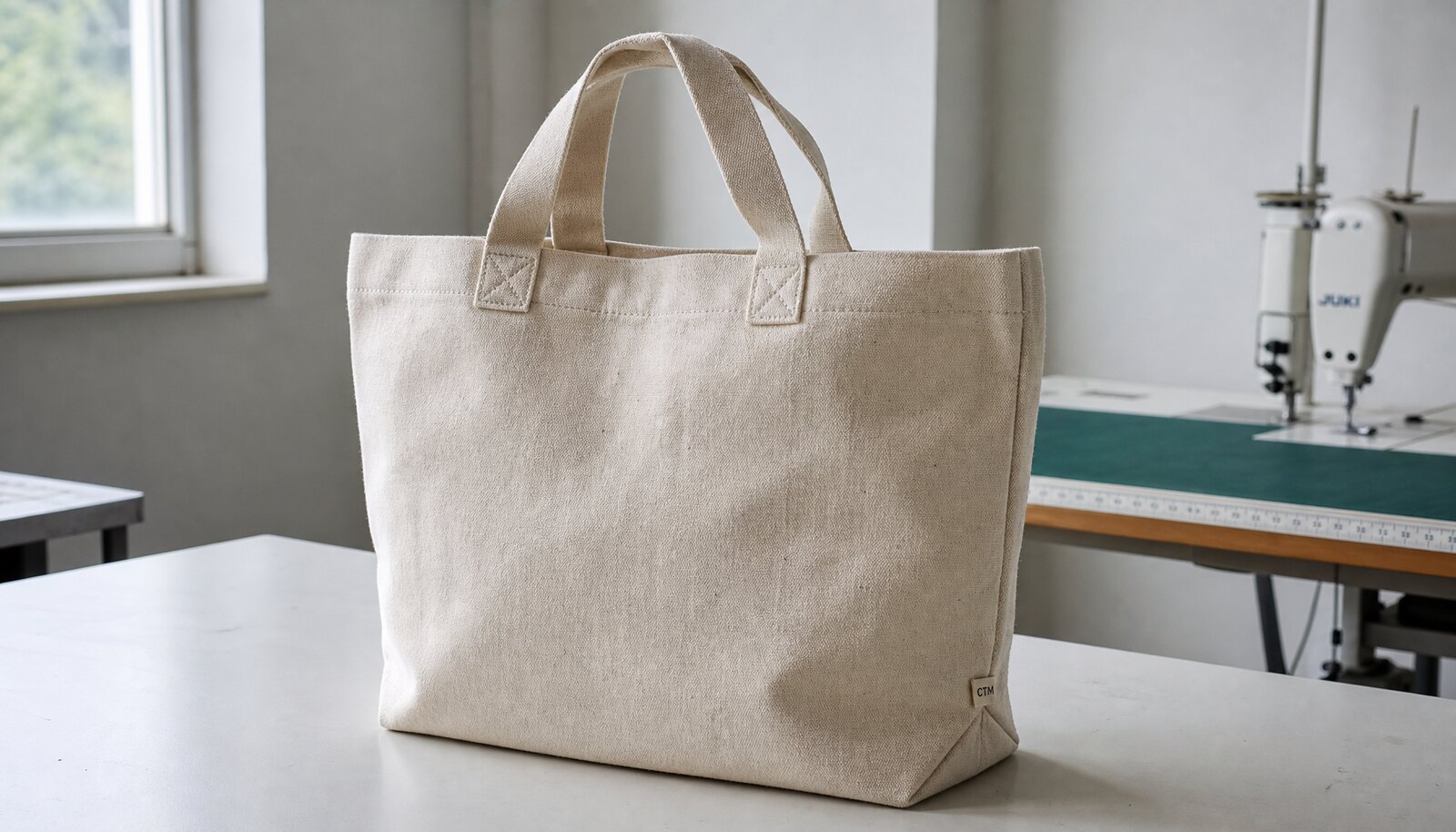
Start With the Use Case, Not the Artwork
Most quote problems start when buyers lead with the logo and leave the job definition vague. A tote for a trade-show handout is not the same product as a retail carry bag, bookstore bag, grocery bag, or subscription-pack insert. If the bag only needs to leave a booth with brochures and a sample, a lighter build and a simpler stitch package can work. If it needs to carry books, bottles, laptops, or repeated daily loads, the fabric, handle reinforcement, seam structure, and packing standard all need to move up together.
When you send an RFQ, describe the actual use, not just the decoration. State whether the bag has to stand upright, fold flat for e-commerce shipping, hang on a peg, ship on a shelf with a barcode already attached, or survive repeated use over months. That context tells the factory whether to quote a basic promo build or a more durable retail spec. If the use case is unclear, the supplier fills the gap with its own assumptions, and that is where quote drift begins.
- Promo handout: lighter build, simpler print, lower-cost bulk packing.
- Retail carry: stronger handle attachment, cleaner finish, tighter dimensional control.
- Heavy-use program: thicker canvas, reinforced seams, and a real load test.
- If the bag must work in-store, add folding, barcode, and carton-label requirements to the RFQ.
Normalize the Spec Before You Compare Price
A useful quote is a technical offer, not a sales estimate. The most important buying discipline is to put every supplier on the same basis before you compare the number at the bottom. That means the same finished size, the same fabric weight basis, the same print coverage, the same handle construction, the same packing variant, and the same incoterm. A low quote on a lighter fabric or a simpler pack is not a better quote until the spec has been normalized.
Use a dimensioned tech pack, not a paragraph of notes. Include finished width, height, and gusset depth; cut size if the factory insists on quoting it; handle length and width; reinforcement method; print area; and carton pack. If you also need audit documentation, test reports, or traceability, ask for those at quote stage. A supplier that can quote the bag but not the supporting documents is often not the right fit for procurement-led buying.
- Compare finished size against finished size, not finished size against cut size.
- Ask for the same pack count and the same packaging format on every quote.
- Request any audit documents or test reports up front if the program is compliance-sensitive.
- If a supplier cannot state the exact assumptions, treat the quote as incomplete.
Choose Canvas Weight by Load, Hand Feel, and Decoration Coverage
Buyers often ask for 'canvas' as if the term were a standard. It is not. A better approach is to tie the fabric weight to the actual job. As a practical starting point, 6-8 oz works for light promotional carry and low-cost distribution, 10 oz works for most retail and general-purpose programs, and 12 oz or more is safer when the bag needs a denser hand feel, better body, or heavier load capacity. The right choice also depends on whether the artwork needs a smooth print surface or whether texture is part of the brand look.
Do not accept a vague fabric description. Ask whether the weight is finished or greige, whether the cloth has been pre-shrunk, and what shrinkage allowance the factory has built in. Ask for weave description, shade variation range, and hand-feel expectations. If you are normalizing bids across multiple factories, make them quote the same fabric basis or the comparison is meaningless. A 10 oz bag quoted from one mill and an 8 oz bag quoted from another is not a pricing comparison, it is a spec mismatch.
For procurement use, the best fabric weight is the one that matches the channel and the expected abuse. If the tote is headed to a premium customer-facing program, require a sample cut and a sealed shade reference. If the tote is a high-volume giveaway, focus on weight consistency, color stability, and repeatable sourcing of the blank. The point is not to over-engineer every bag. The point is to avoid buying the wrong weight and then spending money to correct the mistake after release.
- 6-8 oz: light promo programs and broad giveaway use.
- 10 oz: balanced option for retail, bookstores, and everyday carry.
- 12 oz and above: heavier loads, premium presentation, or a more structured bag.
- Ask for finished GSM, shrinkage allowance, and a sample cut before final approval.
Construction Details Change the Bag More Than the Logo
On custom canvas tote bags, the handle, gusset, seam allowance, and reinforcement pattern usually matter more than the logo. A long handle changes how the bag carries on the shoulder. A bottom gusset changes how the bag stands and how much it can hold. Box-X reinforcement or dense bar-tacks at the handle attachment points reduce failure risk when the bag is loaded and swung around in use. If the bag is supposed to survive retail traffic, the seam structure is not a cosmetic detail; it is the product.
Ask the supplier to quote the exact construction, not a generic tote. If the handles are self-fabric, confirm handle width, finished length, and whether the handles are folded, turned, or raw-edge concealed. If there is contrast binding, ask whether it is decorative or structural. For heavier programs, require the sample to show how the stitching lands at stress points and how the corners are turned. A neat sample is useful, but a controlled construction is what prevents returns and rework.
This is also where buyers can save money without damaging the product. If the use case is light and the bag does not need to carry weight, you may not need the most elaborate reinforcement package. If the use case is demanding, do not let the supplier simplify the seam logic just to make the line easier to run. The quote should reflect the construction that matches the channel, not the construction that is easiest for the factory to sew.
- Define handle length, handle width, and attachment style in the spec sheet.
- State whether you want a side gusset, bottom gusset, or flat body.
- Require reinforcement at the handle attachment and base corners.
- Ask the supplier to identify the stitch density by seam zone on the sample.
Match Print Method to Artwork, Quantity, and End Use
Screen printing is still the default for many custom canvas tote bags because it handles spot colors well, gives strong coverage, and scales cleanly on repeat orders. It is usually the right choice when the artwork is simple, the logo is large, and color consistency matters. Heat transfer can work for shorter runs, more detailed graphics, or smaller orders, but the buyer should check hand feel, edge quality, and adhesion after curing. Embroidery is less common on lighter canvas because it can distort the fabric, but it can work when the brand wants a premium tactile cue on a heavier bag.
The right method is the one that matches the artwork and the service level. If the design has thin lines, small type, or tight registration, ask the factory for the minimum readable line width and the likely failure points. If the artwork uses gradients or photographic detail, ask whether the supplier can control the result at the intended volume or whether a simplified print would be safer. Do not let the supplier choose a method only because it fits their line. Choose it because it can survive production and field use.
Buyers should also normalize setup costs. Screen count, color count, cure method, and setup time can change the economics more than the base bag price. A two-color logo with a low setup fee may beat a supposedly cheaper quote that adds hidden charges for each screen, each color change, or each additional print position. That is why the RFQ needs the exact artwork, the exact coverage, and the exact print method before the supplier prices it.
- Screen print: best for flat spot colors and repeat orders.
- Heat transfer: useful for small runs or more detailed graphics.
- Embroidery or woven label: better when the brand wants a tactile premium cue.
- Set a minimum line width and clear space around the logo to reduce print defects.
- Ask for a cure or adhesion test result on the approved sample.
Vet the Factory, Not Just the Quote
A low quote is only useful if the supplier can actually execute it. The first screening step is to confirm that the factory makes the relevant product type in-house or through a stable, disclosed network. Ask who sews, who prints, who controls packing, and whether any critical step is subcontracted. If the answer changes by order size, that is not a deal breaker by itself, but it is a traceability problem you need to understand before placing the PO. The buyer should know whether the same plant handles cutting, sewing, printing, and final packing, or whether the tote moves between sites.
Traceability matters because it tells you what can be controlled after approval. Ask for the source of the blank cloth, the dye or color batch if relevant, and the lot or batch reference that will appear on shipment paperwork. For repeat orders, confirm how the factory will link the finished cartons back to the approved sample and production run. That linkage is what lets procurement resolve complaints without restarting the entire investigation. If the supplier cannot explain how traceability works, it will be harder to isolate quality issues later.
A practical vetting workflow is simple: request the factory profile, ask for a recent product photo set from an order similar to yours, verify the business registration details if your internal policy requires it, and compare the quoted process against the physical sample. If possible, review an actual production floor photo or short video that shows the sewing line, print area, and packing station. The point is not to create bureaucracy. It is to confirm that the supplier can manufacture the exact tote you are buying, not a nearby substitute.
- Ask which steps are in-house and which are subcontracted.
- Request the material source, batch or lot references, and how they map to the finished cartons.
- Verify that the quoted process matches the actual sample and not just the sales description.
- Use a recent photo set or short factory walkthrough video to check the real line setup.
MOQs, Sampling, and the Cost of Small Changes
MOQ is not just a factory rule. It reflects how much setup work the order creates. A simple stock-color canvas tote bag with one-color printing and standard packing can often be quoted at a lower MOQ because the factory can use existing fabric, existing sewing patterns, and standard carton routines. Add a custom size, special handle length, multiple print colors, or a branded label, and the MOQ usually rises because the line has to stop and reset. Buyers sometimes assume the MOQ is a negotiation target, but in many cases it is a setup math problem.
Sampling needs the same discipline. Separate the digital proof, the sewn sample, and the pre-production sample. If the artwork changes after the physical sample is made, the sample no longer protects you. For programs with a hard launch date, ask for the sample path up front and make the supplier state what happens if the print or sewing result differs from the approved reference. The goal is not to get the cheapest sample. It is to avoid discovering the mistake in full production.
For commercial buying, ask the supplier to itemize what changes trigger a new setup fee. Some factories will absorb small artwork edits; others will charge for every screen revision, label change, or packing adjustment. Put those triggers in writing so procurement can forecast the real cost of change before the creative team approves the final version. That is the practical difference between a quote and a controllable program.
- Stock blank plus standard print usually supports the lowest MOQ.
- Custom fabric, custom size, custom label, or special packing usually increases MOQ.
- Separate proof approval from physical sample approval.
- Treat the approved sample as the production reference, not the sales mockup.
- Ask which changes trigger a new setup fee before artwork is finalized.
Compare Landed Cost, Not Just Unit Price
A fair quote comparison starts with landed cost. On custom canvas tote bags, the unit price can hide packaging, origin handling, documentation, test fees, inland transport, and destination charges. Two quotes that look close on paper can diverge sharply once you include the real shipping model. A supplier that quotes a low ex-factory price but leaves freight, carton labeling, or export paperwork out of scope can end up more expensive than the supplier with a cleaner all-in offer.
Ask each supplier to break the quote into the same cost buckets: bag price, print setup, packaging materials, packing labor, origin charges, test or document fees, and freight basis. If you need DDP, clarify whether duty, brokerage, and local delivery are included or merely estimated. If you are buying on FOB or EXW, confirm who books freight, who pays origin charges, and who is responsible if the cartons miss the ship date. Procurement teams lose time when the quote looks complete but the incoterm interpretation is different at each supplier.
This is also where landed cost can be improved without changing the product. Consolidating cartons, simplifying unit pack, or standardizing the label format may reduce labor and freight volume. But those savings only matter if they do not break the receiving channel. The right comparison is not the cheapest bag. It is the lowest cost version that still passes the buyer's receiving, shelf, and freight requirements.
- Break quotes into product, setup, packing, origin, and freight assumptions.
- Confirm whether the quote is EXW, FOB, CIF, DDP, or something similar.
- Check whether labels, carton marks, and test documents are included or extra.
- Normalize freight volume and carton count before comparing suppliers.
Set Hard QC Thresholds Before Production Starts
Quality control for canvas tote bags should focus on the defects buyers actually see in the field: wrong size, weak handles, crooked print, off-color fabric, poor folding, and inconsistent label placement. A sample can look acceptable even if the factory is not controlling the line tightly. That is why the approval process should include the first sewn and printed output, not only the final sample. Once production starts, the checks need to cover dimensions, seam behavior, print quality, and packing consistency.
Set the acceptance standard in plain language and in numbers. As a starting point, many teams use about +/- 0.5 cm on smaller dimensions and about +/- 1.0 cm on larger dimensions, but retail and carrier programs often tighten that range in the spec. Stitch density should be defined by seam zone, not left to the operator's preference. A practical baseline for many programs is 7-9 stitches per inch on body seams and 8-10 on handle seams, but the right range depends on fabric weight, seam type, and intended load. If the bag will be heavily loaded, define a program-specific strength test rather than relying on a generic number.
Print quality needs the same discipline. Ask for registration tolerance, edge sharpness, and color target, and define what counts as acceptable after curing. A crosshatch tape test is a simple way to catch adhesion issues before shipment; the point is not to make the factory guess. It is to force the factory to prove that the print survives handling. If you buy through AQL, put the defect classes in the PO. If you do not use AQL, spell out the pass/fail rules so that inspection is not negotiated after the fact.
- Use the approved physical sample as the production reference.
- Define size tolerance, stitch density, seam strength, and print adhesion requirements.
- Inspect the first output from printing and sewing, not only the final carton sample.
- Require carton count, barcode, and folding checks at the packing stage.
- Use AQL 2.5 major and 4.0 minor as a common baseline only if it fits your program.
Packing Specs Affect Retail Readiness and Freight
Canvas tote bags are light but bulky, so packing decisions change both cost and usability. A flat-fold pack reduces carton volume and usually makes freight more efficient. If the bag is headed to retail, you may need individual polybags, belly bands, hangtags, or barcode stickers, but each of those adds labor and materials. A factory can quote a competitive bag price and still lose the order on packing if it cannot deliver shelf-ready units in the right sequence.
Packing also affects condition when the cartons are opened. A loose pack can wrinkle the fabric, shift the print, or bend the handles. An overly tight pack can crush the tote and leave visible fold lines that look poor in a retail environment. The right answer depends on the channel: distribution cartons for B2B replenishment can be simpler, while store-ready assortments need more disciplined unit packing and carton labeling. Make the supplier quote both the bag and the packed format so you know what the true comparison is.
If your retail partner has a packaging standard, use it. That means carton dimensions, pack count, unit labeling, and master carton marks should all be stated before production. The bag itself may be the same from one supplier to another, but the fulfillment burden is not. This is one of the easiest places to create hidden cost because the packing difference only becomes visible when the warehouse opens the cartons.
- Specify flat fold or folded-to-size rather than leaving it open-ended.
- State whether each bag needs a polybag, belly band, insert card, or hangtag.
- Define barcode placement and master carton labeling if the bag goes to retail.
- Ask for carton dimensions and pack count before freight is booked.
- Compare a bulk-pack quote against a retail-ready quote only after packing is normalized.
Specification comparison for buyers
| Spec decision | Recommended option | When it fits | Buyer risk to check |
|---|---|---|---|
| Repeat order with stable artwork | Factory direct with locked spec, batch traceability, and repeat tooling | You reorder the same custom canvas tote bags for seasonal campaigns, retail replenishment, or multi-drop distribution | Ask for the prior PO reference, the sealed approval sample, the fabric lot record, and the carton pack spec; a new salesperson should not be allowed to respec the bag |
| Small test run before launch | Stock blank bag with local print or a low-MOQ converter using documented blank-source and print-spec controls | You need market validation, influencer seeding, sample sell-through, or a short pilot program | Request blank-bag material spec, print adhesion test result, and packing variant photos; stock blanks can vary by batch and by handle lot |
| Tight deadline tied to an event date | Regional converter using in-country printing, or a factory that can release production on a confirmed slot | Lead time matters more than unit cost and the in-hand date is fixed | Ask for a dated production slot, sample turnaround time, and shipment method assumptions; a short quote without a schedule is not a usable promise |
| Heavy-load retail use | Factory direct sewing plant with reinforced handles, gussets, and seam controls | The bag will carry books, bottles, groceries, or trade-show kits | Require a handle pull test method, seam construction detail, and stitch-density range on the approved sample; a good print does not prove the bag will hold weight |
| Retail-ready private label | Vertical factory that can sew, print, fold, barcode, insert labels, and master-pack by SKU | Barcode, hangtag, woven label, and shelf-ready folding are required | Request unit pack photos, barcode placement mockup, and carton labeling proof; packing errors can create store-level rejects even when the bag itself is fine |
| Simple logo with 2-4 spot colors | Dedicated screen-print factory or a factory with an in-house screen room | The design is flat, repeatable, and color consistency matters more than decoration complexity | Ask for screen count, Pantone matching approach, cure method, and adhesion evidence after curing |
| Audit-sensitive or chain retail program | Supplier with documented QC flow, batch records, and recent audit documentation | You need inspection evidence, repeatability, and a clear approval trail | Request a factory profile, QC SOP, social compliance audit summary if required, and production traceability records; polished sales language is not enough |
| Lowest headline price | Only after spec normalization across fabric weight, size, print coverage, packing, and incoterm | You have several bids and need a fair comparison on the same basis | The cheapest quote often excludes sample fees, labels, packing, test reports, or origin and destination charges |
Buyer checklist before sampling
- Lock the use case first: promo handout, retail carry, grocery use, school kit, or trade-show pack.
- State finished size, gusset depth, handle length, target load, and whether the bag must stand upright.
- Specify fabric weight in GSM or oz, and say whether that figure refers to finished fabric or mill weight before finishing.
- Define the construction: flat body, bottom gusset, side gusset, binding, reinforcement patches, or box-X stitching.
- Send vector artwork, Pantone references, print area, and the minimum readable line width.
- Require a pre-production sample that matches the final fabric, print method, packing, and label format.
- Compare quotes on the same incoterm, carton count, unit pack, and label standard.
- Define acceptable size, stitch, seam, and print tolerances before production starts.
- Confirm overrun or underrun policy, lead time, sampling path, and inspection plan in writing.
- Ask the supplier to identify the mills, converters, or material sources behind the quote if traceability matters to the program.
Factory quote questions to send
- What is the finished fabric weight in GSM or oz, and is that measured after finishing or before finishing?
- Is the quote based on finished size or cut size, and what tolerance do you allow on each finished dimension?
- Which print method is included, how many colors are covered, and what are the setup charges for screens or plates?
- What handle construction do you use, and what reinforcement is included at the attachment points and stress corners?
- What stitch density do you run on body seams and handle seams, and what seam-strength target do you validate against?
- What packing is included: flat fold, polybag, insert card, barcode, belly band, and master carton count?
- What documents can you provide with the quote: factory profile, QC SOP, audit summary if required, and material or test reports?
- What is your sample path from artwork approval to pre-production sample and top-of-production sample?
- What is your overrun or underrun policy on custom canvas tote bags, and how do you handle replacement units?
- Which incoterm is quoted, what origin charges are included, and what destination charges are excluded?
Quality-control points to confirm
- Finished size matches the approved sample within the agreed tolerance. As a starting point, many programs use about +/- 0.5 cm on smaller dimensions and about +/- 1.0 cm on larger dimensions, but retail and carrier programs often tighten that range in the spec.
- Handle length, symmetry, and attachment position are consistent across the lot, with no twist or visible asymmetry beyond the approved tolerance.
- Stitch density is controlled by seam zone rather than left to operator preference. A common starting point is 7-9 stitches per inch on body seams and 8-10 on handle seams, but the correct range depends on fabric weight, seam type, and intended load.
- Handle attachment and seam construction pass a load or hang test that matches the program. Many buyers set a program-specific minimum rather than rely on a universal number; if your team needs a numeric target, define it in the PO or test method, not as a generic rule.
- Print registration, edge sharpness, and color match stay within the approved standard, and the ink passes a curing and adhesion check suitable to the chosen print method, such as a crosshatch tape test where relevant.
- Fabric weight, weave, and color variation between body panels and handles stay within the approved shade band or sealed sample, especially where body and handle materials are sourced separately.
- Barcode, label placement, folding method, and carton pack count match the packing spec, with unit pack and master pack counts reconciled at final inspection.
- Use AQL only as part of a defined inspection plan. A common retail starting point is AQL 2.5 for major defects and 4.0 for minor defects, but buyers should tighten or relax that plan based on channel risk, warranty exposure, and customer requirements.