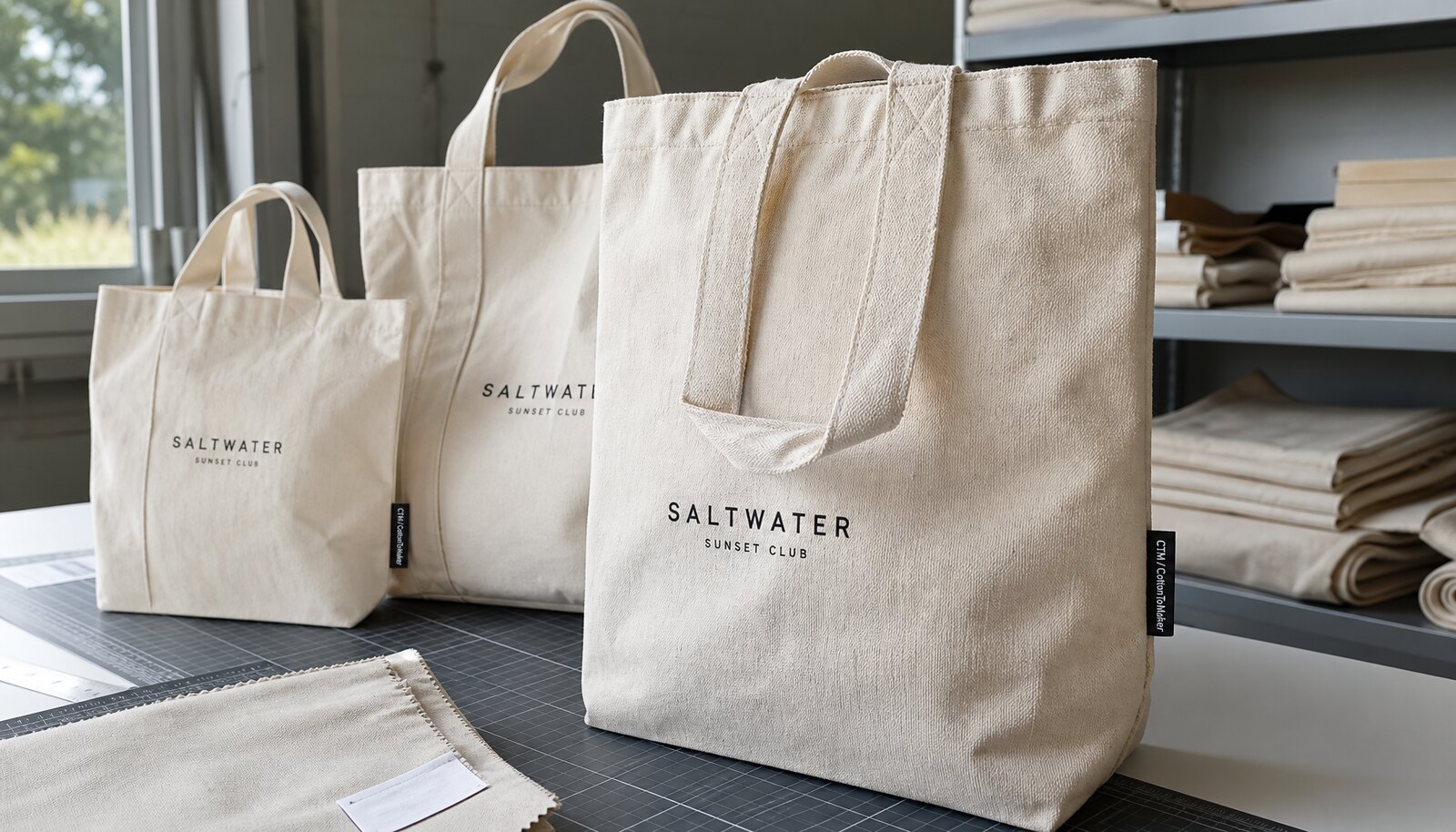
Start With the Retail Use, Not the Logo
Canvas retail merchandise bags for apparel brands are usually part packaging, part resale item, and part brand carrier. That matters because the buying decision changes depending on whether the bag is meant for a checkout handoff, a premium purchase moment, an ecommerce insert, or an event giveaway. A tote that only needs to move folded tees from store to customer can be lighter and simpler than a bag that will be reused for daily carry and seen outside the store. If the use case is vague, the quote will be vague too.
Write the function first and the decoration second. One sentence is enough: what goes inside, who receives it, how often it should be reused, and what impression it should create. That single line shapes fabric weight, handle comfort, print method, carton count, and even whether a gusset is worth the added cost. Buyers who skip this step often end up comparing very different products as if they were equivalent.
- Define the bag's job before you define the artwork.
- State the likely contents: T-shirts, denim, accessories, mixed apparel, or boxed goods.
- Choose the resale expectation: single-use carrier, occasional reuse, or everyday tote.
- Match the bag's feel to the brand moment: premium, practical, or promotional.
Choose the Supplier Route Before You Price the Bag
A clean procurement process starts with the production route. A direct factory is usually the most cost-efficient option for repeat orders when the brand team can manage sampling, artwork approval, and packing details. A full-package factory is often easier when the buyer wants one owner for fabric, printing, labels, sewing, and cartons. Trading companies and sourcing offices can reduce coordination burden when the order has multiple components, but the buyer should verify which stages are actually in-house and which are subcontracted.
Region matters, but not in the simplistic way many RFQs suggest. Coastal China often gives broad capacity and mature export paperwork. Vietnam can work well when you need disciplined manufacturing and acceptable transit times, but the supplier base may be narrower by product type. India is a strong source for cotton and natural-fiber programs, but lead times can shift with mill capacity, dyeing schedules, and inland logistics. Nearshore production can simplify replenishment and cut transit time, but the unit price is often higher and fabric options may be more limited. The right route depends on how much control your team can hold through production and how much schedule risk the brand can absorb.
- Use a direct factory for repeatable programs with stable specs and enough volume.
- Use a full-package factory when one accountable owner is worth a higher quote.
- Use a trading company only when coordination is the real bottleneck and you can verify the subcontract chain.
- Check who owns fabric booking, printing, packing, and final inspection before comparing prices.
Set Fabric, Weave, and Finish With the Retail Moment in Mind
For apparel brand merchandise bags, canvas weight should be chosen for use, not habit. Around 10 oz is a common midpoint for a tote that needs enough body to look retail-ready without becoming heavy or expensive to ship. Heavier options around 12 oz usually make sense when the bag must carry folded denim, outerwear, or multiple items while still standing upright on a counter. Lighter cloth can work for inserts or low-cost promotions, but it will show wrinkles and shape loss faster.
Fabric finish changes the buying decision as much as weight does. Natural unbleached canvas is forgiving visually and usually hides small variation better than bright white cloth. Bleached canvas gives a cleaner print backdrop, but color variation and print edge issues are easier to see. Washed canvas feels softer and can look more finished, but it introduces shrinkage and dimensional-control questions that should be built into the cut size. Buyers should also confirm whether the weight quoted is raw cloth or finished cloth, because those numbers are not always interchangeable.
- Specify fabric in oz or GSM and confirm how the supplier measures it.
- State whether the canvas is natural, bleached, dyed, washed, or pre-shrunk.
- Use heavier cloth when the bag must hold shape or carry heavier apparel.
- Build shrinkage allowance into the spec if finishing or washing changes dimensions.
Specify Construction Around Load, Shape, and Handle Comfort
Construction should follow the load path. A plain open-top tote may be fine for lightweight apparel, but a gusseted body gives better volume and a cleaner retail shape when the bag carries folded shirts, knitwear, or boxed accessories. Handle width and handle drop are easy to overlook, yet they control comfort, appearance, and how the bag sits on the shoulder or in the hand. Thin handles can lower cost, but they also cut into the hand and wear faster, which is a bad trade if the bag is meant to be reused.
The strongest tote specs do not stop at dimensions. They define seam type, stitch density, reinforcement at the handle join, and whether the top edge is folded, hemmed, or bound. Buyers should also look at the corner structure and bottom seam because that is where failures usually start when the bag is loaded repeatedly. A quick pull test on the sample, using the intended retail contents, is a practical way to surface weak construction before bulk order issues show up in the warehouse.
- Lock finished width, height, gusset depth, and handle drop in one spec sheet.
- Confirm the top edge finish: folded, hemmed, bound, or raw.
- Require reinforcement at handle joins and high-stress seam points.
- Test the sample with the actual retail load, not a guessed load.
Match Decoration Method to Artwork and Reuse
Screen print is still the most practical default for many apparel-brand tote programs because it handles simple logos, limited color counts, and repeat production efficiently. It is usually the best balance of clarity, durability, and price when the brand wants a clean front-panel mark that can survive folding and handling. Even so, the buyer should confirm ink type, coverage on textured canvas, and where the print sits relative to the fold line. A logo that looks clean when flat can crack or distort once the tote is packed and unpacked several times.
Heat transfer is useful for shorter runs or more complex art, but it must be tested on the exact canvas and fold pattern. Digital print can support more detail and lower quantities, though it often changes the handfeel and may not age as well under repeated use. Embroidery is usually best for a small premium mark or patch, not a large front graphic. The right question is not which method is popular; it is which method holds up to the brand's actual use case and expected resale experience.
- State the artwork color count and allow or disallow gradients explicitly.
- Specify logo placement and size in millimeters or inches, not only by mockup.
- Check whether the design crosses a fold or seam line before approval.
- If the bag will be reused, require a rub or flex check on the approved sample.
Normalize Quotes So the Price Means Something
A tote quote is only useful if the assumptions match. One supplier may quote a low unit price but exclude screens, labels, polybags, or carton art. Another may include those items and look expensive until the buyer compares the actual scope. The clean way to compare suppliers is to separate setup costs from recurring costs, then align the same size, same fabric weight, same print method, same packing format, and same destination. Otherwise the sourcing decision is based on incomplete numbers rather than real landed cost.
MOQ should be treated the same way. Some factories set the bag MOQ low but require separate minimums for fabric dyeing, print screens, woven labels, or special packing. That is not a problem if it is understood early; it is a problem when the buyer discovers it after the artwork is already approved. The best RFQs force every supplier to show what is included, what is excluded, and which line items change when the order quantity moves up or down.
- Compare quotes only after normalizing size, fabric, print method, and pack format.
- Split one-time setup from repeatable per-unit cost.
- Request pricing at multiple order levels so the setup curve is visible.
- Make the supplier state every exclusion instead of assuming it is included.
Treat Samples as a Production Contract, Not a Visual Reference
A sample should prove the exact production path, not just the look. That means final cloth, final ink, final label, final stitching method, and final fold direction. If the factory substitutes a material or uses a temporary decoration method, the sample is not a reliable approval base. The approval record should include the measurement sheet, artwork placement, pack format, and any special workmanship requirements so the bulk team is not guessing later.
The sample should also be tested in the way the bag will actually be used. If it is sold with folded hoodies, load it with folded hoodies. If the warehouse folds it a particular way, inspect it after that fold. This catches issues that flat review misses, including print distortion on creases, handle twist, seam puckering, and a bag that looks clean on a table but awkward in a store or warehouse. For wholesale programs, the sample is the point where aesthetics and repeatability need to agree.
- Approve only samples made with final materials and final decoration methods.
- Measure the sample against the approved spec sheet and sign off in writing.
- Check performance after folding, loading, and handling, not only in flat view.
- Do not release bulk production until the sample and the spec sheet match.
Write QC Limits That Can Be Enforced in Production
Quality control needs concrete numbers. For a retail tote, buyers commonly set dimensional tolerances around plus or minus 5 mm on smaller bags and around plus or minus 8 mm on larger bags, but the real limit should be written into the purchase order and tied to the approved sample. Handle drop should be checked separately because a small error there changes both comfort and appearance. Stitching should be examined for consistency along the seam line, with no skipped stitches, no open ends, and no weak or distorted handle joins.
AQL logic should be agreed before inspection begins, not after a defect is found. Many buyers use ISO 2859-1 or ANSI/ASQ Z1.4 sampling plans and set major defects at AQL 2.5 for first orders, with minor defects looser depending on the brand's standards. That only works if defect severity is defined clearly. Wrong artwork, missing labels, open load-bearing seams, and mixed SKUs are critical defects and should not ship. Cosmetic thread trimming issues are a different conversation. The point is to protect the warehouse, the store team, and the customer experience with rules that are visible before the cartons leave the factory.
- Set written tolerances for width, height, gusset, and handle drop.
- Use ISO 2859-1 or ANSI/ASQ Z1.4 sampling if your team already works to an AQL process.
- Classify defects in advance as critical, major, or minor.
- Reject any carton that contains wrong artwork, mixed styles, or missing labels.
Cover Compliance and Documentation by Destination Market
Canvas tote compliance is lighter than apparel compliance, but it is not automatic. The exact requirements depend on the destination market and the materials used in the bag. For the US, buyers commonly check material declarations and, when relevant, California Prop 65 exposure concerns for inks, dyes, or added components. For the EU and UK, REACH-related restricted-substance questions matter, especially when the bag includes printed inks, dyed cloth, coatings, or synthetic trims. If the program is for children's merchandise, the compliance review must be stricter and handled separately from a standard adult tote.
Paperwork matters as much as chemistry. A factory can make a bag correctly and still fail the program if it cannot produce clean declarations, test reports, or lot-level documentation for the actual production run. If the supplier changes fabric, ink, label, or coating after the sample is approved, the compliance view should be rechecked. Buyers using recycled content should also make sure the claim is backed by the correct certification scope, such as GRS where applicable, rather than a generic marketing statement. The safest sourcing habit is simple: confirm the materials, confirm the destination rules, and confirm the paperwork before bulk starts.
- Match compliance questions to the exact materials used in the order.
- Request declarations or test reports for inks, dyes, trims, labels, and coatings where relevant.
- Recheck compliance if the factory changes any material between sample and bulk.
- Treat children's or youth merchandise as a separate compliance category.
Treat Packing and Warehouse Intake as Part of the Product
Packing affects damage, labor, and presentation. A tote that is sewn well but folded inconsistently creates receiving friction and can wrinkle the print. A carton that is too large increases freight cost and crush risk; a carton that is too small can deform the bag or slow the packing line. For retail replenishment, the fold direction, inner pack count, and carton mark placement should be written into the order before bulk production begins. If the bags are going into ecommerce or store distribution, barcodes and carton labels matter as much as the bag itself.
The buyer should define the full packing chain: fold, tissue if needed, inner pack, polybag, barcode label, master carton, pallet pattern. That may sound like admin work, but it is a product decision because it changes labor and receiving time downstream. Small changes in pack format can save or waste hours at the warehouse. For wholesale buying, the cheapest bag is not the one with the lowest sewing cost. It is the one that arrives in the right format, on time, with the right counts and the least repacking.
- Set fold direction and inner pack count before bulk sewing starts.
- Confirm carton dimensions, gross weight, and pallet pattern.
- Specify barcode or carton mark placement if the warehouse needs scan-ready intake.
- Quote packing labor separately if the format may change later.
Specification comparison for buyers
| Supplier route | Best fit | Cost profile | Main risk to control |
|---|---|---|---|
| Direct factory | Repeat programs with stable artwork, stable packing, and enough volume to justify setup | Usually lowest ex-factory cost at scale | Scope gaps in the quote if the buyer does not lock specs, packaging, and inspection terms |
| Full-package factory | Programs that need one production owner for fabric, print, labels, sewing, and carton work | Mid-range, often balanced for convenience and accountability | Convenience can hide margin if the quote is not split into material, setup, packing, and freight assumptions |
| Trading company or sourcing office | Complex buys with multiple components, mixed factories, or limited internal sourcing staff | Mid- to upper-mid range | The buyer must verify which steps are subcontracted and who owns defect correction |
| Domestic converter | Small runs, late launches, local promotions, or programs where speed matters more than fabric choice | Highest unit cost, lowest communication friction | Less flexibility on fabric sourcing, decoration methods, and unit economics |
| Nearshore or regional factory | Orders where freight time, replenishment speed, or regional compliance simplify the program | Often competitive on landed cost when logistics matter | Check customs paperwork, local testing expectations, and carton or pallet constraints early |
| Material | 8-12 oz cotton canvas, 120-220 gsm cotton, recycled cotton, or blended fabric selected by use case and target price | Before price comparison | Different cloth weights, backing, or certification claims make quotes hard to compare |
| Construction | bag size, gusset, handle drop, seam allowance, stitch density, reinforcement patch, and loading expectation | Before sampling | Weak stress points create returns and failed inspections |
| Decoration | screen print, heat transfer, embroidery, woven label, or hangtag matched to fabric texture and brand durability needs | Before artwork approval | The wrong method can crack, bleed, pucker, or fail on the chosen fabric |
Buyer checklist before sampling
- Write the bag's retail job in one sentence: checkout carrier, purchase bag, ecommerce insert, event handout, or VIP pack-in.
- Lock finished size, gusset depth, handle drop, and expected carry load before collecting prices.
- Specify fabric in oz or GSM and state whether the canvas is natural, bleached, dyed, washed, or pre-shrunk.
- Choose one decoration method and one artwork version per line item so hidden setup costs do not distort the quote.
- Require a pre-production sample made with final fabric, final print method, final label, and final fold direction.
- Compare ex-factory price, setup charges, packaging, inland freight, duty, and warehouse intake, not unit price alone.
- Tie the order to an approved measurement sheet and a written defect standard before bulk production starts.
- Confirm carton count, inner pack count, barcode needs, and pallet plan before the factory books materials.
Factory quote questions to send
- What is the finished fabric weight, and is that measured before or after finishing?
- What exact size, gusset, handle drop, and artwork placement does this quote assume?
- Which costs are separate line items for screens, weaving, labels, packaging, and carton art?
- What minimums apply to each customization step, not just to the finished bag?
- Will the sample use final cloth, final ink, final stitch construction, and final label artwork?
- What stitch pattern and seam reinforcement will you use at the handle join and bottom corners?
- Which inspection standard do you follow, and what AQL or acceptance rules apply to major and minor defects?
- What is the production timeline by step: material booking, sample approval, bulk sewing, packing, inspection, and dispatch?
- Can you share carton dimensions, gross weight, pack count, and palletization details for warehouse planning?
- What material declarations, test reports, or compliance documents can you provide for the destination market?
Quality-control points to confirm
- Measure finished width, height, gusset, and handle drop against the approved sample sheet; for most retail tote programs, buyers set dimension tolerance around plus or minus 5 mm on smaller bags and around plus or minus 8 mm on larger bags, with the exact limit written into the PO.
- Verify fabric weight against the approved range and reject cloth that is visibly thinner, looser, or more transparent than the signed sample.
- Inspect seams for straight stitching, no open ends, no skipped stitches, no loose thread bundles, and no weak handle joins.
- Check handle attachment with a documented load test that matches the intended use; for apparel retail bags, many buyers use a 5 kg to 10 kg test load depending on the bag size and expected contents.
- Review print for registration, coverage, edge sharpness, and flex or fold damage; a logo that looks fine flat can crack or distort once folded.
- Check color under daylight-style inspection and allow for natural fiber variation on unbleached canvas, but do not accept obvious shade drift across cartons.
- Verify labels, hangtags, and carton marks against the approved artwork and placement map so warehouse staff can identify the SKU without opening the carton.
- Confirm pack count, fold direction, and inner pack consistency; mixed folds often create receiving delays and resale presentation problems.
- Use ISO 2859-1 or ANSI/ASQ Z1.4 sampling logic if your team already works to an AQL plan, and define critical, major, and minor defects before the inspection starts.
- Treat wrong artwork, open load-bearing seams, and missing labels as critical defects that do not ship.