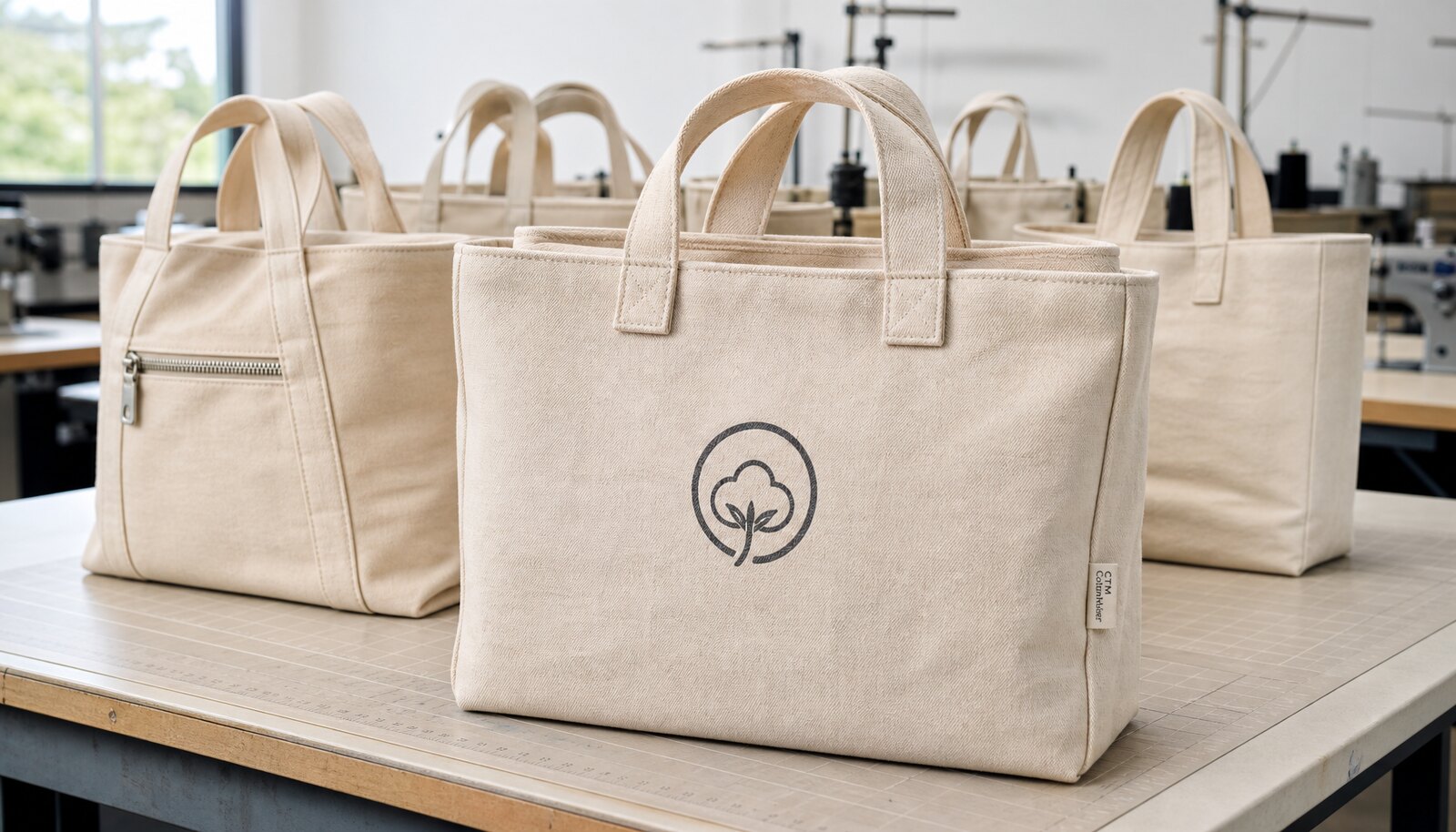
Why Cosmetic Brands Price Canvas Conference Bags Differently
For cosmetic brands, a canvas conference bag is rarely a generic tote. It often has to carry sample vials, brochures, skincare boxes, testers, and sometimes heavier glass items. That changes the buying logic immediately. A bag that looks fine empty can fail once it is loaded with jars, palettes, and inserts, which is why procurement needs to price the real use case instead of the empty bag.
This is also a brand item, not just a logistics item. The bag may sit at an event registration desk, be photographed with product launches, or be reused by attendees after the conference. Fabric weight, seam strength, print clarity, and overall structure all affect how premium the brand looks. Two quotes can both say canvas conference bag, but one may be a lightweight giveaway tote and the other may be a retail-grade carrier with reinforcement, lining, and better finishing. If those differences are not spelled out, the lowest quote is not comparable.
- Treat the bag as a functional event item and a brand touchpoint.
- Price it based on what it must carry, not only on the blank sample.
- Separate material, print, sewing, packing, and freight from the beginning.
Build the Spec Before You Request Quotes
A usable spec starts with the item's real job. For a conference distribution program, the main questions are size, load, and presentation. For a cosmetic gifting program, the questions are closer to retail packaging: does the bag need a cleaner inside finish, does the closure protect the contents, and does the handle feel strong enough to be reused. The spec should reflect those answers instead of relying on a generic tote template.
The minimum spec set should include finished dimensions, gusset depth, fabric weight, weave or finish, handle length, handle drop, closure type, lining requirement, print method, print area, and packing method. If the bag needs to hold fragile products, note the approximate weight and the type of items inside. That lets the supplier price reinforcement correctly instead of making assumptions. It also prevents a situation where marketing thinks it is buying a branded gift bag while procurement is still quoting a flat conference tote.
- Write size in finished dimensions and allow an actual tolerance.
- State the intended contents and approximate weight.
- Lock the print area and the number of ink colors before sampling.
- Decide whether a zipper, lining, or pocket is a requirement or an optional upgrade.
Turn the Pricing Plan Into Real Volume Bands
The biggest weakness in many tote bag RFQs is that they only ask for a single unit price. That hides the cost curve. A better bulk pricing plan shows how the quote changes at 500, 1,000, 3,000, and 5,000 units, because most factories price setup and labor spread differently at each breakpoint. Once the order size is visible, procurement can see whether the program is really getting cheaper, or only appearing cheaper because one-time costs are buried in the quote.
For a basic 12 oz natural canvas tote with a one-color screen print, a practical planning band is about $1.25-$2.00 ex-works at 500 units, about $0.95-$1.60 at 1,000 units, about $0.78-$1.22 at 3,000 units, and about $0.65-$1.10 at 5,000 units. That is a planning range, not a market promise, but it gives the buyer something concrete to challenge. Add a zipper, lining, or larger print area and the price should move upward in a visible way, not disappear into a vague 'customization' line.
A landed-cost model is more useful than an ex-works quote. Example: if a 3,000-unit order is quoted at $0.92 per bag ex-works, then adding a small setup amortization, inner bag, carton cost, and freight handling can move the landed number to roughly $1.25 before duty. If the supplier offers a slightly lower unit price but ships in larger cartons or uses less efficient pack counts, the landed cost can go up instead of down. This is the point where procurement should compare total cost per deliverable unit, not just factory price.
- Ask for one-time setup charges separately from recurring unit cost.
- Request the same quote at multiple volume levels if the order may scale.
- Make the supplier show the cost impact of zipper, lining, and larger print coverage.
- Include carton efficiency in the price comparison, not only the bag itself.
Compare Sourcing Routes With Decision Data
The sourcing route changes more than the quote. It changes who controls the fabric, who owns the print setup, and how much leverage you have when the sample is not right. Direct factory sourcing is usually best when the specification is stable and the order will repeat. It normally gives the best recurring unit price because the middle margin is removed, but the buyer has to manage the spec more carefully.
Trading companies and sourcing agents can be useful when the order is mixed, the buyer is short on time, or the project needs multiple factories consolidated into one shipment. The tradeoff is margin and, sometimes, less transparency about where the bag is actually made. A domestic converter or local printer may cost more per unit, often 15 percent to 35 percent above offshore factory pricing, but the lead time and communication control can make sense for urgent launches. The right choice depends on whether the brand is optimizing for cost, speed, or control.
- Direct factory: lowest recurring cost, more process ownership required.
- Trading company: more flexible coordination, usually a higher unit price.
- Local converter: faster turnaround, higher price, simpler collaboration.
- Ask every route the same operational questions so the comparison stays fair.
Vet the Factory Before You Approve a Sample
A sample is not enough. It proves the design can exist, not that a supplier can make it consistently at scale. For canvas conference bags for cosmetic brands, buyers should ask for the factory's legal name, export history, core product range, monthly output, machine list, and QC process. The answer should show that the factory actually makes canvas bags regularly, not only that it can outsource the work if needed.
Production capability should be judged against the order size. For a 3,000 to 5,000 unit program, look for at least one dedicated sewing line for canvas work, controlled print capacity or a clearly documented print partner, and an inspection process that records inline and final checks. If the supplier cannot explain who books fabric, who inspects incoming rolls, who signs off the first article, and who handles rework, the buyer does not yet have a real manufacturing partner.
Useful vetting checks are simple and concrete. Ask for recent photos of the actual production floor, not only product beauty shots. Ask how they manage shade variation in natural canvas. Ask whether the same fabric source will be used for bulk as for the sample. Ask what defect rate triggers rework or line stoppage. A supplier that can answer those questions precisely is easier to manage when the order is live.
- Confirm the factory makes canvas bags regularly, not just occasionally.
- Ask who owns each production step: fabric, print, sewing, packing, and inspection.
- Request proof of real production capacity, not only marketing photos.
- Prefer suppliers who can show a repeatable QC process and not just a finished sample.
Write an RFQ That Removes Ambiguity
Most avoidable cost overruns start with an unclear RFQ. If the brief says 'premium tote' instead of a measured spec, every supplier will guess differently. One may quote a thin open-top bag, another may include lining and a zipper, and a third may assume the brand wants retail-ready packing. The result is a comparison sheet that looks competitive but does not reflect the same product.
A good RFQ for this category should include finished dimensions, gusset depth, fabric weight in oz and GSM, surface finish, handle length and drop, closure type, lining, print method, logo size, print placement, thread color if it matters, packing format, carton target, delivery window, and destination incoterm. If the bag needs to hold specific cosmetic products, add the approximate internal load and whether glass, liquids, or metal components are involved. The supplier should be able to quote from that brief without asking for a second round of clarification.
If the project has two acceptable options, give them both. For example, one line can be the lowest-cost functional version and the other a premium version with zipper and lining. That makes the pricing ladder visible and helps marketing and procurement agree on where the value step-up actually is.
- Use measured dimensions, not words like large or premium.
- Describe the product load, not only the bag itself.
- State the acceptable range for artwork placement and print size.
- Ask for revision control so a sample change does not become a hidden spec change.
Sample Approval and QC Criteria That Hold Up in Bulk
A sample should prove manufacturability and fit for purpose, not just visual appeal. Before bulk release, inspect the fabric weight, finished dimensions, handle symmetry, seam finish, print alignment, and closure performance if the bag has a zipper. For cosmetic use, the load test matters: the bag should be checked with the actual product weight or an equivalent dummy load so the buyer knows how it behaves when full, not when empty.
Set acceptance criteria before the first sample is approved. A practical approach is to allow size variation within an agreed tolerance, keep logo placement inside the approved print zone, and require clean stitch lines at stress points such as handle joins and gusset corners. If there is a zipper, test multiple open-and-close cycles on the sample and check for snagging, exposed sharp ends, or waviness in the tape. If the bag is natural canvas, make sure the print is opaque enough for the brand standard and that strike-through is acceptable, or explicitly not acceptable, before production starts.
Bulk inspection should follow the same logic. A final sample can be approved with a documented defect list, and the mass shipment should be checked against that same list. For larger runs, use an agreed sampling plan instead of trying to inspect every unit. The important part is consistency: the bag that ships should match the approved sample in feel, color tone, print registration, and construction quality.
- Approve the sample against the actual contents or a realistic load.
- Check print position against a physical reference, not only a PDF.
- Define what counts as a major defect before bulk production starts.
- Do not treat a good photo of the sample as proof of production quality.
Packing, Carton Density, and Freight Cost
Packing has a real effect on total cost. A canvas bag looks simple, but it is bulky, and bulk drives freight. If the buyer leaves packing undefined, the factory may choose whatever is easiest for the line, not what is most efficient for the shipment. For standard bulk distribution, individual polybag packing inside a master carton is usually enough. For retail-ready or premium gifting programs, tissue wrap, inserts, barcodes, or shelf-ready folding may be needed, but every added layer increases labor and volume.
Carton planning should be part of the quote comparison. Ask for units per carton, carton dimensions, and gross weight for each version of the bag. If the bag includes a zipper or lining, the carton count often drops because the item is thicker when folded. That is why a slightly cheaper unit price can still cost more in the air or on an ocean lane with volume-based charges. A procurement team should be able to estimate how many cartons the order will create, how heavy those cartons will be, and whether they should be palletized or shipped loose.
For practical handling, keep carton weights manageable for manual movement and make sure carton size supports your freight method. If the cartons are too large, the move from factory to warehouse becomes inefficient. If the cartons are too small, the shipment may waste cube and increase per-unit logistics cost. Ask the factory to explain how the bags will be folded, counted, and labeled before release.
- Request carton dimensions and weight with every quote.
- Keep packing simple unless retail presentation justifies the extra cost.
- Use carton marks for style, color, quantity, and lot traceability.
- Confirm whether the supplier can control the fold so the bag ships efficiently.
Lead Time, Change Control, and Launch Risk
Most schedule slips do not happen in sewing. They happen earlier, when artwork changes after the sample or the buyer waits too long to freeze the spec. A new logo size can mean a new screen, a print alignment change, or a revised sample. A different closure can trigger a hardware delay. A request for individual wrapping can slow packing more than the buyer expects. The schedule needs to reflect those realities.
A realistic plan separates sample production, sample approval, fabric booking, print setup, sewing, packing, inspection, and outbound dispatch. Cosmetic launches and conference calendars are time sensitive, so the buyer should include a buffer between sample sign-off and the ship date. If the schedule is tight, it is usually better to simplify the spec than to compress QC. Simplifying a zipper, reducing print coverage, or removing a pocket usually saves more time than trying to rush a complex build through the same factory flow.
Change control matters because each revision can create new cost and delay. Once the pre-production sample is approved, any change should be treated as a controlled revision with a written impact on price and delivery. That discipline prevents a late marketing preference from turning into a missed launch.
- Freeze the spec before fabric booking whenever possible.
- Keep a backup spec ready if the first-choice material is unavailable.
- Treat post-sample changes as formal revisions, not informal tweaks.
- Simplify the design before shortening QC.
A Practical Buying Sequence for Procurement Teams
A clean buying process keeps the project from turning into a round of vague quotes. Start by defining the use case: event giveaway, sample kit, retail gift, or internal brand activation. Then choose the minimum acceptable spec and one fallback spec if the budget needs a lower-cost path. After that, ask for quotes at more than one volume point so the team can see the actual breakpoints. This is the most reliable way to build a bulk pricing plan that supports both finance and marketing.
Next, vet the supplier's manufacturing process before approving the sample. Ask who owns the fabric, print, sewing, packing, and inspection steps, and ask for proof that they make this type of canvas bag regularly. Once the sample is approved, lock the QC sheet and the packaging spec. The final step is freight planning: carton dimensions, gross weight, pallet pattern, and delivery method should be known before release, not after the bags are already made.
If the program will repeat, create a reorder file. Keep the approved spec, color references, print file, carton plan, and QC checklist in one place so the next order is not a new project. Reorders are where a good buyer saves time and money, because the supplier can quote from an exact historical spec instead of reinterpreting a brief.
- Define the use case first, then the spec.
- Ask for multi-volume pricing instead of a single quote.
- Approve the sample only after the production process is understandable.
- Store the spec so reorders can be compared against the original build.
Specification comparison for buyers
| Spec decision | Planning range or recommendation | When it fits | Buyer-side check |
|---|---|---|---|
| Base bag spec | 12 oz natural canvas, open-top, one-color screen print | Best for conference handouts, brochure packs, and lighter cosmetic samples | Confirm finished size, stitch count, and whether the quote includes standard polybag packing |
| Fabric upgrade | Move to 14 oz canvas when the bag must feel stiffer or carry heavier product | Use for jar sets, full travel kits, or retail-facing gifting | Ask for fabric weight in both oz and GSM and confirm whether the measurement is before finishing |
| Construction upgrade | Lining typically adds about $0.22-$0.60 per bag; zipper closures often add about $0.18-$0.45 | Use when leakage control, reuse, or a premium look matters | Request separate pricing for open-top, zipper, lined, and lined-plus-zipper versions |
| Print method | Silkscreen is usually the lowest-cost route for one or two solid colors; transfer or digital methods cost more but handle detail better | Choose based on logo complexity and order size | Check print opacity on natural canvas and ask how the print holds up to rubbing and folding |
| Volume breakpoint 1 | About $1.25-$2.00 ex-works at 500 units for a basic 12 oz, one-color tote | Useful for pilot runs or event tests | Make sure setup fees are shown separately so the quote is easy to compare later |
| Volume breakpoint 2 | About $0.95-$1.60 ex-works at 1,000 units for the same spec | Common for regional event programs | Confirm whether the price changes if you switch handle length, fabric color, or print coverage |
| Volume breakpoint 3 | About $0.78-$1.22 ex-works at 3,000 units for the same spec | Good for national launches or repeat conference seasons | Ask for carton dimensions and units per carton before shortlisting the offer |
| Volume breakpoint 4 | About $0.65-$1.10 ex-works at 5,000 units for the same spec | Best when the spec is stable and reorder risk is low | Verify that the supplier can hold the same fabric lot or a controlled shade tolerance across the full run |
| Illustrative landed cost | Example: 3,000 units at $0.92 ex-works, plus $0.06 setup amortization, $0.04 inner bag, $0.05 carton cost, and about $0.18 freight handling = roughly $1.25 landed before duty | Use this as a procurement model, not as a universal market quote | Add duty, inland delivery, and any inspection cost after the landed-cost calculation |
Buyer checklist before sampling
- Confirm finished bag size, tolerance, and usable internal volume, not only flat width and height.
- Lock fabric weight in oz or GSM, plus whether the fabric is raw, dyed, pre-shrunk, or enzyme-washed.
- Define artwork placement, print colors, logo size, and whether the buyer wants matched Pantone references.
- State whether the bag must hold glass jars, palettes, or metal tools so reinforcement can be priced correctly.
- Specify closure type, handle length, lining, and any pocket or gusset requirement before requesting quotes.
- Request carton pack count, carton size, gross weight, and palletization method for freight planning.
- Ask for production lead time split by sample, fabric booking, printing, sewing, and packing.
- Require photo or video approval of first bulk output if the bag is going to a retail or brand event launch.
Factory quote questions to send
- What is your exact fabric weight in oz and GSM, and is that before or after finishing?
- Is the quoted price based on open-top, zipper, lined, or unlined construction?
- What are the one-time setup charges for screen, plate, or artwork preparation?
- How many print colors are included, and what is the surcharge for extra colors or large coverage?
- What is your MOQ by color, print, and hardware option, not just total quantity?
- Can you share carton dimensions, units per carton, and estimated carton gross weight?
- What sample will you provide for approval, and what details can still change after sample sign-off?
- What is your standard lead time after deposit, and which parts of production are critical path items?
Quality-control points to confirm
- Fabric weight matches the agreed spec within an agreed tolerance; the quote should not substitute lighter cloth without notice.
- Finished dimensions stay within the approved tolerance, and handle drop is consistent across the lot.
- Stitch density is even at stress points such as handle joins, gusset corners, and zipper ends.
- Logo placement stays within the approved print zone and does not sit too close to seams or edges.
- Print opacity is adequate on natural canvas and no severe strike-through appears on the back side unless approved.
- Handles are balanced in length and sewn level so the bag hangs straight when loaded.
- Zipper tracks smoothly if used, with no skipped stitches or exposed sharp ends.
- Cartons are packed to prevent deformation, crush marks, or contamination during transit.