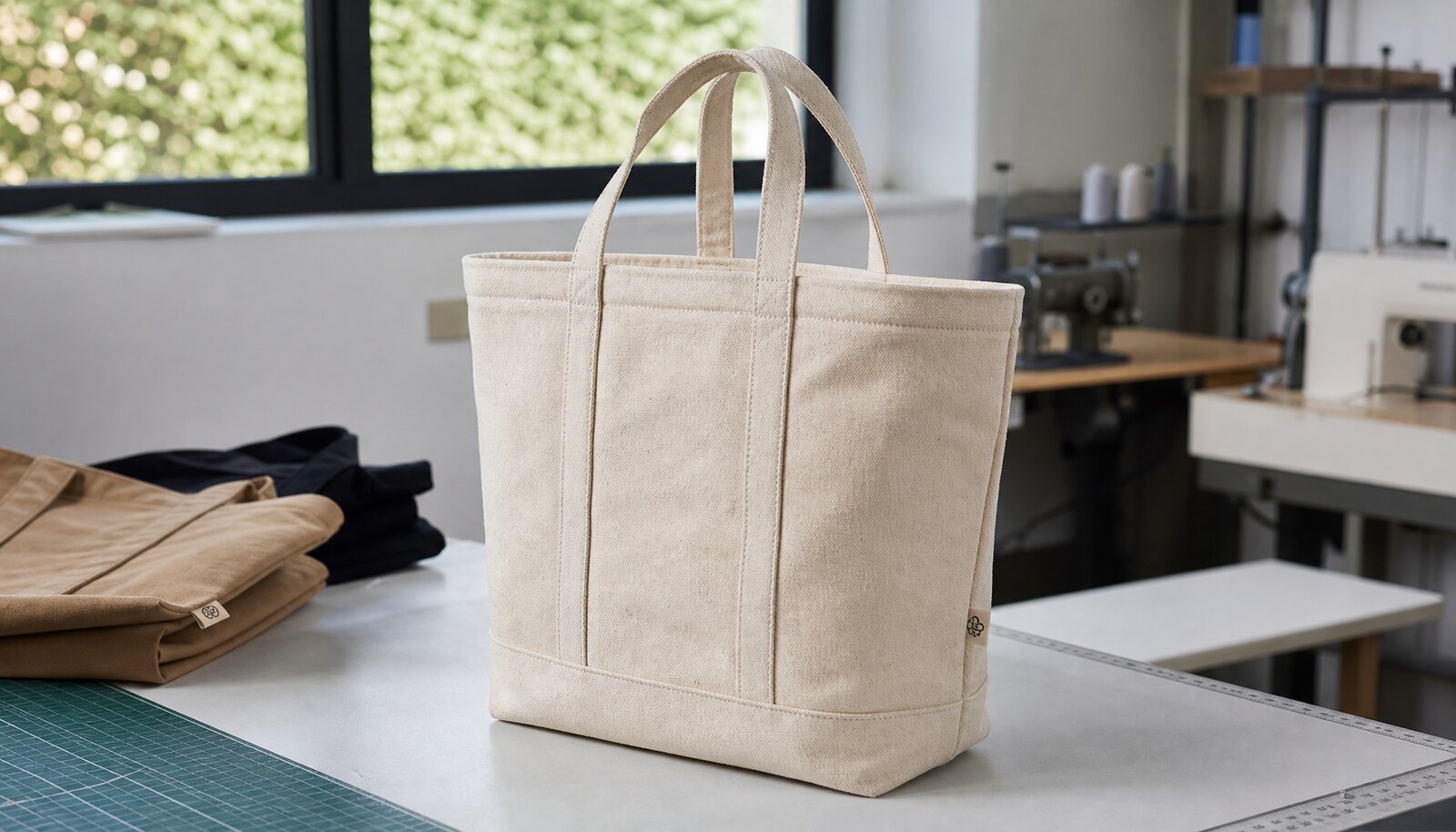
Start with the use case, not the artwork
The fastest way to overpay for high quality canvas tote bags custom is to start with logo size and forget the job the bag has to do. A tote for a trade show, a retail gift-with-purchase, a grocery program, and a library or bookstore carry program all need different fabric weight, handle strength, print durability, and packing. If procurement does not define the use case first, each supplier fills the gaps with its own assumptions, and the quotes stop being comparable.
Write the use case in one sentence before you request pricing. For example: premium retail tote for 3 to 5 kg carry, shelf-ready packed, one-color print, sold through boutiques. That single line tells the factory whether it should quote a promo bag, a midweight shopping tote, or a heavier construction with more reinforcement. It also gives you a basis to reject a sample that looks attractive but does not fit the actual application.
If the program has more than one channel, write separate use cases rather than combining them into one vague brief. A bag designed for a trade-show handout is often too light for retail resale, while a premium boutique tote may be too expensive for a giveaway. Procurement teams that define the channel early can usually reduce re-quoting and avoid later scope creep when merchandising, marketing, and operations all want different features.
- State the expected load in kilograms or pounds.
- Define whether the bag will be folded flat, stuffed in a carton, displayed on shelf, or handed out loose.
- Note whether the buyer values print impact, hand feel, shape retention, or carry strength more.
- Separate retail, promo, and utility versions if the bag will serve more than one channel.
Choose fabric weight that matches the claim
Canvas weight is the first spec that changes both cost and perception. Entry-level promo totes often sit around 8 oz to 10 oz, while more durable retail programs usually move into 10 oz to 12 oz and beyond. If you want a bag that feels substantial in the hand and keeps its shape on shelf, do not let the quote drift down to a lighter fabric just because the print looks acceptable on the sample.
Ask for GSM or ounces with a practical range, not a vague description like heavy canvas. A useful buyer spec might be 280 to 340 GSM for lower-cost campaigns, 340 to 420 GSM for balanced retail use, and above that for premium or heavy-duty applications. Also define whether the fabric is natural, bleached, dyed, enzyme washed, or pre-shrunk, because finish affects color, shrinkage behavior, and how the print sits on the surface.
A procurement buyer should also ask how the supplier measures the fabric. Some factories quote a mill claim while others quote finished weight after washing or coating. Those are not identical. If the tote must be dimensionally stable, ask whether shrinkage allowance has been built into cut size and whether the fabric lot will be checked before cutting. A millimeter-level size issue on a tote becomes a shelf or pack-out issue very quickly if the bag is supposed to fit an insert card or a retail fixture.
- Request the fabric basis weight and weave density together, not one without the other.
- Confirm whether shrinkage allowance is already built into the cut size.
- Check for visible slubs, thin bands, or uneven dye on large orders.
- Ask whether the fabric has been pre-washed, heat-set, or chemically finished, because that changes feel and print response.
Construction details decide whether the bag survives use
Most complaint files on canvas totes do not start with the print. They start with weak handles, poor seam reinforcement, or a gusset that collapses after a few uses. A good tote spec should state how the body is cut, how the side and bottom seams are finished, and where reinforcement is added. If the supplier quotes the bag as one generic item without those details, procurement is not comparing the same product across factories.
For high quality canvas tote bags custom, require a drawing or spec sheet with width, height, gusset, handle length, handle drop, seam allowance, and any interior details. If the tote needs to carry bottles, books, or boxed goods, the bottom seam and handle join need more attention than the logo placement. A low-cost bag that fails under normal load is not a cheap order; it is a reject.
There is also a sourcing nuance that is easy to miss: the same bag can be built several ways and still look identical in a product photo. A factory may use a raw-edge turn-over, a bound seam, a flat-felled seam, or a plain stitched seam hidden inside the body. Those options affect labor, appearance, and service life. Ask the factory to mark the construction on the pattern or technical sheet so the sample is not just a visual reference but a repeatable production standard.
- Specify whether the tote has a flat bottom, boxed bottom, or no gusset.
- State if handles are self-fabric, cotton webbing, rope, or another material.
- Add reinforcement language for handle joins and stress points.
- Ask for seam type, seam allowance, and whether the bag body is lined or unlined.
Print method changes cost, appearance, and production loss
Print choice is where many buyers lose margin without noticing it. Screen print is still the most common route for a one- or two-color logo because it is reliable and economical at scale, but it needs clean artwork and stable color registration. Heat transfer can work for short runs or more detailed artwork, while embroidery, woven labels, and rubber patches can improve shelf value but raise labor time and reject risk if approval is rushed.
Do not ask suppliers to price artwork before the print method is locked. A one-color front print on natural canvas can be straightforward, while a multi-color full-size print across both sides may trigger extra screens, longer setup, and more spoilage allowance. If the design has small text, fine lines, or gradients, the factory should say plainly whether those details are suitable for the chosen process. For procurement, that answer is more valuable than a yes/no quote because it shows whether the supplier understands print limitations.
A useful buyer check is to ask for the print tolerance in plain language. How far can the artwork move before it is considered off-center? What shade variation is acceptable between first-run and bulk-run prints? Can the ink withstand folding, rubbing, or retail handling? The answers help distinguish a supplier that has actually run canvas decoration from one that is simply repeating a catalog capability list.
- Use screen print for simple logos and stable repeat orders.
- Use heat transfer or digital print only when the artwork really needs it.
- Treat embroidery and patches as premium decoration, not a low-cost substitute.
- Ask for print placement tolerance and whether curing or washing affects the final shade.
Compare sourcing routes before you compare unit price
A unit price by itself tells you very little unless you know the sourcing route behind it. Factory direct OEM usually gives the best control over fabric, stitching, print, and packing, especially for repeat programs. Trading companies can be useful when you need consolidation across multiple products, but they can blur the actual manufacturing source and make corrective actions slower if the bag has a defect.
For a small launch, a stock blank tote plus local decoration may be the fastest route, but it is rarely the most exact fit for a brand that needs custom dimensions or a specific hand feel. The right route depends on order size, launch date, and how much product consistency matters. Buyers who compare only ex-factory price often miss the real cost of rework, late freight, and failed shelf presentation.
There are also tradeoffs by region and supply chain structure. An overseas factory may offer lower sewing cost and more capacity on heavier canvas, but transit time, import handling, and carton damage risk become part of the decision. A domestic converter can reduce calendar risk and simplify communication, but unit cost is often higher and material choices may be narrower. Procurement should compare the whole landed and delivered package, not just the sewn bag price.
- Use factory direct when repeat quality and exact construction matter.
- Use stock-and-print when time matters more than total spec control.
- Use local conversion when launch timing is tight and freight risk is unacceptable.
- Ask suppliers to identify which steps are in-house and which are outsourced.
Build the quote so suppliers cannot hide the real cost
A clean quote should separate body fabric, print, labels, packing, and any special finishing. If a supplier gives only one line item for the full tote, it becomes hard to see what changed when one factory is cheaper by 12 percent and another is cheaper by 4 percent. The goal is not just a lower number; it is a quote that lets procurement compare the same scope on the same basis.
A useful RFQ for high quality canvas tote bags custom should ask for the base construction, the print method, the packing method, and the sample cost separately. If you want to know whether the supplier is serious, ask for the difference between blank bag price and printed bag price, and then ask what happens if the order changes from one color to two colors. Real factories can explain the cost step-up clearly. A vague quote that cannot break out the decoration delta usually becomes a change-order problem later.
For better commercial visibility, ask for the price tiers at the exact quantities your business might actually buy: 300, 500, 1,000, 3,000, and 5,000 pcs, for example. Even if the supplier cannot hit each point exactly, those bands show how much cost is driven by setup versus unit labor. If a quote only looks attractive at one MOQ but collapses when demand increases, it may not be the right production partner for a multi-season program.
- Separate bag body cost from decoration and packing cost.
- Request price breaks by quantity, not just one MOQ number.
- Ask for a line item on sample fee and whether it is refundable.
- Request separate pricing for blank, printed, and retail-packed versions.
Set MOQ logic around fabric waste, print setup, and packing labor
MOQ is usually driven by cutting efficiency, print setup, and how much manual handling the order requires. A simple one-color tote with bulk packing may be workable at a lower MOQ than a decorated bag with custom labels, inserts, and retail-ready packing. Buyers should not treat MOQ as a fixed rule; it is a result of factory labor and material loss, and it can move when the spec changes.
If your first order is a market test, ask the factory which element is forcing the MOQ upward. Sometimes the fabric mill minimum, not the sewing line, is the real constraint. In other cases, the print screen setup or label run is what makes a smaller order uneconomic. That answer matters because it tells you where to simplify the spec if you need to lower the entry quantity without damaging the product.
This is also where negotiation becomes more useful than general price shopping. If the factory says the MOQ is driven by label application, procurement can decide whether to remove the label from the first run and add it later. If the MOQ is driven by fabric roll efficiency, changing the bag size by a few centimeters may improve layplan yield and lower cost without affecting the customer experience. Those are the kinds of tradeoffs that save money without weakening the bag.
- Differentiate MOQ for blank bags, printed bags, and packed retail units.
- Ask for the quantity break where unit price drops meaningfully.
- Be clear whether mixed colors or mixed artwork count toward one MOQ.
- Ask what spec change would reduce MOQ the most without affecting function.
Treat sampling as a control step, not a formality
A sample should prove that the factory can repeat the agreed construction, not just produce one attractive piece. The first sample may be hand-finished, so use it to verify dimensions, handle length, print placement, seam behavior, and fabric feel. Once the sample is approved, the pre-production sample should match the actual bulk line as closely as possible. If those two samples diverge, the buyer has not locked the process yet.
For custom tote bags, the sample should also show the exact packing method and label placement. That is where many hidden errors appear: a correct bag in an incorrect carton, a good print on a crooked label, or a clean tote that no longer folds properly once packed. If the supplier cannot provide a stable approval path, the production order will usually carry the same uncertainty.
A procurement team should also decide which sample is the approval reference. In some programs that means the gold sample sealed in the buyer’s office and another sealed at the factory. In higher-risk programs it may mean a top-of-production sample approved from the first production lot. The point is to create a comparison point that survives personnel changes and later disputes.
- Approve a sample against a written spec, not memory.
- Use the sample to finalize artwork position and size.
- Keep one sealed reference sample for factory and QC comparison.
- Require a pre-production sample that reflects the actual bulk process, not a hand-made exception.
Set QC thresholds before production starts
QC for canvas totes should focus on what the customer will actually notice and what can fail in use. That means seam strength, print alignment, size consistency, fabric defects, and packing accuracy. A tote can pass a visual check and still fail the buyer if the handle drop is wrong, the bag twists when filled, or the print sits too close to the seam. Those are preventable failures if the acceptance criteria are written early.
The best way to reduce disputes is to set measurable tolerances. Define acceptable size variance, print location tolerance, handle drop tolerance, and the maximum allowed defect rate in the shipment. If the order has multiple colors or multiple artwork versions, require separate checks for each. A good factory will not resist clarity; it will use the spec to control its line.
For procurement buyers, one of the most useful QC questions is not whether the product looks good, but whether the supplier has a documented inspection process. Ask what the factory checks at incoming material stage, in process, and before packing. Also ask how nonconforming units are marked, segregated, and reworked. That tells you whether quality is managed or simply hoped for.
- Measure size, print placement, and handle drop on a defined sample lot.
- Inspect stress points for bar-tacks, backstitching, or loose thread.
- Hold back shipment if carton counts, labels, or pack format do not match the order.
- Ask whether the factory uses AQL or a comparable internal inspection standard.
Ask for documentation, traceability, and compliance evidence
If the tote is going into retail, corporate gifting, or a brand program with sustainability language, documentation matters almost as much as the physical bag. Verbal claims about cotton source, recycled content, or compliant printing are not enough for procurement. Ask what documents the supplier can provide and whether they refer to the exact order materials or only to a general factory capability.
Useful evidence may include fabric specifications, mill origin information, test reports, colorfastness or rubbing results, and carton or packing records. If a brand is making a claim about traceable cotton, ask what traceability level the supplier can support: mill invoice, batch identification, lot tracking, or third-party certification if applicable to the source. The point is not to demand paperwork for its own sake. It is to avoid buying a product that cannot support the claim made in sales or marketing collateral.
A practical supplier-verification step is to ask for photos or scans of the actual sewing line, print area, and packing zone tied to the quote. Then ask the supplier to name the person who will own quality and the person who will approve changes. That is a simple way to reduce the risk of a polished sales response from a middleman who does not control the line. Procurement should know who can actually fix a problem if one appears.
- Request fabric specs and any available test reports tied to the actual material lot.
- Ask for traceability documents if sustainability or origin claims will be used.
- Confirm who owns quality decisions at the factory and who signs off on changes.
- Verify whether the quoted supplier is the actual manufacturer or a broker.
Specification comparison for buyers
| Spec decision | Recommended option | When it fits | Buyer risk to check |
|---|---|---|---|
| Fabric weight for promo use | 8 oz to 10 oz canvas | Trade shows, giveaways, light retail carry, and price-sensitive campaigns | Can feel flimsy if the bag is meant to hold bottles, books, or repeated daily use |
| Fabric weight for balanced retail use | 10 oz to 12 oz canvas | General retail, gift-with-purchase, bookstores, and premium brand merchandising | Ask whether the weight is pre-finish or post-finish and whether shrinkage was allowed for in cut size |
| Fabric weight for heavier-duty use | 12 oz plus canvas | Grocers, library bags, thick product packs, and programs that need stronger body and better shape retention | Heavier fabric can improve feel but may increase sewing difficulty, needle wear, and lead time |
| Construction for basic programs | Single bottom seam with standard side seams and reinforced handle joins | Simple promo or retail trials where the bag is not expected to carry heavy loads every day | A low-cost seam structure may pass visual inspection but fail at the handle stress point |
| Construction for higher-load programs | Flat-felled seams, boxed gusset, and bar-tacks or dense backstitching at the handles | Books, wine, gifts, or grocery loads where buyers care about service life and bag shape | Confirm the factory can repeat the reinforcement in bulk, not just on the sample |
| Print method for simple logos | Screen print, usually one or two colors | Stable brand marks, event campaigns, and repeat orders with clean vector artwork | Ask about color registration tolerance and print curing so the graphic does not crack or offset |
| Print method for detailed art | Digital print or heat transfer where the artwork requires finer detail | Complex graphics, gradients, smaller runs, or launches where artwork flexibility matters more than lowest unit cost | Check abrasion resistance and whether the chosen method changes the hand feel on canvas |
| Sourcing route for a repeat program | Factory direct OEM with in-house sewing, decoration, and packing | 1,000 pcs and up when repeatability, documented QC, and stable construction are priorities | Verify the factory is not quietly subcontracting printing or sewing without approval |
| Sourcing route for a small launch | Stock blank tote plus local or origin decoration | 100 to 500 pcs when speed matters and exact fabric control is less critical | Blank stock can vary in shade, size, handle drop, and finish from lot to lot |
Buyer checklist before sampling
- Define the end use first: retail carry, event giveaway, grocery use, premium gift packaging, or daily utility.
- Set the target load in kilograms or pounds and make it part of the spec.
- Lock the fabric weight in GSM or oz before requesting quotes; do not accept only the phrase heavy canvas.
- Provide one drawing with bag width, height, gusset depth, handle length, and handle drop.
- State whether the bag needs lining, pocket, zipper, snap, reinforcement patch, or interior binding.
- Choose the decoration method and number of print colors before comparing unit prices.
- Specify whether the bag is natural, bleached, dyed, enzyme washed, or post-finished.
- Define packaging: bulk packed, polybagged, banded, inserted card, barcode label, or retail carton.
- Ask for pre-production sample, top-of-production sample, and shipment reference sample if the order is large or retail critical.
- Confirm carton count, carton dimensions, gross weight target, shipping marks, and palletization rules.
Factory quote questions to send
- What exact canvas weight are you quoting, and is it measured before or after finishing or washing?
- What is the fabric composition and weave type, and can you share the width of the roll or cuttable width?
- Is the price based on blank bag only, one-side print, two-side print, or print plus label and packing?
- What is the MOQ per size, per color, per print design, and per packing configuration?
- Are the handles self-fabric, cotton webbing, rope, or another material, and what is the handle width and length?
- What reinforcement is included at the handle join, side stress points, and bottom corners?
- Can you quote the same bag in two fabric weights so we can compare cost and hand feel?
- What sample stages do you provide, and what is the fee, lead time, and approval purpose of each stage?
- What packing standard is included in the unit price, and which items are extra?
- What is the production lead time after artwork approval, sample approval, and deposit receipt?
Quality-control points to confirm
- Fabric weight matches the agreed range, with the same measurement method used on both sample and bulk.
- Fabric shows no obvious thin spots, broken threads, oil stains, mold, severe slubs, or uneven dye bands.
- Bag width, height, and gusset fall within the agreed tolerance, especially if the bag must fit shelf displays or inserts.
- Handle length and handle drop are consistent unit to unit so the bag hangs correctly on the shoulder or in hand.
- Handle joins, side seams, and bottom seams show reinforcement appropriate to the intended load.
- Stitch count is even, seams are straight, thread tension is stable, and loose thread tails are trimmed.
- Print placement is centered or aligned to the approved artwork position, with no blur, cracking, misregistration, or bleeding.
- Color shade is consistent across body, handles, labels, and any accessory parts.
- Top edge finish is clean, with no fraying, uneven folding, or exposed raw edge where the spec calls for a turned hem.
- Accessories such as zippers, snaps, pockets, and labels are attached securely and do not distort the tote body.