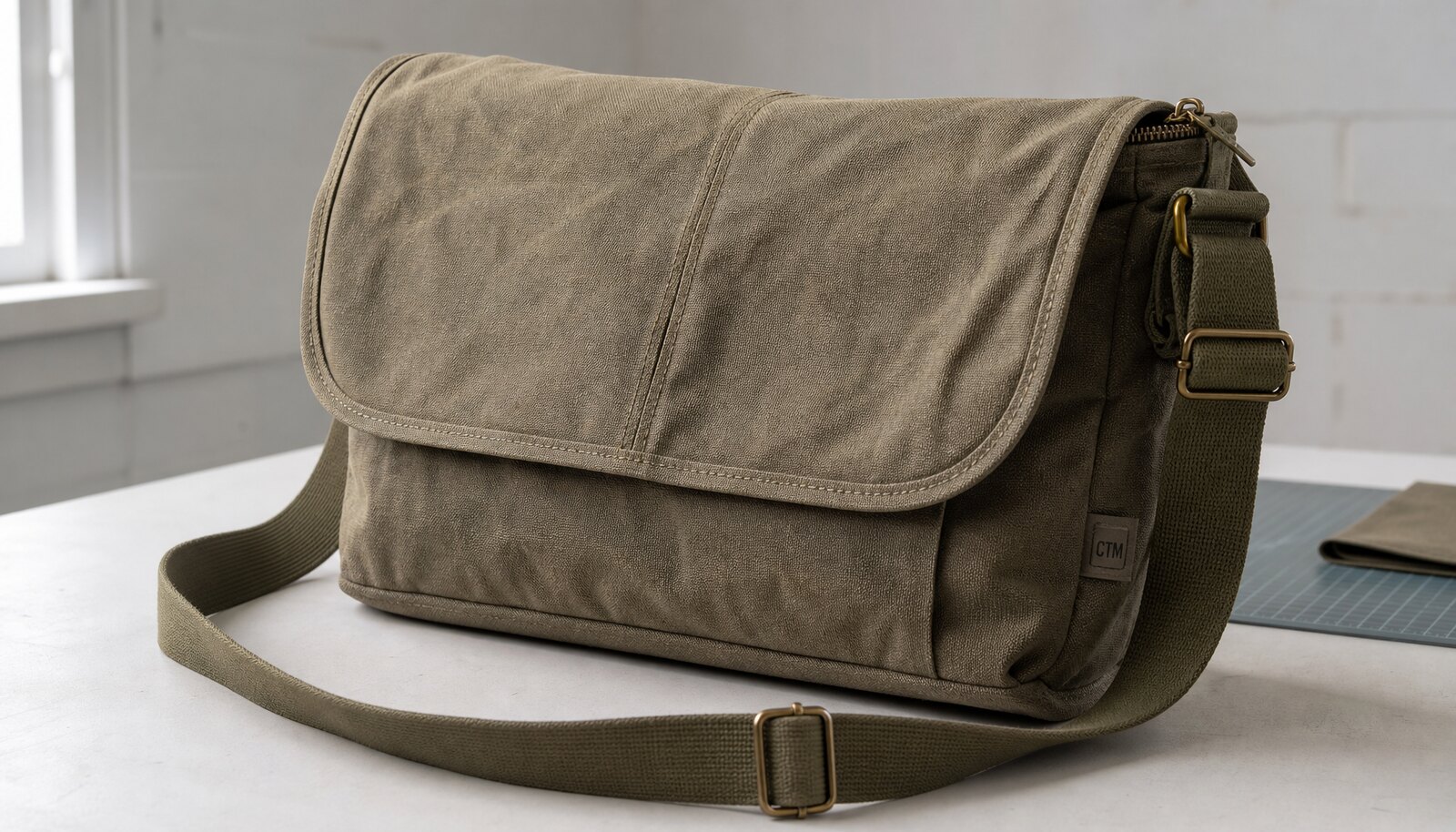
Why event buyers need a heavy duty build, not just a logo bag
Heavy duty messenger bags for events sit in a difficult middle ground. They need to look clean enough for brand use, but they also need to survive books, brochures, bottles, chargers, and the usual trade-show overload. If you buy a bag that only looks good in a mockup, the failure shows up fast in the field: straps stretch, seams open, and printed panels crease after the first busy event day.
For procurement teams, the real problem is not finding a messenger bag. It is finding a build that matches the event format, the giveaway value, and the expected fill weight. A conference bag carrying a few leaflets can use lighter canvas and simpler reinforcement. A delegate bag for product samples or a retail event needs stronger fabric, a better strap, and cleaner packing control.
- Match bag strength to fill weight, not just to marketing language.
- Treat the strap, seam, and closure as the failure points, not the logo panel.
- Write the RFQ around use case first, then decoration and packing.
Choose the right canvas weight before you compare prices
For most event programs, 12oz to 14oz cotton canvas is the practical range. It gives enough body for a messenger silhouette, keeps print surfaces relatively flat, and holds shape better than 8oz or 10oz promotional canvas. If the bag needs to feel premium or carry heavier contents, 14oz is usually the safer starting point. If the buyer wants softer drape and lower freight cost, 12oz can work, but the factory should show how the bag stands when filled.
A heavier canvas is not automatically better. Above a certain weight, sewing speed drops, needle wear rises, and the bag can become too stiff for comfortable shoulder carry. That matters for events where attendees walk long distances. The right spec is the one that survives filling, stacking, and repeated use without turning into a rigid board.
- 12oz: balanced for most branded event carry bags and reasonable unit cost.
- 14oz: better for premium delegate packs, retail resale, and heavier contents.
- Avoid vague wording like “thick canvas”; use ounce weight or GSM in the RFQ.
Messenger design details that change real-world performance
A heavy duty messenger bag is not just a tote with a flap. The shape matters. A gusseted body carries better than a flat sleeve when the bag is loaded unevenly. An internal divider adds function, but it also adds labor and seam risk. A simple front flap looks more polished for events, while a top zipper gives better security when attendees carry phones, passports, or samples.
The strap deserves more attention than the print area. For event use, a 38 mm strap is usually the minimum practical width; 50 mm is better when the bag is loaded heavily or worn for long periods. Ask for box-X reinforcement at each anchor point. If the factory uses only a simple straight stitch on a heavy event bag, that is a cost-saving shortcut you will feel later in complaint rates.
- Gusset depth of about 8 to 12 cm works for documents and small gifts.
- Top zipper is safer for mixed contents; flap is faster and more visible for branding.
- Webbing strap should be wide enough to distribute load without shoulder cutting.
Print method selection: what looks good on paper may fail in production
For heavy duty messenger bags for events, screen print is still the most efficient option when the artwork is simple and the order size justifies setup. One or two solid colors usually produce the cleanest result on canvas. It gives strong opacity on natural fabric and holds up well if the print area is flat. Heat transfer can be useful for small runs, multi-color graphics, or finer detail, but the buyer needs to know exactly which film or transfer system is being used and how it behaves after folding and packing.
Embroidery looks premium but is not always the right answer. On heavy canvas, dense embroidery can pull the fabric and make the front panel curl. Woven labels or sewn side labels are better for subtle branding, while print remains the main decoration for event visibility. If the logo has fine text, do a print proof at actual size. Many event bags fail because the art was approved on a screen but not tested at bag scale.
- Screen print: best for simple logos and repeat production.
- Heat transfer: useful for small runs or complex artwork, but test for cracking and edge lift.
- Embroidery: premium feel, but watch fabric distortion on lighter canvas.
MOQ logic: why low minimums are not always cheaper
Factories quote heavy duty messenger bags in different ways depending on fabric stock, print setup, and sewing line efficiency. A stock natural canvas bag with a single-color logo can sometimes start at 200 to 300 pieces. Once you move to custom dyed fabric, special liners, extra pockets, or a more complex closure, the MOQ often moves to 500 to 1,000 pieces because cutting and printing change from a small job to a proper production run.
The trap is assuming the lowest MOQ equals the best test order. Lower quantities can carry higher unit cost, weaker carton efficiency, and less favorable packing. If the event program will repeat, it may be better to buy 800 pieces with a more stable spec than 250 pieces with a rushed, underdeveloped one. Ask the factory which cost items are being spread across the order: screen setup, die cutting, labeling, polybagging, or carton printing.
- Low MOQ is most realistic when fabric is in stock and branding is simple.
- Custom color, lining, and hardware usually push MOQ upward.
- Compare MOQ against total landed cost, not against unit price alone.
How to compare factory quotes without missing hidden costs
When two quotes differ by 10% to 20%, the difference is usually in the detail. One factory may quote the bag body only, another may include print setup, another may exclude inner packing or barcode stickers. For a fair comparison, standardize the spec sheet: canvas weight, strap width, print position, closure, sample type, packing method, and carton instructions. Without that, you are not comparing suppliers; you are comparing assumptions.
A useful quote breakdown should show material, cutting, stitching, printing, accessories, packing, and carton terms. If the quote is unusually low, find the missing line item. If the quote is high, look for hidden extras such as pre-shrunk canvas, heavier webbing, or a better zipper grade. Price alone is not a sourcing decision; it is a signal that tells you where the factory is spending or saving money.
- Separate body cost from print cost and packing cost.
- Ask whether carton labels, hangtags, or barcode stickers are included.
- Compare quotes against the same sample photo or sample reference number.
Supplier route comparison: direct factory vs trading route vs local converter
For heavy duty messenger bags for events, the supplier route changes both risk and control. A direct factory usually gives better visibility on fabric sourcing, seam construction, and print line discipline. Trading companies can be useful if you need multi-category consolidation or a smaller administrative load, but they may not control the sewing line directly. Local converters can shorten communication time and help with urgent replenishment, yet their unit cost is often higher because they are reselling or adding finishing work on top of another source.
The right route depends on order size, urgency, and how sensitive the bag is to production mistakes. If the event is high visibility and the bag will be handled by delegates, retailers, or sponsors, direct factory sourcing tends to be the safest path. If the order is exploratory and the buyer wants to test artwork and market response, a local converter or trading route may be acceptable, provided the sample approval and QC obligations are written clearly.
- Direct factory: best control, better for repeat events and custom construction.
- Trading route: easier coordination, but verify who actually makes the bags.
- Local converter: faster for small urgent runs, usually higher cost per piece.
Comparison table: sourcing routes for event messenger bags
Use the following comparison to decide which sourcing route fits your event program. The best option is rarely the one with the lowest visible unit price. It is the one that gives you the right balance of control, speed, and repeatability when the event calendar gets tight.
If your brand needs a stable annual program, prioritize the route that can reproduce the same stitch standard, print placement, and packing format without re-learning the job every season.
- Write decisions in measurable language, not only descriptive wording.
- Ask for sample photos plus one physical approval sample for important orders.
- Keep quotation, sample approval, and inspection notes tied to the same spec version.
Sample approval: the checks that prevent expensive mass-production errors
The sample is where heavy duty messenger bags for events are won or lost. A good approval process starts with a blank sample to verify proportions, then moves to a printed sample or pre-production sample that shows the actual artwork, strap length, and packing. Do not approve from photos only. Canvas behaves differently in hand: it folds differently, print density changes with pressure, and gusset shapes can look fine on screen but fail when the bag is filled.
During sample review, load the bag with realistic contents. A stack of brochures is not enough if the actual use includes bottles or gifts. Check shoulder comfort, strap drop, zipper travel, flap overlap, and how the bag stands after being packed and unpacked a few times. If the sample already feels awkward, mass production will not fix it.
- Approve actual print position against a measured template.
- Test strap load with realistic fill weight, not an empty bag.
- Keep one signed sample at the factory and one with the buyer team.
Packing, cartonization, and lead time: where event orders usually slip
Packing is often ignored until the last minute, yet it affects both damage rate and freight cost. Flat packing saves carton volume, but printed canvas can crease if the fold line crosses the logo panel. Individual polybags help protect the surface and improve retail readiness, but they add labor and plastic cost. For large event shipments, bulk packing with internal separators is often the best balance if the bag is not intended for immediate shelf display.
Lead time should be written as a sequence: sample approval, material booking, bulk production, final QC, and shipment booking. For standard heavy duty canvas bags, 20 to 35 days after sample approval is a realistic planning range. Rush orders can be done in some factories, but the buyer should expect tradeoffs in color choice, packing complexity, or inspection depth. If your event date is fixed, build a buffer for artwork correction and carton rework.
- Avoid folding the print panel on the sharpest crease line.
- Specify whether bags should be polybagged individually or packed loose.
- Confirm carton dimensions early to protect freight calculations.
Specification comparison for buyers
| Spec decision | Recommended option | When it fits | Buyer risk to check |
|---|---|---|---|
| Canvas weight | 12oz to 14oz cotton canvas | Most event bags that need structure, print clarity, and repeat use without feeling too stiff | Lightweight 10oz bags may sag when filled; very heavy canvas can raise cost and make sewing slower |
| Bag structure | Unlined body with binding or partial lining at stress points | Promo events, conferences, and retail giveaways where cost control matters | If the bag carries laptops or thick catalogs, unlined corners and base seams may wear faster |
| Print method | 1 to 2 color screen print or heat transfer for small art areas | Logo-led event branding with clean flat artwork and medium to large quantities | Overly detailed art can blur in screen print; heat transfer can crack if film quality is weak |
| Strap construction | 38 mm to 50 mm webbing strap with box-X reinforcement | Heavy use, shoulder carry, and event attendees who will load catalogs, gifts, or sample packs | Thin straps cut into the shoulder and often fail at the seam before the body fabric wears out |
| Closure option | Top zipper with metal puller or flap with hook-and-loop | When the bag will hold documents, electronics, or mixed event materials | Zippers add cost and can cause rejection if the coil gauge, puller finish, or stitching alignment is weak |
| MOQ logic | 500 to 1,000 pcs for custom colors and print; 200 to 300 pcs for stock canvas with simple logo | Test orders, regional event runs, and buyers validating artwork or packaging | Low MOQ often means limited color choices, weaker packing, or higher per-unit print setup charges |
| Packing method | Flat packed with bulk carton divisional packing or individual polybag if required | Large event shipments and warehouse replenishment | Poor packing can crease print, distort bag shape, and increase carton volume charges |
| Supplier route | Direct factory with in-house cutting, printing, and sewing | When you need tighter control on material, stitch quality, and lead time | Trading routes can hide subcontracting, making QC accountability harder during peak season |
| Lead time | 20 to 35 days after sample approval for standard builds | Normal production windows without unusual fabric dyeing or complex print layouts | Rush orders can push factories to skip wash testing, carton checks, or proper pre-production confirmation |
Buyer checklist before sampling
- Confirm the event use case: document carry, gift pack, retail resale, or premium delegate bag.
- Lock the canvas weight, strap width, and closure style before requesting prices.
- Send a vector logo file and note the maximum print area in millimeters.
- State whether you need color matching to Pantone or a stock natural canvas look is acceptable.
- Specify packing: bulk pack, individual polybag, barcode sticker, or master carton label.
- Request stitched seam photos, base reinforcement photos, and a pre-production sample before mass production.
- Define carton load limit, carton dimensions, and warehouse receiving requirements.
- Set your acceptance standard for print sharpness, stitch density, and measurement tolerance.
Factory quote questions to send
- What canvas GSM or ounce weight will you use, and is it pre-shrunk or raw?
- Is the quote based on direct factory production or through a trading company/subcontractor?
- How many print colors are included, and what is the setup charge per color or per position?
- What strap width, webbing GSM, and reinforcement stitch pattern are included in the price?
- What is the exact MOQ for my chosen fabric, color, print method, and packing requirement?
- Can you quote separately for bulk packing, individual polybag, barcode sticker, and master carton mark?
- What sample type is included: stock sample, blank sample, printed sample, or pre-production sample?
- What is the production lead time after sample approval, and what causes it to extend?
- What carton size, carton quantity, and gross weight per carton do you expect?
- What percentage of overs/shorts is allowed, and how are defective units replaced?
Quality-control points to confirm
- Canvas weight should stay within the agreed range, with no obvious thin spots, slubs, or dye variation beyond the approved sample.
- Stitching at strap anchors and base seams should use dense, even stitches with no skipped stitches, broken thread, or loose back-tacks.
- Box-X reinforcement on strap ends should be centered and consistent on both sides, not offset or puckered.
- Print registration should stay within the approved artwork margin, with no smearing, pinholes, or wash-down of dense colors.
- Zippers must run smoothly from end to end, with pullers aligned and no fabric caught in the coil.
- Bag dimensions should stay within a practical tolerance, especially height, width, gusset, and strap drop.
- Cartons should arrive clean, correctly labeled, and packed to prevent crush marks or permanent fold lines on printed panels.
- Pre-production sample should match the approved fabric shade, print position, and hardware finish before mass run starts.