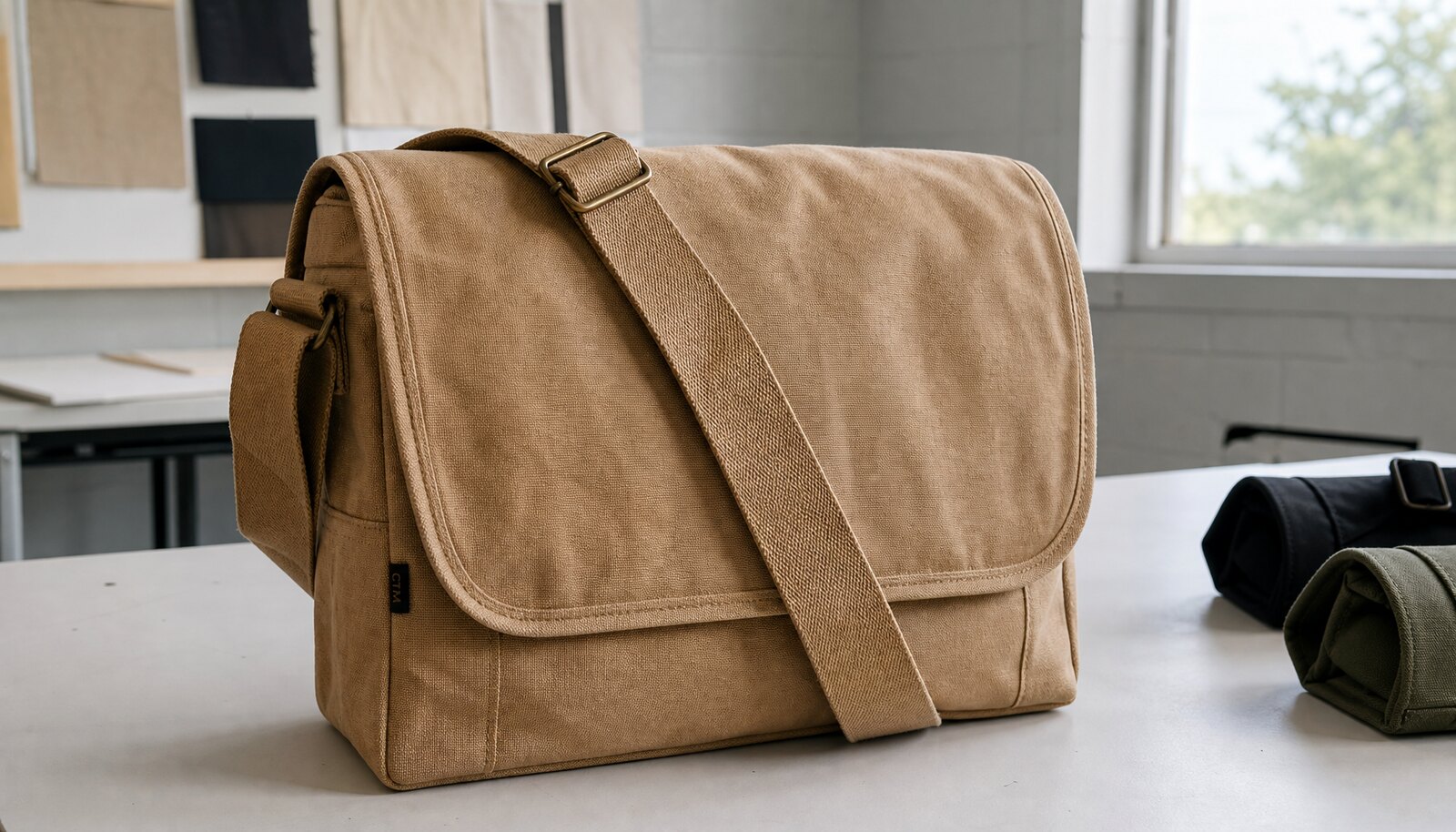
Why this bag works for corporate gifting
Heavy duty messenger bags solve a common corporate gift problem: the item must feel useful on day one and still look presentable after repeated commuting. Compared with simple totes, a messenger bag gives more structure, better security, and a more premium profile for clients, staff, or event attendees. Buyers usually choose this category when the gift needs to carry a 13-15 inch laptop, documents, chargers, or a welcome kit without looking like a throwaway giveaway.
For procurement teams, the real decision is not whether the bag looks good in a catalog. It is whether the bag can survive weight, hold its shape in transit, and accept branding cleanly at the target budget. That means locking the fabric weight, internal build, and decoration method before you send an RFQ, because a bag that works for a trade show handout may fail badly as a corporate onboarding item.
- Best use cases: onboarding kits, sales team gifts, conference packs, client appreciation gifts
- Less suitable when: the program needs ultra-low cost, very small pack size, or full waterproofing
- Buyer priority: structure, logo placement, and load-bearing performance before cosmetic extras
Choose the right canvas weight and structure
For heavy duty messenger bags for corporate gifts, the most common sourcing mistake is comparing only the fabric weight on paper. A 16 oz canvas can still feel soft if the weave is loose or the bag lacks reinforcement, while a 12 oz canvas with a proper lining, bottom board, and strap bar-tacks may perform better than a thicker but poorly built alternative. Buyers should treat GSM or oz as a starting point, not the final answer.
A practical spec for premium gifting is 14-16 oz canvas, roughly 420-475 GSM, with reinforced stress points and a base board. For budget-conscious volume orders, 12 oz canvas, around 340-380 GSM, can work if the bag is not expected to hold heavy electronics. Once the load exceeds a few kilograms, you need to focus on strap anchor construction, seam allowance, and gusset depth as much as the cloth itself.
- 12 oz canvas: good for document kits and moderate-use gifts, lower cost and lighter freight
- 14-16 oz canvas: better for executive gifts, laptop carry, and long-term brand value
- Reinforcement details to specify: bar-tacks, base board, binding tape, and optional foam padding
Print methods that hold up on thick messenger bags
Canvas messenger bags give you several decoration routes, but not all of them behave the same on a thick, textured surface. Screen printing is usually the cleanest choice for one or two spot colors and gives strong opacity on darker canvas when the ink system is matched correctly. Embroidery feels premium, but on heavy canvas it can pull the fabric if the design is large or dense. Heat transfer is useful for short runs or detailed artwork, but it can show edge lift if the material is stiff or the bag is folded tightly in packing.
For corporate gifts, simple branding is usually the safest and most durable approach. A centered logo on the flap, a woven side label, or a small embroidered mark often looks more professional than a large full-panel print. If the artwork has fine lines, gradients, or small text, you should request a strike-off or printed proof on the actual fabric, not just a digital mockup.
- Screen print: best for clean logos, strong coverage, and repeat orders
- Embroidery: best for premium perception, but keep the stitch count reasonable
- Heat transfer: useful for detailed art or low volume, but test edge durability
How MOQ changes the real quote
MOQ for heavy duty messenger bags is usually driven by three separate things: cutting setup, print setup, and accessory sourcing. A factory may accept 300 pieces on paper, but the price per unit can rise sharply if you need a custom size, custom lining, custom zipper pull, or more than one print position. Buyers sometimes compare quotes without noticing that one supplier is pricing a stock body while another is building a fully custom bag.
A sensible MOQ strategy depends on how much design risk you can accept. If the corporate gift program is a one-time event, a stock-based spec with limited branding will usually give the best total cost. If the bag is part of a recurring brand program, paying for a higher setup may be worth it because the repeat order cost drops and the factory can reserve better QC attention for the tooling already approved.
- Lower MOQ usually means fewer material choices and less flexible decoration
- Custom size, custom lining, and custom hardware all push MOQ upward
- Ask whether the quote includes cutting loss, print setup, and carton packing; these are often hidden in different lines
Supplier routes: direct factory, trading company, or stockist
When sourcing heavy duty messenger bags for corporate gifts, the right supplier route depends on schedule and control. Direct factories are usually the best path when you need custom dimensions, exact canvas weight, and repeatable branding. Trading companies can help if your order includes several gift items and you want one shipment and one paperwork flow. Stockists or local importers make sense when the deadline is short and the bag spec can be accepted from existing inventory.
The risk is that each route presents a different version of the same quote. A reseller may quote a familiar bag shape but not control stitch density or material batch. A factory may be cheaper but less helpful on mixed SKU consolidation. Procurement teams should compare not only unit price, but also sample lineage, carton data, and who actually owns the production line.
- Direct factory: best for custom construction, better for long-term reorders
- Trading company: useful for mixed-category sourcing and easier communication flow
- Stockist: best for rush orders, but limit customization assumptions
Comparison table: sourcing routes for corporate gift buyers
The route you choose changes more than the price. It affects how quickly you can approve samples, how much correction is possible after artwork review, and who bears the risk if the final print or stitch quality is off. Use the table below to compare the practical tradeoffs before you shortlist suppliers.
For a corporate gifting program, the best supplier is not always the cheapest on unit cost. It is the one that can reliably hit your load requirement, print standard, and packing format without turning the project into a long correction cycle.
- Write decisions in measurable language, not only descriptive wording.
- Ask for sample photos plus one physical approval sample for important orders.
- Keep quotation, sample approval, and inspection notes tied to the same spec version.
What the sample must prove before bulk production
A good sample for a heavy duty messenger bag should prove construction, not just appearance. The bag needs to show how the canvas behaves at the fold lines, whether the strap sits comfortably on the shoulder, and whether the flap closes cleanly after the bag is filled. If the sample is only a blank shell or only a printed front panel, it may hide problems that appear once the bag is fully assembled and packed.
The approval sample should be as close to mass production as possible, especially for large corporate gift runs. If the factory swaps zipper quality, changes lining weight, or uses a different foam insert after approval, the final goods may no longer match the approved standard. Put the sample type in writing: proto sample, printed sample, or pre-production sample.
- Inspect dimensions, seam alignment, and the actual feel of the strap
- Load the sample with items similar to the end use, not just empty-hand testing
- Record logo placement, color tone, and hardware finish on a sample approval sheet
Packing, carton planning, and freight impact
Packing is not a minor detail on a messenger bag order. Thick canvas, padded bodies, and metal hardware make the bag bulky, so the packing method can change your freight cost materially. If the bag ships folded without stuffing, you may save carton space but risk hard creases and strap deformation. If the factory inserts paper, individual polybags, and a stiff inner board, the item arrives cleaner but the cube increases.
For corporate gift buyers, the right answer depends on the next handling step. If the goods go straight to end users, better packing is worth the extra carton volume. If your warehouse will repack locally, bulk packing can be acceptable as long as the bags are protected from abrasion and the straps are tied cleanly. Always request carton dimensions and gross weight with the quote, not after production starts.
- Use paper stuffing for shape retention on structured bags
- Confirm whether polybags are required for each bag or only for carton protection
- Ask for master carton count that matches warehouse receiving and distribution plans
Lead time risk and schedule planning
Lead time on custom messenger bags is usually driven by material availability, sample approval, and print coordination. If the canvas weight or lining color is not standard, the fabric mill or trim supplier may add days before cutting even begins. Artwork changes after sample approval are one of the biggest schedule risks, because they often force a new strike-off or a fresh pre-production sample.
A realistic production flow is sample development, sample approval, material reservation, bulk cutting, printing or embroidery, sewing, QC, packing, and shipment booking. If the order is tied to an event or campaign date, leave enough room for a correction cycle. A late bag is often more expensive than a slightly higher unit price from a supplier that can start sooner and keep communication tight.
- Common schedule risk: late artwork approval
- Common schedule risk: hidden material substitution after sample sign-off
- Common schedule risk: carton and freight booking left to the last week
Landed-cost comparison before you place the PO
For heavy duty messenger bags for corporate gifts, landed cost often matters more than factory price. A low unit price can disappear once you add logo setup, sample fees, carton volume, inland transport, and import handling. Buyers should compare at least three quote layers: ex-factory price, packed carton cost, and estimated landed cost to destination warehouse.
When comparing quotes, isolate the variables. If one supplier includes a lined bag, a stronger zipper, and a printed dust bag while another quotes an unlined shell, the lower number is not comparable. Put every quote into the same framework: same canvas weight, same decoration, same packing, same MOQ, and same delivery term. That is the only way to see whether the premium is real or just a construction gap.
- Compare unit cost on identical spec, not on look-alike photos
- Add freight cube, carton count, and handling charges to the true cost
- Ask for separate line items when a supplier includes optional add-ons
Specification comparison for buyers
| Spec decision | Recommended option | When it fits | Buyer risk to check |
|---|---|---|---|
| Fabric weight | 16 oz canvas (about 475 GSM) or 12 oz canvas with reinforcement | Corporate gifts that must hold laptops, binders, or sample kits without sagging | Thin canvas may look fine in photos but collapse at load; verify finished bag weight and seam strength, not just fabric GSM |
| Body structure | Padded or semi-structured body with reinforced base and side gussets | Premium gifting, staff welcome kits, travel use, and premium event giveaways | Over-structured bags can drive cost and reduce foldability; confirm carton count and shipping volume |
| Print method | Screen print for 1-2 spot colors; heat transfer or embroidery for small logos and variable placements | Branded corporate gifts with stable artwork and controlled color count | Large full-coverage prints can crack on thick canvas; confirm wash/rub expectations and print placement on seams |
| Lining choice | Unlined for low-cost volume, lined with 210D/PU backing for premium use | When the bag will carry electronics, catalogs, or customer-facing documents | Unlined bags can shed fibers and show poor interior finish; ask for photo of inside seams and binding |
| Closure and security | Zipper top plus front flap or magnetic snap for higher-value gifts | Executive gifting, travel, and field-sales packs | Zippers can fail if coil grade is low; test slider action, tape alignment, and top opening width |
| MOQ strategy | 500-1,000 pcs for stock-like specs; 1,000-3,000 pcs for custom size and print | Most corporate gift programs where price and customization both matter | Very low MOQs often hide surcharge, limited print options, or weak QC allocation; compare tooling and setup charges |
| Packaging route | Bulk packed with paper stuffing and master carton; individual polybag only when retail-ready | Procurement teams optimizing landed cost or distributors repacking locally | Overpacking inflates freight and waste; underpacking causes strap crease marks and deformation |
| Supplier route | Direct factory for custom build; trading company for mixed-item consolidation; local stockist for rush orders | Use based on schedule, artwork complexity, and import process capability | A reseller may hide actual bag construction limits; request factory photos, sample lineage, and carton specs |
| Decoration placement | Centered front print or woven label on flap; side label for discreet branding | Brands that want a clean corporate look and repeat reorders | Print too close to seams may distort; require a strike-off or placement template before bulk cutting |
Buyer checklist before sampling
- Define the bag use case: laptop carry, document transport, event gifting, or staff onboarding kit.
- Lock the fabric spec in GSM/oz, including whether the canvas is washed, dyed, or coated.
- State the target finished size, gusset depth, strap width, and whether you need inner pockets or padding.
- Provide vector artwork with Pantone references and note the maximum print area by panel.
- Specify closure type, lining requirement, hardware finish, and whether a bottom board is needed.
- Set the acceptable packing format, carton count, and whether each bag needs a hangtag or barcode.
- Request pre-production samples and one inline photo set before mass cutting if the order is large or time-sensitive.
Factory quote questions to send
- What is the exact canvas weight in GSM or oz, and is that weight before or after finishing?
- Is the bag fully sewn from one fabric spec, or are the base, flap, and trim using different materials?
- How many colors can you screen print at the quoted price, and what is the surcharge for additional colors or larger coverage?
- What is the MOQ for the bag itself, the print setup, and any special hardware or lining option?
- What sample will you send: blank proto, printed sample, or pre-production sample with final materials?
- What is the standard packing method, master carton quantity, and carton dimension for freight planning?
- What is your normal production lead time after sample approval, and how does it change during peak season?
- Which QC checkpoints do you perform for stitching, print registration, strap load, and zipper function?
Quality-control points to confirm
- Measure finished size against the approved spec, allowing only a small tolerance for canvas shrink and seam take-up.
- Inspect stitch density, back-tacking, and reinforcement at strap anchors, base corners, and flap stress points.
- Rub-test the logo print for smudge risk and check for misregistration, pinholes, and color unevenness.
- Open and close the zipper repeatedly to confirm smooth travel, secure end stops, and aligned tape stitching.
- Check the lining for loose threads, puckering, and exposed raw edges inside pockets and gussets.
- Load-test the bag with a realistic corporate gift fill, such as a laptop, notebook, and bottle, before approving bulk.
- Verify carton packing count, polybag thickness if used, and whether bags arrive folded without hard creases or strap twists.